Archive for the English Manga Category


School Zone Girls, Volume 2, Guest Review by Christian LeBlanc

September 29th, 2021

Welcome to Guest Review Wednesday on Okazu! This makes a third guest review in a row and we have at least two more on the way! If you enjoy our guest reviews, I hope you will support the Okazu Patreon. Thanks to our Patrons, who make reviews like Luce’s review of Volume 1 of this series and Christian’s review of Volume 2 possible! Welcome back, Christian LeBlanc for today’s review. ^_^

So, let me admit something to you: Ningiyau’s second volume of School Zone Girls from Seven Seas has proven to be a very hard book for me to review, as I would often find myself re-reading the stories instead of trawling its pages for beats to describe and funny lines to quote. Flipping back and forth through its short, episodic chapters is like a ludic loop of dopamine hits.

With its ensemble cast of misfit high school girls and their cool-as-hell uniforms of black dress shirts and white ties, this manga feels a bit like if Azumanga Daioh went through an emo phase (at least stylistically), abandoned the 4-koma style, and leaned more towards slacker than absurdist humor. Chapters are three to eight pages long on average, and this brevity perfectly suits the lighter tones of this book full of lovable, surly idiots.

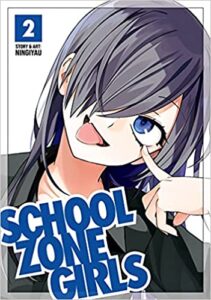
Tall, breezy, beautiful Yokoe Rei (as seen on the cover) is still disastrously crushing on her best friend since middle school, the short, perpetually-perturbed Sugiura Kei (last volume’s cover star). Their friend and classmate Negoro Yatsude is the connective tissue between most of the cast, since she’s also friends and classmates with Matsuri Fuji, and club senpai to Hinase Tsubaki, both of whom we’ll get to. Yatsude’s withering reactions of concern and/or annoyance over everyone and their bull$#!t make her the perfect foil for her friends’ eccentricities, bouts of despair, etc.

Hinase Tsubaki is a bit of a wallflower (a friend of a friend describes her as “a gloomy li’l reject loner girl”), although bright and cheerful Kaname Yamashiro keeps taking the initiative of being friends with her. Tsubaki’s twin, Hiragi, is a surly loner, and also has a bright, cheerful classmate (Utsugi Ren) she’s getting closer with. To be honest with you, it wasn’t until I got towards the end of this book that I realized these were four different people, instead of two (Volume 2, due to reasons, was my first time reading School Zone Girls). We do see some flashbacks in this volume, so I expect we’ll soon learn why Hiragi hates her twin Hinase so much (which may or may not be related to Hinase’s let’s-hope-the-author-just-drops-it sister complex, ugh).

Matsuri Fuji is new to the cast, and is first depicted playing a crane game with increasing fury; the prize (which she thinks looks stupid anyway) has twisted itself in her mind into some form of character growth, like a next stage of enlightenment she needs to attain. You’d be right to assume from this that she takes herself way too seriously; she speaks with a heightened dialect that only makes her look more awkward to the arcade employees, and tortures herself with inner dialogue spirals about honor, respect, doing good deeds for selfish reasons, etc.

Once arcade employee Kishiya admits to feeling embarrassed over something, she becomes an inadvertent mentor to Fuji, helping her realize that even adults can be imperfect – and that’s ok. It’s almost like the relationship between Miyako and Sayaka at the coffee shop in Bloom Into You, except, well, Miyako would never laugh her ass off if Sayaka freaked out and gave herself a nosebleed. (Or keep replaying the moment in her mind, laughing a little harder each time.) Incidentally, I hate to admit how much Fuji reminds me of myself at that age, and I have to wonder why I’m being called out in this manner.

Most of the time, our cast is just $#!tting around: hanging out at school, riding each other over who can’t wink with their eyes, watching TV during homework dates, falling down 3 flights of stairs into a bloody mess before admitting they need someone to walk them home because the ad for a scary movie messed them up, etc. Stakes are fairly low all around, in spite of how hard Rei freaks out whenever she interprets Kei’s gruffness as affection, or Fuji’s obsession with winning that stupid stuffed toy at the arcade.

As I said earlier, School Zone Girls eschews the 4-koma style, so the comedy has more room to breathe naturally. Chapters are exactly as long (or short) as they need to be, contributing to the natural rhythms and quick pacing. I think this makes the poignant 18-page It Was a Joke stand out that much more, increasing its dramatic impact. This tale sees present-day Rei narrating some flashback scenes from middle school that shed light on why her crush on Kei hasn’t gone any further than it has. I’ll admit, the slapstick and spit-takes up to this point had my guard down, so I wasn’t expecting to see such an affecting portrayal of why two girls would still be stuck in a “will they or won’t they?!” stasis required by the plot. And, I know I can be a bit of a soft touch for scenes like this, but I dare you to flip back to the first page of this chapter again after you’ve read it and not feel something for poor Rei.

This section actually struck me as realistic (as opposed to contrived for the plot), but I got hung up on whether or not that was for me to judge. I asked Erica for her opinion, and she reminded me that authenticity is individual, but to go with my gut; my gut simply told me not to speak for others on what is or isn’t authentic to them. And then I wondered if I wasn’t overthinking a book where someone got punched in the tit last issue. Such is the genius of School Zone Girls!

Ratings:

Art – 9 A good comedy needs expressive, inventive body language and exaggerated expressions, and this one has it. Clean lines, screen tones that expertly give depth to the page and guide the eye, and engaging character designs all contribute to this rating. Ningiyau is particularly skilled at rendering affectations of disdain.

Story – 7 There’s a lot of fun nothing happening, except when Ningiyau decides to hit us in the feels with some of those bittersweet drama times. And that’s fun too.

Characters – 7 The twins still confuse me, but there’s hints that we’re about to see their history soon. Rei is best girl and I want everything to work out for her.

Service – 2 One panel stands out as a little cheeky, but otherwise there’s a welcome lack of gaze.

Yuri – 6 The audience is meant to root for Rei and Kei to get together. I can see some relationships forming among other cast members, and others staying platonic, but everyone else is just friends at this point.

Overall – 9 There’s a fair bit of substance here, in spite of its plain title and covers. The humor is dumb but in a smart way, and it feels like there are hints of relationships and future story arcs sprinkled throughout.

Special commendations should be given to the translation/adaptation team of Avery Hutley and Jamal Joseph Jr. for translating a comedy that reads briskly, naturally, and lands all the jokes and interactions, along with slang that sounds fresh, natural and unforced. Aidan Clarke’s lettering helps convey all the different beats as well – font types and sizes change when they need to, and sound effects do a great job matching the varying ways the original kana are written.

Erica here: Thank you so much, Christian! You and Luce have convinced me to read this comic! As we mentioned last time, Volume 3 is on the way in November, as well.



Failed Princess, Volume 2

September 27th, 2021

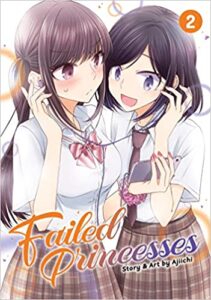
In  Volume 1, we met Fujishiro Nanaki, one of the cool and fashionable girls and Kurozawa Kaede, one of the fujoshi girls,  who meet and find their lives somehow interconnected. Here in Failed Princesses, Volume 2, a culture clash had set the two young women up for an all out war on reality.

Nanaki is frustrated at Kurokawa, but she’d be hard pressed to explain why. She just knows that Kurokawa’s new found popularity pisses her off…but her jealousy is not AT Kaede, but is definitely because of her. Kurozawa is just angry at a world that never rewards her for trying. The cool girls clique has become openly hostile, the teachers are punishing Nanaki and being rude about Kaede and if not for the decency of the nerdy girls, I probably would have given this series up.

Volume 2 felt exactly like what it is – a short series that was meant to wrap up, but was extended. So instead of Nanaki falling in love with her Galatea, Galatea has come to life and been treated like garbage and Nanaki punished for standing up for her and only Izumi apparently smart enough to see what is going on. Nonetheless, Nanaki does realize that she’s missed Kaede and Kaede realizes there’s no point to her beauty if her Pygmalion isn’t there to enjoy it with.

I’m up to Volume 4 in Japanese, and I’m struggling with the series. There just isn’t a lot holding this series together beyond two girls who run in different circles in high school fall in love, which is simply not very compelling for me. More critically, everything interesting in the story has come from one of the fujoshi group – Kaede’s “we live in different worlds” commentary, Izumi’s awareness of the cool girls’ jealousy and loneliness. The cool kids are, well, kinda as boring as they were in school.

What I hope from this series would be more insight into in-group vs out-group dynamics, but what we are getting is high school crushes and drama. This series is definitely great for folks who like Morinaga Milk’s GIRL FRIENDS but wanted more conflict. Ajiichi’s art is good, the characters are solid. And I’ll hope that the plot develops past “what is going on with me?”

Ratings:

Art – 8
Story – 7
Characters – 7
Service – 1
Yuri – 6

Overall – 7

Thanks very much to Seven Seas for the review copy!


Superwomen in Love, Honey Trap & Rapid Rabbit, Volume 2

September 24th, 2021

In Volume 1, we meet Hayate who is a part-time performer and superhero, Rapid Rabbit. When Antinoid Army executive Honey Trap fights and defeats Rabbit, she pull off her helmet and falls head over heels for Hayate. Ditching the evil Antinoids for the side of good, Honey and Hayate now fight together.

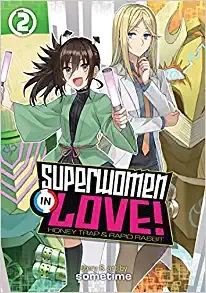
In Superwomen in Love, Honey Trap & Rapid Rabbit, Volume 2, the cast grows larger. We meet Cool Down another Antinoid executive, who has a Yuri fetish and X, the mastermind behind the evil army attacking humanity.  On the side of good, we meet Orb Owl, a young woman motivated to protect her older sister.

What story we get in this volume is more of a series of questions, than an actual story. Why is X leaving dimension tools around and why does she want to turn humans into monsters? At the moment, we don’t know, but let’s set that aside for a sec. I’ll get back to this in a moment.

Yuri here is implicit, but not, explicit. Honey Trap is very in love with Hayate, two of the Antinoid execs, Suigetsu Kyouka and Melt Out appear to be a couple, Hina seems kind of obsessed with her sister and X seems very obsessed with Hayate. And, again Cool Down is obsessed with Yuri as a whole.

But…what is this story about? I was super excited at the idea of sentai-style Yuri story about adults, but at least here in Volume 2, there’s no story, really. And while there are adults, there’s nothing about it that feels like it is written for an adult audience. I’m not talking about sex, that’s just the trappings of adulthood, the kind of thing that children think makes something “adult.” I’m talking about solid, nuanced, writing with humor and content. This feels more like a series of gags and costume designs strung together than a story.  Probably, I’m asking too much of the series, but you can’t fault a reviewer for trying. ^_^;

That said, if you love sentai series, and the thought that goes into every costume and superpower, with a dollop of goofy. monster of the day style roboto-enemies, slathered with a Yuri icing, then you’ll definitely enjoy this series. Yuri love will save the day in Superwomen in Love.. ^_^

Ratings:

Art – 8
Story – 7
Characters – 7
Service – 2 Costumes and some of the angles
Yuri – 4

Overall – 7

Shout outs to the entire team at Seven Seas from bringing us this niche-y fun series. I look forward to reading the third volume which will be out in winter 2021!


School Zone Girls, Volume 1, Guest Review by Luce

September 22nd, 2021

Another Wednesday, another Guest Review – and this one comes with a built in bonus, as Volume 1 will be followed next week with Volume 2! Please welcome back Luce, with a review of School Zone Girls, Volume 1, out now from Seven Seas in print and digital. Luce, the floor is yours!

I’m Luce, the owner of a book collection too big for the room I currently inhabit. I own a lot of yuri manga, and Erica kindly asked me to review Volume 1 of this manga. I can be found in the Okazu Discord under the name farfetched, and on tumblr at silverliningslurk. Now, on to the review! 

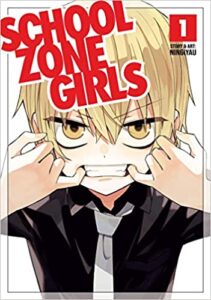
School Zone Girls shows us the daily lives of two friends; Sugiura Kei, a short-haired, short-statured generally sensible girl, and Yokoe Rei, a beautiful but nonsensical girl. Alongside their fellow students, it depicts their high school lives and adventures. Or misadventures, as we see very quickly.

In many ways, this feels much more like what actually happens at schools than any shoujo. Romance drama? I don’t remember much of that, more having daft conversations with friends, the weird things you were into and all the things school said you had to do but you didn’t want to. School Zone Girls is very much this. The chapters are short, with a four-koma style comedy about them, despite being normal manga form. There are no school princes of any gender here, just people in often ridiculous conversations and situations of their own making. Kei and Yokoe are the kind of friends that you don’t really know how they’re still friends – and neither do they – but they do care about each other underneath the bantering. I love it.

One of my favourite things is the expressions. They’re not ridiculous (most of the time), but get the emotions across very well. The characters also look distinct from each other, with different eyes and such, which I appreciate. There are a set of twins who look very similar, and they’re about the only ones you would mix up, but they have different uniforms, as they go to different schools, so that’s sorted too. Speaking of uniforms, I really like the uniform of this school. I haven’t seen anything else like it in manga. Never mind all the sailor uniforms, this is the one I’d want.

As for yuri, the blurb on the book makes no secret of the fact that Kei and Yokoe like each other… but maybe can’t admit it. This isn’t so much a blushing rom com though – more of the comedy, without the stupid set-ups. By halfway into the book it’s clear that Yokoe is very aware of her feelings, whilst Kei is… not really there. Mainly, Yokoe is usually annoying her too much to actually dwell on it while they’re together. There is a great scene where Yokoe confesses because she thinks Kei isn’t listening… Turns out she was kind of listening. But misconstrues it anyway. When you consider that Yokoe often proposes to Kei when she’s in her post-exam ‘anaphylactic shock’ (nothing to do with allergies), perhaps it’s not so weird. It feels like a character that is so often daft that she no longer knows how to be serious about something even when she wants to, something that’s touched on more in the second book. If anything, I find it hard to believe they will get together, just because it almost feels like them getting together might ruin the dynamic of the manga. But we’ll see how that goes! I’ll trust in Ningiyau, since they’ve done a good job so far.

Ratings:

Art: 8 for the faces. The ‘serious’ art is pretty nice, although pretty standard for decent manga
Story: 6 
Characters: 9, I love them all, but I hope the twins reconcile in later books
Service: 1 purely because a bra gets mentioned once. I guess they were in swimsuits at one point? It’s not a male gaze series at all.
Yuri: 6? More friendship based at the moment than romantic

Overall: 8

It’s daft, but I really enjoyed it. Second book in the series is already out in digital and print, which will have a guest review next week, and the third will be along shortly I believe. 

Erica here: Thanks so much for this heads up. I know I could sure use a goofy, fun series on my  tablet these days. Next week we will indeed have Volume 2 on tap, with a review from Chris.


Otherside Picnic Manga, Volume 1, Guest Review by Sandy F.

September 8th, 2021

Happy day! Not only is it  Guest Review Wednesday here on Okazu, we have a brand new reviewer! Today  we welcome Sandy, who is taking a look at Otherside Picnic, Volume 1 manga, out now from Square Enix! I know you’ll give him a warm welcome. Take it away, Sandy!

I am a huge fan of Iori Miyazawa’s Otherside Picnic series of novels. I enjoy following the adventures of Kamikoshi Sorawo and Nishina Toriko as together they explore the wonders and terrors of the Otherside. And at the same time, they also explore the wonders and terrors of human connection with one another.

When I heard that the novels were bring adapted into a manga, I was so excited that even though I can’t read Japanese, I bought the Japanese editions hoping that at least I would enjoy the artwork…which I did. When I finally got my hands on the English translation, it was worth the wait.

Like the novels, Sorawo is our guide to the Otherside. We are given glimpses of her story as text and artwork combine to introduce us to Sorawo’s first journeys into the Otherside where she will encounter the enthralling Toriko. This will lead into their shared experiences of the Otherside; experiences that will change them both.

For example, I particularly appreciated the depiction of the Wriggler also known as the Kune-kune. Not just the Wriggler itself, but how it acts as the path that will draw Sorawo’s deeper into the world of the Otherside and how this impacts her and Toriko. With this artwork I certainly feel that I am being given a glimpse of the Otherside and its mysteries, but not in such a way where I understand everything.

Overall, the artwork and the dialogue between the characters complimented my vision of these people and the Otherside that Iori Miyazawa had created so vividly in the novels. There are moments of the terror that creeps up on you from the Wriggler and the Eight-Foot-Tall Lady. And then there is the wary banter between Sorawo and Toriko as they take their first steps in learning about one another and helping us to understand what brings them into this world.

As well as the banter, through Sorawo’s internal monologue we are introduced to Sorawo’s emerging and complicated feelings about Toriko. Feelings shaped by Sorawo’s response to the nature of Toriko’s quest to find the mysterious Uruma Satsuki, as Sorawo wonders, what are Toriko’s expectations of her?

There are a couple of minor issues, such as the artwork was sometimes a bit cutesy for my taste. I appreciated the work of the translator, though I did miss some of the colourful British words and phrases used in the novel. There is also a bonus original story that gives us some interesting insights into Kozakura and the nature of her relationship with Uruma Satsuki and Toriko.

Ratings
Story – 9
Character – 7
Service – 4
Yuri – 5
Overall – 9

All in all, I thoroughly recommend reading this manga, but don’t forget the novel!

Erica here: Thank you Sandy! I’ve got this on my to-read list and am looking forward to it even more, now. ^_^ Thanks for whetting out taste for more Otherside Picnic.