Archive for the English Manga Category


Attack on Titan Anthology Manga (English) Guest Review by Eric P.

January 10th, 2018
Happy first Guest Review Wednesday of 2018!  Thanks to Okazu Patrons, this is also the first paid Guest Review ever here, hopefully, the first of many. I cannot think of a better person to be our very first paid reviewer here than our longtime supporter and friend Eric P.! Please give him your attention and a few kind words and away we go!
 
You know a series is a huge popular hit when the manga remains bestselling to this day, when it inspires a big-budget (underrated) live-action movie adaptation, and when a devoted fanbase (im)patiently waits for the next anime season to adapt the next arc to the screen no matter how long the gap between. Another sign is when manga authors/artists get together and create a special anthology of original stories paying tribute to the series. But how often is it when western authors/artists do the same thing for the same purpose, and still under the original creator’s supervision? It does not get clearer than that in how successful Attack on Titan has been in achieving a cross-cultural impact.
 
The Attack on Titan Anthology is a collection of 12 personal takes by supposedly high-profile comics creators. I say “supposedly” because I confess I do not normally follow western comics and am unfamiliar with all the listed names, so I could really only judge this book by the content within once I open the cover. The results found are indeed diverse as well as widespread. 
 
Some titles are more lavishly illustrated than others, and some are more intriguing and poignant than others. All the dramatic stories are meant to take place in the manga’s universe. They may not be taken as “canon” per se, but their placement within the original continuity not only still feel like they make sense, but they also help expand on Hajime Isayama’s mythos. The first one, Under the Surface, provides a window to a world far more familiar to us right before the Titans begin their invasion. Another called Live and Let Die is about a Survey Corps member separated from her party outside the walls, before finding a group of other stranded Survey Corps members that chose to never return. Even though there is danger to be had dealing with the Titans, they ironically find more freedom outside the walls than they do within. One other standout is The Glorious Walled Cities, not a story but a field guide styled as blatant propaganda depicting the world within the walls as a paradise. The last entry, however, is disorganized and cuts off abruptly when the writer apparently ventured into confidential territory.
 
 
But the story relevant to Okazu would be Skies Above,written by Rhianna Pratchett and Ben Applegate, illustrated by Jorge Corona, colored by Jennifer Hickman, and lettered by Steve Wands. In a time before Eren, there was a female engineer named Lyla who also dreamed of breaching the world beyond the walls. This was when Erwin Smith was student-aged, long before the Survey Corps existed and when the Military Police was Law itself, and scientific bureaucracy prevented any and all technological innovation. Rene, a teacher acquainted with Erwin Smith’s father (both worked at the same school), on the other hand is content with the world they live in since they have everything they need. But Lyla recognizes everything as nothing but a cage to break free from, thus in secret she puts together a flying contraption to serve that purpose, seated for two. Rene, her confidante and lover, in the end resigns to Lyla’s wish as they make the attempt, and escape the Military Police’s clutches. Just from reading this, one could already assume this story about two people ahead of their time in an oppressive world does not have a happy ending. But depending on how one looks at it, especially with how beautifully drawn the final page is, one could still get a strange sense of alleviation that counters the usual Attack on Titan themes of cruelty and injustice.
 
But not all in this anthology is drama, it also balances itself out with parodies poking fun at the source material, some being far more amusing than others. In the original story, you know how the characters have a habit of consistently screaming out their dialogue? That gets spoofed here, and there was one other clever bit about how the title, Attack on Titan, actually does not make much sense when you think about it.
 
When this book came out last year, Kodansha had raised hype and excitement over it, yet in the end it seemed to garner a mixed reaction from its fanbase. Having read it just recently, I am surprised that it was not better received. Like with most anthologies, there are both hits and misses to be found, but it can really vary depending on the reader’s personal taste or expectation. Ask this reviewer, and there are a few stories I cared less than others, with maybe a couple I did not get at all, but there is too much more to like and appreciate. If you are an Attack on Titan fan, and are open to western interpretations—especially by artists that clearly did this out of passionate love for the original—you are bound to find at least a handful of titles to your liking, and even that still makes it worth the purchase for one’s collection.
 
Ratings: 
 
Overall-a rounded-out 8 (Solid without being completely perfect, once again due to personal tastes)
 
Erica here again: Thank you Eric for this look at something I would never have thought to take a look at. Which is exactly why I love Guest Reviews. Gail Simone, Faith Erin Hicks, Tomer Hanuka and Attack on Titan creator Hajime Isayama all have stories in this collection. Now I’ll keep an eye out for this. Thanks!


Yuri Manga: Sweet Blue Flowers, Volume 2 (English)

January 8th, 2018

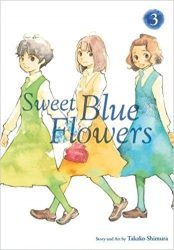
A good translation of a manga can be a little bit like magic. You pick up a book and without effort you are able to read this story created in a different country, in a different time or place. It’s an extraordinary feeling. The Viz Media edition of Takako Shimura’s Sweet Blue Flowers is a little bit like magic.

In Volume 1, we met Manjoume Fumi and Okudaira Akira, two childhood friends reunited as teens, and their school friends. 

In Volume 2, Fumi is coming off a relationship with Sugimoto, an older girl who hadn’t been honest with her and she’s feeling a bit bitter about it. Even worse, Sugimoto keeps trying to salvage it, but is doing a crappy job of it. Fumi’s had it with her ex, and lets her know that in no uncertain terms. 

Akira is surrounded by people who are falling in love and isn’t sure at all how she feels about it. When she asks Fumi, Fumi admits that Akira was her first love and again Akira has no idea what to do with the information. It’s almost as vexing as one of her friends going out with her annoying older brother. And when she overhears something she didn’t want to know about her friend Kyoko’s family, she has no idea what to do with that, either.

Back at school, the girls are all second-years now, with new students coming in. We meet Ryoko Ueda who kind of reminds Akira of Fumi and Haruka Ono, who is clearly (to us) bearing the burden of a (to us) fairly obvious secret of her own. Side stories indicate that there’s more complexity to relationships than just what we see here in the main story.

This volume moves quickly and slowly at the same time. Scenes are slow and leisurely – drama club practice, sleeping over a friend’s house – but time is whizzing by. One second Mogi sort of likes Akira’s brother, then next they are dating and we never actually saw them together much at all. Good translation can be magic, but it can’t fill holes left by a serialized manga schedule. ^_^;  Shimura’s super strong on developing characters, but putting in all the details of the story has never been her best skill.

This volume comprises Volume 3 and Volume 4 of the original Japanese edition. This is an excellent English release and I think we can expect it to maintain this high quality.

Art – 8
Characters – 8
Story – 7
Lesbian – 4
Service – 1

Overall – 8

Volume 3 of the English edition will be available in March, so you have plenty of time to pre-order. ^_^ If you haven’t already picked up this “new classic” of Yuri, I definitely recommend it, for having a depth of early 20th century  literary history and still being grounded in the present.


Yuri Manga: Hana & Hina After School, Volume 3 (English)

January 4th, 2018

In Volume 3 of Hana & Hina After School, Hana and Hina face a growing distance between them manufactured out of their mutual desire to avoid their feelings for one another. Nonetheless, we’re probably not all that concerned about it, and the story just sort of coasts along from small crisis to confrontation to confession and finally conclusion.

Because we’re not really concerned at whether the principals will get together – it’s pretty much assumed that they will – it’s more or less how they’ll get there that is what we’re reading.

In my review of the Japanese volume, I noted that it’s extraordinary for a Morinaga Milk Yuri manga story to address any real-life issues. I wrote:

“In Kisses, Sighs and Cherry Blossoms Pink, Hitomi merely fantasizes about a future in which she and Nana are adults and can be together. In GIRL FRIENDS (Volume 1 and Volume 2) Morinaga-sensei took a step outside the isolation of a “couple in love” and gave Akiko and Mari friends…friends who accepted them and their relationship. In the very end, Mari even gave some thought to the issues of coming out to parents and what school and work might think…in the future.”

And that’s about all we get. In this volume we touch briefly on the concept of same-sex marriage at the very end and, in a roundabout way we see the possible awakening of same-sex interest in classmate Takagi, although it’s somewhat disappeared by the translation. My memory of the original has her saying something like, “I think I’m like that, too…” rather than “I want to do that, too.” Of course I could be wrong – and I could have been wrong originally, as well. I’m not motivated to go find Volume 3 to find out. ^_^ The rest of the technicals are top notch, as always. I just remember this particular scene as bing a “whoa!”moment for Hina’s classmate.

So brief touches on the realities of a life after getting together is all we’ve gotten and all we’re likely to get, but I still hope that one day, Morinaga-sensei writes something that goes beyond Story A. (Wouldn’t it be nice if in a future girl-meets-girl manga, we see a grown up Nana and Hitomi (or Hina and Hana they are mostly interchangable, so it hardly matters) who are there to help the main characters through their first-love-crisis-du-jour? I kinda think it might. 

Ratings:

Art – 8
Story – 8
Characters – 8
Service – 6 
Yuri – 8 

Overall – 8 

3 volumes was just the right length for this series. I think Morinaga-sensei is at her best when she has time to work through the “zOMG we’re in love” crisis, without having to rush it or drag it out. 


Top Ten Yuri Manga of 2017

December 27th, 2017

2017 brought us a veritable excess of Yuri riches. So much so, that with 2 exceptions, every item in this list is available in English and Japanese – and even one of those is available on USA Kindle. It’s been an amazing year and has set up an amazing 2018 for us. What a perfect time to look back and celebrate some of the best the year had to offer. Check out the Yuricon Store for links to all these Yuri manga series and more.


10. Hana & Hina Afterschool /Hana to Hina no Houkago (ハナとヒナは放課後)

A new story by Morinaga Milk is always good news. This story contains all her favorite themes, which means we can sit back, relax and enjoy the ride.  ^_^

Hana and Hina are both likable, their struggles with “what is this feeling?” are adorable rather than awkward and we spend all our time with them hoping for a happy ending.

A solid example of “Story A” – exactly what Morinaga-sensei does best. Cute, sweet, slightly sexy, without deep emotional commitment.


9. Bloom Into You / Yagate Kimi ni Naru (やがて君になる)

Nakatani Nio seems to have hit a zeitgeist with this story of an aromantic and the girl who is in love with her. Provocative, with sleek shoujo manga-style art in a seinen series, and a lot of unanswered questions, makes this a fascinating (if occasionally maddening) series to read.

The addition of an adult lesbian couple as role models and guides for the young lesbian character puts this series up on LGBTQ points, part of a positive new trend in Yuri. 


8. Kiss and White Lily for My Dearest Girl / Anoko ni Kiss to Shirayuri wo (あの娘にキスと白百合を)

I admit to being a sucker for stories that do all the Yuri tropes, all at once but don’t let that sentence fool you. Characters here are more than a single trope, and the main relationship is given plenty of time to develop past it’s own set-up, so when this series ends, we’ll have gotten a well-developed relationship rather than just a Yuri coupling.

Yes, this series by Canno lacks the emotional gravitas of her previous series, but trading one emotional triangle tangle for multiple ways to explore relationships – including poly relationships – makes this an interesting take on the all-Yuri couple school.


7. After Hours (アフターアワーズ)

Adults doing adult things. Check. Adults struggling to find meaning in life. Check. Actual relationship dynamics that make sense, by making no sense. Check.  The complexity of the character’s emotions, the conversations they have – even the way their spend their time signals that this is not a child’s story. 

Nishio Yuhta does a good job of building two unique and interesting characters without pandering, even if the art is the only not-adult thing about the series.

It’s so refreshing. I can’t wait to find out what will happen in Volume 3!


6. Sweet Blue Flowers / Aoi Hana (青い花)

Classic S tropes wrapped gently around a modern tale of a young lesbian coming to terms with herself and her place in the world. Shimura Takako never loses the touch with early 20th century, but gives her characters a 21st century sensibility.

More importantly, the main characters have family, they have friends, they have agency. Decisions have consequences and we watch them mature as a result of making them.

The art is simple and stylish, the roots deep and literary. And Viz had given us the definitive English-language edition of this new Yuri classic.


5. My Lesbian Experience With Loneliness / Sabishi-sugi Rezu Fuzoku ni Ikimashita Report(さびしすぎてレズ風俗に行きましたレポ)

A heartfelt and  honest look at a life with chronic depression and an eating disorder, Kabi Nagata’s autobiographical online comic made it’s mark on both the Japanese and English manga scenes by speaking directly about real life issues for many.

With a rough style that echoes the storyline, this manga has been on the top of the charts since it’s release. This story, of the less functional aspects of adult life, clearly resonated with many readers. 


If you enjoy these end-of-year lists, and all the reviews, news and interviews we write on Okazu, please consider subscribing! Even a dollar a month helps us pay Guest Reviewers, cover events and buy the content we review. 

***

Enjoy today’s post? Subscribe to Okazu with Patreon!$5 a month- only 17 cents a day!

***


4. MURCIÉLAGO (ムルシエラゴ)

Yoshimurakana’s “Violence Yuri” manga is unique in being an action manga, starring a lesbian serial killer, a lesbian sociopath and a lesbian Yakuza, with a bunch of other random lesbians, all in the middle of gonzo violence and ridiculous enemies.

The art is ugly, which suits the characters and situations well. 

Blood, guts and lesbians all around. I love it.


3. Kase-san Series/ 加瀬さん シリーズ

This schoolgirl romance is awkward and wonderfully realistic in turn. A “story A” that reminds of all those moments when we first had those feelings. 

The art is loose, a little service-y and occasionally excruciatingly sweet.

Asagao to Kase-san, the first book, already has been made into an adorable animation clip and will soon be a OVA getting theatrical release in Japan in 2018.

Sometimes all we really want is a story where two lovely people get to be together. This is that story.


2. 2DK, GPen Mezamashitokei (2DK、Gペン、目覚まし時計。)

I love this Josei Yuri series by Ohsawa Yayoi for what it isn’t, as much as for what it is. A story of adult life that includes things that adult women often care about, like having more than one outfit and nice smelling face soap and, I don’t even know, normal life things like having a drink with a friend, and being competent at work. 

Kaede is a human golden retriever and Nanami is a girl magnet and I want them to get together…just not yet.

This series is a “josei” series, for adult women by an adult woman. It would make a terrible anime, which is exactly why I like it. No hijinks, just humans.


The Top Yuri Manga for 2017 is….


1. Galette (ガレット)

This is the Yuri magazine I have been waiting for for years. Talented Yuri creators banding together, supported by fans, creating the Yuri they want to create, rather than the Yuri editors want them to create.

Already the magazine has taken a few chances with narrative, but in ways that expand the genre. There’s still plenty of schoolgirl Yuri for readers, but the stories about adults are some of the best I’ve read this year. 

For this…for being the Yuri magazine I’ve wanted to be able to support for so long, Galette is my top Yuri Manga of the Year. 


Yuri Manga: Bloom Into You, Volume 3 (English)

December 15th, 2017

As I read Nakatani Nio’s Bloom Into You, Volume 3, I get to experience a vast range of emotion, much of which I find hard to put into words. I can’t help seeing the narrative through my own lens, even when the characters tell me that my interpretation is wrong. ^_^;

In Volume 3, Yuu is at great pains to explain her feelings about Touko. She acknowledges confusion about what she and Touko want and also that their needs are only partially compatible. But what is not acknowledged is that Touko’s needs and desire from Yuu are mutually exclusive in and of themselves. On the one had, she needs Yuu to never fall in love with her, but she also wants Yuu to want her. Yuu, as always, has a different story in her head. She kind of reminds me of a person I knew who was waiting for some kind of spiritual awakening. She did all kinds of different spiritual practices, but never felt that “aha!” she was looking for. I keep wondering if Yuu is just missing what she’s actually feeling, while looking for something else.

In the meantime, I give all my attention to Sayaka and the cafe owner, their teacher’s lover. The cafe owner has good gaydar, (and again, I crow about the important place of adult role models in teen narrative.)

But, back to me and my feelings. I am exasperated with Touko, and her pushing Yuu for whom I feel sympathy but no empathy. Before I began writing this review I asked myself if I would have less frustration if I knew that Nakatani-sensei were either queer herself or was, in actual fact, attempting to portray a complexed, nuanced queer narrative. To be honest, the answer was yes. As it is, I’m taking the narrative as it’s presented, which means I’m as at a loss as Yuu. I can’t help but compare this to Shimanami Tasogare. While equally fraught, the situations in Kamatani-sensei’s story are more realistic and I believe we can trust the creator to tell us a strong LGBTQ story, neither of which is true for Bloom Into You.

Ratings:

Art – 8 Generally good, with a few lazy panels
Story – N/A I have no idea. Is it good? Is it going exactly the way the creator wants it, or not? I can’t tell!
Character – Erm, um, 3? I can’t get a bead on who/what Touko is, and as she’s the main plot driver….. +3 for adult lesbian couple
Service – 5 Yes, see below
Yuri – 8 Yes, despite narrative (and/or overthinking reader) confusion, there’s plenty of Yuri.

Overall – 7, with me waffling back and forth throughout from good and nuanced to argh.

Volume 4 will be hitting shelves in February 2018. It’s not going to resolve any of my conflicted feelings