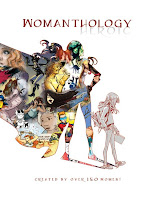
 By now, I hope all of you have heard of Womanthology Heroic, the anthology created by over 150 women comic creators. It had an amazingly successful Kickstarter (to which I contributed, so in the back, among the many, many names of supporters you’ll find mine ^_^) and is quite possibly the most beautiful book I have ever seen in my entire life.
The project came about on Twitter, where a number of female comic creators finally just lost their bacon at the industry trope of “women don’t x comics” (where x can stand for “like,” “read,” “draw,” “make” etc.,) despite the masses of evidence to the contrary. It’s pretty apparent that there were plenty of folks – women and men – who were very ready to read something just like this.
Womanthology is…a book of treasures. I’m not going to single out a story or three. It’s not for me to tell you which are the best stories in a collection of good stories. Buy the book, open it up and begin to read. Art and stories are variable, but none of them are less than excellent. You’ll like some better than others, some will touch you more deeply, but those particular gemstones are for you to find in this box of treasures.
Womanthology is…inspirational. Yes, some of the stories are about empowerment, but really not. What they are about sometimes is what it takes to grasp the power in ourselves. But that is so beside the point, because the underlying presumption in this collection is that we already have power, and we can use it any damn way we like. Some stories are just plain creepy, or sad, or silly. Some stories work with stereotypes, others bash them gleefully. There is love of the female form and psyche and not one person tries to “fix” that.
Womanthology is…luscious. Full color pictures, stories that run up to 6 pages, but many that are a chunky page or two. Some have morals, some have plots, some have messages, some are just explorations of “wtf can I draw today?” The paper is thick, the cover is beautiful and my first words upon getting this copy was, “There is no way I’m giving my Library this. I’ll get them a separate copy.”
Womanthology is…educational! I love the Pro Tips that run throughout the book, with real advice about art, writing, networking, getting and making jobs. For that alone I’d say every female who wants to be part of the comic industry needs to get this book. If I taught an art class, I’d make this my text book.
Womanthology is…layered. Read it through for the shorts, then again for the bios and info about the creators, then again for Stacie Ponder’s comic strip that runs through the entire book on the page bottoms, then again for the Pro Tips. You’d find something to love all over again every time you do. It’s too much of everything to take in one reading. Read it as you might eat a box of delicious chocolates, a few pages at a time.
Womanthology Heroic is about, by and for, women and girls who create, read and love comics. If you buy one book this year, it should be this one (especially if you’re buying for a library.)
Ratings:
Overall – 10 (But really way more than that.)
The really cool thing about this book is that so many of the creators are on Twitter, and many of them have their websites listed on their bios, and you can talk to them directly to tell them how much you love this book. And, of course you can always shout out to @Womanthology. I’m sure they’d love to hear from you.