Archive for the Guest Review Category


Bustician Manga, Guest Review by Bruce P

March 20th, 2011

Erica here. I’m busy chauffeuring Rica Takashima today to the Dykes Draw the Line slide show and discussion at the Bronx Academy of Arts and Dance, and with news, both good and bad, we’ve had few reviews here in the past week. Today we have one of those ever-so-special treats when a Guest Reviewer jumps in to save me from losing my mind and you from having to go a single day without wit and/or wisdom from Okazu. Today it is my very special pleasure to welcome back Okazu superhero, one of my dear friends and best lackeys, Bruce P. with what I promise is a very witty and wise review….

Breasts.

Just practicing. Its a word that will be used an awful lot in this review.

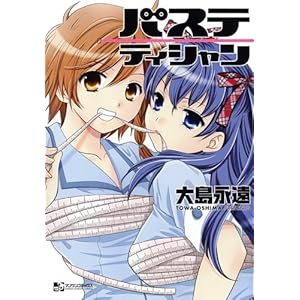
To begin addressing the manga Bustician (バステティシャン) by Oshima Towa, it is useful to refer to an earlier review by Erica of Gokujouu, in which that manga was described as ‘a more nudity-filled, more pervtastic, even MORE stupid version of the same exact set of gags in High School Girls…if Kouda was the lead character.’ Oshima Towa, author of High School Girls, apparently is not one to let such a challenge in the arena of plummeting taste go unanswered. Unfortunately with Bustician she succeeds brilliantly, plumbing the depths of bad burlesque in a fundamentally bizarre manga that centers entirely on the female breast. Incidentally, the term ‘plumbing’ was brought to mind by the manga itself, see below (‘plumber’s helper’).

The word Bustician is a contraction of bust aesthetician, an expert in breast aesthetics. Kokoa and Mami are new busticians working in the salon Bustnia. They are under the tutelage of the lovely and poised Sarasa, and are rivals for her affection (actually, they are less interested in the affection than in the groping, but we’ll get to that). Bustnia is a breast salon. Women who are unhappy with their breasts are treated to various massages and non-surgical treatments to augment, diminish, reshape, or otherwise change them. Each chapter involves a woman (or pair of women) who has a difficult relationship issue or career issue or self-image issue originating with their breasts and hopes that Salon Bustnia is the answer. These issues are serious concerns to the customers and obviously highly personal, but what we are treated to is a barrage of slapstick gags as the two new girls maltreat their customer’s breasts in painful, extended and explicit displays of nominally hilarious, clueless, Kouda-esque ineptitude. You would think the girls had never encountered a breast before. For breast augmentation cases Kokoa is always reaching for the vacuum cleaner. And yes, the plumber’s helper.

In fact Kokoa and Mami are girls only on the outside. They behave in every way like adolescent boys – presumably mirroring the intended audience. They are fascinated by breasts, excited to learn new things about them, unable to keep their hyperactive, groping hands off them. Their prime desire is to see Sarasa naked, and they get all nosebleedy on those occasions when it might just happen. You get the feeling that somewhere along the line they must have been hit on the head by one of those falling spaceships, and since their reconstruction as girls are now living a boy’s voyeuristic fantasy. On one page that will get you some interesting looks on the bus Kokoa is massaged by Sarasa and falls into a trancelike dream where she is lying in blushing, naked, orgasmic bliss in a bulging sea of elephantine breasts. This illustration takes up a full page, in the corner of which a chorus of smiling disembodied SD breasts are singing the happy breast song. You know, the one that goes ‘O, o, o, o, o–, oppai oppai oppai opapaai.’ Yeah, that one.

There is Yuri. Two of the employees have a relationship, one of whom, Asahi, is brought onto the case of the customer with the insensate breasts. Asahi’s explicitly sexual and obviously well practiced massage solves the woman’s problem, only to create another one: a hopeful repeat customer (it’s not that kind of salon, apparently, though it sure looks like it most of the time). A woman with large breasts wants to look more like a man when she is making love to her girlfriend (it turns out that her girlfriend likes her just the way she is.) Then there’s Kokoa’s and Mamai’s desire for Sarasa, but again, it’s more adolescent male lust than anything else.

Ratings:

Art – 7 Typical Oshima Towa, which is not bad. Her breast art is an adolescent’s dream. In this manga she had lots of practice.

Story – 2 Pain, embarrassment and interminable physical abuse can sustain a story only so far.

Characters – 4 It might seem like the customers deserve some sympathy, but they really don’t, because they rarely get up and pound the living crap out of Kokoa and Mami.

Yuri- 6 Some of the secondary characters are definite couples. Kokoa and Mami lust after Sarasa’s breasts. Put it all together and shake and OK, there’s some Yuri.

Service – 90 Breasts. Naked. Multiple. Massive. On every page. Without some of the women’s issues it could have been 91.

Overall – Oh, somewhere below 5. That the translucent first page that allows you to remove the negligee and reveal the breasts of a full color Kokoa actually sums it up pretty well.

Having enjoyed High School Girls, I would like to believe that Bustician was meant to be so unbelievably over-the-top, so tongue-in-cheek in its breast obsession that normal standards were sort of beside the point. But as in the case of Ernest Vincent Wright’s Gadsby from 1939 – a novel written without once using the letter ‘e’ – intense single-mindedness may be a source of amazement, but can make for a pretty lousy read.

Erica again: Hahahahahahahahahhahah

Better you than me, Bruce.


Gatch Gatcha Manga, Volume 8 (English) Guest Review by Sean Gaffney

December 21st, 2010

Gatcha Gacha Volume 8 I know it’s only Tuesday, but I’ve been sick the past few days, and so asked Sean to hustle and write me a guest review for today. And he did! So, once again, let’s welcome back Guest Reviewer, Sean Gaffney!

I’ve already reviewed Gatcha Gatcha, Volume 8 on my own blog, but since I had  previously done an overview of the series here in September 2008, I  thought that I would come back and dwell a bit on the more Yuri-friendly  aspects of the series as a whole.

First, a small digression. A lot of manga have sidebar comments  interspersed throughout the volumes. In the magazine, this is a place where the page was thinner so that an advertisement could be placed. For the volume, the publisher asks the artist to fills those spaces with original material to draw in a reader who may not want to buy something they already read in the pages of, say, Melody magazine. As readers of shoujo manga know, 90% of the time the material is the artist talking about what they ate, or where they shopped, or the awesome fellow manga artist they hung out with, or simply whining about how awful they are. And Yutaka Tachibana does this a bit too, no doubt. But she also discusses this series, and the choices she made.

She talks about Motoko, and how the editor asked for her more violent and lecherous tendencies to be toned down, but that Tachibana put her foot down. She also mentions Yuri, and said that she tried to make her a girl who’d only gone as far as kissing with her boyfriends, but felt Yuri worked better when she was ‘less pure’. More to the point, Tachibana wrote this manga ‘doing what she felt like’, and decided to simply dispense with most of the shoujo romance most series demand. Volume 8 gives us a good idea of why – it doesn’t fit the characters at mall. At least not the female characters. Yuri spends most of this volume trying to get herself to fall out of love with Yabe and in love with Hirao. She certainly does have some feelings for Hirao, and notes that she’d be jealous if she saw him with another girl. But she doesn’t get him. When she finally goes on a date with him – a very awkward one – she senses stares coming from the other females in the room, and worries that they all see Hirao as some ’empty-headed bimbo’. Later, seeing him blushing after eating a bite of her food, she compares him to… a princess.

Role reversal is the order of the day throughout this volume. Yuri dreams of being rescued from a snowy mountaintop by a ‘prince’ whose face she can’t quite make out. It’s clearly Motoko, but she hasn’t yet connected those dots. Later, she and Hirao are captured by the evil gang leader who’s been trying to make everyone’s life miserable this whole series. She then decides to disguise herself as Hirao and take the abuse and torture of her captors so that he can escape. Yuri is supposed to be the blushing shoujo heroine, only she simply can’t fall into those lines.

Neither does Motoko. Her main character arc wrapped up in Book 7, so here she simply does what she does best – makes insensitive yet telling remarks and beats up tons and tons of people. Much of this is a facade, of course – we’ve seen how much Motoko cares for Yuri, and she’s been trying to get her and Hirao to stumble towards each other almost from Day One. It’s not working, though, and clearly Yuri’s happiness is more important to her than she ever expected – Sekine understands this when he asks in a prior volume how she feels about Yuri and Hirao, and Motoko blankly replies “Dunno.”

So the climax of the series is, of course, Motoko coming to Yuri’s rescue, not Hirao. And in the final scene, we see Motoko finally at peace with herself. Her big sister is back, but seems to have lost the obsession with Motoko that led to jealous insanity. Motoko even cut her hair again, now that she doesn’t have to be ‘girly’ to ward off Kanako’s affections. And Yuri notices, saying that Motoko looks cool and makes her heart skip a beat. Now, Motoko had flirted with Yuri in a joking way several volumes earlier, but this comment seems to pull her up short. Then she just smiles and says “You bet I do.” This is lampshaded by the author, who has Sekine noting to Hirao while this is going on that Hirao has to win Yuri quickly and keep her or else he’ll lose her. But then the final line of the author’s narration is “Then again… maybe it’s already too late?”

The author already mentioned she stood her ground on keeping Yuri and Motoko the flawed yet far more awesome characters they were. More to the point, most of the time she didn’t go for the easy out, or the typical plot. The narrative, from the start, clearly was about the meeting and subsequent friendship of these two girls. And the two guys co-starring were shown, over and over, to be fairly weak and ineffectual, no matter what was done to toughen them up. As a result,
when it’s implied Yuri and Motoko get together at the end, this isn’t a surprise. It’s what the series has been working towards.

Ratings:

Art – 6. Still can get busy and confusing, especially during action scenes.

Story – 7. There are some cliches here, don’t get me wrong, but I liked the way the author stuck to her guns much of the time.

Characters – 9. Fantastic, especially the females. Even the psycho incestuous sister, Kanako, gets a depth rarely seen in psycho incestuous sisters.

Yuri (no, not the character): 5. It can still be read as hypothetical, but you’d have to squint, especially with the final pages.

Servicey – 2. There’s not a heck of a lot of service here.

Overall: 8. A highly underrated series from Tokyopop, and I’m pleased that it is finally finished. Definitely worth the effort to find it.

Also, the inside cover picture has Motoko wearing a fedora while snuggling Yuri. Fedoras make everyone sexier.


Magical Girl Lyrical Nanoha The Movie 1st Blu-Ray (English) Guest Review by Richard B.

December 8th, 2010

 Today is Wednesday and you know what that means – a special guest review treat! Richard B. has been a commenter here several times and, as I will not get to see this BD until the new year, I thought I’d let him give us his two Canadian cents before I have a go at it. Take it away, Miwa!

Magical Girl Lyrical Nanoha the Movie 1st is a retelling of the events of the first Nanoha TV series. While this may not seem like a good thing, it does pay to remember that back in 2004 the first Nanoha TV season was a scattered mess. As a spinoff from the Triangle Hearts adult game series the first few episodes were nothing more than a bad Card Captor Sakura clone. With a few unsavoury elements left over from its source material.

It wasn’t until later on in the series when Fate was introduced, that the things became interesting. She was a dark, mysterious magical girl with a troubled past, fighting our main character. So the first thing fandom did was pair them together as a couple. Add in the fact the battles in the final few episodes were done in more of a shounen giant robot style (complete with giant beam attacks) and the series took a complete 180-degree turn.

With all that and seeing how the later series were more popular and sold better in Japan, you could see why the makers wanted to redo the original material. And, for the most part, Nanoha the Movie is a superior retelling of the 1st chapter in the Nanoha universe.

The movie creators know what the fans in the series want – action and Nanoha/Fate. Luckily we get both fairly quickly into the movie. Fate is introduced much sooner in this version, and set up as the central conflict of the movie (with the Jewel seeds relegated to being a plot McGuffin). The movie handles the two becoming friends through fighting better than the TV series, both with better action scenes and better introspection. The pacing is tighter than original season, which dragged on at the beginning until pace picked up in the last 4 episodes.

The action is more like the later episode of the series, and here is where the movie shows off its big animation budget. The final battle between Fate and Nanoha in particular is well done and I had a big smile on my face while watching it.

There are some new original scenes, including some nice bits showing Fate’s past and training. But the character most benefiting from the new material is Precia, whose motivations are  given more detail as is the accident she had her in past. It fleshes her out greatly and makes for a much better character over all.

Most of the more unsavoury stuff from the original is gone, too. Except for the transformation scenes which were pretty ick. Thankfully, they only appear once for each of the leads.

The Blu-Ray version of the movie comes with an English subtitle track that is fairly well done. Except for a few nits (Arf is called Alf and the TSAB is called the DAB) it’s well written and easy to understand. The subtitle font is middle of the road, readable but I would have rather had either a bigger black outline or a non-white font color. The picture and sound quality is amazing though, as colors stand out and the animation quality never dips for the battle scenes, showing what BluRay can do for animation.

Nanoha the Movie fixes a lot of the problems I had with the first season, keeps the elements I liked and adds even more of what I wanted. It reminded me why Nanoha/Fate became the first Yuri couple I really liked. I hope we see the same budget and care given to StrikerS when it gets a movie. Highly recommended to Nanoha fans.

Art – 8
Story – 7 (Better than the TV but still the weaker of the 3 series)
Characters – 8
Yuri – 7 (Alot more than the first TV series)
Service – 8 –

Overall – 8

I’m told that the 2nd movie has been greenlit (presumably because this movie is doing well in DVD/BD sales, so good!) Next up is As, where we’ll be treated to the reimagined Knights and Hayate. Let’s keep our fingers crossed that it’s as good a reboot as this appears to be!


Yuri Manga: Lesbian II Mitsu no Heya, Guest Review by Bruce P

November 28th, 2010

I cannot tell you how happy I am today. We have a guest review! Not *just* a guest review, though – a guest review by one of my chief lackeys, Bruce! I won’t waste your time with too much of an intro, but I will say this – a review by Bruce is a rare and wonderful thing.

Lesbian II: Mitsu no Heya is hentai Yuri, make no mistake. But that being understood, this volume definitely has some good things going for it.

Senno Knife has been drawing manga for a long time. He has a very distinctive and peculiar artistic style – his characters are look-alike mannequins inhabiting a world of ornate architecture. The biggest influence on his style is clearly the Belgian surrealist painter Paul Delvaux. Delvaux was obsessed with mannequin-like nudes, nude ‘sapphic couples’ (as the art books put it), architecture, trains, skeletons, and hat pins, in scenes with accentuated perspective. All of these are found in Senno Knife stories (except, possibly, for the hat pins). Lesbian II leaves out the trains and skeletons as well. But Delvaux peers out from every page.

Lesbian I Shoujo Ai (2007) was Senno Knife’s first volume of nominally Yuri stories – though sadly it included a lot of unpleasant men performing ugly, abusive acts. Lesbian II Mitsu no Heya is without question a superior collection. The stories are about desire and love and contain no physical abuse, what a concept.

Michelle is a well-to-do art student who has artist’s block – she just cannot put anything on canvas while the lovely Kiki is modeling nude for the class. That night Michelle is tormented by desire for the woman, but the next day there is a new model. Michelle, complete with art pad, discovers Kiki in a church, living in straitened circumstances. With Kiki’s help, under the unblushing gaze of a statue of Maria-sama, Michelle loses her artist’s block. Kiki happily moves into the family mansion as Michelle’s maid and model-in-residence.

Sheri is attending maid school (well, they have to come from somewhere). Her fantasies involve sempai Misa, stockings, and little maid caps. To her embarrassment she is assigned to practice her servant skills on none other than her charming sempai. Washing Misa in the tub does nothing to calm Sheri’s jackhammer heart. That night she hears Misa and their instructor Mary making love, and can’t refrain from standing at the door watching. She is discovered – and cordially invited to join. Top student that she is, she realizes that maid practice will never be the same.

Maiko and Miho are at the pool, but phooey, it’s raining. On the theory you get wet anyway, and it’s fun to have the pool to themselves, they go ahead and dive in. Staring from below at the rain-speckled surface they discover a sensuous, ethereal world. The water is magical, and they have to take their bathing suits off to appreciate it fully. They come up for air and a lifetime of aqueous love, as continued in Part 2.

Part 2 – Maiko and Miho spend their summer vacation together, alone at a relative’s seaside house where they can make love in a variety of watery ways: in the surf, the bath, and outside in the middle of a typhoon. They also utilize a school piano; possibly there wasn’t a hose within reach (the story, from 1996, strikingly mirrors such series as Strawberry Panic!, and Cream Lemon Escalation, complete with a mansion on a bluff in a storm, so a school piano is almost expected). The storm goes away – so much for the drama – and the girls look forward to their future together as they make love in the back seat of auntie’s car.

Megumi longs desperately for sempai Emi, but Emi can think of nothing but the loss of her poor Pochi. All she has left to treasure is Pochi’s leash and collar. Can Megumi break through the sorrow and gain Emi’s affection? Yes! Though it involves occasionally being taken out for walkies, and we’ll leave this one right there.

The woman operating the elevator longs for the girl that rides up to the penthouse level every day to enjoy the pleasure of the rooftop garden. One evening the girl sees the woman observing her moment of enjoyment, and soon they make a habit of enjoying the garden together. The impersonal nature (they never ask each other’s name) makes this story seem a bit more hentai than the others.

Livonne is smitten with a lovely girl she sees being driven to school, and wistfully sketches her in a notebook. The lovely girl is given the desk beside her, which you just couldn’t see coming. Seeing the sketch, Marian asks Livonne to draw her nude. Quite untroubled by artist’s block, Livonne happily agrees. They find themselves drawn together in a passionate and joyful love that contrasts with the grotesque situation in Livonne’s family, where her mother takes in a succession of oafish ‘boarders.’ In the deep woods Marian introduces Livonne to the charms of witchcraft, and they bind themselves together in marriage. When their love is discovered by their parents, who get pretty exercised about it, they say screw this and bicycle off for the magic world together.

Ratings:

Art – 8 distinctive, sometimes awkward, often pleasant, occasionally quite lovely, and kudos for the Delvaux influence.

Story – 6 generally not so much stories as situations with simple and happy resolutions. ‘A Dog’s Life’ was pulling down mighty hard on this number.

Characters – 7 almost all good-hearted and just plain nice, though with a distressing tendency to be poleaxed by love at first sight.

Yuri – 24/7 and happy Yuri at that.

Service – 9 a point was taken away for those who might actually miss all those ugly abusive acts.

Overall – 7 without old Pochi in the mix it could have been higher.

I have to tell you, I real all the reviews I put on Okazu out loud to my wife, to check for obvious issues of coherence and typos (which I know only works in part, but it’s better than nothing.) The two of us were hysterical as I read this last night. Thanks Bruce, this was a fantastic review! Also, thanks to Bruce for obtaining a copy of this book for me, as well. You are, as always, my Hero.


Yuri Game (or not): Final Fantasy XIII Guest Review by Taz

July 7th, 2010

51D6yXi2hjLI’ve said this before, and you know it well if you are a regular reader but, for anyone who might discover this review through the magic of search, I don’t play games. It’s not that I am philosophically opposed to them – I don’t find them an entertaining way of spending my time. Not board games, card games, RPGs, Visual Novels or computer games. Games simply are not my cup of tea.

So, I am always thankful when someone who has played a game with Yuri content writes a guest post for us! In this case, I’d like to welcome Taz, who answers the question, “Is FFXIII Yuri, or not?”

This review, like pretty much every review on this site, contains spoilers.

Take it away Taz!

In brief summary, the plot of FFXIII is as follows: A band of heroes, some more likely than others, get branded with the “l’Cie” cursed seal that comes with a mission, called a Focus: to become the beast Ragnarok and destroy the world. Through positive thinking and sheer bullishness, they resist their mission and instead defeat the being who tried to make them tools of apocalypse.

A large portion of the game involves your characters discovering new abilities, burdens and challenges. At the end-of-chapter divisions you’re often rewarded with a cut scene flashback from the near two weeks preceding the beginning of the game. Both the chapters and the flashbacks go towards showing you just how much can go wrong in a fortnight. This is balanced with heartfelt speeches about not losing hope (and sometimes not losing Hope) and being true to themselves. The speeches are in turn balanced by some wonderfully badass fight scenes and the characters Lightning and Fang (yeah, the names in this game border on unfortunate) being generally awesome.

Fang was a good suspect for being lesbian from the first release of her character design. She had the anime version of tough-girl styling and was named Fang, for a start. Also, Square couldn’t be accused of subtle weapon design: Her double sided lance must have raised a few amused and appreciative eyebrows. When first mentioning Vanille, Fang refers to her as her ‘partner.’ Considering that they were given the same mission at the same time, it’s not such a telling remark. That one of her next comments is about being willing to tear apart both worlds for the other woman does sort of draw attention to the possessiveness of the title, however. When Vanille is in more peril than usual, Fang starts to invoke the nearly requisite Psychotic LesbianTM scene, but it’s not so bad since she can’t actually make herself go through with it.

Vanille is a lot less obvious contender. My first impression was that she’s the bubbly, happy, possibly dim archetype with a little of the feral child (a la Mikoto of Mai HiME). Her attitude and actions in the early part of the game take on some very different implications when you learn more of her story. Of course, she’s still a version of the bubbly, happy type, but she’s not nearly dim enough to misunderstand just how seriously not good things are.

Yuriwise, what the game doesn’t have are the markers that define “couple”– no kissing, no confession. Fang and Vanille do hug a number of times and exchange significant looks. They are also inclined to shout each others names in distress, and at least once (well, Fang does, Vanille is busy feeling guilty) in happiness when they’re reunited. At the end of the game, they do become one… literally become one beastly Ragnarok who doesn’t destroy the world, but wipes out the monsters that are rampaging around, and makes a crystal pillar between Pulse and Cocoon which……might have served more purpose than looking impressive. Inside said impressive pillar, the two have become crystal versions of their human forms, holding hands in a sort of yin-yang like pose. It makes an absolutely gorgeous screenshot but also tends to make you think, “But actually, that would really suck.”

Art – 10
One of the few things that people really agree on concerning Final Fantasy is that it’s pretty.

Characters – 8
This, people are not going to agree on. There are some tedious moments, but by the end I even liked Hope and Snow fairly well, and I really didn’t think I would. And, though not mentioned specifically before in this review, Sazh is fantastic.

Story – 7
The story is uneven. There are some wonderful parts and some distinctly not-wonderful parts. It could just be me who feels this way, but I think that epic plots need to stop having significant connection to God, for at least a decade, so that it actually has a little shock value again.

Yuri – 3
There’s quite enough fodder for fond hopes, but nothing leaves the realm of implication.

Service – 3
It’s a video game, which with their semi controllable characters could be the impetus behind most self insert fan fiction…. Maybe I’m going easy on it, but as I don’t remember any bouncing boob shots (remember Tifa?), I think they kept it comparatively classy. Of course, manly Snow did get the Eidolon that was actually two hot babes.

Overall – 8

Final Fantasy XIII is what it aims to be: a fun game. It would still be a fun game even if there weren’t highly slashable characters, but they are a huge bonus.

Thank you Taz for an excellent – and amusing – review. Sounds like they’re the next generation’s Xena and Gabrielle.

It’s a safe bet that the ambiguity is placed there on purpose, since ambiguity sells. I’m beginning to understand that, too – by forcing you, the viewer/player to make decisions about the characters, it means you *make decisions*. Once you’ve picked an opinion, you buy into that opinion, and so, work harder at reinforcing it. That means you have to buy into the game as a whole, or why would you care at all? The more ambiguous a situation, the more you have to care to make your decision make sense. So, in effect, the less the story tells you, the more you’ll defend your point of view about it. It’s an interesting bit of psychological manipulation, isn’t it? ^_^