Archive for the Guest Review Category


Yuri Manga: R+ Princess (ロケットプリンセス) Guest Review by Boooo~ce P

October 31st, 2013

rprinYou know what zombie Bruce eats for breakfast? Traaaaaiiiinnns.
We think that’s a hysterical joke, so feel free to laugh like you understand it. Now, while you’re doing what I say, enjoy this special Halloween Guest Review by Booooo~ce.

There are no zombies.

I actually used to believe that. It was a matter of logic and rational thinking. But on a recent rainy morning in Tokyo I was forced to confront the darker truth. Because there, in a Lawson convenience store in Ikebukuro, next to the puffed potato cubes, rising up from the grave, was a brand new bargain-priced 2013 imprint of the manga R+ Princess (ロケットプリンセス) by Anzai Nobuyuki. Originally serialized in 1994, R+ Princess was one of the first Yuri manga I ever read. When I buried it in the backyard so many years ago I figured it was gone for good. Its creepy reappearance has no rational explanation. If you see it, run. If you read it, it will eat your brain.

Anzai Nobuyuki is not an obscure one-shot wonder. He achieved considerable success in the 90’s as the author of the 33-volume manga Flame of Recca, and later with 15 volumes of MÄR. R+ Princess came earlier, before the art lessons. If there ever were any art lessons. But he had an important story to tell–complete with a Rocket Princess and a Caterpillar Queen and so much more–and learning to draw takes, you know, effort.

Kohime, part ditzy high school girl, part ditzy cyborg, suddenly shows up in town. She appears sketchy and oddly proportioned, but in this neighborhood no one notices. She’s equipped with a rocket backpack and has a right cross that can flatten Kango, the toughest lug in the school, whose dysfunctional family Kohime ends up moving in with. This pair is the love interest. They hit each other a lot. And at school they have to deal with Komura-san, the student council vice president and head of the Committee for Discipline. She has an armband, a whip, and a slavish hench-geek, everything needed to make her girlish heart flutter. Komura-san is delighted to hate Kohime on sight. Psychotic fascists require a rival they can lose to and she knows it.

The Yuri arrives in the form of Mikado, who rollerblades onto the scene with her spiky hair and old-school sukeban outfit, beating up punks who get in her way and planting a big kiss on Kohime. And why wouldn’t she? Kohime has lovely big eyes, sometimes drawn the same size, is able to demolish any guy in the school, and has a cool rocket backpack. Mikado repeatedly bursts blood vessels at the thought of their future life together. Her relentless (and unrewarded) pursuit of the rocket girl touches the heart of the school’s creepy principal, Kango’s grandfather, who likes nothing better than to see his students beat the crap out of each other. He sets up a school-sponsored super no-holds-barred battle, rocket propelled Kohime vs. rollerbladed Mikado. If Mikado wins, she gets to take Kohime home. Mikado, let’s just say, is incentivized. If Kohime wins, she only gets to go home; not much of a prize, but at least she can hit Kango again. Komura-san, who is unable to stay out of anything involving interpersonal violence, has her hench-geek provide Mikado with monstrous diesel-powered caterpillar track rollerblade boots, the better to stomp rocket girl. They do look pretty diabolical, as footwear goes.

But really, Mikado doesn’t qualify as an Evil Psychotic Lesbian. Though proudly lesbian, and happily psychotic, she’s not evil, just highly enthusiastic. Komura-san on the other hand is both evil and psychotic, if not lesbian, so together they make a complete package. When Kohime finally triumphs in the Rocket Princess vs. Caterpillar Queen battle, Mikado and Komura-san are just as happy to get back to plotting future outrages, so everyone wins. It’s… heartwarming.

The story and the characters in R+ Princess could potentially be a lot of low-expectation fun, if handled well. They are not handled well. The art really is nasty–don’t be fooled by the cute cover, apparently subcontracted. Much of the art struggles hard to attain an Ed Roth Rat Fink style, guaranteed to appeal to low/sub-teen boys. This is in fact the audience, which explains the abundance of embarrassing firecracker-in-the-butt type humor. It possibly also explains the manga’s unnatural second life. As long as everyone is getting beaten up and there’s a lot of funny snot coming out of people’s noses, 13 year-olds will love it, literary merits notwithstanding.

Ratings:

Art: A lot of drawing, but no noticeable art.

Story: 4. It had wacky potential until hijacked by the kids who made noises in the back of the class in 8th grade.

Characters: 7. They’d make for a fascinating lunch group, disputing and squeaking in their gurneys.

Yuri: 7. Mikado is actually pretty cool, less of a caricature than you might expect from someone named the Caterpillar Queen. Well, not much less, but still.

Service: 4. Not as much as you might expect. Which doesn’t mean that the non-servicy parts are any less embarrassing to look at, they’re just embarrassing in a different way.

Odor: Substantial. Quite natural after 20 years in the ground, but the first incarnation was no better.

Overall: 4. The cover is cute.

To be fair, R+ Princess was never meant to be read by anyone older than 15, much less treated to an extended analysis. But being fair is no fun at all.

Erica here: Look what I found! You can read at least some two dozen pages of this manga on the official Shounen Sunday Web Manga Museum where, clearly, they think this series is a zombie series, as well. ^_^




Yuri Doujinshi: Touhou Project (東方Project) Guest Post by Mara

October 16th, 2013

TPimagIt is once again Guest Review Wednesday here on Okazu and this time, we have yet another special treat! Guest Reviewer Mara wrote me to suggest that he provide an overview of a series that has had way more longevity and breadth than I could have ever imagined – Touhou. I’ll editorialize after the post, so take it away, Mara! /applause/

Touhou Project (東方Project) is a shooting game that stands out by being more about dodging bullets than shooting them. Set in a fictional part of Japan called Gensokyo; the Touhou games mostly follow Reimu, a shrine maiden, who is dragged into solving supernatural incidents. Produced by Team Shangai Alice, run for the most part by a single person who trades under the moniker Zun, Touhou has enjoyed unusually high successes.

With success comes a large fandom and in my small opinion Touhou fandom is the most productive fandom in the world. I say this with absolute certainty that I am wrong. There are so many fan communities that are larger, older and have far more cultural clout than Touhou.

Still I believe it would task you to find another fandom responsible for not only fan produced comics and fiction but video games, music remixes, fake manzai competitions, anime and more. The level of fan involvement in Touhou is staggering for such a niche series.

This leads me to two important points. Firstly, that one does not need to be a big fan of shooting games to enjoy the Touhou fandom, you can enjoy all the jokes and story of Touhou though fan-produced work. Secondly, Touhou while not taking place in a fantasy all-female world, does take place in a fantasy world where, if you want to be an important character in the games you had better be a snarky cool woman.

So when you combine the two reagents of a highly creative and productive fan base and a huge cast of varied women Yuri is not far behind. Thus it is not surprising that there is a sizable segment of the Touhou fan base who ‘ship two (or more) characters together and go so far as to produce doujinshi. Doujinshi that is readable and enjoyable even to those who have never played a Touhou game.

That is where this article comes in. To a person with no starting point, Touhou can seem an inscrutable mess, full of in-jokes and an indecipherable collective understanding of the characters within it. So to help those who may want to get into Touhou without playing the games I have created the following list of doujinshi circles that someone new to Touhou might like to try.

This list contains circles that produce comics and also fulfill two other criteria:

1: Have produced at least two Yuri (according to the Okazu definition) Touhou doujinshi at the time or writing that I have physical evidence of.
2: Have a working web presence I can provide a hyperlink to so that you can search out and buy their work legally.

The name of the circle should be hyperlinked to the circles homepage, or what passes for one. Followed by what parings the circle prioritizes, if any. Also those names are also hyperlinked to a wiki page about that character so that those of you just starting can get a feel for them.

Because we are dealing with doujinshi here do not click any of the links to a circle’s web page if you are younger than the age your country requires to view adult content. There was no way for me to check each circles output to a level that would be without doubt, also that would exclude some good comics so please be responsible and age yourself the appropriate amount before visiting those links.

Atmosphere
Keine X Mokou
First off we have a comedic circle. Atmosphere pairs the Keine and Mokou characters in a kind of domestic teasing relationship. Where one tries to be romantic and everything just spirals out of control with over-reactions abound. Very good circle as far as art and writing goes but they need to experiment with their panels more as there are shapes other than rectangles.

Canary and Swallow
Everyone X Mystia
Marisa X Yukari
Mostly cute stories paring someone up with Mystia. They even produced a two part story that pairs Mystia and Alice. Sadly in my collection except for one book that pairs Marisa and Yukari none of these stories have much substance despite being technically apt as comics.

Chihagura
Kaguya X Mokou
Now this is more like it. If there is one problem with fan created content is the desire to keep the same tone throughout the whole work. Chihagura bucks this trend were a single book can have a few jokes but also a very romantic or sad element that runs through them too. They also never permanently stable the label of ‘Uke’ or ‘Seme’ on any of the characters they use that makes for far more possibilities and ensures each book is different.

Honey Sakura
Reimu X Cirno
This circle’s main achievement is a long running series named Cirno and Reimu’s 1-2-3. One of those love stories where everyone is blushing and working out their feelings rather than acting on them or living with them. Still very well executed and genuinely pleasant work. Not my cup of tea but I would be at a miss to not include it.

Ichinose
Marisa  X Alice + lots more
Artwork so cute it might give you toothache but a genuine sincerity and a good long running series that pairs Marisa and Alice together very well. Gets a bit to angst filled for its own good and should have more payoff after the climax considering how sugar sweet the art is.

Personal Color
(Should be Colour)
Various
One of my favourites on this list and highly recommended. Personal … Color (ugh) has the three technical aspects of comic creation down. Their work has no real deficit in writing, artwork or composition. They also manage good adaptations of the more serious back stories without losing themselves in angst completely. They only downside is that overt romantic tones must take a back seat in a few of their longer stories and must thus rely on references that would only be noticeable to fans of that paring to begin with. But some of their shorter releases are more direct romance stories.

Pigeon Blood
Meiling X Sakuya
A circle almost entirely dedicated to this paring and very good at it. Not their only output but I have only bought their books that ship Meiling and Sakuya. Because of this we do get a fantastic sequence of standalone stories that show these two characters in many different situations and most crucially many different points of their relationship.

Pure
Everyone in the Scarlet Devil Mansion
Two of the artists in this circle also work in Frontier Aja who made the Koumajou Densetsu games. Touhou fan games with Castlevania’s mechanics. Their output is thus rather small but worth mentioning because what comics they have released are one: very funny, two: contain truly beautiful artwork and three: knowing about the early work of Minakata Sunao will allow you to look really ahead of the curve once Riddle Story of Devil comes out soon.

Shako
Yuuka X Alice
Now if there is one circle that provides the stories I wish for more of it is Shako. While they actually produce a lot my collection of their work is dominated by the books that pair the characters Yuuka and Alice. These three books do not merely pair these characters but show them start then build and continue an actual relationship. It also uses the characters and their back stories in a way that someone unfamiliar with Touhou cannon can understand. Easily my most highly recommended circle on this list.

Vivit Gray
Mokou X Keine

Again a favourite circle of mine that focuses on a favourite paring of mine. Both the art and the stories manage that difficult balance of being cute without going too far and becoming ‘cutesy’. Even better for you beginners they have released an omnibus addition of most of their Mouku X Keine stories. It includes their multi part ‘how they got together’ story and a few other short comics.

That is the end of my list. If you know of a circle that you feel should be mentioned I am sure everyone would like to hear about it in the comments. I hope this list can provide you with some entertaining manga at the very least.

***

Erica here: Terrific overview, Mara, thank you very much. In my opening statement I said that this series has more longevity than I would have imagined. Well, that’s not some kind of crazy accident. While the doujinshi fanbase grew, the anime/manga store chain Tora no Ana took notice and invested in the series. For a while Touhou dominated an entire floor of their Akihabara store, in fact.

Touhou is now an established sight in doujinshi sections and goods stores and I don’t see it going anywhere for a while. ^_^


Hyakko Complete TV Series Anime, Disk 2 (English) Guest Review by Matt W.

September 25th, 2013

HyakkoCTS

A few weeks ago, I reviewed Disk 1 of this series and at the time, I gave away a copy of the complete set, thanks to TRSI. The winner had to write a review of Disk 2. And so, with great pleasure and appreciation, I welcome brand new Guest Reviewer Matt W. to Okazu on this Guest Review Wednesday. ^_^

Hello there, I am Matt W.

Based on a 4-koma gag manga, like most school slice of life shows these days have as their basis. Hyakko is the adventures in the life of four high school girls (Ayumi, Suzume, Tatsuki and Torako) and a school with a bunch of rather eccentric students. It’s like a slightly wacky version of Azumanga Daioh.

Disc 2 is about all about introducing more side characters and developing the main girl quartet.

Episode 5: Torako gains a love interest/hopeless romantic Shishimaru. It also introduces the Photo Club: Koma-chan the girl in Torako’s class and her boss Yanagi who is a rather obsessive photographer and gains a rival/buddy in the punk girl Ushio as they spend a lively afternoon together.

Episode 6: Tatsuki is dealing with being left out one day but then surprise Torako, Ayumi and Suzume show up at her house one afternoon. We also get a look into her home life involving her absentee parents and therefore her need for a live-in house maid Toshiko.

Episode 7: We are introduced to Kitsune-san, a sly fellow (as his name suggests) who starts to hang out with the Photo Club. Later he is revealed to be Torako’s aniki (big brother); he’s also a skirt flipper which leads to a slight bump of fanservice certainly.

Episode 8: Proper introduction of the scary girl/Sadako lookalike Inori; easily shunned and avoided by her classmates; Torako tries to get Inori to open up and be friendly; ‘hair-ality’ ensues.

Focus goes towards other characters, so they grow and the show’s story can develop in interesting directions, exploring them beyond the school setting. Though most of the humor amounts to “School Shenanigans”, but since this is slice of life series that isn’t a bad thing. The plot seems a bit more grounded on this set of four episodes, but the characters and their interactions are still very zany and funny. There isn’t so much a story, but a string of interconnected vignettes again tying it back to its 4-koma origins. Nene Andou is the main draw for potential yuri still in this series, although her appearances are more sparse then in the first four episodes. Granted, one can discern some form of yuri subtext when wearing the ‘yuri googles’ to be sure. This disc also contains an extended preview (between episodes 6 and 7) made after the series aired on TV which is only mildly entertaining and yet superfluous at best. I also like how the episode portions are marked by which manga chapter they are based on, as if to say ‘hey remember this?’ to the part of the audience that read the manga. Of course, this doesn’t mean much as the manga has yet to be licensed much less released over in the USA.

Bits of Beethoven music used during the scenes of Shishimaru and Torako interacting which was comically effective I must say. In addition, Liner notes on the DVD are very nice addition as they help to explain some of the more esoteric details/references in the show.

Ratings:

Art-6
Story-4
Characters-6
Yuri-2
Service-6

Overall-6

Far from being a laugh out loud show, like Azumanga Daioh or NichijouHyakko is certainly chuckle-worthy at the best of times.The thing to keep in mind about slice of life anime is that they are gimmick-based: for example, K-On! has music, Kiniro Mosaic has foreigner humor/cultural misunderstandings, etc. Hyakko‘s gimmick lies in pure eccentricity and the nice thing about it is that the show nearly revels in being eccentric and totally wacky without an ounce of shame or regret.

On a final note, I shall plug my own blog for anime reviews: http://eclecticdudesanimereviews.blogspot.com/ as well as an article I wrote for Animation Revelation, another anime/animation review website (a 3 Reasons article on Bodacious Space Pirates).

E: Thank you Matt, for your perspective! We’ll be getting a third opinion for Disk 3. ^_^


Vividred Operation Anime (English) Guest Review by Jennifer L.

September 4th, 2013

vividred

Welcome to another exciting Guest Review Wednesday! Today’s special treat is a review by Jennifer L. Once more I say this, with feeling, Okazu readers are the best. You make this blog better in a million ways. Thanks to Jenny and thank you all for reading. ^_^

Aniplex USA recently launched a new partnership with Hulu (subject to region limitations, of course), which has led to numerous new anime series being released through that streaming service. One of these is Vividred Operation, a magical girl / sentai anime with heavily-implied Yuri elements. The series centers around second year junior high school student Akane Isshiki, a papergirl with a flying bicycle, a little sister who acts as the adult in their family, and a mad scientist grandfather. In the first episode, we learn that the grandfather, Kenjiro Isshiki, developed a zero-point energy reactor known as the “Manifest Engine,” which now supplies 95% of the world’s energy needs.

All is not sunny, however, because seven years ago, the reactor (built on an artificial island off the coast of Tokyo which clearly owes design inspiration to Shimizu’s “green float” paper study) overloaded, killing Akane’s father, and seriously wounding her mother, who is still in the hospital throughout the series. The incident admitted an extradimensional alien force, the “Alone,” to the world. The powers that be, however, refused to believe in the Alone, and blamed Dr. Isshiki for the incident. Isshiki, we learn, has been preparing ever since then to fight the Alone when they inevitably return to try and destroy the Manifest Engine again… which they do in the first episode. How has he been preparing? By creating “pallet suits” keyed to his granddaughter Akane, which run on the “Vivid System” to make her (and eventually, her friends) into superheroines, of course!

There is plenty to dislike in this series. The characters are relatively two-dimensional, with the initial emotional problems they have quickly erased by the power of friendship. Fan-service abounds: virtually every shot in which we look past a character is a butt /crotch shot… many of them lined up so that we’re looking between a character’s thighs at whatever she’s looking at. There’s at least one Magical Girl transformation in each episode, which features lingerie-clad early-teen girls looking awfully happy to be getting suited up in their pallet suits. In addition, however, there’s a secondary transformation which occurs, in which two of the girls “dock,” combining into a single, more powerful version which has large, bare, bouncing breasts as she gets suited up.

There’s also a lot of “but never mind that,” going on. The alone came through seven years ago, but waited for our heroines to get old enough to fight them before they attacked? Well, never mind that. Dr. Isshiki is in disgrace and making no money, so his granddaughter has to work multiple part-time jobs to support the family, but somehow the mad genius has the money to create the pallet suits? Well, never mind that. Dr. Isshiki’s work on the pallet suits comes to fruition in an explosion which “somehow” transfers his conciousness into a stuffed animal? Well, never mind that. Dr. Isshiki, now in a stuffed-animal body, can somehow move, talk, and needs to eat and drink? Well, never mind that.

In spite of these drawbacks, I find myself very much enjoying the series. Interestingly, other than Dr. Isshiki himself, males essentially don’t exist within the series. They appear on screen from time to time, have a line or two, and then disappear, never to be seen again. This series is all about the Girl Power. The executive director of the Manifest Engine is a woman; her secretary / assistant is a woman. The Japanese Defense Forces pilot who becomes the heroine’s contact with the Establishment is a woman. And, of course, the heroines and the anti-hero are all junior high school girls.

There are strongly implied Yuri elements. When the Mad Doctor tells Akane and her best friend Aoi that they can / have to “dock” to become stronger to fight the Alone, and that the docking is accomplished with a kiss, Akane is puckered up and ready to go… with Aoi being initially hesitant, but then falling into the plan when Akane talks about how Aoi’s friendship makes her “tingly all over.” The two friends embrace in their underwear, and become one.
There is some interesting word play going on with the character names. Akane means “madder” in Japanese, and madder is a root used to create red dye. Aoi, her best friend, has blue eyes and blue hair, and Aoi of course means “blue.” The third girl to get a pallet suit, Wakaba, has a name meaning “young leaf,” and as you might guess, is the green member of the team. Fourth comes Himawari, “sunflower,” who becomes the yellow heroine. Each of these girls in turn “docks” with Akane to become an older, more powerful version of herself to defeat an Alone. Later in the series, Wakaba and Himawari develop a secondary intense relationship between themselves as well.

The series hits all the tropes of the Magical Girl series, almost as if checking them off on a list. I can’t decide if it’s deconstruction, pastiche, or just laziness on the part of the creators, but if you like that kind of thing, this is just the kind of thing you like.

Art – 7
Story – 3
Characters – 3
Yuri – 3
Service – 9

Overall – 5

Bottom line on this series: I’m enjoying watching it, but if Final Fantasy XIV wasn’t constantly overloaded to the point I can’t log on, I probably wouldn’t have watched the whole thing.

Jennifer Linsky is a nurse in North Carolina. More of her writing can be found on Jenny’s Blog Thing of Doom.

E here: Fantastic review, Jenny! Thank so much. To your point about it seeming like they used a checklist…you’re not imagining it. There are a number of fandoms that really, actually do checklist. (If the tsundere character isn’t twin-tails and a rehead, the series is no good. Or if the series doesn’t have a dashing blond, a brooding dark-haired guy and shota character, it’s no good.) They do it so they hit most of the main fetishes of the intended audience, of course.

One last note: the series is also streaming on Crunchyroll, and will be ad-free if you have an account.. Thank you again!


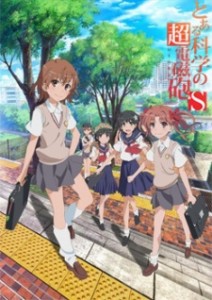
A Certain Scientific Railgun S Anime (English) Guest Review by Mara

August 7th, 2013

ACSRSWoo-hoo! It’s Guest Review Wednesday! Please welcome back serial Guest Reviewer Mara!

A Certain Scientific Railgun S (streaming for free, legally with applicable region limitations from Funimation) is a direct sequel to the anime A Certain Scientific Railgun… which doesn’t have ‘S’ at the end. Picking right up where its predecessor left off, it adapts the manga of the same name. If you are one of the lucky ones who only watched the anime of either Railgun or its mother series A Certain Magical Index, you should give this new season a go right now as it will be more of the same – i.e. an incredibly entertaining esper action story.

However if you are as voracious a consumer of the ‘A Certain Blank’ franchise as myself, you may be hesitant. Understandably so as this new series of Railgun is forced by existing cannon to now tackle the story arc that pushed Railgun into the so called ‘dark side’ of Railgun’s setting: Academy City. A story that focused on illegal cloning and perhaps the most gruesome form of level grinding in fiction. Known as the “Sisters” story arc – in the original novels it was responsible for introducing a lot of important characters; such as Kuroko, the Misaka clones and Accelerator. When it came time for the Sisters arc to appear in the Railgun manga the story focused almost entirely on Mikoto’s point of view leaving fan favourite characters out of the spotlight for an extended period of time; pretty much assuming you had already seen the Index version of the story in some way.

Not so for the anime adaptation. The anime gives you a complete story to enjoy and while Mikoto and the Sisters arc cast take centre stage we are not allowed to forget the rest of the cast, including characters that were introduced in the first Railgun anime:

By that I mean that Haruue is still around as is Banri, both characters from the first season. It is a treat to see that the anime staff did not just ignore them and assume that no-one would care if these characters appeared or not. In a show that had less effort put into it Haruue would have been put off stage now she has been reunited with Banri, instead we see their story continue alongside everyone else’s.

But it is Kuroko Shirai who receives a good portion of episode seven all to herself with her own sub-story that includes Saten, Uiharu and Haruue too. It keeps Mikoto’s story from becoming the dense all-encompassing mass it was in the manga buy piding up other events that would otherwise be entirely sequential. It also gives us an important glimpse of Kuroko’s view of Mikoto during this period, how concerned she is and the frustration that comes with trying to help someone who does not wish to be helped.

New to the Railgun story are quite a few scenes from Touma’s point of view as a digest version of the events he experienced in Index to add context for those who may have not seen or not remember the Index anime (way back in 2009). The manga assumes that we have seen Touma’s point of view before and thus gives us little to explain his appearance or motivation.  The anime however does show us how Touma finds out about Mikoto’s situation, including his interaction with Kuroko which involves a fun bit of perv to perv verbal combat that I really enjoy.

So if you have read the manga like myself and are wondering if you should bother with the first half of Railgun S, rest assured. The first season improved and expanded upon the story and the second season does the same with its source material far better than expected.

Score so far (Episodes 1-16):

Art – 7
Character – 10 (The A Certain Blank series is a fantastic example of Erica’s thesis that every character should have a unique ‘voice’. You would not mistake one character for another based on their lines… apart from the clones.)
Story – 6
Yuri – 5
Service – 9
Overall – 9

E here: Well, you’ve convinced me to watch it! I was dithering, since the manga had been so gloomy, but okay, I’ll give it  a try. ^_^ Thanks so much for the review and the prompt to reenter Academy City once again. ^_^