Archive for the Guest Review Category


YuriTetsu ~ Shiritsu Yurigasaki Joshikou Tetsudobu Manga (ゆりてつ~私立百合ヶ咲女子高鉄道部) – Guest Review by Bruce P

June 19th, 2013

“Once upon a time there were three little sisters,” the Dormouse began in a great hurry; “and their names were Elsie, Lacie, and Tillie; and they lived at the bottom of a well—”‘

This Alice in Wonderland line effectively describes the manga YuriTetsu ~ Shiritsu Yurigasaki Joshikou Tetsudobu (ゆりてつ~私立百合ヶ咲女子高鉄道部) Volume 1, by Matsuyama Seiji. The story involves three little girls (though not sisters) who live at the bottom of a well. They are the Yuritetsu—the Yurigasaki Girl’s High School Railway Club. They recruit a fourth little girl to their club, and go on train trips. But the whole time they never leave their well. Which is to say they travel all around Japan without ever interacting with or even seeing another person, except for one old guy in one panel on one page. Not another living soul in 191 more pages. There are occasionally dim outlines of other people, but these are drawn as indistinct phantoms. Their isolation is truly bizarre. It’s almost as bizarre, though not quite so head-banging, as seeing high school girls drawn as four-year-olds. And these are just two of the many short circuits in Yuritetsu.

The author isn’t inept, he just knows his audience. This isn’t a manga for folks looking to read a good story; that crowd will be somewhere off in the approximately real world reading Aoi Hana, or maybe Asagao to Kase-san. This is a manga for fanboys who like girls, without knowing too much about them, and who like trains, and who pretty much live in wells of their own. Logical consistency can be a major annoyance when all you really want is to see drawings of four-year-old high school girls in swimsuits. And trains. For some, of course, even the trains get in the way.

The story goes like this—Elsie, Lacie, and Tillie, three typical character types (tsundere; food-obsessed wack; quiet computer geek) are the members of the Yuritetsu. They meet Peanut, a new student at Yurigasaki High, and convince her to join the club. Peanut, the girl whose odd pose in the cover illustration suggests she’s just finished reading the manga, is the usual character type that stars in these kinds of quartets, the clueless klutz. Idiocy, so endearing. The girls take trains. They eat ekiben. They go to the beach. They never attend school. The end.

It’s not much of a story, but the story isn’t the point. Yuritetsu is really a travelogue of railway lines in Japan with little girls as your guides and as your companions (isolated as they are from the rest of the world, you don’t even have to share them with anyone). You ride to Hokkaido and stand in the snow; you explore the newly reconstructed Tokyo Station; in a chapter titled “Tetsu-on!” you ride the train to Toyosato and visit the high school where K-ON! was set. And so on. And at the end there are the swimsuit scenes. Ewww. It’s a bubbling stew of fanboy fetishes. It’s probably selling nicely.

So is there Yuri, as vaguely implied by the title?

Oh come on, these high school girls are four freaking years old. But for wellish fanboys the Yuri couldn’t be more obvious. Elsie, Lacie, and Tillie fall hard for Peanut, and who can blame them, she’s such a stammering, wide-eyed dope. So before you know it, they are fighting to stand next to her. They stand next to her a lot. They can’t get enough. And it’s not just two of them at a time – sometimes three, and occasionally all four girls will brazenly defy the conventions of 21st century morality and stand together in, as the French would say, though they would say it atmospherically in French, a group. Who knew it was that kind of manga?

Ratings:

Art—5. Well, the train illustrations are pretty good.
Story—2. Not so much.
Characters – 2. Elsie, Lacie, and Tillie are actually named Mamiko, Maron, and Hakutsuru; Peanut is Hatsune. For the record.
Yuri—2. All girls, so it has to be there, right?
Service—10. The reason it exists.

Overall—3. Of all the short circuits in logic contained in this volume, the oddest may be that this manga could actually be used as a little reference guidebook when visiting different railways, as it includes handy maps and information. The disconnect is that in reality, this would mean opening it up in public, and… ewww.

Scary fact #1 about this manga: there are two more volumes.

Scary fact #2 about this manga: the author has another series involving trains and girls titled Tetsuko na Sanshimai that is creepier than Yuritetsu.

Erica says: Happy Guest Review Wednesday, thanks Bruce and hahahahahah!


Yuri Game: Heileen 3 – Sea Maidens, Guest Review by C. Banana

April 5th, 2013

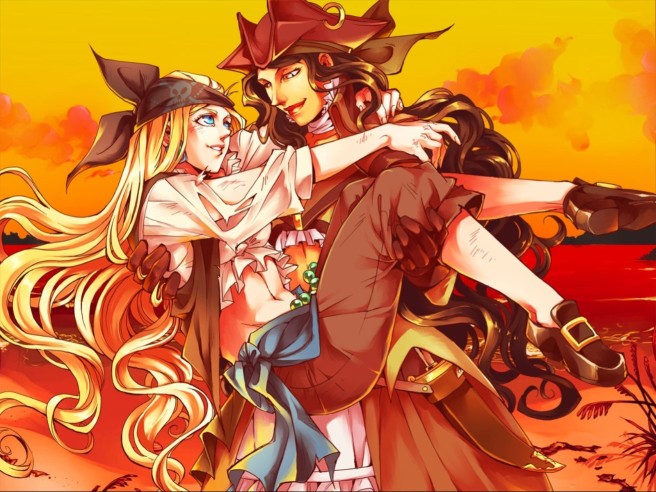
heileen headerToday we have a special treat. Long-time commenter C. Banana has joined the Borg taken up the pen and become an Okazu Guest Reviewer! How excited am I? Very, I assure you. As you know, I do not game, so I am thrilled to be able to let C. tell us all about a Yuri game. Take it away C!

I’m here to talk about an indie dating sim/visual novel in the form of Heileen 3: Sea Maidens from Winter Wolves. For those who don’t know, Sea Maidens is the standalone expansion to the otome game Heileen 3: New Horizons offering four potential Yuri romances. It does help to play the first two Heileen games but it’s not necessary as the third game explains enough that newcomers won’t be lost. If you’re considering buying the first two games, keep in mind that some Yuri fans may not like them, as they’re more Yuri-lite than the third game expansion gets. That said, if you own an Android tablet, Heileen 1 & 2 can be found cheaper on Google Play.

The setting for the Heileen series is during colonial times on an expedition to the New World. The game series puts the player in the shoes of the titular Heileen, a very young noblewoman, who starts out the series very spoiled and immature -although she does get better over time. The events of the first two games involve the initial expedition crashing, resulting in Heileen and friends being stranded on a tropical island. At the end of the second game, Heileen is rescued by relatively friendly pirates which starts off the events of the current game.

Before delving into the romance part, the simulation part of the game should be get a comment. Basically, you train Heileen’s stats and skills to possibly get a possible non-romantic profession ending for Heileen. Usually in simulation games, the first part of the fun comes from the discovery of all the mechanics. The next part of the fun comes from using knowledge of the mechanics to figure out the puzzle of how to use them to achieve your goals. Unfortunately, the simulation side of Heileen 3 is way too simple to find any of this kind of enjoyment from the game and it doesn’t affect the romance scenes at all, anyway.  It’s lucky for the game that the simulation and profession bits are not the main draw – but it does seem like a missed opportunity as it could have added to the game’s enjoyment.

As for the romances, they’re set up in the usual visual novel way, where the choices you make direct who Heileen ends up with (if anyone at all).  For Sea Maidens, the romantic choices are a childhood commoner friend (Mary), a vivacious women in her early forties (Lora), an ex-slave African woman (Ebele), and an irascible pirate lady (Juliet).  As this game was built off the original otome game, the early parts of the game do involve Heileen heavily crushing on guys. If you  only own Sea Maidens, the guys become  impossible to romance.  All of the romances are reasonably long as each playthrough should last multiple hours unless a player is skipping text like crazy.

***

Subcribe with Patreon Enjoy today’s post? Subscribe to Okazu with Patreon!
***

As for my comments on the romance paths…

Heileen/Mary – One thing that really surprised me about this route is how high the drama was during this romance, especially for a childhood friend option.  Luckily though the drama didn’t overstay its welcome for me and I ended up enjoying this route quite a bit.  As someone who’s played the first Heileen, it was nice touch that there was quite a bit of contrast to the Mary route in the first game as Heileen shows herself as much more mature and competent during the third game’s Mary route.

Heileen/Lora – A confession I’ll make is that I liked the Heileen/Lora route in the first Heileen game.  That said, playing this route in Heileen 3 actually creeped me out a little as the mother/daughter vibe of their relationship is played up at the same time during this route.  I’m pretty sure people who can get past that would enjoy the route a lot more than I did.

Heileen/Ebele – This romance certainly plays out significantly nicer than the others as, during this route, conflict between Heileen and Ebele is kept to a minimum.  I liked this route in a mild way but unfortunately that doesn’t give me a lot to say about it.

Heileen/Juliet – I romanced Juliet the first time through and on subsequent playthroughs, I kept being tempted to play through her route again.  One really positive thing about this route is that both Heileen and Juliet go through a fair amount of character development during this route.  The ending CG is without a doubt my favourite of the bunch.  Also, in what universe is a kickass pirate lady not considered a plus?

heileen-juilet ending cg


All in all, the potential romances offered are different enough that most people should find one route that they particularly like.

Art – 7
Story – 8
Characters – 8
Yuri – 5 to 9
Service – 5

Overall – 8

Erica here. Thank you so much for this review and the lovely picture which we all can enjoy. ^_^ Sincerely, I can’t thank you enough. 

As always, if any of you, my dear readers, would like to offer a Guest Review, please take a look at these guidelines. I’m always on the lookout for points of view that are not my own and reviews of things I can’t or won’t review. Thanks again C. and here’s to more great Guest Reviews!


Jormungand Perfect Order Anime Guest Review by Mara

January 16th, 2013

JORPOFirst Guest Review Wednesday of the Year! I have basically said everything I have to say about Jormungand but, as Jormungand: Perfect Order is streaming legally and free on Funimation (as Episodes 13-24 of the series. Registration is required,) I felt it was worthy of a decent review. And so here is Mara with a very decent review. Please welcome him once again to Okazu! Take it away, Mara…

I remember picking up the Jormungand manga right off the shelf of a comic shop with completely zero expectations, as I usually do and being firmly impressed. Here was a half decent action manga with two protagonists that have hilarious chemistry. So it was fantastic to find out it was getting an anime.

The anime of Jormungand was aired in two half season segments and with a thirteen week break between them. This gives the production team a sliver of extra time to make sure that we do not see too much quality slippage over the whole run. A sensible idea for an action heavy show such as Jormungand where if the motion is not there on the screen to an adequate quality the show will suffer. It is a good thing too as Jormungand: Perfect Order starts right at the R/Hex arc where we have a big set piece climax.

The problem is while Jormungand’s action scenes work very well in the manga, they have not been transplanted so well into the anime in places. In a way they were moved into the anime too well with no attempt to change them to suit the animated medium. This means a lot of static shots of the characters firing with bottomless magazines while exposition goes on. Very noticeable in the street fight between Koko’s group and Hex’s group, it sadly sucks a good deal of the tension out from the action.

Despite that minor gripe, I still loved the action in Perfect Order. The stand out point for me would be the tunnel chase sequence in Tojo’s story arc; an exciting and energetic chase scene that improved upon the manga and used everyone in Koko’s group.

So, sadly, you may be thinking that as we had Valmet personal arc in the first season of Jormungand there is not much Yuri to talk about in Perfect Order. Well, it is true that Valmet fades a bit into the background now she has had her revenge. Valmet becomes Koko’s yes-woman for the most part. We do have a small scene in episode twenty where Koko messes around with Valmet to show off to Minami; but nothing is made of it afterward.

In fact, the major Yuri moment is more of a what we might call ‘Yuri goggles’ variety, but not of a relationship. No, I would suggest that we should turn our lily-tinted lenses to the group of four women who end up creating and wielding the power that changes the world: Jormungand. That while Koko gets the world, the girl (Valmet) and the adorable boy (Jonah), Dr Minami, Koko’s co-conspirator, gets her own elite science harem.

Firstly she easily secures the then unemployed Karen Low and easily pulls her into her own unique working environment. Then when Elena Baburin gets kidnapped from her kidnappers by Koko’s team she seems really distraught, who would not be? But then when we get a very jarring bathing scene later on we see that Elena is totally okay we working on Jormungand… now that she has met Minami! Later Rabbitfoot is also kidnapped out of a different kind of captivity to work on Jormungand, Koko makes it clear that she does not really like Rabbitfoot due to her previous conduct. Someone however finds Rabbitfoot’s single-mindedness cute… Dr Minami!

Frankly for me, it did not take much effort to see the whole of Perfect Order as having a sub-plot of Minami ensuring her retirement in a toy factory in South Africa, with three differently beautiful women who are all geniuses in their fields and her own personal open air bath. Not to mention she also gets her own cool high-backed chair among the four people who will ensure peace in the world for the foreseeable future. Minami makes out of this show like a bloody bandit.

Even if you don’t agree with me on that, it is still pretty sweet that the four people who will put an end to war, something that has often been used as an excuse to suppress women, are four women who are super geniuses in their respective fields. At the very least it gives me a feminist power fantasy high.

Speaking of the end of Jormungand I do feel like I have to mention the run up to the ending. In the last few episodes Koko finally reveals her plan to everyone and to Jonah. Sadly Koko, who to this point seemed so in control and genre savvy, seems to do a complete one hundred and eighty and simply delivers a speech about the sacrifices Jormungand will require, like she was a villain in a less interesting manga. It does not help that all of Koko’s ideas hinge on a very pessimistic and conservative viwew of people and of changing the world for the better. It is a real shift in tone for Koko to go from: ‘This is right because I’m awesome’ to: ‘This is right because it is the most cynical possibility’. A trope that I am getting sick and tired of being used as a crutch.

Now this was not an out and out character assassination, but this did not fit the standard of Koko’s actions up to that point and there was little attempt to show Koko’s turmoil as we immediately focus on Jonah and his thoughts for most of the rest of the series.

The writer clearly tries to distract us from this with a bit of fanservce that actually seems aimed at me for once. Koko cuts her hair to above shoulder length and starts wearing a black suit, plus the official reveal of the aforementioned lesbian cabal that will rule the world. Yay and all, but that does not distract me when the even greater fanservce of Kasper giving the best villain speech I have heard this year to Koko; thus highlighting that Koko, a character I fell in love with because she does awesome and cool things, has not done a cool thing in the last episode of a show about her.

The end, though, is very sensible. A reconciliation is achieved and the anime ends on a point where we know where everything is going and does not continue beyond that; sensibly preventing us from being disappointed.

Jormungand was a fantastic manga about a woman who though her own will and ability changes the world. Not for someone else but for her own aesthetic ideals. The Perfect Order anime was a fantastic adaptation of the last half of the manga. Such a good adaptation I will hold it up as an example of all the good and bad you can do by being perfectly faithful to the source material.

Ratings:

Art – 5, every third character looks flat like they are in a different show

Characters – 10, best part of the whole thing

Story – 7, Good but points off for dithering

Yuri – 5, Valmet is awesome but needs a spine, everything else is just in my head.

Service – 10, Let’s see, suits, abs, eye patches, adorable guys and butch ladies. Can’t give this any other score when I am the one scoring it.

Overall – 8

Two points off for dropping the ball with character models and for forgetting at the end that Koko needs to be the coolest person in the room. Other than that as close to perfect in this genre as I have seen in a while.

Erica here: Mara you hit the nail on the crumpet, IMHO. I also saw Minami’s ‘true’ plan. Laudable, I thought. ^_^ Thanks for the review and for being the one that got me into Jormungand in the first place!


Yuri Manga: Lesbian III – Kyuketsu Reijo (レズビアン3 吸血令嬢) Guest Review by Bruce P

November 1st, 2012

I said “reviews will resume” but I did not tell you that they would resume with a veritable masterpiece. Today, Guest Reviewer Bruce P offers up what I sincerely believe to be the most masterly review I have ever read, just in time for Halloween!

Lesbian III: Bloodsucking Women, (レズビアン3 吸血令嬢) is the latest volume of Senno Knife’s manga centered on lesbians, but not really. As was stated in a review of Volume I there have typically been no lesbians in these lesbian stories. And there are none in Lesbian III. There are only female vampires living in a world unaccountably devoid of men, so their targets are necessarily also female. And although they do seem to enjoy the lovemaking that takes place before getting down to business, those naked preliminaries appear to be of somewhat secondary interest to the women involved (if not to the intended audience). Unlike stories in previous volumes, Lesbian III is pure melodrama with a lack of actual love between any of the characters.

While the previous volumes consisted of short stories, Lesbian III is one long epic. This provides the author with less room for creating different artistic atmospheres, one of Senno-san’s strengths, but provides a chance to see if he can expand a simple idea into a sustainable narrative. Does he succeed? Heavens no. But it’s a pretty ride.

Asari-san, a beautiful woman, is in the vaguely 1930’s-style Capital City looking for employment, but has had no success. It’s dark. She’s despondent. And then an expensive limousine pulls up, from which a mysterious, beautiful woman emerges, offering Asari-san a ‘job’. In the live-action movie this is the point at which the audience yells “Don’t get in the car.” She gets in the car. She’s blindfolded. New to the workforce, she figures this must be what they call commuting. Arriving at a very gothic Japanese mansion she is led to a padlocked tower and informed that the beautiful woman’s daughter is languishing within, suffering from a mysterious medical condition. With a bit of a shove and a ‘good luck,’ Asari-san is locked inside. It’s only now that she gets a sense that something dreadfully peculiar is going on. And you wonder why employers were not terribly keen on hiring her.

The girl in the tower, Saya-san, is very beautiful. Actually, every character in the manga is either a beautiful woman or a beautiful girl, except for a few grumpy looking nuns who don’t get much page time anyway. Saya-san is charmingly straightforward about the situation – she’s a vampire, Asari-san’s a buttered scone, and it’s way past tea time. It seems that Saya-san has been bitten by one of those beautiful Eastern European piano teachers of whom you must be so careful. Asari-san is horrified by this declaration of hellish intent and thinks: oh such pretty eyes. So they undress and fiddle around a little before Saya-san gives her eternal life and all the issues that go with it. Recoiling at the enormity of her fateful actions, Asari-san thinks: pretty lips, too.

Existing now in a timeless, twilight world, undead and never-aging, Asari-san has no need for a pension plan and is much more employable. She is given a job teaching at Saya-san’s pseudo-Catholic school where she and Saya-san begin systematically seducing other girls to the ranks of the undead. Incidentally the type of vampire in this story, while preferring the night, has no real problem with daylight. Or with crosses, or presumably with the garlic in the refectory’s lobster bisque. This is most fortunate for a vampire teaching day classes at a Catholic school. Asari-san and Saya-san soon enough have their hands full. Teachers and students, each one prettier than the last, form a line to the couple’s door, eager to shed their clothes and join the army of the damned. It’s great fun. It’s a long line.

So everyone’s becoming a vampire. But like a plague that begins spreading and killing millions in a crowded city, eventually somebody’s going to notice, what with all the blood everywhere. The nuns turn for help to the dormitory guardian, a literally 10 foot tall armored woman who leads an elite troop of jack-booted hall monitors. Meanwhile Eliza, the piano teacher who started it all, reappears. She surprises ex-pupil Saya-san with an urn of ashes, the remains of that famous literary vampire Carmilla, who in this version had been burned at the stake by hooded executioners from the Vatican. Eliza intends to revive Carmilla in the crypt beneath the school.

Inserting Carmilla at this point is a little like when they put Dracula into an Abbott and Costello movie. You have to feel a little sorry for the old bloodsucker. The story of Carmilla, like Dracula, is of course relatively old, in a literary sense, with roots going all the way back to the Sakura Taisen Dramatic Card Game Series, and, um, possibly even earlier.

While it sounds very much as though the story has long since merrily degenerated into bad farce, you don’t notice this so much as you are reading. In fact if your reading consists of just looking at all the naked vampires you won’t see any problem at all.

Anyway at this point a great deal of swashbuckling hurly-burly takes place, naked vampires vs. sword-wielding storm troopers with pretty eyes. Carmilla is being revived with vampire blood, Asari-san has escaped the school dungeon but is about to be impaled with the dorm guardian’s two-handed longsword…

And then she wakes up. It was all a dream. Or was it? As she rides off in the moonlight with Saya-san and Eliza and an urn of Carmilla ash in Eliza’s expensive 30’s-style roadster she takes a nibble at Saya-san’s wrist. While you can argue that this ‘it was only a dream’ type ending is a lousy way to end a story, the greater disappointment, for the majority of folks who have made it all the way to the end, will be that as they disappear into the night they still have their clothes on.

Ratings:

Art – 8.  Precise, Paul Delvaux inspired mannequin-like characters and sharply drawn gothic backgrounds.

Story – Are you kidding?

Characters – 7.  They may chew on each other, but they’re very nice about it. Good vampires and bad pseudo-Catholics.

Yuri – 9.  100% women, but despite all the lovemaking, there’s little love in all that vampirism.

Service – 10.  It would be 9.9 because of the fully clothed ending, but when closing the book, the back cover probably gives it that extra tenth.

Overall – 6.  A fine example of the fact that just because something is bad – and this one is bad – there’s no reason that you can’t say what the hell and enjoy it.

Erica here: Bruce, you’re killing me. Please write all my reviews so I can just read them….!


Yuri Manga:Teito Takoyaki Musume – Taisho Yakyuu Musume Extra Story Manga, Guest Review by Bruce P (帝都たこ焼き娘。―大正野球娘。番外編 )

March 22nd, 2012

My favorite day of the week has arrived – Guest Post Day! Once again we welcome back Okazu Superhero and Friend of Yuricon, Bruce P! It’s always a treat when he writes a review, so let’s curl up somewhere comfy and have a read, shall we?

The year is 1925, and the Oukakai have shown that they can compete with the boys head-to-head at the game of baseball. Their self-confidence has grown through their own efforts in the dust and sweat of the playing field. But now the games are over, and Suzukawa Koume is back to her normal school activities: attending classes; studying English; causing other girl’s hearts to bang like marimbas. All the while inexplicably losing the self-confidence she’s just acquired, as though never having lifted her spikes to break up a double play.

Teito Takoyaki Musume is a manga sequel to Taisho Yakyu Musume. In one sense this is a pleasure, as the members of the Oukakai baseball club are a set of characters worth spending time with. On the other hand, the original Taisho Yakyu Musume is a wonderfully self-contained story, for which a sequel could easily seem a cranked-out franchise extender. In Teito Takoyaki Musume you can hear the gears.

Koume is back to the books, but finds that she is pathetically behind everyone in schoolwork. Kawashima-san is obsessed with Koume, and with keeping her on the path of academic progress. But she is confronted at every turn by Tomoe, whose interest is in keeping Koume happy, progress be damned. These three make the triangle that impels the story. Interestingly, Akiko is relegated to a relatively minor role. Frustrated by Tomoe’s cool competence, Kawashima-san is desperate for any advantage, so she contacts her stylish, look-alike Kansai cousin Momiji for assistance. Bad idea. Momiji’s a handful, and unexpectedly appears in the Chancellor’s office to make cutting remarks about, of all pertinent things, Tokyo cuisine, and the poor comportment of Tokyo schoolgirls, whom she has observed acting most unbecomingly – she had encountered Koume and Tomoe sharing dango (you know… ‘Say aaaan’) on a rendezvous in Shinjuku. Well, the crisis is now truly at hand. Tempers rise. Anna-sensei takes control by proposing that the Tokyo and Osaka schools settle their culinary differences by engaging in a ‘food stall battle’ to determine who’s cuisine reigns, um, tastier.

The remainder of the story involves the Oukakai attempting to develop a recipe that will be a winner, or at least something that doesn’t cause them to gag, which takes a surprising number of pages. They learn about food stalls, and street food – how to eat soba noodles, an uncouth activity, which Anna-sensei demonstrates with immodest pleasure. They eventually hit on a recipe for Tokyo takoyaki, predating the actual development of this Kansai specialty by about ten years. On the big day Koume is paralyzed by yet another attack of self-doubt – and with Prozac so darn far in the future, too. But at last with support from her friends she succeeds in making wonderfully aromatic takoyaki that delight the festival crowd. Though not before Kyouko has had to dash off to find some necessary ingredients… if only she can make it back in time… she does. It’s all very dramatic. But victory still hangs in the balance until Tomoe and Shizuka surprise everyone by doing a Takarazuka thing, arriving in a large box, gotten up as a pair of living dolls (male and female) to attract the customers.

Lyndon Johnson won election to the senate in 1948 by flying around Texas in a helicopter yelling down at the gathering crowds. Nothing beats spectacle to draw the saps, and after the living doll show the game is over. Momiji has no choice but to concede defeat. But only to offer the Okaitai a further challenge – on the baseball field.

There is more Yuri in this volume than in either the anime or the quirky, original Shimpei Itoh manga (the very Shimpei Itoh manga – U-boats and rocket launchers and aluminum bats). Koume is surrounded by adoring fans, enough that at one point even she has to ask why so many of the girls like her so much (akogare). An excellent question. Her quivering lack of confidence in all things is unbecoming and very annoying. Tomoe on the other hand is poised, cold and intelligent. But she melts with happiness when alone with Koume, on a date or when they share a futon. Happy couple #2 – Yuki and Tama-chan – also share a futon during the same overnight. Yuki has orchestrated the entire evening, from the partner selection (which sounds less innocent than it is) to the insufficient supply of futons. Tama-chan doesn’t mind. Throughout, Anna-Sensei and Kawashima-san are drawn to each other; it’s an intellect thing, but if they were a lot closer in age it’s not hard to guess that Anna-sensei’s kiss would have been a little less maternal. And then there’s Momiji’s cross-dressing pal Sakura, looking good in shirtsleeves, suspenders, and knickerbockers, who takes a special interest in Koume at first sight.

In Teito Takoyaki Musume the Yuri is gentle but fun. The story, though, seems artificial and the drama forced. But the real let down is that, rather than striving to accomplish something wildly unprecedented, which no one believes they can do, or even thinks they should attempt, the girls are… cooking. And fretting about it.

Ratings:

Art: 5 Adequate, but only. There are some odd proportions on occasion.
Story: 5 Artificial. Hey everyone, let’s put on a play!!
Characters: 8 A great ensemble.
Yuri: 6 Cheerful and sweet.
Service: 0

Overall: 6

I have to admit I like series set in the Taisho era – Sakura Taisen also comes to mind (at least to my mind). It’s not nostalgia, I don’t remember crystal sets and scarlet fever, but the mix of old and new is intriguing.

Thank you again, Bruce. I have only one question, Service – 0? Really? ^_^