Archive for the Guest Review Category


Visual Novel: Aoi Shiro Guest Review by Mara

January 13th, 2010

It must be Wednesday, because we have a Guest Review! Today I welcome back Mara, who will once again be reviewing the Anime/Manga/Choose Your Adventure/PowerPoint hybrid known as a Visual Novel. Enjoy!

It is a sign of success when a visual novel makes the port from PC to console. This is because the game in question must have significant appeal when you remove the erotic content (none of the console makers allow it). But when a game makes the leap the other way, from console to PC, the reasons are less consistent. In the case of Aoi Shiro it was a couple of extra scenes and some more event CG in an already CG-heavy game.

Aoi Shiro is a game by Success who previously brought us the Yuri visual novel Akai Ito – both games are set in the same supernatural universe. The main character this time is the serious kendo team captain Osanai Syouko who is played with surprising flexibility by Noriko Hidaka.

The plot of Aoi Shiro follows Syouko as she heads to a summer training camp with her kendo team. Their location, a Buddhist shrine on the southern coast, invokes sad childhood memories for Syouko. The exact nature of these memories takes awhile to become clear as Syouko seems to be cursed with a memory that makes any act of deep recollection EPIC in a clumsy attempt to give these events additional gravitas.

Regardless of this, Aoi Shiro has a pretty decent plot for a visual novel that really hangs more on the ‘visual’ aspect than the ‘novel’ aspect. When the characters are voiced and have animated sprites that blink and are lip synched to the lines, it becomes clear where the money went.

Regardless, Aoi Shiro has plenty of fun scenes where we get to know most of the characters pretty well and come to like their eccentricities. The many eating sequences stand out as they set the rhythm for each day of the story and there are some truly inspired conversations, such as the finer points of Zen vegetarianism.

Sadly, three major heroines can not share in these scenes and so feel underdeveloped. For example, when we are solidly on Nami’s route and she gets her voice back and begins to develop a personality, Syouko’s sudden gushing crush on her is rather jarring. Indeed the characters rarely discuss their feelings for each other and the short time span of the story (only 4-5 days) means that the endings for each route feel ultimately unfulfilling and do not resolve any of the romantic possibilities.

Although the stories may be low on Yuri the heroines themselves are not, as each fills a specific Yuri archetype, and does so very well. The stand out star heroine, however, is easily Kohaku, the deliberately androgynous, efficient, prideful and damn cool oni that kills off mooks by flicking stones as though she was playing marbles.

Kohaku is played by Kei Mizusawa, who plays her with a nice aggressive tone, and has easily the most ‘Yuri route’. It is in this route that Syouko expresses most strongly reciprocated romantic feelings. A route where we can leave our Yuri goggles on a very low setting and still be satisfied.

While many routes feel very watered down or evasive towards the end Kohaku’s at least feels like a “And that’s how we met” story that couples might tell you at their wedding…if they fought oni for a living.

But, having only one route that has a solid Yuri feel to it is a tad disappointing for a game of this pedigree. Even then there is the ‘grand route’ that we must thus assume is cannon, as all the mysteries and problems are solved. In this route, however, Syouko is not pared up with anyone although it does progress down Nami’s route for a while it is clearly everyone’s story and, so, there is not any time for any romance as the plot about summoning a demonic storm god takes priority. But it is a bit depressing that after all those routes where Syouko ‘got the girl/sister/rival’; the route that is considered the ‘true ending’ has no really romantic scenes at all.

While it is depressing that a game that clearly markets itself and is considered a Yuri game has very little Yuri content Aoi Shiro is still a very good visual novel. The artwork is undeniably beautiful to look at and the story has wonderful characters that each make the best of their short time in the limelight. I cannot recommend this game enough.

Ratings:

Art – 10 (It’s like an inverse Umineko)
Story – 6 (Rushed at the conclusion)
Characters – 9 (Everyone will latch onto one or two heroines)
Yuri – 3 (But Kohaku gets a 7)
Service – 4 (There’s an onsen at the shrine, you don’t say?)
Loser fan girl – 4 (The antagonist and the worlds most awesome Buddhist monk)

Overall – 9

It is the game equivalent of fireworks. A few beautiful explosions that leave your jaw hanging open, you just wish that there was one more or that they lasted just a bit longer

Erica again: First of all, thank you Mara! This really interested me, as I have read all of the Aoi Shiro manga, and I’d say that it’s pretty equivalent. Too many characters left undeveloped, too many opportunities for relationships squandered and too little Yuri, after a lot of Yuri-ish set-up. So, once again, thank you for the review and another glimpse into a piece of the Yuri puzzle that I don’t cover.



Taisho Yakyuu Musume Manga, Volume 1 (大正野球娘) Guest Review by George R.

November 4th, 2009

TYMM1Once again it is my great pleasure to welcome back George R., with another timely review, so I can get a few chores done. :-) As it happens, thanks to another Okazu Superhero, Bruce P., I am currently reading this very volume, so I may have some comments at the bottom. In the meantime, George, the room is all yours….

Seeing Taisho Yakyuu Musume from this summer’s anime lineup prompted me to look at its appearance in other media. This show followed the now-common path of starting as a light novel series, then branching out to both manga and anime adaptations. I’ll talk about Volume 1 of the manga here, as I still need to get the novels. In this case, the manga adaptation is done by Shimpei Itoh, a well-established mangaka, though not one known for Yuri.

I think the manga works well on its own, though it is interesting to see how it differs from the anime. For instance, several girls end up playing different positions, which makes me wonder where the novels originally assigned them.

The art is unquestionably Shimpei Itoh’s style. This differs from the anime, but is just fine in its own right. In fact, the art and humor remind me of his 1999 manga, Shoujo Tantei (Girl Detective), which was also set in the Taisho era, but has no Yuri. I think Itoh-sensei’s girls are a bit less moe than those of the anime, or at least Koume and Noe are.

It also follows Itoh-sensei’s story-telling style including a healthy dose of physical comedy and over-the-top humor. Somehow I doubt the novels include Noe experimenting with small rockets for military use (unsuccessfully) or suggesting they make bats from aluminum (accompanied by an illustration of an aluminum-armored tank from the ’70s). Those just seem his style. A couple bath scenes give us a little humor and also a chance to see the characters modelling their birthday suits. I wonder why the Japanese seem to have a fascination with spring-based resistance training harnesses. I’ve seen these in multiple shows. These appear a couple times here, though only played for humor.

The first volume of the manga covers introducing the characters and assembling the team. Baseball doesn’t even come up until the second chapter where we get Akiko’s motivation and her request to form the team.

Koume is still the sweet girl who happily follows and supports her friends through their adventures. Her mother seems to have no problem with her and baseball, wishing her a fun time and even letting her wear a western school uniform.

Akiko is the same rich daughter who is chauffeured to school, so naturally she is called Ojou. Noe is more of a ringleader here, taking Akiko’s baseball idea and running with it. She is the only one, other than Anna-sensei, who starts knowing anything about baseball.

We are given a closer look at some of the supporting characters. Shizuka is possessive of her twin sister Tomoe, and they both seem equally athletically competent. Their dad is a well-known doll-maker, and some call the twins living dolls he made. Tomoe likes Koume’s friendliness and warmth and hopes that becoming friends will warm the heart under her (and maybe Shizuka’s) cool porcelain skin.

Tamaki and Yuki are childhood friends. Tama-chan takes care of all the cooking at home as her mother is busy being a newspaper reporter. This may be a bit anachronistic for Japan of this era, but I find it hard to argue with women having independent careers like she and Anna-sensei do. However, Tama-chan certainly wishes her mother was a bit more responsible at home, which may be the source of Tama-chan’s attitude. Yuki is her same responsible, caring self, supplying her
friends with advice and equipment among other things.

Saburo comes off well as Koume’s fiancee, even taking her out for a date to watch a practice baseball game. When he finds she knows little of the game, he happily explains it to her.

What Yuri is here requires goggles to see. Mine needed a higher setting for the manga than the anime. We are treated to displays of both akogare and shinyuu in the different relationships among the girls. Kome and Akiko vary between the two. Tama-chan and Yuki have the comfortable ease of shinyuu, whereas Tomoe’s feelings for Koume are definitely akogare, as are those of Tomoe’s fanclub.

Ratings:

Art – 7
Story – 6
Characters – 8
Yuri – 1
Service – 4

Overall – 6

In all, I found this an amusing manga. Though it never made me fall off the couch laughing, it did bring many a grin to my face. I will admit to preferring the anime. Perhaps because it seemed better at keeping the feel of the Taisho era: some of Itoh-sensei’s humor jars my mind out of the era. Or perhaps seeing the anime first left me naturally biased in its favor.

Erica here. The art style is distinctively Itoh’s and, as a result, everyone is a bit over the top. Akiko’s fiancée’s rant about women in the home was three pages long and done at high volume, as opposed to his quiet, old-fashioned confusion as to why on earth women would want more from the anime.

I disagree that baseball is not mentioned until the second chapter – and, oddly, it seems that you’re not alone in thinking this, George. In the first chapter, the baseball team is *already* formed, Koume’s mother asks her if it’s fun to play baseball, and she waxes rhapsodic about how much fun practice and games are. The rest of the story is a flashback to how the team was formed. I’m guessing that, since Itoh’s specialty is not sports manga, they skipped trying to show any of that. ^_^ So we can understand that Koume and the others are, in fact, *already* playing ball, even if we don’t see it. Which we don’t. ^_^;

The other thing I wanted to add was that the anime, surprisingly, added a great deal of dignity to the story. By pulling back from over-the-top antics and rants, the issue of feminism was handled really, shockingly, well. Considering the dehumanization of women into object d’fetish so often in anime, it was just that much better handled than I could have possibly expected. Where the anime was a comedy-drama, with an emphasis on “sports drama,” this manga is definitely “comedy.” Fun, at times funny, but firmly in the “wackiness ensues” side of comedy. It is Itoh, after all. ^_^

Well thank you, as always, George for a great review!


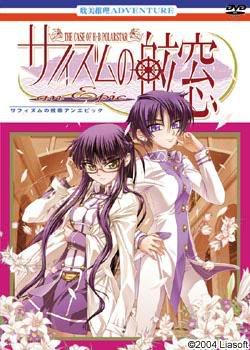
Yuri Game: Sapphism no Gensou

October 10th, 2009

Brain is a bit melty today, so it is with great relief pleasure that I welcome Guest Reviewer Ashley for today’s post! And even better, because as you know I don’t game and have no interest in games, Visual Novels or anything similar. So what a genuine pleasure to be able to provide you all with a review of the Sapphism no Gensou game that came out a few years ago and is undeniably Yuri. Take it away Mara!

Personally I do not comprehend the thinking behind same sex schools. Most of all I disagree with the argument that they somehow protect their students from something. But to each their own.

The school from Sapphism no Gensou on the other hand, I get. Not content with the usual standards of security a private school, the H.B. Polestar is a giant ship that sails an undisclosed course across the ocean to provide the best and most luxurious education for the daughters of the elite. Think a floating Ashford academy and you will not be far off. This is the absurd and fun setting of Sapphism no Gensou a visual novel by Lair-soft who since have done nothing else of note although they have kept with the theme of an unusual setting in nearly all their games.

This game’s unusual setting is home to a powerfully diverse cast, and not just diverse in the usual visual novel model of: ‘girl for every taste so we maximise sales’ way. The main character Anri, some sort of experimental fusion of Utena (Revolutionary Girl Utena) and Tamaki (Ouran Host Club), deserves mention for not only being out but also deliberately going to this closed-off all-girl school so that she has the highest possible number of girls to hit on. Such openness and self-confidence are refreshing in a female main character in general, much less a Yuri main character. So much so that I overlook Anri’s massive ageism as a required character flaw (she gets over it anyway).

Anri is not alone in this story – besides the three main heroines, who are for the most part the dullest characters; there is Anri’s pre-existing, pre-Iono harem. These characters deserve an article all to themselves mainly because half of them are completely bonkers. For example there is Nicolle, the long-fringed daughter of an Italian mafia don who talks machine gun fast and has a serious gambling ‘interest’. Kanae, Anri’s sempai and incredible computation genius, who is addicted to coffee and goes into withdrawal if she misses her regular fix. Anne Shirley, the daughter of a Columbian drug lord, who constantly offers the rest of the cast giant fistfuls of ‘medicine’ and talks to spirits invisible to everyone but her, and the player.

I could go on forever.

For the most part the entire cast is made up of fantastically far out individuals with suitably silly dialogue; each scene with them is a treat. It is a good thing that the supporting cast is so amazing, as the three main heroines about which the three main story routes revolve are the dullest cookie cutter characters that could hope to disappoint you. This is almost appropriate though because the main story is utter crap.

Simply put, the writers seemed to have deliberately picked the only form of a closed circle mystery that could completely turn one’s stomach. A series of sexual assaults have been committed on board the H.B. Polestar and in this all female environment immediately the out lesbian is inaccurately labelled as the suspect. So much so that the onboard authorities decide to expel Anri regardless of her guilt so that they can escape charges of incompetence themselves. If this summary so far has not made you throw up then let me close it by saying that we are treated to one of the assaults as the opening scene of the game in an act of Somme-level idiocy by the designers.

This half of the story is so at odds with the pleasant atmosphere of the other half that I am truly convinced that Sapphism no Gensou was written by two completely separate groups who then shuffled their scripts together before sending it off to the producer. It is a real shame because this game does have some greatness that is not totally obscured by the crap that makes up the rest.

Luckily, the idiots who wrote the rape half of the game were fired for the special DVD edition of Sapphism no Gensou. This version comes with a whole game’s worth of extra short stories and scenes that expand on the all of the characters with further disregard for being disgusting in preference for being silly. All the characters get at least one including the main character and the old lady who founded the H.B. Polestar.

If you are a complete collector like myself then you should buy the DVD version of Sapphism no Gensou as the extras make it more than worth it. However I cannot recommend such a game generally when there are other, better, Yuri visual novels out there.

Art – 7
Story – For the main story: 3 For everything else: 8
Characters – 9
Yuri – 9
Service – 10 (a massive neon 10 advertising a swimsuit maid cafe)

Overall – 8

I truly liked this game but I cannot recommend it to others for the same reason I would say that you should not become friends with a racist just to borrow their car.

Thank you for reminding me just why my aversion is something to treasure and nurture, rather than get over. ^_^ And thank you for today’s review! As I’ve said many times, if you, dear reader have a Yuri game you’d like to review, please contact me. Legitimately purchased copies only, no downloaded or pirated games, please.


Hidamari Sketch Manga, Volume 4 Guest Review by George R.

September 2nd, 2009

It’s Guest Review Wednesday once again on Okazu and once again, it is my sincere pleasure to welcome George R. for this week’s guest review!

The fourth volume of Aoki Ume’s Hidamari Sketch manga (ひだまりスケッチ) came out in Japan this past January. I was a bit slow in picking it up, but am glad that I did. It doesn’t have a deep involved plot or more than hints of Yuri, but then again Hidamari Sketch never has. If you’ve liked the previous manga, light novels, or anime, you’ll probably enjoy this as well.

Ume-sensei has a strong cast of characters already and we can again enjoy the amusement in their daily lives. But she doesn’t make them carry the entire load in this character-driven manga. The first extra we meet is Yuzawa Arisa, a senior art major, who is the only one left in the art room to answer Yuno’s phone which she forgot there. She can’t resist Yuno’s cuteness and has her pose for a sketch.

The end of the school year brings exams and Yuno does poorly enough to need to take a supplementary test on English grammar. Everyone offers their help, each in their own way, and thanks to that she scores 100% on the retest.

A new school year brings new students to Yamabuki-high, and two new freshman neighbors to Hidamari-sou. The landlady talks the Hidamari-four into help clean their rooms before they move in.

Nori moves into room 103 and adds a modern touch, bringing her computer and the internet to Hidamari-sou. Her computer-related interests are incomprehensible to the other residents, but they accept and welcome her all the same. She also becomes a good friend and supporter of the other new resident.

Nazuna is a polite, timid girl who moves into room 203 next to Miyako. She had lived in the area, but had to move when her father’s job transferred him elsewhere after she was accepted to Yamabuki. She feels unready to live on her own, being bad at cooking and cleaning. Yuno gets the chance to grow, as she learns to support Nazuna like the others supported her last year. When Nori wants to put up curtains, Nazuna is able to direct them to the local “I’m Home” [Depot?] to get them. Ume-sensei is able to show humor in this simple shopping trip, though perhaps Miyako with a chainsaw is more frightening than funny.

The volume ends with an extra chapter of “ordinary manga,” instead of the usual 4-panel. This tells of Natsume’s entry to Yamabuki-high, and how she met Sae on her first day there a couple years ago. She finds that Sae’s confidence, looks, lifestyle and career make her irresistibly cool, and so develops a huge crush on her. When she finally gets the courage to go talk to Sae again, she finds Hiro already talking with her about what to make for dinner. Sae’s easy thanks and offer to accompany Hiro grocery shopping on the way home shatter Natsume’s dreams, though not permanently. Previous volumes show us that Natsume continues to carry a torch for Sae.

This volume offers the humor and double-meanings I’ve come to expect from Ume-sensei. What Yuri can be seen centers around Sae, in either her relationship with Hiro or Natsume’s crush on her. I think the level of Yuri peaked in volume 3, with this one returning to that of the first two.

Over time Ume-sensei’s art style has grown on me, or maybe I’ve come to see it as the natural way to depict these characters I’ve come to like.

Did this volume blow me away? No, but that is also not the style of Hidamari Sketch. Did it give me a wonderful time with my “old friends” at Hidamari-sou and added some new ones to the group? You betcha! Did I enjoy it? Definitely. Several times I was glad not to be drinking while reading, as spraying manga with milk from your nose is not a good way to take care of it, or any other book.

Ratings:

Art – 7
Story – 6
Characters – 8
Yuri – 1
Service – 1

Overall – 7

I hope that Yen Press will continue on and translate this volume as well. There’s really just one way to encourage them to do that, and that’s for all of us to show them it’s profitable by going out and buying the first three.

Absolutely agreed George. Our support for this genre must be expressed with $ or we’re just killing the thing we love. Thanks again for a loving look at this gentle slice of life comic!


Hidamari Sketch Light Novel: Hidamari School Life, Guest Review by George R.

July 22nd, 2009

I really intended on writing my own review today. Then I ended up sacrificing some hours to the gods of Tech Support and by the time I was done, I just couldn’t do it. I just couldn’t. Sorry. Bravely, George R. has leapt into the gap to save my shattered nerves and so, I commend him and his review to your care. It’s all yours, George!


I enjoyed the first Hidamari Sketch novel enough to go right on and try the second one, and I was not disappointed. Hidamari Sketch: Hidamari School Life (ひだまりスケッチ―ひだまりSchool Life) concentrates on Yuno’s life at school, as opposed to the first one at her apartment. We are again treated to a set of short stories, where the characters are the focus, not the action.

Autumn has come to Hidamari-sou and tomorrow is the day for everyone to change from summer to winter school uniforms. I’ve always been amused that the Japanese schools change their uniforms according to the calendar regardless of what the weather may actually be. Apparently consistency schedules trump practicality.

Aoki Ume, the manga-ka, has again done the illustrations. Each of the four chapter illustrations show one of the characters partly wearing the blazer of their winter uniform, as if they aren’t sure if it’s suitable for the current weather or not. Their characters clearly show through in they way they handle their blazers.

I like the way Yuno still looks at the world with innocent pleasure, and enjoys simple things like her new uniform. This gets her thinking of how she might grow during the rest of her school career, though maybe only a few millimeters. She even tries out standing on cushions to see how the world will look from a taller perspective.

The other residents of Hidamari-sou are fun to meet again. Miyako is as off-the-wall and full of energy and appetite as always. She has a good heart, but ends up causing trouble and amusement. Sae and Hiro are the “Yuri couple” that everyone knows of, though this is more told to us and hinted at than actually shown. In fact, if you take off your Yuri Goggles and tilt your head, all the Yuri can disappear.

In addition to new uniforms, Autumn brings falling leaves. As Yuno and Miyako rake them up at school, Miyako’s thoughts naturally turn to food, in this case roasting potatoes in a bonfire. Miyako’s solution to the school forbidding this is to bag the leaves up and have the bonfire at Hidamari-sou. Yoshinoya-sensei joins them as do Hiro and Sae, though Hiro only agrees to join if Sae promises to keep her from overeating. They all try the potatoes and agree the leaves lend an especially good taste (they sounded so good I made baked potatoes for dinner). The principal comes by and tells them they shouldn’t be doing this unsupervised (I agree Yoshinoya-sensei doesn’t quite count). They convince him to join them and help pass on this school tradition of roasting potatoes instead of stopping them.

Autumn also brings exams, and Yuno finds her room has too many distractions to let her study successfully there. Sae promises to help, and the four meet after school in the library. Yuno sees how each of them have different individual methods, and we are treated to some more teasing about Hiro supporting Sae while she’s writing her novels. Yuno finds that this environment and study partners really do help. Time comes for them to leave and Sae gives Yuno the “certain victory” she promised earlier, a collection of her and Hiro’s tests from last year as a study-aid. Their sempai helped them out in the same way last year.

A student teacher comes to Yuno and Miyako’s class to do her practice teaching. Maejima-sensei is polite and reserved, and Miyako thinks she looks a tall version of Yuno. Yoshinoya-sensei wanted to be her mentor, and she went to great effort cleaning up in preparation for her arrival. Her running around confused Miyako and Yuno, in fact. However, the principal puts Maejima under the teacher in her field, Modern Japanese.

Lunchtime in the cafeteria after Maejima’s first appearance is crowded, so Miyako invites her to join the Hidamari-four at their table. When she finds the four know each other from living at the same apartment, Maejima says she often visited friends living there while she was going to Yamabuki-high. Yoshinoya-sensei later joins the table, to Maejima’s delight. We find that she actually was Maejima’s inspiration to go into teaching.

When Maejima-sensei has finished her observing and stands up to try teaching the class, Yoshinoya bounds in to “help” with her combat nervousness. I think it’s actually her concern rather than the make-up that helps Maejima. Maejima does pretty well teaching until the principal and assistant sneak into back classroom door to observe. This quite flusters her, and it takes the attention and good wishes of the class to calm and restore her spirits so she can continue.

Maejima returns to the university after completing her classroom practice. She sends the class a letter thanking them for helping and inspiring her, both while she was there and with letters afterward. She closes thanking both the class and Yoshinoya-sensei and resolves to become a good teacher so she can return to Yamabuki-high.

I think Higurashi Chaboh manages to capture and maintain the essence of the characters, and they’re what drew me to Hidamari Sketch in the first place. Maejima fits well with the rest of the cast, in fact Higurashi-sensei was able to use her to improve my opinion of Miyako and Yoshinoya. Their interactions with her show they both have caring hearts under their annoying behaviors. These two are the favorite characters of some. I still find them annoying at times, but am happy to also see them in a better light.

Now, if only Higurashi-sensei would write a novel focusing on Sae and Hiro.

Ratings:

Art – 6
Story – 6
Characters – 8
Yuri – 1
Service – 1

Overall – 7

If light novels in Japanese aren’t your thing, I still recommend the Hidamari Sketch manga. The four-panel format doesn’t allow as full a story as a novel, but Yuno and friends are just as fun. Yen Press has done a good job with their English versions, too. Here are reviews of the first and second English volumes.

Erica here. Thank you George! This Light Novel sounds like a relaxed, pleasant time spent with characters we like to spend time with.