Archive for the LGBTQ Category


I Wanna Be Your Girl, Volume 1

September 11th, 2025

by Eleanor Walker, Okazu Staff Writer

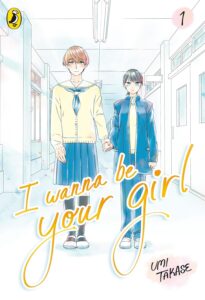
It’s always nice to see a new publisher enter the manga space, especially one whose first title is explicitly LGBT+. I Wanna Be Your Girl ,Volume 1 tells the story of two childhood friends, Hime and Akira. But when Akira comes out as trans before starting high school, headstrong and fiery Hime makes it her life’s mission to protect her best friend from the world. Only the world turns out to be a little more complicated and less black and white than Hime realises.

It’s so nice to read a manga where the teenage characters actually feel like real teenagers, but this one is just a little more personal to me than most. When I was in high school, I had a crush on someone who I thought was a boy, but she told me she was actually a girl. My reaction at that point was “huh, that’s a bit weird but ok” and still kept kissing her. Maybe I should have realised earlier on that I wasn’t straight… But having experienced something similar myself, I can believe Hime when she acts the way she does to try and protect Akira. She’s clearly madly in love with her and will do anything for her, and in a show of entirely well meaning solidarity, shows up to school in the boys’ uniform Akira’s parents bought for her. This however causes a new set of problems (Disclaimer: I am not trans but I am married to a trans woman and have many trans friends) Akira, like most trans people, just wants to get on with her life and not have people make a big deal about the fact she’s trans, and Hime is unintentionally shining a spotlight on her. The classroom erupts into chaos and their rather strict teacher yells at everyone to calm down and be quiet.

It seems though, that there is more to the teacher than first meets the eye. He sits Hime down for a talk one day, and it’s strongly suggested that he’s gone through something similar regarding identity in the past, but by the end of the volume Hime and Akira have even managed to make some friends in their class, and they struggle over which after school club to join together. Just normal teenager things.

I cannot recommend this series enough for queer/questioning/curious teenagers and those around them. I wish something like this had existed when I was this age.

Ratings: 

Story – 7
Art – 6. It’s nothing groundbreaking but it does the job.
Characters – 8
Service – n/a
LGBTQ — 10

Overall – 8 but probably 9 if you’re a confused teenager looking for something to relate to.


It Rhymes With Takei

June 8th, 2025

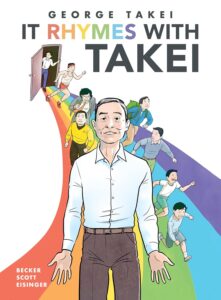
It’s a bit of a stereotype that a seinen manga protagonist has an incredible emotional journey from the beginning of their tale to the end, in classic bildingsroman fashion.  In George Takei’s autobiographical comic It Rhymes With Takei, we are along for an extraordinary journey, made even more extraordinary because it is a real person’s story of experiences he truly lived. For someone who only knows George Takei as an actor, or as an activist, this story takes us to places far more unreal than outer space. by whch I mean American politics.

Takei’s childhood as a Japanese-American citizen put into a “internment camps” by his own government is related in They Called Us Enemy and the musical stage play Allegiance. This book tells the the story of George Takei, the boy who felt different in many ways, and who carved out a career in acting, in politics, in activism and as a viral Internet memelord.

Takei’s story is told simply and plainly, his emotions and thoughts about living a closeted life and the losses he encountered when he finally came out of the closet at 68, as well as the triumphs, are conveyed strongly through the story written by Steven Scott and Justin Eisinger. Harmony Becker’s illustrations are absolutely fantastic. Characters are conveyed without portraiture, but their essences are caught perfectly, and the whole feeling of the moment is expressed with brilliant use of color and design, for a captivating whole. 

As a primer on LGBTQ+ American history  of the 20th century with a California focus, as seen by a man who was working with more than one prejudice against him, this comic is an important chronicle of the progress we’ve made and the work that went into it. 

For Pride Month 2025, I would recommend this book as way to ground ourselves, acknowledge our successes and failures and gird our loins for the next fight, knowing that there have always been good, smart and funny people like George Takei on our side.

Ratings: 

Art – 8
Story – Autobiography is always hard to score, but this is also a very compelling and surprising narrative, 10
LGBTQ+ – 10

Overall – 10

Thanks to Top Shelf Productions for the review copy of this outstanding memoir. You can get It Rhymes With Takei on Bookshop, Amazon and everywhere books are sold.


X-Gender, Volumes 1 & 2 (complete)

May 30th, 2025

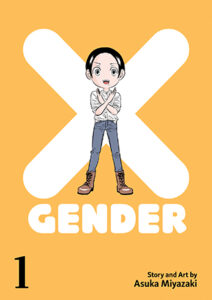
A cartoon of an ungendered human with short dark hair close to their scalp, wearing white shirt, grey pants and brown boots, their arms crossed in front of them in an 'x' mirroring the white 'x' on a yellow background they are in front of.by Eleanor Walker, Staff Writer

Content warning: this series discusses topics including human euthanasia and suicide.

Perhaps inspired by the success of My Lesbian Experience with Loneliness and its sequels, Seven Seas has also published some other queer autobiographical manga, including The Bride Was a Boy and the subject of today’s review, X-Gender (性別X) by Asuka Miyazaki. X-gender is an umbrella term used in Japan to describe various non-binary and genderqueer identities.

This series is most definitely aimed at people who have no knowledge of LGBTQ+ or women’s health, as it was originally serialised under Kodansha’s Young Magazine umbrella, a seinen (aimed at young men) magazine. There’s lots of explanation of basic queer terminology which may seem superfluous for many readers of this site, as well as a chapter explaining periods, but probably needed for the average reader of Young Magazine. I hesitate to compare this directly to My Lesbian Experience with Loneliness, as I don’t really feel it’s fair to compare people’s real life experiences, but there are definitely some parallels to be drawn with the stories. Being queer can often be an incredibly isolating experience, and X-Gender tells the story of Asuka finding a community they can be a part of at local gay bar Poker Face, owned and run by a fantastic trans man known as “The General”, only to then have it ripped away from them by the Covid-19 pandemic.

Whilst volume 1 mostly deals with Asuka’s finding themselves as a newly out X-gender person, there’s a noticeable change in tone in volume 2. Japan and the rest of the world is shutting down due to Covid, and Poker Face, Asuka’s favourite IRL hangout, is closed. I did find this volume rather unfocused compared to volume 1. This is acknowledged by the author though, as they were finding life very difficult during the pandemic and lockdown. The chapters are much shorter, and there’s very little story continuity between them, they’re more like a set of short stories with recurring characters. I don’t like to criticise someone’s real life experiences when used as the basis for a story, but I do think that Asuka is a good visual storyteller, the panels flow nicely and it’s an easy read visually.

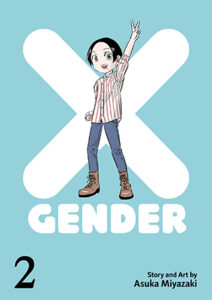
Gender non-specific person with short dark hair, striped button down shirt, grey pants and brown boots in front of a large white 'x' on a light blue background. They hold their left arm up making a 'V is for victory" sign, smiling, while their right arm is help in a fist at their right hip.Overall, I’m happy this series exists and was released in English. It’s a good introduction to non binary identities for those who have absolutely no idea what they are. (I am a cis lesbian with many non-binary friends, and I acknowledge this is not a substitute for actual lived experience.)

Obviously this is only one person’s story and the non-binary experience is vast and variable, but I feel like a lot of readers of this site can relate to the feeling of not belonging in society or not being comfortable in our bodies, as well as the isolation many of us felt during 2020. For the cishet men this was aimed at, I hope it can be an insight into a life that’s very different to your own, but ultimately a reminder that we’re not so different after all.


Ratings:

Art – 7
Story – 6. This one is definitely best read a chapter or two at a time, rather than all in one go, especially volume 2.
Character – 7. The General is by far my favourite.
Service – 7. There are some fairly graphic descriptions of the author’s porn and sex preferences but nothing explicitly illustrated..
LGBT+ – 8

Overall – 7


Ark: The Animated Series Part 1 Review, Streaming on Paramount Plus

May 28th, 2025
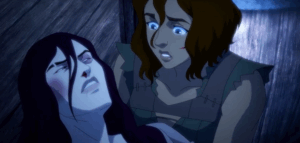
A woman with shoulder-length messy hair looks down at a woman with pale skin, and facial bruises with concern.by Burkely Hermann, Guest Reviewer
Helena Walker is a renowned paleontologist in the 21st century. She suddenly finds herself in the ocean, escapes monsters which try to devour her, and washes ashore on a strange, and vibrant, island, filled with prehistoric plants and animals, going far beyond the dramatic dinosaur breeding theme park in Jurassic Park. Helena has to survive, make new allies, and avoid being killed. This mature sci-fi series is bloody and brutal in some ways, with trauma forced upon on her through death, violence, and spilled blood. At the same time, Ark: The Animated Series is inspiring, with Helena choosing science rather than cruelty. People from a variety of cultures, whether Inuit, Lakota, Chinese, or African-American, fight alongside her for what is right and against the forces of oppression. The latter is primarily led by two White men: power-hungry General Gaius Marcellus Nerva, originally from Ancient Rome, and his right-hand man, a former disgraced and egocentric scientist from the Royal Academy,  Edmund Rockwell. The latter dubs the island “the Ark,” hence the series name. This series is the first animated adaptation of the 2017 video game Ark: Survival Evolved.
Ark: The Animated Series, which originally began streaming on Paramount Plus in March 2024, has more going for it than its star-studded voice cast. The series serves as a bit of an antidote for the current, and terrible, political environment in the U.S. where anything and anyone claimed to promote diversity, inclusion, or equity is under attack. Gareth Coker’s music score is a driving force, seamlessly connecting with the superb animation, voice acting, and writing, which helps the compelling character dynamics and visual storytelling come alive. The voice cast is headed by Aboriginal Australian actress Madeleine Madden as Helena Walker. It also includes Malaysian actress Michelle Yeoh as Chinese warrior-leader Meiyin Li (or Mei Yin Li), part-Lakota actor Zahn McClarnon as Lakota warrior Thunder Comes Charging (or John), Devery Jacobs as Inuit teen Alasie (also John’s adopted daughter), and Jeffrey Wright as Henry Townsend, a Black Revolutionary-War-era spy for the Patriots. Apart from other well-known actors in the voice cast, Aboriginal Australian and Maori actress Deborah Mailman voiced Helena’s mother and Chinese actor Ron Yuan voiced Meiyin’s brother, Han Li.
The voice cast is not the only place there is diversity: showrunner Jay Oliva is of Filipino descent. Actor Devery Jacobs is part Mohawk and queer. Canadian actor Elliot Page is a trans man. Ark: The Animated Series serves as the first voice role (as Victoria) for him since his gender transition, in 2020, and his first-ever major voice role in an animated series. Voice actor Cissy Jones previously voiced Theoda, one of the two moms of Akila Theoris in Cleopatra in Space, and Lilith Clawthorne in The Owl House. One series writer, Kendall Deacon Davis, is a Black man. The other, Marguerite Bennett, is a queer woman known for her depiction of female relationships. She previously said she wants to write queer relationships which are honest, sincere, and real, with “tenderness, loss, joy, motherhood, [and] partnership.” In another interview, she expressed her enjoyment of writing stories about complicated heroines, “body horror, historical fiction[,] and queer romance,” some of which are present in Ark: The Animated Series.
This series is queer from the very beginning. In the first episode, Helena, after she has been isekai’d to the Ark, has flashbacks of her with her wife Victoria. For instance, she centers herself by looking at her at least twice when she is under pressure while making a presentation. Both women are a lovely couple who support one another, with the implication they are about to have sex with one another, as they walk into their bedroom together. Victoria is a humanitarian aid worker who travels to war zones and Helena is an acclaimed paleontologist. Helena wants Victoria to stay with her, rather than putting her life on the line to help others, saying other people can do the work instead. This mentality becomes part of Helena’s arc through the series, as she goes from being a thinker, an intellectual to be precise, to a fighter putting her life on the line to fight oppression.
In a heart-wrenching flashback during the 47-minute first episode, Helena is informed that Victoria is presumed dead. She sees her die and disappear. Due to their deep emotional connection, she becomes depressed, drinking wine to an excess. She ends up overdosing on prescription pills and dies. Perhaps the latter is a trope, but you cannot blame Helena. Her actions go far beyond Rei or Kaoru taking painkillers in Dear Brother. There’s the implication Victoria somehow brings Helena back to life in the Ark. In a social media post about Ark: The Animated Series some years ago, Bennett highlighted the music score for the relationship between Helena and Victoria, saying she was heartened by “queer stories of love, conviction, and survival that persist beyond space and time.” While the latter doesn’t apply to Helena and Victoria directly, it is still a story of survival, justice, conviction, and love.
Helena has no chance to stay depressed, nor does she struggle through her trauma as Korra did in The Legend of KorraInstead, she is thrown into yet another life-threatening situation, after she flees a camp where she is held captive by Nerva, Rockwell, and their soldiers, barely escaping with her life, after they injure her with a spear. This is when Meiyin comes into the picture. She saves Helena from soldiers out to get her and from a sabertooth tiger. They are both drawn to each other. Their connection goes beyond any intimate friendship. It is clearly romantic and sexual. While they fight together as comrades, arachnophobic Meiyin blushes when Helena saves her from a spider, inside its lair. In what echoes scenes from the newest yuri-ish Lara Croft animated series, they uncover secrets about the Ark and find a new fancy weapon, a gun with tremendous power, and blast their away out of the cave. Once outside, they are soon surrounded by warriors led by the aforementioned John, setting the stage for the third episode.
Later episodes bring them even closer. Helena and Meiyin join John in the nearby Indigenous village. Helena quickly becomes friends with the spunky Alasie, a teen who would be at home in the interlinked words of Avatar: The Last Airbender or Korra. She takes a liking to the moniker for Meiyin (Beast Queen) even though she isn’t sure why people name her this (she learns why in the fourth episode when Meiyin rides a dinosaur). Seeing Meiyin’s amazing skills, she can’t help but compare herself, even though Alasie cautions her to not do so. In one scene which hints at their growing feelings, Helena begins sketching in her journal. One page has a dinosaur and another has a portrait of Meiyin. Soon thereafter, Helena and Meiyin fight side-by-side, to liberate a mining camp, even after Helena’s movie-inspired plan fails. Meiyin becomes disappointed when Helena does not kill a messenger who escapes. This is a constant theme Ark: The Animated Series: whether to kill oppressors or let them live. Meiyin favors the former, but Helena supports the latter, as someone who cares about life.
The fifth episode is a bit of a turning point. Meiyin and Helena come from different time periods, the first from the 3rd century and the second from the 21st century. So, it is no surprise they have different ideas for how to fight oppression. Putting aside their back-and-forth banter on this, Meiyin’s command of forces gathering against Nerva and Rockwell is put under question. A man named Henry (noted earlier) says that she is a great warrior, but not a good leader. Despite Henry’s sexist undertone, Helena continues to support her. She reminds her that it is okay to ask for help and treats Meiyin’s wounds.
This is a key moment: Meiyin shows that even though she is a skilled warrior, she has her own weaknesses and vulnerabilities. Before this, she is a bit closed off, with her red-colored armor serving as barrier-of-sorts. Acting as a healer, Helena allows these weaknesses and vulnerabilities to melt away, while she still has her own. She respects Meiyin as a fighter and asks Meiyin to teach her, which surprises her. Meiyin takes her up on it, putting her through tough training. Helena continues to treat Meiyin and they have good times together. They get so close that Helena sleeps on Meiyin’s shoulder. This does not last. Meiyin and Helena realize the village is under attack from enemy forces. Despite a valiant effort, during which General Nerva is injured, Meiyin is captured after she’s shot with a tranquilizer dart by Rockwell. While Helena wants to follow, she takes John’s advice, and decides to fight another day.
The final episode brings Meiyin and Helena closer. Meiyin refuses to answer questions about where Helena is hiding and she is roughed up in the process (i.e. tortured), showing the pain she is willing to endure, even though she incorrectly believes she has nothing. Perhaps she thinks that no one will come to save her. This can’t be further from the truth. Back at their makeshift camp, Helena sings Meiyin’s praises, remains scared for Meiyin and everyone else, and helps put together a plan to save Meiyin. Later on, once Helena gets inside the enemy palace. She discovers something horrifying which shows the sadistic nature of the series villains: Meiyin is tied up on a crucifix, a common Roman punishment aiming to publicly humiliate victims. Meiyin is glad Helena came for her.
As it turns out, it is all a trap set by Nerva. He likely believed, as other Romans did, that lesbianism was a “degenerate Greek perversion…an absurd impossibility” rather than something that should be “accepted as normal.” In contrast, Meiyin is from the time of the Yellow Turban Rebellion, a 21-year peasant revolt during the reign of the Han Dynasty in Ancient Time. During that era, the dynasty’s ten emperors were “openly bisexual.” As such, she likely knew what a lesbian was, even if she had never had romantic feelings for another woman before Helena, or had never heard the term “lesbian” in her life (the term isn’t used by any character in the series). In the video game that Ark: The Animated Series is based on, Meiyin later has girlfriend named Diana Altreas.
His plan soon falls apart: John saves the day, setting off explosions, allowing them to escape with help of Henry and others. John’s sacrifice, in a violent death, after he kills the favorite T-Rex of General Nerva, is in vain. Rockwell’s hand is chopped off and the palace is ablaze. While the series villains had hoped to exploit Helena’s love for Meiyin, instead their actions allowed the love between them to blossom. While riding a parasaurolophus, named Scary, Helena and Meiyin realize their feelings for one another. They look each other in the eyes and kiss, while tears stream down Helena’s face, reciprocating their love.

Ratings:

Art: 9
Story: 9
Characters: 8
Service: 3 or 4, the main outfit Helena wears on the Ark can be a bit revealing and the same can be said for some outfits Victoria wears, or when Helena is treating Meiyin
Yuri: 7 or 8, since there are kisses, sexual innuendos, and implied sex between Helena and Victoria in a flashback
Traumatic situations: 10, as this series can be very bloody at times, with people dying, getting stabbed, shot with arrows, or trampled, plus substance abuse, torture, discrimination, and the like
Music: 7

Overall: 9

The next part of Ark: The Animated Series, set to come later this year, promises to be even more queer. If the preview at the end of sixth episode, is any indication, viewers will see Helena’s first meeting with Victoria, Meiyin getting new armor, Meiyin praising Helena for saving her, Meiyin and Helena training and having good times together, and Helena having short hair. The latter is common across queer media, whether Sage in High Guardian Spice, Korra in Legend of Korra, Vi in Arcane, Amaya in The Dragon Prince, Rei Asaka in Dear Brother, Kase in Kase-san and the Morning Glories, Lynn Lambretta in Bodacious Space Pirates, Haruka Tenoh in Sailor Moon, Catra in She-Ra and the Princesses of Power, Ruby in Steven Universe, or Rei Hasekura in Marimite, to give some examples. I am curious to see what else will happen in the second part of Ark: The Animated Series, and hope it continues in the future.

Burkely Hermann is a writer, researcher, and former metadata librarian. His reviews can be read on Pop Culture Maniacs or his personal WordPress blog. He can be followed on Instagram, Bluesky, or on Mastadon communities such as library.love, glammr.us, genealysis.social, and historians.social.

Motherlover

May 11th, 2025

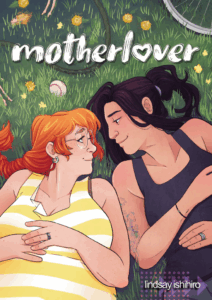
Two women lie in the grass looking deeply into each other's eyes. One is a heavy-set white woman, with bright orange hair tied in a braid wearing glasses and a yellow-and-white striped tank top. The other woman is Asian with black hair, tied back in a high pony tail, wears a dark gray tank top, and has tattoos on her right arm.By Matt Marcus, Staff Writer

Where would we be without our mothers? As a parent myself, I’ve felt starved for stories about parenthood within the world of Yuri media. In fact, a large amount of Yuri centers on characters that explicitly reject the notion of having children and raising a family, and not without good reason. That’s valid and I support it. But it leaves out a few avenues for telling new stories, which is why I was excited to discover the topic of today’s review.

Motherlover is a spinoff comic (launched on Mother’s Day, of course) centered on two random characters from Lindsay Ishihiro’s long-running autobiographical comic How Baby. After creating them, she felt compelled to give them their own story. The first leading lady, Imogen, is a quintessential Midwestern homemaker, managing a household of four kids; her counterpart is Alex, a Cool Artsy Queer mom who has moved back into her parents’ house after their recent deaths.

Both leads are well-rounded characters. Imogen became a mother at 19 and flunked out of college before meeting her current husband. Her inexhaustible capacity to care for her children is only matched by her insecurity about her limited life experience. Alex, meanwhile, pushes away people who love her as a result of the emotional abuse she suffered from her extremely strict parents.

The core of the story is the dynamic between Imogen and Alex. Their friendship feels lived-in and believable, which further sells you on their compatibility as their feelings for each other deepen. You could even say that they are a bit too accepting at times; even when one is venting ugly honest feelings, the other never takes offense. It’s as if they are committed to each other before they are committed to each other. There is no moment of doubt that their connection will break, which makes for a breezy read even when the topics get heavy.

Putting my Serious Critic hat on, I would say I wish the children had more space to be characters. For instance, how did Alex’s daughter Nolan feel about her mother’s previous partner? How does her feelings parallel Imogen’s kids feelings about their parent’s divorce? The only one of the five children who is given any spotlight is Imogen’s oldest, but their arc is so siloed from the core of the story that it could have been cut without affecting the plot at all. I’ve read enough of How Baby to know that Ishihiro knows how to talk about motherhood in a raw, vulnerable, and hilarious way, but not much of that transferred over to this story.

I also find myself wishing that the issues around Imogen’s marriage didn’t boil down to cheating. I thought Ishihiro did a great job sketching Imogen’s husband as a man who is controlling and withholding, but not in a domineering manner. The way he perpetuates Imogen’s insecurity by shooting down her ideas of going back to school is compellingly insidious; it felt so strong to me that I found myself disappointed when the breaking point of their marriage turned out to be infidelity. It’s believable, but a bit expedient.

One thing that occurred to me is that this is a queer love story where very little of the challenges center on queerness: Imogen never struggles with her gay awakening, Alex doesn’t encounter hostility from the community for being loudly out, a young character comes out as trans and basically no one bats an eye. It represents a kinder world than the one we live in, and I’m sure many readers will love that part of it. (Yes, there is some queerphobia represented in the text, but it’s treated with a light touch.) My feeling is that, in a story where being a parent is the premise, I would have liked to see it tackle what it means to be a parent who is queer, AND what it means to be the parent of a queer child (though I felt the coming out scene was well-handled). To be clear, all of these critiques are quibbles for what is an easily enjoyable story.

While the comic is complete and free to read online, I was unaware of it until seeing an announcement of a physical release from Iron Circus Comics. It’s a lovely softcover book with glossy hearts embossed on top of the matte finish of the cover. The art and paneling is solid and translated well to the printed page. Also, I was pleased to see Abby Lehrke in the credits as a proofreader, given her involvement with A Certain Manga Series Set In College that I am fond of.

If you are looking for the perfect sapphic comic for Mothers’ Day, this would be one to pick up, but I’d say it can be enjoyed and celebrated on the other 364 days of the year as well, just like your mother. (And would it kill you to call every once in a while?)

Art – 8 Solid and clean
Story – 8 Tightly paced; could have been expanded but would have required a longer page count
Characters – 9 Everyone is well written, though some characters could have had more to do
Service – 1 Domestic snuggles is as spicy as as it gets
LGBTQ – 10 70% of the named characters are queer, so it gets high marks

Overall – 9 The best Mom-meets-Mom story on the market

Yes, Ishihiro is aware of the SNL skit of the same name; it’s mentioned on the comic’s About page.

Matt Marcus is a cohost of various projects on the Pitch Drop Podcast Network, as well as the writer for the blog Oh My God, They Were Bandmates analyzing How Do We Relationship in greater depth.