Archive for the LGBTQ Category


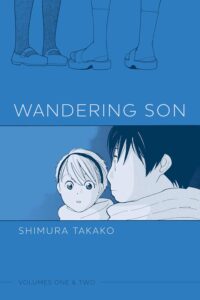
Wandering Son: Volumes One & Two

August 23rd, 2026

Reading an older manga can be very edifying. Re-reading an older manga even moreso.

I have written at length in many places here on Okazu and elsewhere about my conflicting feelings about Shimura Takako’s work. But as I re–re-read Wandering Son, which I initially started in Japanese and of which I reviewed a number of volumes in English, before the series was discontinued. I was, and am convinced that bringing it out in hardcover was a terrific idea, but no grounded in good business sense.

Now Fantagraphics is taking a second stab at bringing out this series. With much more staid covers, these are two-volume omnibuses, something that helps the story flow a lot better. This will become important in later volumes, as the plot slows and change also slows.

But here in Wandering Son, Volume One and Two, we meet Shu, a trans kid who AMAB is very strongly contemplating the idea that they are a girl. We also meet Yoshino, AFAB, who wants to be a man. I say it that way, very carefully, because issues of gender and gender presentation in this book is complicated… and maybe not what you as a reader might be looking for.

In part, this is due to Shimura who, for many years has been writing queer stories. I don’t object to her doing so, but she has said that she is not herself queer. And to be clear I don’t mind that, either! If it’s working and people find joy in it, that’s great. I love her art, and I have enjoyed watching her story-telling grow and change. So what is my pain point? I am conflicted at Shimura mining queer trauma for content. It makes me feel… icky. In this older series, her story-telling is not so skilled and there will be pacing issues, but also some choices that will sit uncomfortably.

All this to say that, while I absolutely think Wandering Son is worth reading it, like Sweet Blue Flowers may not have aged well. The last twenty years we have seen tremendous change in the way we approach gender and sexuality. There is so much more nuance now, leading me to think that, if Yoshino and Shu had met genderfluid or nonbinary people as well as trans people, their choices might have been less along a binary and more somewhere in the middle. I know if someone had to me at 11 or 12 that non-binary was an option, I know I would have leapt for that.

Ratings:

Art – 7
Story – 8
Characters – 9
Yuri – 0

Overall – 8

Thanks so much to Fantagraphics for the review copy, and I really look forward to reading this series again!


With My Own Hand: The Secret Life of Marie Maitland

August 20th, 2026

by Eleanor Walker, Okazu Staff Writer.

Erica is away, so the staff get to play and I’d like to introduce you all to the story of Marie Maitland, Scotland’s 16th century Sappho.

A woman in a 16th century dress holding a quill in one hand and a red notebook in the other

I first learned of Marie a few years ago when I discovered that the National Portrait Gallery of Scotland in Edinburgh was displaying an imagined portrait of her, commisioned by historian and translator Ashley Douglas. Ashley discovered Marie’s lesbian love poetry hidden in the depths of a manuscript long attributed to her father, known as “The Maitland Quarto.” This manuscript is a collection of poetry published in the Scots language (N.B. Scots is a related but separate language from Scottish English, the dialect of English spoken here in Scotland. Both English and Scots are West Germanic languages, unlike Gaelic which is in a completely separate family and very different to both English and Scots. It’s most closely related to Irish and Manx, and then more distantly to Welsh, Cornish and Breton.) Scholars have debated over the years who actually authored the poems in the manuscript, with Marie generally considered to be the scribe for the majority of the manuscript. It wasn’t till much later that Marie’s potential authorship was examined, although one scholar who published many of the poems in 1786 suggested that Marie had at least some involvement in writing the poems, not just transcribing them. Naturally of course other male scholars disputed that a woman could possibly have actually written any of the poems.

Scotland in the 16th century was not a kind place for women of any social class. This is the time of the Protestant Reformation, spearheaded by John Knox, the author of the magnificently titled and utterly misogynistic, even for the era, screed “The First Blast of The Trumpet Against The Monstrous Regiment of Women.” If you were lucky enough to make it out of childhood alive, your best hope if you were middle to upper class was to be married off to a man who would treat you even a little kindly. After that, your job was to get pregnant and produce a male heir. This is the destiny which awaited Marie Maitland too, until fate intervened. The youngest of her sisters, she watched her sisters be married off one by one and no doubt had consigned herself to the same fate, until her father went blind and required a scribe. This afforded Marie a degree of independence and self sufficiency almost unheard of for women in this era, and allowed her to pen her remarkable poetry. Poem 49 in particular was almost certainly written by Marie, and reads as follows (Original Scots language followed by English translation):

And thoucht adversitie ws vex
Yit be our freindschip salbe sein
Thair is mair constancie in our sex
Than evir amang men hes bein

And though adversity us vex
Yet by our freindship shall be seen
There is more constancy in our sex
Than ever among men has been
.

If that’s not written from a lesbian point of view, I don’t know what is.

A pair of hands holding a quill and a red book in front of a woman's chest. The woman is wearing a 16th century dress.

Fast forward to summer 2026, and Ashley’s book is finally available. It’s been one of my most anticipated books of the year and I’m delighted to say that it was as enjoyable as I hoped it would be. Ashley herself is a lesbian and in my opinion, the perfect person to bring this tale to a 21st century audience. Queer people and queer love have always existed, and Marie’s story is a remarkable one of resilience and trying to fit into a world which was not made for her in the slightest. Earlier in the 21st century, Scotland was the first country in the world to introduce an LGBT+ inclusive school curriculum, which includes Marie and other queer figures from Scotland’s history. Her life is an important part of our history, and I’m very pleased that I’m now able to share her story with Okazu readers all around the world. You can order your own copy of “With My Own Hand” from bookshop.org

The only known copy of the Maitland Quarto is in the Samuel Pepys collection at the University of Cambridge. I’d love to see it come home to Scotland one day.

Online sources:

https://www.nationalgalleries.org/art-and-artists/features/marie-maitland-scotlands-16th-century-sappho

https://en.wikipedia.org/wiki/Marie_Maitland


Manga Mavericks Licenses Queer Manga Classic Sword of Paros

July 3rd, 2026

Last night at Anime Expo, Manga Mavericks Book announced the license for Sword of Paros, written by Kaoru Kurimoto with art by Yumiko Igarashi! /flailing hands/

This is being sold as a complete series in a deluxe print hardcover volume, with the most gorgeous design, including sprayed edges featuring the Sword of Paros itself. Dan Luffey is translator, I am editing, Jeanthrix Andres is doing the lettering and Darren Vogt is the designer. When I tell you that this will be *amazing* I am not using hyperbole. 

Here is the official synopsis:

The legends that speak of the Sword of Paros say that it can bestow either prosperity or ruin on its kingdom…depending on the heart of its wielder.

The kingdom’s current princess, the beautiful yet resentful Elminia, laments being treated as a soulless tool simply for being born in a woman’s body.

Accompanied by Count Yulias, Elminia rides as far away from the kingdom’s politics as possible. One day, Elminia meets a beautiful young girl named Fiona, and their lives and the kingdom are changed forever.

My 2004 review of this series missed a key point: Elminia (I favored ‘r’ over ‘l’ in my initial review)  is a trans masc or nonbinary character. Despite being told they have “two hearts” like Sapphire, Elminia is clear about not belonging in a woman’s body. I interpreted this in 2004 as Elminia being a masculine lesbian (as I interpreted Elminia’s desires through a lens of my own.) This book was written in 1986, and so the issue of Elminia’s gender could be the topic of respectful discussion, as Kurimoto was drawing on the “Girl Prince” archetype and playing with the idea of expected gender role vs gender presentation/gender identity. In a world where women are tools and men are free, the options are clear.  In our world, there is more nuance. I look forward to your thoughts.

I’m delighted to introduce this amazing, emotional, action-packed and incredibly beautiful queer manga Sword of Paros to the world!  Pre-order it today on the Manga Mavericks Store!  Direct orders are only for North America and UK. If you live outside US/CA/UK, keep your eyes on your local Amazon or check with your usual bookstore when the book is released.


Horon of the Closed Country, Volume 1

June 12th, 2026

On a background of sepia clouds, a woman in brown outer rode, with gold embroidery at the cuffs, holds a thin double=bladed sword in her right hand, while clutching a child in her left, as the wind blows her hair.Today I am indulging in a little self-interest. I am Managing Editor for Manga Mavericks and I am the editor for the book I’m talking about today. So of course I’m going to tell you that I love it and you should get it. ^_^ Horon of the Closed Country, Volume 1 by Sen, published by Manga Mavericks, is my pride and joy.

But seriously, if you are a reader here on Okazu, you should get this book. ^_^

The story begins with a fairy tale that goes very, very wrong. The story is beautiful; haunting and human.

The eponymous character, Horon, is ungendered, another of the main cast, Kera, is non-binary and the third of our protagonists is Darshna, a woman who, in the Closed Country is uncommonly tall and strong. Their stories will weave into and through one another’s, until it becomes obvious that this journey is meant for all three. This is a fantastic book to pick up for Pride.

The translation by Trish Ledoux is fantastic. Mercedes McGarry did a brilliant job as letterer. It may look simple, but believe me, it was not. As an editor I love this book, truly. Sen-sensei’s art and characters feel so real.

Luckily, you don’t have to just trust me, Rebecca Silverman gave the book 4 stars in her review for the ANN Spring Manga Guide: “There’s a lot of intrigue here, wrapped up in a gentle pace and simple, beautiful art.”

It’s not an action series, but it does have some action. It is not a romance, but… and this is not just a quest, although these three are looking for things of importance to them. I hope Okazu readers will give this book a chance! 

My ratings this time would be hopeless skewed by being in love with this series. 10s all around. ^_^


Ayaka is in Love with Hiroko!, Volume 2

May 11th, 2026

A blonde woman in pink, whispers into the ear of a woman in a grey suits and white button down shirt, who is visibly cringing with embarrassment, under the words Ayaka is in Love with Hiroko (echoed)In Volume 1, we were thrown into a torrent of emotion as beloved and competent office sempai Hiroko, has a passionate, if awkward, junior, Ayaka, who is doing everything she can to catch Hiroko’s eye. 

When Ayaka finally just tells Hiroko how she feels…Hiroko rejects her. As Ayaka grieves, her best friend Risa asks if Ayaka couldn’t find a way to going out with her. But, no, Ayaka is not able to give Risa what she wants. Everyone is unhappy. 

And then something important happens. The ladies at the lesbian bar unpack Hiroko’s baggage.. They explain to Risa and Ayaka just how much different things were 15 years ago and how being out carries a lot of weight for an older generation of lesbians. This is a crucially important bit of storytelling. Hiroko has her own personal heartbreak and the consequences that she’s been carrying, but also a lifetime of society forcibly rejecting queer people. Not like the conservative extinction burst attacks we’re seeing now, but the full confidence of a majority of society being queerphobic. Hiroko’s beloved sempai, a woman she admired and loved, took the fall for her and she cannot let that go lightly.

I love that this has to be explained…how genuinely wonderful for younger queer folks who rightfully see transphobia and homophobia as the problem, rather than themselves. But it does have to be explained, because while that kind of queerphobia still does exist-  people are still regularly thrown out of homes, lose jobs, access to family, children, housing, – it is nowhere as common as it once was. So for folks who have not experienced it, here is an example.

And, having learned the whole truth, Ayaka, Risa, and Hiroko are ready to move on. No, wait, Risa and Hiroko are, but Ayaka has other ideas. She’s still convinced that Hiroko just need convincing. In Ayaka fashion, that means she’ll choose the wackiest way to go about it.

Ratings:

Art – 8
Story – 8
Characters – 10
Service – 6 When Ayaka stops dressing for attention, it’s actually pretty funny
Yuri – 7
Lesbian – 9

Overall – 8

This volume manages to be funny and poignant with Sal Jiang’s fabulous reaction expression art. A good read, a fun read, and a read that I hope in 15 years will make almost no sense at all to the next generation of queer youth, who will be befuddled by anyone who doesn’t just automatically acknowledge their right to exist.