Archive for the LGBTQ Category


Yuri Visual Novel Studio Élan: Creating Queer Arts for Years to Come

May 6th, 2026
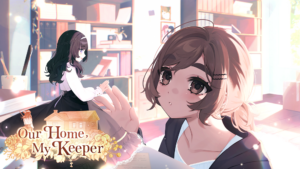
Title image of “Our Home, My Keeper”, Studio Élan’s latest yuri visual novel, released on April 30, 2026. Image by Studio Élan. Two women stand in a library or study, one close to us with brown hair pulled back in a ponytail, another diminutive figure on a shelf a white blouse and long black skirt, with long dark hair pulled back by an Alice band

Title image of “Our Home, My Keeper”, Studio Élan’s latest yuri visual novel, released on April 30, 2026. Image by Studio Élan.

by Lena Tama, Guest Reviewer

In 2019, Erica had the pleasure of interviewing Studio Élan, one of the pioneers of western yuri fantasy visual novel (VN) developers in the industry, for Okazu. Seven years have passed since then and the studio continues to publish VNs by queer people for queer people, despite the ever-increasingly hostile internet environment for both the audiences and the studio.

Before the creation of Studio Élan, a studio called Alienworks released Highway Blossoms in 2016, which was well-received among fans and players worldwide. From there, a number of people from Alienworks, including Josh Kaplan, founded Studio Élan and marked its debut with the release of Heart of the Woods, a dark fantasy yuri VN. 

Since then, many more VNs have come out under Studio Élan’s name, which cover multiple subgenres and explore a wide range of gender & sexual identities. In addition, Highway Blossoms also became an official part of their catalog in 2019 and received a major story expansion titled Next Exit in 2020.

In 2026, Studio Élan is publishing three new and distinct VNs:

  1. Our Home, My Keeper. Released on April 30 in collaboration with another VN developer ebi-hime, it tells the story of a struggling novelist who purchases a new home in the English countryside, only to find it already inhabited by a fairy, who occupies a doll for her body.
  2. My VTuber Rival is Actually Cute? Planned for release in summer, this is a shorter and more experimental VN about a VTuber protagonist whose character design is customizable by players.
  3. Summer at the Edge of the Universe, a solarpunk adventure story planned for release by the end of 2026. A playable demo is available to download for free.


The importance of women and LGBTQI+ people in VN development

The diverse subgenres and exploration of gender & sexual diversity among their VNs is supported by the involvement of women and LGBTQI+ people, both within Studio Élan as well as their partner collaborators. Josh Kaplan stated that the majority of people working on their projects fall into those categories and have some creative influences and opinions over those games.

“It is always rewarding when someone mentions how seen they felt or represented by one of our games or characters,” said Josh

As such, a number of their VNs also feature LGBTQI+ characters and plot points, whether canonically in the games or through supplementary materials, which resonate with a lot of queer people, including the community on Discord that the studio has built over the years. Some of those characters include Tara from Heart of the Woods who identifies herself as a trans woman in the game, Olive from Twofold who is canonically non-binary, and Aspen from Please Be Happy who is asexual based on supplementary materials.

Among those people involved with Studio Élan is adirosa, who initially joined the studio in late 2017 as a graphic designer. Since then, she became more involved in the majority of the studio’s works in multiple roles, with Please Be Happy being her first major project as its Director.

Reflecting on her works so far, adirosa said, “I have always felt valued and heard at Studio Élan.”


Working against the increasingly hostile internet environment

Despite the progress over the years, not everything is sugar and rainbows. In the current year of 2026, the internet has grown ever-increasingly hostile due to global politics, increasing misogyny and hatred towards LGBTQI+ people, particularly lesbians and trans/non-binary/other gender identities, and rampant usage of generative AI (genAI) technology.

As a result, Studio Élan has become exceptionally prone to receiving hate speech and review-bombing, whether on their social media or game store platforms such as Steam or GOG. In addition, genAI technology puts them at risk of getting their arts, such as the artwork and voices, stolen and abused.

Furthermore, the people working on the VNs are also facing an increasing risk of experiencing harassment both on the internet and in real life.

“I’m seeing my friends torn down in modern society and their works disrespected and undervalued. It’s incredibly difficult and heartbreaking, and there’s really no easy answer to this,” adirosa commented.

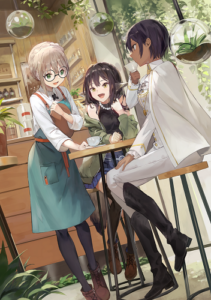
Key visual for “Please Be Happy”, from Studio Élan. Three woman at a hightop table. One woman with medium brown skin, black collar length hair in white , wearing black boots to the knee, a young-looking girl with animal ears and brown hair. Standing next to them a pale-skinned woman with blonde hair, wearing glasses and a teal apron (over her?) dress.

“Please Be Happy”, a yuri visual novel by Studio Élan. Characters from left to right: Aspen (left), Miho (middle), and Juliet (right). Image by Studio Élan.

In spite of those setbacks, Studio Élan remains optimistic. For starters, they are committed to upholding their integrity without utilizing genAI technology. Josh explained, “We are wholly against genAI for art, writing, voice-acting, or anything else. Our work process hasn’t changed, in that regard.”

“I’m confident that people will continue to seek out and value human-made art and stories, and that our games will continue to find an audience with whom they resonate,” he continued.

Even further, in the face of hatred and bigotry towards LGBTQI+ people in current times, Studio Élan also remains committed to creating more stories and games by queer people for queer people.

“Right now, it’s more important than ever for both creators and fans to support LGBTQI+ art, not just for us but also for all of the many creators who continue making and sharing things despite the pressure to stop. Even if we have to sell them off handmailed USB drives,” said Josh.


Moving forward alongside the community

Studio Élan continues to produce and publish yuri VNs and will continue to do so for many years to come, all while fostering a community which stands tall as a safe space for women and LGBTQI+ people. The people working behind the scenes are also hopeful that they’d be able to create more exciting VNs that resonate with a lot of people.

adirosa stated, “I plan to release more games in the future, and I hope that they will be able to make people a little bit happier and maybe make the world a bit of a better place.”

Meanwhile, Josh is optimistic that the studio will create new and exciting VNs in the future, all thanks to the support of the community.

He said, “We are super grateful for the community and audience that we have, whether they’re newcomers or long-term fans on Discord whose name I see every day from before we even released our first game. I hope that we’ll continue to earn our support.”

“I also consider myself incredibly fortunate to be able to keep making games alongside some of my favorite people and to still have fun doing it. Here’s to many more years of that.”

=====

This article is written by Lena Tama, a contributor and queer journalist from Indonesia. She loves all things yuri and will bake cookies & sweets for you!


Koharu and Minato: Happy Life with My Girlfriend, Volume 1

April 20th, 2026

Two women smile at one another holding tapioca teas. One is taller with collar-length black hair that fades into lavender, wearing a fashionable black suit and accessories. The other is shorter, with long light brown hair, casually dressed in a green tee and jeans with her arm around the other woman's waist.Koharu and Minato: Happy Life with My Girlfriend, Volume 1 is a fictionalized version of the lives of two very real women, a team that go by the names Daruma and Hyaluron. This retelling of how they met, fell in love and moved in together, is the first collected volume of an ongoing serialization in Comic Yuri Hime magazine. 

Overall, this is a very cute and sweet slice-of-life story. There are no great (and very few small) conflicts in this tale. Despite that – or, maybe perhaps because of it – I think this is a really important story. Over the years, Comic Yuri Hime has had a few serialized manga featuring lesbian characters, (thank you Morishima Akiko-sensei, inori.-sensei), occasionally living together (thank you Inui Ayu-sensei!) but it’s not a magazine that tends to wave rainbow flags, or display Pride stickers. Manga in the magazine often include lesbian content without explicit or implicit lesbian identity. 

I don’t mean this as a dig against the magazine at all. Sometimes, it’s just not relevant to the story or the setting. Sometimes it might complicate the issue. I do actually like when characters take note of their sexuality in real-world(ish) manga. I am very happy to see a comic essay about a happy lesbian couple running in the only monthly Yuri manga magazine. Even if, in this volume “lesbian” life in Japan isn’t the main focus.
 
Koharu and Minato meet online, then in person, then start dating and fall for each other. Now they live together and despite small disagreements, are living very happily in love. This volume is full of a lot of lovey-dovey moments as the relationship builds.  The art is quite cute, without being overly moe.  In this volume they do not talk very much aboutpolitical issues regarding Japanese same-sex couples.  Here, it is all very charming and low-key. And lesbian. I’m happy with that.


Ratings:

Art – 8
Story – 7
Characters  – As I said in my review of the JP volume, “it’s never not weird to score a person’s perspective on themselves. They both seem very nice. 8”
Service – 0
Yuri – 10 

Overall – 8


Volume 1 just came out this week from Seven Seas! Volume 2 will be out in English this summer. And thank you to Seven Seas for providing the review copy for ANN, where I reviewed this for their Spring Manga Guide.


I Wanna Be Your Girl, Volume 3

March 11th, 2026

Two people in Japanese style school uniforms, one in boy's uniform, one in girl's uniform, their head on their knees, sit on a school stairway.by Eleanor Walker, Okazu Staff Writer

We have now reached the penultimate volume of Umi Takase’s I Wanna Be Your Girl, and having also reviewed volumes 1 and 2 here on Okazu, this one is definitely the weakest of the three. One thing this series continues to excel at though, is portraying teenagers realistically. Hime is still headstrong in her convictions and her determination to protect Akira. Akira, meanwhile, just wants to be treated like one of the girls and be noticed by the senpai she has a crush on. At the end of volume 2, we start to delve into another character’s back story. Hamuro is another student who has a secret of his own. He cross dresses as a maid while working at a cafe near the school, and it’s revealed that he’s not trans like Akira but cross dresses to support his younger sister Momo who was bullied for being too cute.

I don’t really feel Hamuro adds very much to the story, and the whole starting cross dressing because your sister was bullied just seems a little too out there, especially for a seemingly cishet teenage boy. Fortunately, it’s not a big part of this volume. What we get after Hamuro though is something I’ve hoped would happen since volume 1, and that is Sasaki-sensei’s backstory. I mentioned in my review of that volume that “It seems though, that there is more to the teacher than first meets the eye. He sits Hime down for a talk one day, and it’s strongly suggested that he’s gone through something similar regarding identity in the past” He now reveals in a conversation with Akira that he is aromantic, and how he has suffered from not meeting society’s expectations too. I’m glad we got this segment, especially since in the afterword the author mentions that he was only supposed to appear briefly in chapter 2.

The rest of the volume is just more of what we’ve already seen before, Hime and Akira continue to misunderstand each other, side characters are used as sounding boards for the main characters to talk about their feelings and we’re not really any further forward with their relationship either.

I Wanna Be Your Girl is still an enjoyable series and I’m very glad it exists, but nothing new really happens in this volume, especially when compared to the previous two. I’m optimistic though that everyone will get their happy endings in the next and last volume, and I’ll be reading it to find out.

Ratings: 

Story – 6. This would be a point lower if we didn’t get Sasaki-sensei’s backstory.
Art – 6.
Characters – 7 Hamuro and his sister are unnecessary.
Service – n/a
LGBTQ — 10

Overall – 7 but again, probably an 8 if you’re a confused/closeted queer teenager looking for something to relate to.


Star Sword Nemesis

February 13th, 2026

Title art for Star Sword Nemesis. On the left a girl in a jersey jacket and short skirt floats upside down, holding an enormous sword. An older woman, with white streaks in black hair looks askance. On the right a series of concentric circles, with a round blou dot on the other circle and he title of the game.by Ashley Payne, Okazu Staff Writer

Star Sword Nemesis, a new novella from Christine Love, wears its robot anime influences on its supremely fashionable sleeves. You might think that a novel where on the ninth page someone puts up a slide that consists solely of the sentence: “GIANT ROBOTS MAKE YOU STUPID.” would be more of a subversion but no, this story is doing what I have been asking for: make a robot story for the lesbians.

Our heroine Eris is struck with a profoundly relatable problem. Her instructor Halley is so cool and competent Eris’s crush on her is making it hard to focus on their lessons on wielding Star Sword Nemesis. Having a crush on Halley is a profoundly foolish idea, not just because Halley is Eris’ instructor, as Halley was an enemy combatant until a few months ago.

This results in the irresistible force of “I can fix her” meeting the immovable object of “This is the real world kid”. What is truly impressive is that it chooses very different points of tension than you might be expecting if you were familiar with kissing books. It has great fun indulging in the expected peaks of confession and heartbreak and then pushing past them with a refreshing resolution that spins the story forward. The momentum really shifts up at the halfway point, becoming almost impossible to put down.

While the core of the story is Eris rushing headlong into what appears to be obvious betrayal, it is entwined with some of the most impressive sci-fi world building I have had the pleasure to read in a while. We learn about the semi-untopian society of the Trans-Neptunians both directly, with Eris talking with her friends and in the moments when Eris and Halley miss-communicate. It really reminded me of the brief moments in an Ian M. Banks Culture novel. Only here the Trans-Neptunians are not an idealised, post scarcity society, but a small collective holding on to their ideals in the face of direct hostility from the Earth Sphere.

Star Sword Nemesis is only one hundred and fifty-eight pages but it is broken up with wonderful art from Max Schwartz, who illiterates key events light novel style. Only we get more art per page in Star Sword Nemesis in delightful colour too. Frankly, comparing Star Sword Nemesis to a fun light novel is the ideal comparison. It is short, straightforward, has a powerful sense of its world and characters and has a denouement better than most novels.

Ratings:

Art: 10
Story: 7
Characters: 8
Service: 10
Yuri: 10
LGBTQ+: 10

Overall: 9

I know for most of the people who read this blog Star Sword Nemesis is barely an afternoon’s reading and it is well worth one afternoon.


Lesbian Space Princess

January 14th, 2026

Screencap from Lesbian Space Pirate, with humanoid and alien girls kissing under the light of an alien star in a purple sky. The alien girl has white skin, and aquamarine hair, the human girl has medium-brown skin and dark long hair. by Burkely Hermann, Guest Reviewer

In this 87-minute mature sci-fi fantasy film, with space opera, comedic, and romantic elements, an introverted princess, Saira (voiced by Shabana Azeez), goes out of her comfort zone of safety and shelter. She leaves her home planet of Clitopolis and travels outside the confines of protected Gay Space so she can save a woman that means everything to her.

This Australian film, Lesbian Space Princess, is more than a fun ride, that can be comedic and heartfelt at times, involving Saira confronting her anxieties. At first, I was drawn toward this film through the media that influenced it. On social media, it was noted that the film was directly inspired by six animated films and three live-action films. This includes Steven Universe: The Movie and Revolutionary Girl Utena: The Movie(otherwise known as Adolescence of Utena). The film’s directors, Emma Hough Hobbs and Leela Varghese, praised the first film for its emotional truths and space lesbians (Garnet and Pearl for one). They said that the second is a “great reference” for queer anime that hits hard emotionally, while “not taking itself too seriously, and…[is] really clever with its budget.”

They further listed the film Blue is the Warmest Colour, which is briefly referenced in the film, and an adaption of a comic by Jul Maroh, as an inspiration. In their view, although that film does not have the best lesbian representation, it has remained influential to many queer people. They note that Lesbian Space Princess is, in contrast, “a more authentic and positive take on queer culture.” Although the Steven Universe film is only a few years away from being eligible for the National Film Registry (it will be eligible starting in 2029), it remains a cultural touchstone in many ways, not just for fans, but for queer representation as a whole.

In a Q&A with Hobbs and Varghese, they further described the film’s world, and character design, as influenced by Sailor Moon, Utena, Invader Zim, and Adventure Time, adding that “LGBTQIA+ flag colour schemes” are shown throughout the film. Both directors stated that they were inspired by French lesbian filmmaker Céline Sciamma, Canadian screenwriter Emma Seligman, and gay Korean-American screenwriter Andrew Ahn. Sciamma is known for, among other works, her acclaimed and majestic historical drama film, in 2019, entitled Portrait of a Lady on Fire (Portrait de la jeune fille en feu). Seligman is a queer filmmaker known most recently for the satirical black comedy, Bottoms. Ahn, on the other hand, had his directorial feature debut with a crowdfunded film, Spa Night, set in Los Angeles’s Koreatown, about a closeted, gay, and Korean-American teenager named David.

The queer themes start from the get-go. The film begins with Saira’s scrapbook for her girlfriend, Kiki (voiced by Bernie Van Tiel), who have only been together for two weeks. She notes her struggle with getting attention since people are obsessed with her two moms, Queens Leanne and Anne, voiced by Jordan Raskopoulos and Madeleine Sami respectfully. These queens are the rulers of the lesbian planet of Clitopolis. The on-the-nose name makes me think of C.L.I.T. (Center for Lesbian Information & Technology), a collective lesbian archive in the 1996 classic queer film, The Watermelon Woman. Saira is determined to not be single, even though she is scared to go anywhere, or do anything, while Kiki is an adventuring bounty hunter. Her girlfriend cannot take this anymore, not liking how clingy she is and for openly expressing her emotions (mainly through crying and apologizing), while admitting that Saira is “good with her hands” in bed.

Kiki leaves despite Saira’s pleas. It turns out that this is happening on an open stage that anyone can observe. It’s part of her parents’ birthday celebration for her, parents who forget how old she is. Saira is the lesbian space princess in the film’s title. The crowd and her parents pressure her to summon her labrys, a lesbian feminist symbol referring to self-sufficiency and strength, the same symbol which Marceline’s ax bass likely resembled in Adventure Time. However, when Saira is unable to summon the labrys, everyone declares that she is useless and worthless, including her own parents.

Following this disastrous celebration, the film’s main conflict begins. While Saira is feeling sorry for herself, falling into despair, her now-ex-girlfriend, Kiki, is kidnapped by a group of three beings, Known as the Straight White Malians, and voiced by Mark Bonanno, Zachary Ruane, and Broden Kelly respectfully, they kill the three women she is having sex with. These beings have been ostracized in the galaxy. They have one goal: to have her as bait so they can use Saira’s royal labrys to draw in women to their “chick magnet.” These characters are not only the film’s villains but are supposed to resemble boring and awful straight White men, particularly male podcasters. Although the film could have been written differently without them, their presence drives forward the story.

Due to their threat, Saira is forced to rescue Kiki. She leaves her protected surroundings and rolls into a “problematic ship” (rather than a perfect one) that is male-centered, sexist, and racist, and voiced by Richard Roxburgh. Her galactic adventure begins. After she exits the Safety Bubble (voiced by Reuben Kaye) surrounding of Gay Space, she crash-lands on a planet. Soon thereafter, she meets Willow (voiced by Gemma Chua-Tran), a bisexual free-spirited goth girl, songwriter, and musician, who uses they/them pronouns.

Willow’s entrance makes the film more exciting, rather than a sad adventure, especially when Willow and Saira begin flirting with one another and enjoying one another’s company. Willow sometimes sings her heart out, often playing her guitar, almost akin to Marceline the Vampire Queen in some ways, but different in many other ways. Willow and Saira bond in a deep way, especially after Willow explains that she escaped the horrifying prison of gay pop and went indie instead. This part of the film’s exploration of allosexuality. 

Willow serves as a positive influence on Saira, who falsely believes that she is nothing without Kiki. She even begins a makeover montage, which pales in comparison to the montage involving Adora, Glimmer, Catra, and Scorpia in the “Princess Prom” episode of She-Ra and the Princesses of Power. Afterward, Saira and Willow enter S Club, that is run by a drag queen named Blade (voiced by Kween Kong). At first, Saira is terrified, especially after Willow leaves her side when they enter the club.

I liked how the film depicts her as confronting her inner demons, manifested as a dark version of herself, continue to haunt her, telling her she isn’t good enough. This includes her moms, who hate single people. This first comes to a head when she helps DNM Girl (voiced by Demi Lardner), with her words about loving someone ringing true to how she feels about Kiki. Blade, a drag queen whose real passion is weapons, declares that you have to empower yourself. She tells her that she is not broken, encouraging her to begin mediation.

Thus begins one of the film’s best sequences, when she enters her mindspace, overcoming her strong mental barriers that are holding her back, with trauma from bad friends, abandonment, and parents which are neglectful and arguably emotionally abusive. She is able to unlock her labrys, that is chained and locked inside this mental space. A ball of light comes from between her legs and in Utena-like fashion, the labrys comes out of her lower body as she leans back, moaning in ecstasy. At that moment, when she feels that she won, Blade reveals her true goal. She yanks away this special weapon, almost equivalent to a heart-sword in Utena, from her hands.

After a battle, in which Willow saves her with a pineapple, she ends up beheading Blade, who had tried to kill her. Later on, back on the ship, Willow sings the obvious in a song about her having a crush on Saira. They end up kissing, a scene shown at the beginning of this review, and have sex with one another, after clicking the incognito button, so the ship can’t judge them. This relationship does not last. The lesbophobic Malians, in their man cave, continue to hold Kiki hostage, dangling above an acidic, toxic brew, with terrible jokes and accidentally killing a thespian, with one Malian falsely thinks is a lesbian, followed by a discussion of The L Word. They plan to killing Kiki sooner, since she keeps arguing them and calling them out, as she begins to slowly lose it, with many failed attempts to escape. In a heartbreaking scene, Saira dumps Willow, friend-zoning her, believing that she can get back with Kiki.

In the film’s final part, Saira saves Kiki at the last second, with the ship inspiring her to go forward. In the process, she destroys a phallic ship which resembles male genitalia. She gives up a personal part of herself, her labrys, in order to save Kiki. Despite this, and the fact she has changed on this journey, Kiki falsely declares nothing has changed. She leaves the man cave like a jerk, remaining emotionally unavailable. She is barely even thankful she was saved nor does she recognize the journey Saira had ensure in order to get there. As a result, her labrys fades away. Doubts and mental blocks cause it disappear. While Saira’s inner insecurities take over at first, she soon defeats them, realizing that her parents are bad and that Kiki is a “narcissistic asshole.”

Using her inner power, she transforms, in a somewhat magical girlesque way. Her crown moves to another part of her head and she summons her labrys once more. She leaves the suffering Malians on their own, especially after their “chick magnet” ends up killing a woman. She proposes they date one another and they take up her suggestion, beginning a polyamorous throuple. What follows is one of the best scenes of the film: she leaves behind Kiki, despite her ex-girlfriend’s continued claims that she is still in love with her, declaring that she can’t be with her anymore. The film ends happily: there’s family therapy, Willow writing a hit album about her, and Saira beginning new adventures with Ship, which is now an ally. She has no partner but is confident in herself instead.

Even before the film released in the U.S., the queer themes were evident. The film’s directors described their film as a queer love story, championing queer voices and people of color, seeing it as a step forward for “queer voices in adult animation,” and describing the film’s characters as epitomizing queer fashion trends, with a focus on self-love and self-acceptance. They hoped that the film would become an example for queer art to be seen “as more commercial and valuable” than in the past, particularly in animation. The film’s directors were committed to continue telling funny queer animated stories which provide a “safe space for the community,” including a possible sequel, perhaps in a game format. More than that, the film’s message is unique.

Many films like Lesbian Space Princess would have Saira begin a romantic relationship with someone, either involving, in this film’s world, Saira resuming a relationship with her controlling ex-girlfriend (Kiki) or with her free-spirited rebound (Willow). Whether reviewers picked it up or not, the film has the message that you can be confident by yourself, with self-love, rather than having to be with someone. Similar themes of self-empowerment are a key part of Steven Universe, while anime series, particularly A Place Further than the Universe, Wandering Son, and Skip & Loafer, focus on self-discovery.

Furthermore, the film’s diversity is reflected in the voice cast, which is primarily composed of Australian actors, and a few New Zealanders like Madeleine Sami. Specifically, drag queen Kween Kong, lesbian actress Madeleine Sami, trans lesbian comedian Jordan Raskopoulos, bisexual comedian Demi Lardner, and drag artist Reuben Kaye voice characters. This film was the first film voice role for Raskopoulos and Sami. Both had voiced characters in animated series before. Sami voiced characters in multiple episodes of Bro’Town, which featured a faʻafāfine school principal. Raskopoulos provided voices in the animated series The Team. For Lardner and Kaye, this film serves as their first-ever voice roles. This was also the case for Shabana Azeez, who is of Fujian and Indian heritage.

– Ratings

Art: 8

Story: 7

Characters: 8

Service: 4 or 5 (some occasional nudity at certain points in the film)

Yuri: 7 (there’s at least two sex scenes shown off screen, plus multiple kisses, blushing, etc.)

Music: 8

Overall: 8

Postings on social media have indicated that this film may be continued in some form. If it is continued, I’m not sure what storyline will be followed, since all the conflicts were already resolved in this film. I wouldn’t say that Lesbian Space Princess could ever become a “cult classic” as some have claimed. Nor would I say it is a “serious arthouse drama,’ is “peak queer comfort cinema,” or simply delightful, splendid, and unapologetically queer. Some might say it “behind the curve” by echoing Adventure Time, Steven Universe, Twilight, BoJack HorsemanFuturama, and Rick and Morty, or that it is designed for those once involved fan discussions on AO3 or Tumblr. Those discourses are not to be simply sneered at and pushed away as some would like to do. Lesbian Space Princess is worthwhile queer film in its own right, with its own charm and overt queerness, even if it is irreverent at times, or clunky at others.

Lesbian Space Princess is presently available, for purchase or rent, on PrimeVideo, AppleTV, Google Play, and Fandango at Home, and streaming on Fandor. The film’s Blu-ray can be pre-ordered from Umbrella Entertainment, with a collectors edition also available for pre-order.

Burkely Hermann is a writer, researcher, and former metadata librarian. His reviews can be read on Pop Culture Maniacs or his personal WordPress blog. He can be followed on Instagram, Bluesky, or on Mastadon communities such as library.love, glammr.us, genealysis.social, and historians.social.