Archive for the LGBTQ Category


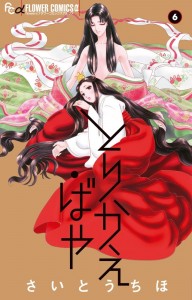
LGBTQ Manga: Torikaebaya (とりかえ・ばや ), Volume 6

March 17th, 2015

Torikaebaya6When we last left Chiho Saito-sensei’s beautiful and tragic retelling of the Heian classic tale, Torikaebaya (とりかえ・ばや ), I was having a crisis. It’s so damn beautiful, I want to keep reading, but it’s so damn heart-wrenching, it’s hard to keep reading.

Volume 5 ended with Sarasojuu running from the capital, pregnant with Tsuwabuki’s child, devastated that she can no longer live her chosen life. Suiren, overcome by love for Toguu-sama, gives in to desire and kisses her.

As Volume 6 opens, I keep wondering if there are any more boots to drop…and, of course, there are.

Suiren has been called up to the Emperor’s residence to be one of his women. This precipitates a decision that Suiren can never go back and change. Refusing the Emperor’s call, Suiren confesses that he is a man to Toguu-sama. He leaves her service, and returns home, to become the man his sister was. Passing is merely a matter of not interacting because, although Suiren and Sarasojuu are identical in looks, Suiren has none of Sarasojuu’s skills at horseback riding or other pursuits.

Suiren, disguised as Sarasojuu, overhears a rumor of Tsuwabuki’s second woman being pregnant, guesses what has happened and heads off to find Sarasojuu.

Sarasojuu, having been taken in by Tsuwabuki, is now called Sara-hime, and is pining away, as the baby’s birth grows near. Conversely, Tsuwabuki is beside himself with joy, having both the women he loves and their children in his home. Sara is not on board with this, and poor, poor Shi-no-hime, who had no idea who this other woman was, until her son calls Sara “father”. Shi-no-hime, who has been unconscious for much of the volume swoons once again. Of everyone, I feel the most pity for her, a woman drawn into someone else’s story with no good way out.

Sara’s baby is stillborn and, naturally, she blames herself.

Suiren finds Sara, at last, as she is just about to drown herself. Suiren tries to convince Sara to return to the capital and resume their lives as before, even though he himself is not sure he can ever return to the life he’s left.

I am less distraught this volume, as I carefully fed myself a few pages at a time, knowing that this story was going to offer no respite. Parsing out mere pages of exquisitely gorgeous, emotionally agonizing story, meant that I was able to get through it without trouble. I’m desperately flailing in mind, as I read every fresh hell, to come up with ideas for a non-horrible ending. So far I am failing. And the one ending I foresee that will give the characters the happy end they deserve will have to be a very annoying tengu ex machina. ^_^;

Ratings:

Art – 9
Story – 8
Characters – 9
Service – 1
LGBTQ – 6

Overall – 9

Saito-sensei’s art has always been exquisite and here, she reaches her pinnacle. It’s so perfect a tale for her style.


LGBTQ Comic: Doukyonin no Bishoujo ga Lesbian Datta Ken (同居人の美少女がレズビアンだった件)

February 22nd, 2015

DnBgLdKMakimura Asako is a woman who, for the last few years, has been working very hard to make a name for herself in Japan as a LGBTQ advocate and activist with books like Yuri no Real and her essay on being a “Yuri” otaku in the Eureka “Current State of Yuri Culture” issue. In Doukyonin no Bishoujo ga Lesbian Datta Ken (同居人の美少女がレズビアンだった件), she and her erstwhile roomate, artist Koike Miki, create an autobiographical comic essay about her life.

The principle concept is that in expensive Tokyo, there are “share houses” which function much like a dormitory – as many as 16 people in a room with bunk beds, sharing a kitchen and bath facilities. Koike, having come to Tokyo for a job, finds herself renting space in a share house and meeting Makimura. Makimura Asako, former Miss Japan finalist and TV personality, comes out to her housemates and they just sort of all get over themselves.

The middle of the book is more autobiography about Makimura’s life and experiences coming out and building a career post-coming out. And then…she falls in love. Her girlfriend, known here as “Mori-girl” or “Moriga” for short, is a French woman who was into anime that ran on French TV, learned Japanese and came to the land of miruku and hachimitsu. She and “Makimuuu~” meet at a club and fall in love. Now the housemates have to not only deal with the idea of a lesbian, but the actuality of a lesbian couple.

Ultimately, Koike and Makimura move out together, while Makimura travels the world, Koike stays behind to work on this book, which was, in part, motivated by Higashi Koyuki and Masahara Hiroko’s own bio comic essay Lesbian-teki Kekkon Seikatsu. We get a little side trip into Koike’s interest in having a romantic partner, but not much. There is quite a lot about Makimura meeting and being accepted by her French in-laws, and a bit about Same-Sex Marriage becoming legal in France. These are paralleled by Koike’s struggle to make the book work, and her editor’s coming out as Trans*.

Ratings:

Art – 9
Story – 10
LGBTQ – 10

Overall – 10

Overall, this is a pleasant read, with an emphasis on the cute and silly moments, and nods to the struggles of LGBTQ folks, without wallowing. If I were teaching a class in Japan on LGBTQ issues, this seems like it would make a nice addition to the curriculum.


Support the Queers and Comics conference with Queer Pin-up Cards!

February 20th, 2015

In conjunction with Northwest Press, the Queers and Comics Conference, in New York City, May 7-8, 2015, is fundraising with a set of original Queer Pin-Ups.

The list of contributors is a great overview  of Queer Comics in America today.  The list includes many folks we consider friends here, Rica Takashima, Jennifer Camper, Mari Naomi, Carlo Quispe, Kris Dresen, JD Glass and and Bara sensation, Gengoroh Tagame.  And of course many more. Check out the full list on the Northwest Page.

Many of these folks will be participating at the conference, as well. I’ll be running a session on Yuri manga and moderating another. As soon as details are avaiable, I’ll get them to you. ^_^ This is going to be a fantastic conference!

Queer Pin-Ups Cards, from Northwest Press
$15 pre-orders, $20 afterwards

This is a one-of-a-kind gift and a fantastic way to support queer comics in America!


Yuri Short Story: Yoshiya Nobuko’s Yellow Rose (English)

February 15th, 2015

yellowrose Today’s review comes under the category of “At last!” Dr. Sarah Frederick’s discussion and translation of Yoshiya Nobuko’s Yellow Rose (黄薔薇) from her Hana Monogatari collection is available to us in English on Kindle from Expanded Editions press. It was worth every penny of the 299 pennies it cost – and to be perfectly honest, I would have paid considerably more to have it.

This epublication begins with a very excellent discussion of the time frame of the story, the symbolism it contains in the context of early 20th century Japanese literature, conjecture about the lacunae within the story and other literary and historical commentary. The kind of thing that reawakens my dormant inner Comp. Lit. major and makes me ridiculously happy. Even more personally meaningful, Frederick includes a small, but pointed rebuke to academic authors who do not acknowledge that reader’s impressions have both meaning and weight in popular thought. You may remember that that was my primary criticism of Passionate Friendships – that being cautioned to not see something as “lesbian” when, through my filter it could not be read as otherwise, is wasted effort. ^_^ Here Frederick acknowledges my point as, if not objectively verifiable, then at least subjectively valid.

The introduction was at least as good as the story itself. That alone would have been worth reading this for. But then, we get to enjoy one of the two “Yuri” stories from Hana Monogatari. In Yellow Rose, we meet a just-graduated young woman who is off to her first job as a teacher, only bare years older than her students and the student with whom she forms a romantic relationship. It is a short, fraught story with a surprisingly bleak ending. Even more unusually bleak, when compared with Otome no Minato a scant decade later. But, perhaps more importantly, while the ending is neither happy nor sad, it also does not contain the “marriage or death” ending that will plague Yuri narrative from the 1960s well into the 2000s.

The translation itself is…well, wonderful. Frederick is able to capture the early 20th-century constipated sentence structure while keeping both the narrator’s voice and the narrative whole.

In short, this was tail-waggingly good and if you are at all interested in early Yuri, early queer lit or basically anything that we care about here at Okazu, you should absolutely get this Kindle edition! (If you don’t have a Kindle or kindle app, you can read it on Amazon’s in-browser Kindle reader.)

Ratings:

Art – 9 The cover art is adapted from a Takabatake Kashō illustration ,“Bara no gensō” (薔薇の幻想). It suits this edition well.
Story – 8
Characters – 8 For such a short story, the protagonist is surprisingly three-dimensional.
Yuri – 6
Service – 2 That distinctively early 20th century verbal sensuality-service

Overall – 9

Thanks to Dr. Frederick for shout-outs to both Yuricon and Okazu. An unexpected surprise. Thank you!

Lastly I want to note the obvious, intentional irony of the one incontrovertibly not-‘S’ character in Maria-sama ga Miteru being the Yellow Rose, Torii Eriko.


Lesbian Novel: Dolly Dingle, Lesbian Landlady

February 2nd, 2015

DollyDLLA few years ago, I discovered Monica Nolan’s genius with the Big Book of Lesbian Horse stories. Following that, I’ve read and reviewed Bobby Blanchard, Lesbian Gym Teacher, Lois Lenz, Lesbian Secretary, and Maxie Mainwairing, Lesbian Dilettante.

Dolly Dingle, Lesbian Landlady continues the saga of the lady-loving ladies of Magdalena Arms in Bay City. Like the earlier entries in the series, Dolly Dingle, is simultaneously a romp through lesbian pulp novel tropes, a drawing room comedy and a mystery story.

The elderly landlady of The Magdalena Arms is taken ill and resident Dolly steps in until Mrs. DeWitt is well again.  While acting as stand-in landlady, Dolly starts cleaning up the old place, until she learns that it’s not just that the carpets that are worn and out of repair. The finances are in serious disarray and if Dolly can’t think of some way to get them all out of a predicament, the Arms will be closed and torn down!

Unfortunately for her, Dolly is also trying to balance her own career, and not one, but two, love affairs, neither of which seem to be going quite the right way.

Will Dolly decide whether it’s Kay or Arlene she loves? And what is with all that stuff in the basement? Will Dolly and the gals save the Arms? Find out in this thrilling – well, highly amusing – installment of the Bay City series by Monica Nolan! /end AM radio announcer voice/

As always, I adore Nolan’s campy mixture of mid-century YA literature and pulp prose (that is, apparently, entirely on purpose.) The mystery this time started in one place and ended in another, but it was a terrific ride getting there. And ultimately, the mystery part was more developed than the love affairs.

A notable addition to the ever-changing cast is Jackie, an African-American nurse. I hope we’ll get her story in the near future…and I’m still holding out for a barracks romance story one day. ^_^

Ratings:

Overall – 8

As always, I’m looking forward to the next pulp novel adventure in Bay City. ^_^