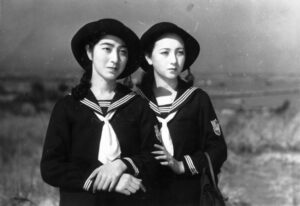
 Minato no Nihon Musume, Japanese Girls at the Harbor is a 1933 silent black and white movie. Directed by Shimizu Hiroshi, it is based on a novel by the same name, written by Kitabayashi Toma that same year.
Sunako (Michiko Oikawa) and Dora (Yukiko Inoue) are bosom friends in the port city of Yokohama. They swear to never part and always be close to one another as they walk home from school. Both Sunako and Dora are mixed -race girls who attend a Catholic school. Yokohama at this time was a true melting pot of people and cultures. You can still see a very little bit of that in modern Yokohama, with it’s huge Chinatown and “westerner’s houses” as well as European construction that is disappearing a bit, but still exists.
Dora and Sunako, almost the moment they make their vow are torn apart by “Henry,” a young man who has adopted western ways. He’s flashy, playing with both girls separately, but its Dora who receives his attention more and they ride off together, setting Sunako into a spiral. Sunako has no other friends and resents Henry, while still desiring him. She learns that Henry has a third girl – and older girl named Yoko. Yoko pities Sunako, because she’s still a child. In response Sunako shoots Yoko in the school’s chapel. Yeah, not much symbolism there.
Sunako runs away, becoming a prostitute. Years later, when Henry comes into the bar where she works he’s excited and happy to see her, and asks her to visit. Even as she does, Sunako thinks of the former madam’s word about how she’ll be unwelcome forever. The movie then becomes a psychological drama as Dora and Henry, now married with a child, and Sunako can never truly reunite. Despite her own success as the madam of a bar, and as she works to build a real business with her money to claim the kind of respect she can never get as a madam, Sunako is both happy for and resentful of Henry and Dora, and the friendship that meant so much to her.
It is both easy and difficult to parse this as an early “queer” movie. Dora and Sunako’s love for one another is immediately, fatally, cast as an immature love, nothing more than girls’ friendships that it is so fragile it snaps over a man. (You may imagine me rolling my eyes.) But as the movie goes on, Sunako continues to be disgusted by Henry’s behavior, long after he’s a respectable married man, to focus on Dora. As with so many movies of the early twentieth century, Sunako sees herself as unclean, both for shooting Yoko and for becoming a prostitute. Even as Dora invites Sunako back into their lives, she is shook with the feeling that she can not, may not sully those lives. Dora misses the Sunako she knew and loved, but that girl is long gone. Sunako still longs for Dora, but that’s just not possible.
The biggest problem with the story is that Henry is, immediately and consistently, trash. He’s a two-bit criminal, which becomes apparent when Yoko enters the scene. She’s older than Dora and Sunako, knows what Henry does for money and expects to marry him. He’s useless in every scene he shows up in.
What really stands out, even now, is the acting. Inoue’s Dora feels typical of portrayal of a teenager of the time, but Oikawa carries the movie as Sunako. She’s a fabulous actor, but sadly, her career was over early as she died at 26 from cancer after nearly 2 dozen movies and other works. Inoue went on to have a storied career, making her final acting appearance in 2004!
I would not claim this movie as a genius work of early queer cinema, but it is a very interesting look into the early 1930s in urban Japan, with it’s multi-cultural prosperity, something that was sacrificed a decade later for no good fucking reason. And it is actually an interesting movie, despite all the attempts to make it about two girls fighting over a guy.
Ratings:
Cinematography – Pretty good, given some obvious limitations. Let’s say 8
Acting – 9
Story – 7
Yuri – 5
Overall – 8
The whole movie is available with English subtitles on Youtube. It’s worth a watch.