Archive for the LGBTQ Category


LGBTQ Comic: The Legend of Bold Riley, Continued (English)

July 7th, 2014

Bold-Riley-2-463x700If you, like me, have been impatiently waiting for the next installments of the wonderful series The Legend of Bold Riley, written by Leia Weathington and drawn by a number of artists, your wait is over! Three new issues have been released following our favorite dashing adventurer!

In Issue 1,  The Talking Bone, Riley encounters a bone that regales her with a tale of love lost. So, of course, she wants to reunite it with its love and, of course, it’s more complicated than it seems.

Issue 2, Warp and Weft, finds Riley sleeping on a moor alone. And, as everyone knows, when you sleep alone on a moor, strange things happen to you. In this case, Riley meets an old woman whose tapestries tell stories, of the past and maybe the future.  I was fortunate enough to receive a reviewer’s copy of this and Zack Giallongo’s art is perfect for the story. In many ways, it reminded me of the opening to the quite epic anime Erin, (which if you have not watched is absolutely worth a watching. It’s streaming on Crunchyroll.) And the cover (pictured here) makes Riley look so darn cool.

In Issue 3, The Lion Jawed, having left her grief behind her, Riley encounters more visions and a new purpose, as she heads off to find adventure (and beautiful women) in Kabumzala.

As sword and sorcery short stories go, I find Bold Riley to be just about perfect. Each artist gives me the sensation of listening to well-known stories told by different storytellers.  The only thing missing from the series at this point is a Pirate Queen to be Riley’s frenemy. ^_^

One of the million things I love about Northwest Press is the variety of formats their work is available in. Paper pamphlet comics, e-book, PDF, iPad ePub and CBZ…and each linked issue has a few pages up for you to take a look at before you buy. The collected volume should be out next holiday season, but throw a few bucks NWP’s way and get more amazing LGBTQ comics now.

Ratings:

Art –  is always dependent upon your taste
Story – 9 I love this stuff
Characters – 9 I love this stuff
Service – Variable

Overall – 9 for Lesbian Adventurer.

Seriously, I love this stuff.


LGBTQ Manga: Wandering Son, Volume 5 (English)

June 27th, 2014

wson5One of the most maddening things about human relationships is our frequent inability to escape from previously established patterns of interaction with people. We return home to visit parents to find them – and ourselves – slipping into well-worn and often dysfunctional habits of communication and behavior.

As Nitori Shuichi begins 7th grade in Wandering Son, Volume 5 (Amazon | RightStuf), I couldn’t but help feel as if I was reading a return to old habits and relationships. Chiba’s still angry, Mako’s still perceptive in an awkwardly adult way, Sasa’s still energetic and Nitori and Takatsuki are still fighting battles on multiple fronts. A few relationships have changed, but many have not and the tensions they create fill the book with chapters that look eerily like the shadows of earlier chapters. But, even as I say that, I realize I’m being ungenerous. Everyone – especially Nitori and Takatsuki – have indeed changed.

Which is why I almost found it frustrating that the plot complication of the gender-switch play was introduced…again. Yes, it works for this class and yes it allows the characters to work some stuff out, but don’t you wonder if the rest of the kids in the class thought, “Really? Again?!”

And the super awkward obsession of the teacher is, well, just straight up freaky. Now I’m wondering if any of my teachers looked at me and thought of some past person they knew instead. (-_-);

The issue of the gendered uniforms is subsumed in Chizuru’s wearing of the boy’s uniform because she feels like it, while Takatsuki, who desperately desire to do so, does not. And Nitori is almost reflexively denying the desire to wear girl’s clothes, but Mako rightfully points out that they may not be able to get away with it for much longer. Puberty creeps ever closer.

In all sincerity, I am reviewing this volume for the last scene in which Chiba, in an unusually lucid moment, asks Nitori if he likes Takatsuki as a boy who likes a girl, or as the girl he wants to be liking Takatsuki as a girl. I’d also add the possibility that Nitori as a girl could like Takastuki as a boy. Not surprisingly, Nitori cannot answer that question. It’s a tough one and the answer to it is the primary reason I’ll read the next volumes.

Ratings:

Art – 8
Story – 9
Characters – 9
LGBTQ – 8

Overall – 9

I find this series deeply uncomfortable reading, but I keep coming back. I want to see how this plays out.


LGBTQ Manga: Torikaebaya, (とりかえ・ばや) Volume 2

May 20th, 2014

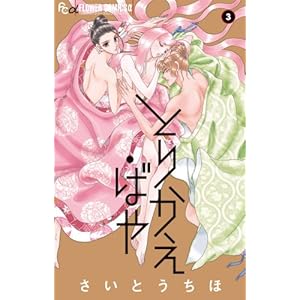
In my review of Volume 1 of this gorgeous manga version of the classic Heian story, Torikaebaya (とりかえ・ばや), I discussed the story’s history. Today, we’ll talk about the protagonists of the story.

Two children born on the same day to the same father, but different mothers – a girl, Sarasojuu, who is now living as a young man in the Heian Imperial court and her brother, Suiren who is living as a woman in the women’s quarters. They look so similar, they could be twins, and they are both beautiful. They are also, however, unsuited to the sex into which they were born, and as Volume 2 begins, both of them are passing with their father’s and his older brother’s knowledge and consent…and I want to take a moment to say, Dad’s kind of awesome, really. He’s gotta know the chances of this going well are slim. But he’s owning it. As we shall see.

Sarasoju befriends another young courtier, Tsuwabuki and they, like guys do, have contests of arms and talking smack. Tsuwabuki loves his dear friend, but Sarasoju is never able to truly relax around him. How could she? The moment she’s discovered, it’s all over. (Note: If this were a story in a modern context, I would be referring to Sarasoju and Suiren by the sex that they present as, but for the moment, since the idea that they are passing in world in which trans* people do not exist is the conflict at the heart of the story, I will continue to use their birth sex pronouns. My sincere apologies to anyone who disagrees with my choice.) To complicate matters,  Sarasoju receives a marriage offer from the Fourth Princess, Shinohime. At a very fraught discussion with her uncle and father, Sarasoju goes all in and agrees to accept the offer.

Tsuwabuki is livid at the news – how dare Sarasoju get married without telling him! They have a fight, which they heal up in the time-honored way of beating the crap out of each other and Tsuwabuki confesses that he wants to get married, too…to Suiren. Erk! Erm, Sarasoju tries to put him off, but it’s not happening.

Sarasoju takes up the position of husband to Shinohime, but their relationship is, for the moment, platonic. However, Ume-tsubo, one of the ladies of the court is convinced that Sarasoju is female and has several times tried to catch her out. She corners Shinohime and asks about the sex with her new husband…. Shinohime chalks up their lack of sex life to Sarasoju’s age, since they are 7 years apart. But seeds of discontent are sown.

In the meantime, Suiren has taken up a position with Toguu-sama, the Crown Princess and has been requested to write stories for her entertainment. He is up late one night writing when Tsuwabuki barges in and forces his attentions upon Suiren. Suiren counters with a hysterical reaction about hating men, and beans him with an inkstone. Tsuwabuki retreats, feeling like a heel. Sarasoju tries to console him by explaining that Suiren has a deep aversion to men, but Tsuwabuki has a different problem now.

Having seen Suiren, he’s decided that Sarasoju is better looking…a thought that freaks him out. Homosexuality is not unknown, but it is considered the purview of Buddhist priests and creepy dudes. He encounters Shikibukyo no Miya, a metrosexual sodomite wearing a wisteria flower in his cap, swallows his pride, and asks about homosexuality. Shikubukyo is pretty much as creepy as possible, leaving Tsuwabuki even more uncomfortable with his desire for Sarasoju than before. Unable to sleep, tormented by his own desires, Tsuwabuki sees Shinohime in her garden and again, does the unthinkable by barging in on her in her quarters as the volume comes to an end.

This description makes Tsuwabuki seem like the bad guy in the story, but he’s really not. If there is indeed a bad guy, it’s Ume-tsubo.

The question I had when I began reading this series was “Will this be a comedy or a tragedy?”. As I finish Volume 2 I am no closer to an answer, really. But now I’m annoyed as heck I didn’t just pick up Volume 3 when I had the chance!

Art – 9
Story – 8
Characters – 9
Service – 2
LGBTQ – 4

Overall – 9

Saitou Chiho’s art is gorgeous, of course, and the story remains elusive as of yet. Volume 3 will have to be where we address at least one of the multiple impending crises. Yikes, but you know I’m going to read it. ^_^


LGBTQ Manga: Torikaebaya (とりかえ・ばや) Volume 1

April 16th, 2014

The Heian period was a period of intense artistic creation in Japanese history. Like the Italian Renaissance or the Chinese Tang period; the cycle of life quality for the well-to-do hit a high and with it came the leisure and drive to create. So much of what we in the West consider “Japanese” culture flourished in that period. Mostly everyone is familiar with Murasaki Shikibu’s famous serial, the Tale of Genji. Fewer people are familiar with the ambiguously comedic/tragic/erotic Torikaebaya, which would probably translate to something like “If only they could switch.” You may recall this story from the 4th season of Maria-sama ga Miteru, in which the Yamayurikai’s school festival play is chosen around Yuki and Yumi’s uncanny resemblance.

When it was announced that veteran manga artist Saitou Chiho, the creator of the Revolutionary Girl Utena manga, would be working on a manga adaptation of the Torikaebaya  (とりかえ・ばや), I was downright ecstatic. Saitou-sensei has repeatedly shown interest in trans* characters and this manga deals not with one character or two who merely switch clothes, but who are entirely suited to the gender expectations of the opposite sex.

The story follows two siblings with the same father and two different mothers, born on the same day. The daughter is active, lively, good at sports, rhetoric and other masculine pursuits. The son is retired, shy, good at music and other feminine skills. Circumstances conspire to allow them to switch clothes – and lives.

I have not read the original in either translation or Japanese and before I even read the manga, I realized that my only encounter with the Torikaebaya was as a comedy, when the Lillian and Hanadera Student Councils had some fun with it. But, I wondered, was it actually a comedy…or a tragedy? As it turns out, we don’t actually know the answer to that. It has been interpreted as comedy, tragedy, social commentary and erotic romp by varying critics in varying ages. That actually made me more interested in it than before! We don’t know what this story is, how cool is that?

Saitou-sensei has specifically set out to treat this story as a story of transexuality. This is stated plainly on the cover and the relationship between gender roles and one’s sex is explored within. The daughter, Sarasoju is painfully aware that she really is not suited to be a girl, and her brother Suiren, likewise, really would do so much better as a girl. They switch clothes and roles and as far as I am in the first volume, their father is complicit in this, having just introduced his “son” to the Emperor.

I have not finished Volume 1, but I know that Sarasoju will play her part as a male well, but that that will not stop her from falling in love with a man, or having intimate relations with him. Her pregnancy is a major part of the original story. But she will also be married to a woman, and in one of the two versions of the tale (known as the Ima Torikaebaya Monogatari), both she and her brother end the tale in functional homosexual relationships.

I’m frequently asked for recommendations on trans* manga, and I usually don’t have much to offer, as trans folks are not well represented. This book will be going on my short recommendation list.

Ratings:

Art – 9 Gorgeous, but how could it not be? Saitou Chiho-sensei doing Heian period. Duh~
Story – 8 I’m intrigued, fearful, hopeful all at once
Characters – 8 Not bad, actually. Dad’s not a bad dude, and Sara and Suiren are sympathizable
Service – 4 Nudity, not nakedness
LGBTQ – 4 We meet them just as their self-identity is forming.

Overall – 9

Saitou Chiho-sensei’s version of the Torikaebaya may well become my go-to version of this Heian classic. Here’s hoping!

If you are interested in a garbled version of the story and a mixed bag of scholarship, here’s the Wiki entry on the Torikaebaya. It’s rather less helpful than I had hoped.


LGBTQ Manga: What Did You Eat Yesterday? (English)

April 9th, 2014

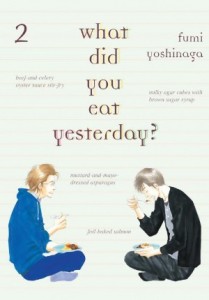
wdyey1So there I am, in the Rijksmuseum in Amsterdam, standing in a room full of still life paintings from the 17th century, feeling irrationally rational about Stilleven met vergulde bierkan, by Willem Claesz. This painting, executed in 1634, is photorealistic, almost ridiculously so. The way the light hits the silver salver in the front was so…real. I stood there for a good long time, amazed at the technical skill, but also kind of put off by it.

The thing about still-life paintings is that we don’t need them any more.  I mean, it’s all well and good for 17th century painters to be cranking out photorealism, because they didn’t have actual photos, right? So when I recently encountered Luciano Ventrone‘s work – I have to stop and think, no seriously, why do we still do photorealistic still life?

It makes sense to recognize that in the 1600s they needed painting like this. But in this day and age of photography, there clearly is still a place for painting like this – and the literary equivalent, the slice-of-life story. For a slice of life, we might justify it to ourselves and say, “Well, this is not our life, so this is a glimpse into another world.”  But the best slice of life stories don’t have to be alien, or alienating. The protagonist of Kitchen, by Banana Yoshimoto, is not me, but I was able to fully engage in her non-engagement with life. Willy Loman’s story is both alien and alienating – and to me, so is something meant to be realistic, but feels not at all real, like Sakura Trick.

In the same way that I am able to observe, but not engage with, still life paintings, I was able to read, but not really engage with Yoshinaga Fumi’s What Did You Eat Yesterday? It’s slice of a life that is not even remotely alien, but was surprisingly alienating.

The protagonist, Kakei Shiro, is a lawyer in his 40s who is off-puttingly attractive and youthful according to his co-workers. His major interest is in cooking and he’s a narcissist. Shiro lives with a boyfriend, a hairdresser. Kenji is out at his work, although Shiro is not. At first I thought Shiro was out, just not at work, but as the story goes on, he comes off as more uptight and closeted, although his parents know he is gay. Kenji’s equally as annoying and I cannot see how he and Shiro stay together with such vastly different approaches to life.

As the story goes on, Shiro become less likable, until I realized that he just doesn’t really like anyone and suddenly I felt as if I was observing a stunningly drafted bit of 17th century tablecloth. Realistic, technically well-crafted, but not all that interesting, ultimately

As a slice of life, I found the story less engaging as it progressed. Shiro and I are not far apart in age, we both are professionals, in committed relationships, love food. and I’d rather have dental surgery than spend half an hour stuck in an elevator with him. The more hyper-realistically his life is shown, the less I cared for it.

I was very much looking forward to a story in which the protagonist is gay, has a relationship and then the story happens, but very disappointed with the lack of any connection between Shiro and Kenji. They may as well have been roommates.  Shiro’s gayness is both talked about and shown as normal, but completely stripped of any affection of any kind. Shiro shows no tenderness towards his lover, his family, his coworkers, clients or self.

Ultimately, the story isn’t ever really sure if it is a commentary on the food Shiro cooks, with his life as the background, or a commentary on his life, with the food as the background.

Ratings:

Art – 9 Excellent as always
Story – Not as compelling as usual, with unlikable Shiro standing between me and delicious-sounding food, like a disapproving aunt keeping me out of the kitchen.
Characters – 3 Honestly, there’s almost no one to like.
LGBTQ – They talk a lot about being gay, but they could be talking about being a fireman, as we see no signs of affection, not even a kind word.
Service – Foodie only, with meals in detail

Overall – 5

Vertical does a great job of getting out of the way of Yoshinaga-sensei, now the story needs to get out of its own way and develop into a narrative. As it stands, it’s a perfect slice-of-still-life.