Archive for the Light Novel Category


There’s No Freaking Way I’ll Be Your Lover! Unless…, Volume 4

January 7th, 2026

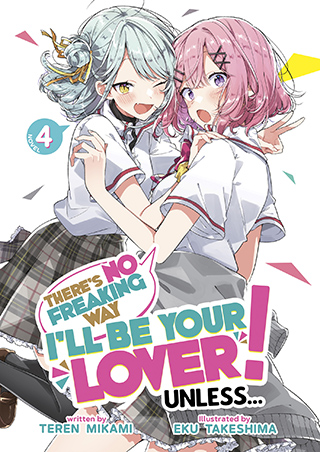
Cover of There's No Freaking Way I'll Be Your Lover Unless...! Two girls embrace, looking out at us. One has pink hair with a crossed barrettes as decoration on the front, the other has silver-blue hair tied up with a gold ribbon. They both wear Japanese style school uniforms of white blouses with red piping, and gray plaid skirts.by Eleanor Walker, Okazu Staff Writer

It’s been a while, but I’m back to volume 4 of the light novel There’s No Freaking Way I’ll Be Your Lover! Unless… We’re back to the standard cover design of Renako x whoever is the focus of this volume. If you’re looking to start where the anime ends, this is the volume you need.The anime which aired earlier this year covered volumes 1-3 of the novel series and introduced our first 3 members of the harem who are Oduka Mai, Sena Ajisai and Koto Satsuki.  There is, however, this one more introductory volume to go, which focuses on the last member of the group, Koyanagi Kaho.

Like the other members of the group, there is more to Kaho than meets the eye, but it turns out Kaho and Renako have actually met before, at cram school when they were younger. Kaho, much like Renako has reinvented herself from nerd to popular girl, and due to changing her surname because her parents divorced, Renako doesn’t immediately recognise her. Hijinks of course ensue, including an amusement park trip with a ride on the Ferris wheel of course, and we learn that Kaho is actually jealous of Renako and her newfound popularity, partly because she likes Mai too.

By now, if the first 3 volumes or the anime didn’t grab you, then this one won’t either. The writing style is as it always has been, with lots of exaggerated freaking and internal monologues from Renako especially. Eku Takeshima’s art continues to be pleasant and I do enjoy Renako’s panic face. This volume, much like the previous 3 with the other characters, focuses mostly on Kaho and sets her place in the harem. As well as reinventing herself as an extrovert, Kaho is also now a pretty popular cosplayer, and she ropes Renako into dressing up with her and doing a photoshoot together. and then performing together at a cosplay event where Mai is a surprise judge/special guest. Nothing is ever simple for a harem protagonist is it?

In the afterword, the author describes this volume as the conclusion of season 1, and I am interested to see what happens in the next volume. The harem is assembled, Renako hasn’t been forced to choose just one person, so now we’ve been introduced to everyone, let’s see what happens next.

Ratings:

Art – 7
Story – 6
Characters – 7
Service – 7 Renako has now bathed with every member of the group.
Yuri – 7

Overall – 7


The Beauty’s Blade: Mei Ren Jian

December 4th, 2025

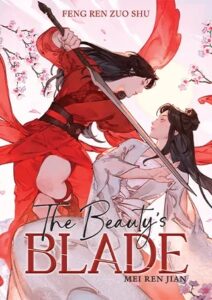
A woman in flowing red robes holds a long sword at the neck of a woman in white robes, who calmly parries it with her hand.Where to begin with The Beauty’s Blade: Mei Ren Jian, the first Baihe licensed by Seven Seas? This is not a rhetorical qestion, as many readers picking this up might not be all that familiar with the tropes of the Wuxia genre. The book itself gently suggests that, if you are unfamiliar with Wuxia, Chinese “historical” fantasies about martial arts heroes, whose arcane practice and studies of martial art using inner energy – qi – have given them almost magic skills – that beginning with Crouching Tiger, Hidden Dragon,  streaming on  Apple TV, for rent or purchase on Amazon Prime) which was a gateway for many into Wuxia. The word itself is relatively-ish new, and while old kung-fu flicks used some of the same tropes, Wuxia has developed along a separate path from martial arts movies.  (Xianxia is a related genre that deals with immortal heroes and there can be overlap as a lot of the “cultivator” – i.e. “qi cultivator” – stuff can feed into the martial stuff.)

To a very great extent, Feng Ren Zuo Shu’s The Beauty’s Blade (美人剑 [Měi Rén Jiàn]) assumes a certain knowledge of Wuxia in the reading audience. Ideally, you know about the wire-work that allows those warriors who use qingong to fly through the air, or at least leap so far that its much the same. You’ll understand that qi can be used not just offensively, as a kind of energy discharged through a weapon or by hand, sometimes even by eyes and, in significantly over-powered characters through mere will, it can be used defensively by hardening or warming or healing the body. I have trained qigong exercises named “golden bell” and “warming the triple burner” to develop those specific skills. Sadly, I am still soft flesh and blood and often cold. I guess I never trained hard enough.^_^;  All joking aside, the martial art I practice is an “internal” art that would be exactly the kind of thing the warriors in this novel work on. Of course, their powers are hyperbolic and sometimes hilarious.

I don’t follow specific fandoms much and haven’t paid attention to Baihe as much as it deserves. I will say that The Beauty’s Blade reminded me a great deal of The Untamed, a (50-episode! I deserved a medal for watching all of it!)  danmei (m/m) Wuxia story on Netflix in specific structural ways. Chapters here are terse, it often feels as if we were supposed to understand what is going on, although the characters just show up, then have a lot of expository conversation to explain what is going on. I imagine that keeping track of the various houses might not be easy for folks unused to the genre. Visually, Wuxia stories help you along with different colors for different houses/sects and you can see that a little here.  We are told repeatedly that the Diancang Sect wears blue, for instance.

If a reader is not comfortable with the sects or the family names, it might feel much like reading a Russian epic. It’s not *that* complicated if you just remember the three main groups: The Lightpath Alliance, the Jadewater Guild, aka the demonic guild, and the Weiyang Company. Regardless of which group, basically everyone is a complete asshole, so forget “light” and “demonic” as meaningful markers. ^_^

To make this more complicated for western audiences, scenes sort of happen. There’s no lead up, or phase out. We’re in a place, the scene happens. Next chapter, repeat.  The Untamed did that a lot – I assumed it was stuff cut out from the novels, but now I am not so sure. Maybe the serialization of these novels make for choppy story telling. But, by the end of the story, you can at least put it all together, so that was good. 

Because most scenes were presented with no open or close, and no specific weight – almost every scene is full of shouting, cursing, fighting, leering and a bit of exposition. It can all feel very the same, with the exception of Fu Wangqing and Yu Shengyan’s scenes together which break up the rest of the scenes, but also feel much the same as a whole. There is a distinct sense of this being written in the style of or for a short form serialized live-action adaptation.

Many times the overdramatic martial arts come off as plain funny, but my favorite line comes at the very end of the book, after Fu Wangqing injures a man who tries to force his way into her room. Yu Shengyan asks her who it was and Wangqing says “Whoever has a cut on their right hand, duh.” Fu Wangqing was so often incredibly childish and wholly capricious, this suited her perfectly. 

Also, despite the fact that both Gu Yu and Guo Ju are utterly ridiculous in origin and execution, I liked them anyway and were glad for the one-line resolution to both their convoluted stories. Although I would have preferred if the Zhong brothers ended up among the many corpses in the story, they were vile.

I have read only a little Baihe, and what I have read sounds much the same as Yu’s translation, so I will call that satisfactory as far as it goes.   Overall, I cannot say The Beauty’s Blade: Mei Ren Jian is a “good” book in terms of skill of character building or writing, but I found it highly entertaining for 381 pages of Wuxia fun that I would pay good money to see turned into a live-action series. ^_^

Ratings: 

Art – 7 Both covers are quite nice, the interior art by Gravity Dusty gets the point across and thankfully never bothers to illustrate any of the shouty men, only the shouty woman. ^_^

Story – 7 Convoluted, full of shouting, but it eventually made sense and all the lesbian couples live happily ever after.

Character – 8 Fu Wanqing was all over the place, Yu Shengyan had almost no personality, but that was the point.

Service – yeah, a little

Yuri/Baihe – 10

Overall – 7

The Beauty’s Blade: Mei Ren Jian would make a fun gift for the Wuxia fan in your life, especially if they watch danmei for the inevitable one warrior woman character. ^_^


Though I Am an Inept Villainess: Tale of the Butterfly-Rat Body Swap in the Maiden Court, Volume 9

November 2nd, 2025

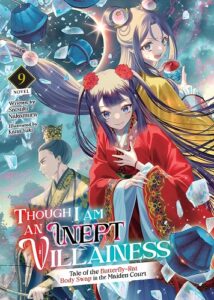
Two young women in fantasy Chinese clothing stand back to back. A stern older man with Imperial crown behind them look off to the left. The air is filled with chunks of ice and bombs.This past summer I discussed Volumes 1-7 of this series. My thoughts were about chronic illness, emotional manipulation, systemic bias and some other overarching concepts, rather than about the story, per se. Also, I noted that the first volume had me sobbing in a plane bathroom, which was awkward. 

I delayed reading Volume 8 of Though I Am an Inept Villainess: Tale of the Butterfly-Rat Body Swap in the Maiden Court until Volume 9 was available, since the story structure thus far has been 2-volume arcs. Volume 9 turned out to be the climax of a number of arcs, including the immediate plotting of that current arc. It also is the climax of the second phase of the relationship between Kou Reirin, the Earth Maiden and Shu Keigetsu, the Fire Maiden, consorts of the Crown Prince of Ei.

Due to the toxic relationships between the Consorts of the preceding generation, the Maidens have all had to overcome significant abuse and manipulation, both emotional and physical. In part due to need and self-preservation, in part to Reirin’s steel-trap wit, all of the Maidens have moved beyond their hateful and antagonistic relationships. They work together now to greater ends, even if they still do bicker. The writing really shines here specifically, as the tension is wholly different. They sound like old friends trashing each other, not like implacable enemies. 

In Volume 8, a situation so complicated that I am hard pressed to explain it in a sentence or two is set up. Reirin and Keigetsu are switched and cannot be switched back, even though Reirin is tortured and Keigetsu made to push Reirin’s frail body beyond it’s ability. To save themselves, they must solve a mystery that has plagued the Emperor since his youth, or die. In doing so, the two women have a fight that seems insurmountable. In Volume 9, all of this comes to a head in what is a genuinely brilliant book. 

Keigetsu has been trying and succeeding for the most part, to pass as Reirin. Imagine if you were suddenly asked to pass a physics professor or an Olympic skater. For Keigetsu, the gap between her, a despised nobody treated like trash in order to serve as a punching bag and be universally loathed as an uncultured joke, to rise to be able to pass as the beloved angel of the Inner Court, delicate and gentle, is nearly impossible to imagine. Keigetsu does that, lifting herself out of the sewer once and for all. Reirin is gutted. We’re told, over and over that the Kou family loves nothing more than to be needed. Keigetsu no longer needs her. Reirin snaps. Her subsequent crisis had me  – for real – fucking sobbing on a plane again.

Keigetsu, in rising to be the person Reirin need her to be, makes Reirin feel as if she is no longer needed. Rushing in to that gap is all the emotion Reirin has never let herself feel about being ill. She spent her lifetime preparing for death. Making sure she had no unpaid debts, no thanks left unsaid. Now, apparently no longer needed and unable to pay off the debt she feel she owes Keigetsu, the weight of her own mortality rushes in and crushes Reirin. She has felt health now, in Keigetsu’s strong body and the horror of returning to her own weak one, as her health deteriorates makes her…angry.  I won’t belabor this, except to say the one thing I will not do to myself is imagine a life without illness, so when Reirin lost it at this point, so did I. 

Keigetsu, for her part is angry and confused. She has exceeded every expectation, risen above her upbringing, her training, the manipulations that she was subject to, only to be met with a Reirin, cool and unemotional. For Keigetsu, this was tantamount to rejection. 

The catalysts to their eventual reconciliation are the men in their lives, which was really a nice touch. One of the best bits of this series is how both men and women are portrayed here as fully-developed humans, with strengths, weaknesses and emotional depth. No non-verbal, unemotional blank slates that we have to mask emotional depth on to. The developing relationship between Reirin’s brother and Keigetsu feels natural and fun, while the Crown Prince frequently ends up being the most emotionally intelligent person in the story. It’s a genuine pleasure, knowing “the boys” aren’t a drain on the story or the character development. 

The climax comes with reconciliation of several kinds. Both Reirin and Keigetsu finally, honestly admit their needs to one another. Reirin is able to compliment Keigetsu with her whole chest, and finally Keigetsu can see herself as the comet Reirin always likens her to. It’s a magnificent moment, beautifully written. 

While this series is not Yuri, in the sense that there is no romantic love between Keigetsu and Reirin, and there is no likelihood of there ever being any, it does not lose out at all in the intense emotional connection. Reirin and Keigetsu have inhabited each other’s bodies and lives, they have had to pass for one another. They have had to save one another and they have conspired to do things that changed the kingdom around them. I cannot think of a friendship in literature more intimate than this. It is a genuinely fantastic series, which I wholeheartedly recommend to Okazu readers.

Ratings: 

Art – 7 
Characters – 9 
Service – Teenier bits in this arc, as there was a *lot* going on.
Intimacy – 10

Overall  – 10

As I said in my previous review, I probably will not be watching the anime, simply because the early parts are simply too hard.  And I’ll have to stop reading this series on a plane.  ^_^; But my sincerest thanks to Sean Gaffney for the recommendation.


Adachi and Shimamura, Volume 12

October 29th, 2025

Two young women stand under a colorful sunset sky on the beach, wearing flowery and flowy bathing suits. by KatGrrrl, Guest Reviewer

Adachi and Shimamura, Volume 12 is the twelfth numbered entry and fourteenth overall in this now long running light novel series by Iruma Hitoma, available in English from Seven Seas. This volume features three ‘what if…?’ alternative universe chapters followed by a return to the main timeline as our titular couple take a trip to the beach.

Despite the way this volume is numbered, it actually continues on from themes established in 99.9, one of two short story collections that were released after Volume 11. In particular, Yashiro’s newfound role as a cosmic matchmaker, making sure every Adachi finds her Shimamura in every timeline and alternate reality. Yashiro, as decently a fun comic relief character as she is, was always a bit too omnipresent in previous volumes for my liking, so giving her constant presence a greater purpose, as well as finally playing into her status as an extraterrestrial, really boosted my overall enjoyment of her character, as well as nicely tying in the AU chapters into the main timeline.

Unfortunately, the first AU story of this volume somewhat sullies this idea. “What If Adachi Was a Teacher?” is the title of this chapter, an innocent enough idea… except that one of her students is a six year old Shimamura. And if the alarm bells aren’t already ringing for you, this story sees child Shimamura propose to teacher Adachi, who promises on the condition that Shimamura wait until she’s eighteen. Twelve years later, Shimamura keeps the promise, proposing once more, a happy ending all round and another job well done for Yashiro… Look, I don’t really have to explain how completely irresponsible and predatory Adachi comes off as here, or how the thoroughly positive, ‘destined lovers’ framing is inappropriate for such a story. If this was a one-shot, I wouldn’t have much more to add, but as an AU, I still found some value in it when reading things a little less literally. Younger Shimamura here really stood out to me with how open and upfront she was to Adachi about how she felt, compared to the emotionally withdrawn teenage Shimamura of the main timeline who needed Adachi to help and push her to open up to her feelings. The way she keeps her proposal promise to Adachi throughout her withdrawn teenage years really shows the strength of her love for Adachi, particularly in comparison to her doomed childhood friendship with Tarumi. The Japanese blurb of this volume (if I’m reading it correctly,) seems to imply these AUs are daydreams of Shimamura’s, and for this chapter I feel the framing of a dream or daydream would be such a simple yet effective improvement that would greatly reduce the grossness and further highlight the insight into Shimamura’s character, and I’m annoyed this framing isn’t text.

Thankfully the next chapter, “What If Adachi Was an Author?,” is not only the standout of this volume, but the best AU chapter in the series so far. In the main timeline, Adachi’s thoughts are so pre-occupied by Shimamura, more Shimamura, and oh, did I mention Shimamura? that we rarely get any insight into other interests and hobbies, if they exist at all. I wouldn’t go as far as to call it a flaw of the series, in fact I’d say Adachi’s single-track mind for Shimamura is one of its strengths. But after thirteen books, I felt some areas of characterisation were still a bit too lacking for the fully-realised characters that the series needs if it’s going to continue throwing them into random slices of life with no overarching plotlines to rely on. So to see author Adachi here giving an interview about her thought process behind becoming an author, what she thinks about the writings of others and her own, and her lack of interest in the film adaptation of her novel, was exactly the kind of fresh look into those lacking aspects that her character needed and I want to see more of it. Not just a continuation of this AU—novelist x actor Yuri is an excellent concept—but more of seeing Adachi and Shimamura interacting with the real world as people with rich, inner lives.

The third AU chapter, “What If Shimamura Fixed the Timeline?,” is fine. It’s mainly a retelling of the events of volume one chapter one where Yashiro shows up too early and breaks the timeline. From the title, I expected Shimamura to take a bit more of an initiative in fixing things, but in the end she’s handheld by Yashiro for most of it. It was fun to see her befriend Adachi for the first time in a different setting, but overall I felt this chapter stuck to the original events to a point where it felt like it was playing it too safe. I still enjoyed reading it, but it left little to no lasting impression. “What If Everything Was Back to Normal?” is the fourth and final chapter and brings us back to the present part of the main timeline, although it actually seems to take place before Summer18 from Volume 11—any sense of linear storytelling in this series is well and truly gone. I’m impressed it managed to take this long to get a proper beach chapter. We’ve had swimming pools, bikinis and even Nagafuji and Hino at the beach already, so it was about time. With this being their last summer of high school, there’s a definite ‘end of an era, start of a new’ atmosphere here, with Shimamura in particular starting to think towards adulthood and a newfound desire for independence fueled by her desire to be with Adachi, whilst also looking back on her past beach trips with family and whether they would ever happen again, which contrasts with Adachi, who has never been to the beach before. I really like this contrast and subsequent balance between the two, Adachi has independence but no childhood, Shimamura has a childhood but no independence, and this beach trip represents the merging and sharing of both experiences, creating new memories and a new life together. I get the impression Shimamura’s mother has also noticed Adachi and her daughter are now an item, she makes some interesting choice of words for sure. I can’t wait to find out the climax of this plot thread in volume twenty-two in ten years time! Overall this was a solid chapter and my analysis above aside, their beach date was exactly the kind of wholesome cute I can’t help but smile at when reading.

There’s a couple of short shorts here, one involving Nagafuji and Hino, the other with Yoshika and Akka (yes, that’s the correct reading of her name.) There’s not much to say about these other than Nagafuji has large breasts (just in case you forgot, you know? Can’t have the reader forgetting something important like that, can we now? No way…) Molly Lee gives us another excellent translation as always and raemz is really making a habit of giving us beautiful cover illustrations.

Ratings:

Art – 9
Story – 7
Characters – 9
Service – 1 (bikinis, Nagafuji)
Yuri – 7

Overall – 7

KatGrrrl finds herself getting more addicted to Yuri by the day. Socials at linktr.ee/katgrrrl.


There’s No Freaking Way I’ll Be Your Lover! Unless… Light Novel, Volume 3

August 29th, 2025

A girl with long, pale hair in a Japanese school uniform of a white blouse with red trim and tie and grey plaid skirt holds a finger up to her lip as if to shush us with a smile.

by Eleanor Walker, Okazu Staff Writer

Volume 3 of  There’s No Freaking Way I’ll Be Your Lover! Unless… changes things up a bit with the cover design. Unlike the Volume 1 and Volume 2 where the covers feature Renako and whoever is the the main character of that volume, volume 3 omits Renako and is purely the next member of the harem, Ajisai Sena.

We know from the previous volumes that Renako already has something of a crush on Ajisai and that Ajisai is often responsible for caring for her two younger brothers, so it seems inevitable that we’ll find out more about both now. This volume is also the “summer vacation” volume, so we can expect traditional hijinks like hot spring trips, beach trips and and festivals, as alluded to on the back cover.

But maybe Ajisai isn’t as angelic as she appears. Perhaps she’s just a normal teenage girl who’s been looking forward to her summer vacation and hanging out with her friends/crushes but instead, she’s stuck staying at home and looking after her brothers. Parentification is a word which has gained traction in recent years and refers to older siblings being thrust into a caregiving role because the actual parents are either absent or negligent. Ajisai’s parents both work long hours, so she is inevitably forced into this position, and in this volume things finally come to a head. Ajisai has had enough and runs away from home, compelling Renako to go with her to, ostensibly, look after her.

This is where Ajisai feels like a normal teenage girl, much more so than either Mai or Satsuki. “Supadari” Mai is obviously meant to be over the top and unreal, whereas Satsuki is her opposite, being quiet, cynical and almost disinterested in romance unless she can use it to get at Mai. Ajisai, by contrast, feels much more grounded in reality. Renako arranges to come over to her house one day during summer vacation so they can play video games together, and this is when she snaps. Her brothers are hogging the game console, and she’s barely had a chance to speak to Renako. She’s had enough of having to put everyone else first and whilst running away is a bit of an extreme reaction, it is believable in this context. One thing I have particularly enjoyed about this volume is the little sections at the end of each chapter retelling the story from Ajisai’s point of view.

The rest of the volume is mostly devoted to the usual summer harem adventures. Renako and Ajisai inevitably end up staying at an onsen with a private hot spring attached, taking the number of members of the group Renako has seen naked and bathed with up to 3. It’s also a good excuse for an illustration of Ajisai in a yukata and a ping pong battle to determine who pays for this whole adventure.

And then enter Mai like the tornado she is, and yet another person to disrupt Ajisai’s time with a friend. She arrives at the inn having used Renako’s sister to find out where they are, so we now have a high school girls’ sleepover party or something like that, and now we’re all off to the local festival together (and bathing together).

We end with everyone back home and the rest of summer vacation passing relatively normally, apart from Ajisai asking Renako out (in front of Mai!)  just in time for school to start again in the next volume, when Renako must also answer Ajisai’s question and figure out where her feelings lie.

This series is ultimately about exploring the difference between friends and lovers, where the line between them lies, how blurry that line is and what it all means to different people. With one more group member to properly introduce in the next volume, my main question is where do we go from there?

If the anime continues at its current pace and it is a 12 episode season, this will be the last volume adapted for now. At the time of writing, there is no news of a season 2.

Art – 7
Story – 6
Characters – 8 Ajisai is definitely the most realistic teenage girl of the group so far.
Service – 6. Some of the illustrations are definitely on the more servicey side in this volume.
Yuri – 7

Overall – 7