Archive for the Light Novel Category


Though I Am An Inept Villainess, A Tale Of Two Privileges

June 22nd, 2025

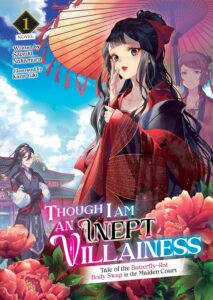
A girl in red and black "ancient Chinese"-styled robes, under a parasol looks at us, while another young woman stands behind her looking disapproving. Off to the left a handsome young man in a black uniform watches, his arms crossed. In the foreground are pink flowering plant,s the background is a Chinese style building.CW for this series and this post: Trauma, chronic illness, emotional and physical abuse.

A few months ago, on the recommendation of my dear friend, excellent reviewer and Sr. YNN Correspondent, Sean Gaffney, I picked up Volume 1 of Though I Am an Inept Villainess: Tale of the Butterfly-Rat Body Swap in the Maiden Court light novel series written by Satsuki Nakamura, with illustrations Kana Yuki, published by Seven Seas Airship as something to read on the plane to visit my mother.

Later, I found myself sitting in the bathroom on a plane, sobbing uncontrollably.

Since that moment, I have wanted to write about this series, but have not had the time. I expected to wait until Volume 9 landed in English (since the series tends towards two-volume long arcs, I was holding off reading Volume 8 until 9 came out), but I find myself today with an unexpected bit of leisure and want to get my thoughts down. Even now, so many months removed from that initial reaction, I find myself overflowing with hopefully not-entirely-inexpressable things I want to say about this series. These notes are not specific to any volume but are based upon my reading of Volumes 1-7 of the light novels.

In a fantasy Chinese-ish rear palace, i,e. harem prison, the consorts of the Emperor and their protégés vie for the Emperor’s and Crown Prince’s favor, blah blah blah. Kou Reirin is the unquestionable favorite to become the next Empress, but Reirin is chronically ill and weak to the point of being unable to do the activities that are required of her. As a result of being forced throughout her life to rely on others for so much, Reirin pushes herself constantly in everything. When she is well enough, she practices dance and martial arts, when she is not she sews and does calligraphy. Every moment she is able to sit up she hones skills and is always as kind as possible. Reirin is universally beloved for her dance, her embroidery, her writing and her generous nature.. 

Across the Inner Court is Shu Keigetsu, despised by everyone for her lowly upbringing, her lack of grace and talent, and her unpleasant personality. In a rage, Shu Keigestu uses magic to swap bodies with Reirin. Keigestsu quickly learns that, yes,  while being respected and loved is a privilege, so is having a healthy body. Reirin, having spent her lifetime captive in a body that was capable of little, suddenly finds herself unfettered. Exiled to a corner of the court as Keigetsu, Reirin find herself in a body that is strong and healthy. She sets out to make herself a life of almost complete freedom through hard work, study and a little luck. 

This swap sets in motion events that will radically change the Inner Palace in ways that no one could possibly expect. 

Sean suggested I would enjoy these books as they are centered on the relationship between two women who are not just intimately – emotionally and physically – intertwined, but who find that they need one another. And I did indeed find that. But I also found a story that touched some deeply felt emotions in my own life. 

I know I’ve talked about it from time to time here, but let me be plain – I am chronically ill and have been my entire life. Like Reirin, every day is a goddamn struggle, and I’m very lucky to have the level of ability I have, which often means I pass an able person. I’m not. I never will be fully able. Like Reirin, I practice martial arts, and I exercise to the best of my ability every day. I practice those things I can do in order to keep my mind as sharp and proficient as I can. (Some of you may remember my struggle with Long Covid which robbed me of cognition and memory. I have worked incredibly hard to be here today, although my memory will never be the same. Like Reirin, I am often forced to and often privileged to be able to, rely on others. I thank people profusely and try to pay it forward for those reasons. 

So, when Reirin was delighting in a body that, for the first time in her life, was able…it hit hard. I felt every single thing she felt deep in my gut. I knew exactly how I might feel if suddenly given a body that just…worked.

Conversely, as screechy as Keigetsu is, I understood her shock and consternation at suddenly being in a body that simply can’t. I know the feeling well. I’m often shocked at how much this body simply cannot.

Even after this emotional volcano, I kept reading the series, which is very well written. While I very much enjoy the current blockbuster novels of  Apothecary Diaries, Inept Villainess is superior in writing skill.

Fantasy Chinese-ish court dramas are  all the rage now, but for any woman watching, the setting is unsettling at best and could be triggering. Abuse and trauma are commonalities of both series, which make some of the arcs hard to read, but so far worth it in both cases. The complexities and politics of the Inner Palaces in Inept Villainess are interestingly complicated and often rather real-world horrible. I could not for a second imagine this series being interesting to a young person, even beyond the fact that before I let a teen read it, we would have to have a long conversation about women being treated as chattel.  

But I did say that there are two kinds of privilege in this series. One, obviously, is physical ability which is easy to understand. The other is so much harder to capture in a single concept. “Systemic bias” might be as close as I can come. Mental wellness is another way to look at it.

Keigetsu is treated as lesser because of social status, yes, but she is also groomed through emotional abuse to become a hateful figure, a person meant to cause pain and hardship in order to eventually serve as a scapegoat.  Her mentor is setting her up for failure from the beginning and Keigestu, although not an innocent, does not have the tools to understand what she is experiencing.  I felt that this was a clear reminder for us that behind every apparently screeching Karen is very likely a lonely and angry person who life is spiraling out of control for reasons they might not even be aware of.  Yes, Keigetsu is abrasive, but she was trained to be. Yes, she is demanding and capricious, selfish and angry…but she was not expected or assisted to not be these things, as they suited someone else’s narrative. And she was abused into becoming the person she is, through emotional manipulation and physical abuse.  So what she sees as Reirin’s “privilege” of being openly and nearly universally respected, is something Keigetsu was not allowed to imagine for herself. The result is a childish understanding of what Reirin’s life must be.

Who among us has not fallen victim to envy at the apparent golden child of school, or work or community? That person who seems to be consistently given permission to do or say anything, who is always forgiven, who always get favors. It’s hard to not be angry at that or want that for one’s self. Keigetsu’s desire to live that apparently easy life, unloved and unliked as she is, is wholly understandable. What might not be as understandable is Reirin’s refusal to be envious of healthy people and her unbridled rage when she can no longer hold that in. Even as I type, I rage with her. Wishing for health is an oubliette into which I cannot look.

While this is in no way a Yuri story, not even if you squint really hard, the bond between Reirin and Keigetsu is undeniable. By Volume 7 it is something that cannot really be described as “friendship” or love or really by any one word. They have literally inhabited each other’s bodies and lives. Reirin has gained brief respite of ability and health, and the ability to move ignored by the rest of the court. Keigetsu has gained access and the power to command. Thus far, Reirin has come out on top, but Keigetsu is beginning to learn to control her powers and her confidence is growing slowly but surely and healing is in her future.

One hopes that they will ascend to the throne together, hand in hand.

Ratings: 

Art – 7 I mean, it’s fine. The anime teaser art looks nicer, frankly. Light novel illustrations really are just so pointless. 
Story – 9 Very good and it’s getting better and better as it goes on 
Characters – 9 Same
Service – A bit here and there, and the boys are stripped down a bit, too
Intimacy – 10

Overall  – 9

Because of my own deep emotional connection to the series, I probably am going to skip the upcoming anime. I really don’t think I can sit through it. But if you do, let us know what you think on the Okazu Discord. I do however highly recommend the novels, with the caveat that if you, too, are chronically ill or disabled, maybe read the first novel somewhere where you can scream loudly or punch something or cry. Not a plane. ^_^;
Homunculus Tears: Alchemy For the Brokenhearted

May 4th, 2025

Stories from the perspective of “other” are not uncommon – and especially so in the context of queer literature. Indeed, much of what we have read from inori.-sensei is from the perspective of “other.” In I’m In Love With The Villainess, Rae Taylor, isekaied into her favorite otome game, was not only not of that world, and a gay woman in love with an apparently straight woman, and a 21st century mind in a feudal society, as the story played out, we learned how she was in fact even more “other” than that. The sequel series and inori.-sense’s subsequent novel, The Girl Who Wants to Be a Hero and the Girl Who Ought to Be a Hero (EN release in June, reviewed here on Okazu in JP,) include the ultimate in-world “other,” introduced to us in the form of young women who are, in whole or part, demon.

In Homunculus Tears: Alchemy For the Brokenhearted, we are asked to contemplate the idea – what if there is only “other?”

In our world, including among the readership of Okazu and folks that hang out with me on a regular basis, I count few, if any, people whose lives are unconditionally privileged. I am happily surrounded by creative folks, queer folks, and women of many classes other than elite. We are all – inexplicably, as we are the majority – considered “other” in a society in which the presumed standard is, weirdly, a small minority. In Homunculus Tears, inori.-sensei presents us a world in which any possible not “other” person is invisible, some unseen (possibly non-existent) elite. Instead, we follow people whose lives are treated as “other” to the extent that an entire military exists for the purpose of being eventually eliminated.

We meet Maha, a woman brought into the world to fight, to die, by a soldier mother who values her who only for that fighting skill. The same mother creates another young woman, an alchelmical homunculus, Ruri, to be an even better fighter. They are trained by yet another outcast, a woman who can read minds, which allows her to, yet again, be a strong fighter. None of these people belong in the context of the society in which they live. The members of the society we do see are the poor, the orphans – the outcasts of a society at war. At no point in the story are we privy to the existence of anyone who is not “other.”

The story makes a point of this, too, so it’s not that we are to infer any of this. Maha is not alone as she ponders why she exists at all, why she was given life and why she continues to struggle. Ruri likewise, when faced with the voices of the “other” around her, struggles with the value of life. Why was I brought into this world? Why do I continue to live? are questions that many of us ask during the hardest times.

The answer here is that we are loved, even if it’s not what or how or by whom we expect. A community might be part of a world at war, but it is community, nonetheless. Throughout Homuncuus Tears, we are told this over and over. And may I remind you that, although the not-othered insist “other” is a problem, they are the weird minority, not you, not us. As “other” as we feel sometimes, we are the majority. If we can band together, the demons don’t stand a chance.

The use of the word “anti-natalism” in the author’s note has been commented on in discussions of this book online. Use of “-ism” usually indicates a belief system. In the context of anti-natalism, it would be a belief that procreation itself is unjustifiable. In this specific scenario, it is not a group or society, community or sect with this belief, not a generalized belief system that procreation is bad, but two individuals who question why they, personally, were brought into the world. However – and this is actually quite relevant to our world right now – the only children we meet in this story are war orphans. The question of “why would anyone want children, or desire them to live in our current society” is valid one. It is a valid one in 2025 on the planet earth, as well. Perhaps more people ought to ask that “why.”

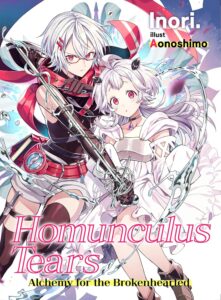
The illustrations by Aonoshimo-sensei miss the chance to illustrate any of the excellent battle scenes, favoring pin-up poses and service. I am always disappointed when, rather than seeing Ney and Maha going head to head in a complicated battle of will and magic, I get to enjoy underwear. Again. This is light-novel tropiness that I would not mind losing. I did not feel that either a bath or beach scene added anything of value. I am ambivalent about the Yuri, as well. Both Maha and Ruri are brought into the world by the same woman, and Yuricest is never appealing to me. The loli jokes fall flat for me as well. Maha and Ruri as a couple is simply unconvincing.

What definitely did work for me was the alchemy. I’m fond of magical systems that are consistent within themselves. This alchemy and it’s trappings of tomes, vials, and attacks worked incredibly well. To that point, the character of Metako, (‘meta’-ko, which works really well across three languages) was the most interesting character to me. Her story, the way she worked and her functional relationship with Maha, were high points of the narrative. How Maha uses alchemy is presented as a kind of standard behavior, but in reality it was very cleverly handled throughout. Also solid is Kevin Ishizaka’s translation, which keeps the narrative running smoothly and provides excellent alchemical magic attacks.

Overall, this was a fast-paced light novel that delved into some tough questions about existence, but missed a few opportunities to be great.

Ratings:

Art – The art is excellent, it’s just of the wrong things
Story – 7
Characters – 8
Service – 4 It will never add anything to a story for me
Yuri –  As above, so below.

Overall – 7.5

As a self-published light novel, this book was poised for success. I hope this allows inori.-sensei some room to work her own way. And I look forward to her next original work.


Otherside Picnic, Volume 9

April 4th, 2025

I have one real beef with Iori Miyazawa’s light novel Otherside Picnic, Volume 9. It was too short.

I’m not joking or saying that like “Tee hee, it was so good, I wish it kept going, I mean it more like, “Dude, this thing needed a denouement, a coda, an epilogue, something, sheesh.”

Aside from this one thing, this volume was excellent. ^_^

After Volume 8, it would be really hard for any author to build a compelling narrative. But, as I said in my review for the previous volume, “Because Sorawo is our narrator and protagonist the story has allowed her the time and space to be unaware that she even is a mystery, or to have any real insight to the mystery that is her.” and, later, “One of the deep leitmotifs of this series is communication – or the lack of it. Sorawo doesn’t understand people and isn’t great at understanding herself. ” This is the main thread here. Once again, under the cover of Sorawo’s disassociative cluelessness, we watch as the people around Sorawo flounder trying to understand and accommodate her needs, while she moves the goalposts as fast as she sees that a goalpost is needed.

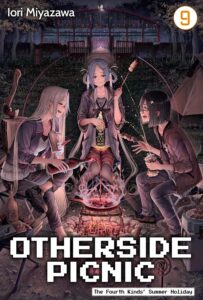
All of this is happening as DS Research asks Sorawo and Toriko to train their mercenaries to be as prepared as possible to face the kind of horror the Otherside presents. Along with Runa and the enigmatic “magician,” Tsuji, they set up The Farm to be a kind of terror-generator. Stuck in a campsite whose only goal is to push people past their normal limits of reason and sense, Sorawo struggles most with the banalities of life and she –  and we – must confront her worst fear as she is forced to understand who people give a shit about her and want her to reciprocate.

What really got to me is how relatable Sorawo’s confusion was, even as she’s being an annoying dipshit. ^_^  It was not at all surprising to learn that other people have a strong reaction to Sorawo, although she kind of sees everyone else as Toriko and not-Toriko.

What made this book work, from beginning to end, was the inclusion of former cult-leader, touched-by-the-Otherside Fourth Kind, Runa. We are reminded endlessly that she is a minor, but we’re never really given her age. I think this is an important distinction. She’s prone to sulking like a child, and having hissy fits, but is probably older than she acts…and, we think, has no real sense of the place of family and friends in a normal life. Runa’s skill in crafting deeply unsettling Otherside horror-inducing rooms makes for outstanding story-telling. But it is her relationship, such as it is, with Sorawo that will change the story.

I haven’t mentioned Kozakura, for a reason. When we meet her, we are told she is an adult…but until Volume 9, we really have only had the vaguest glimpses of it. Now that she (too) has someone to care for, her house is becoming a home, her maturity is suddenly apparent and it deeply affects Sorawo, who is not used to feeling…things… about people.

Everything is changing and despite herself, Sorawo may have built a family. If only she can see it.

Ratings:

Art – I really do not know, let’s talk about the art next volume
Story – Also don’t know, but wow it was compelling
Characters – 9, also compelling
Service – Either no or I am getting used to it
Yuri – 9

Overall – 9

An incredible book, but it still needed a denouement. ^_^;


Did You Think My Yuri Is Just For Show?

March 3rd, 2025

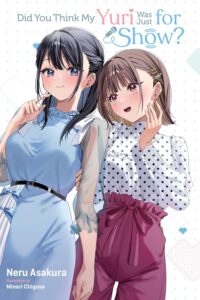
On a white background two women stand. One with collar-length medium-brown hair holds the other's elbow, her other hand up to her mouth, as she speaks.. She wears a white blouse with back polka dots and frills at collar and cuffs, and red slack gathered at her waist in a bow. The taller woman has long black hair and is wearing a belted blue dress with sheer sleeves and white pleats falling from the belt over her right hip as she smiles at the other woman.One of the best things about reviewing is when a book (or anime or game or whatever) surprises you in a good way.  I had no particular expectations for Did You Think My Yuri Is Just For Show? written by Neru Asakura, with illustrations by Minori Chigusa, translated by Jenny McKeon, from YenOn.  For most of the book, I found it a pleasant surprise. It did not *quite* stick the landing, but it very much failed on the right side of flawed.

Suzune Sengu is a veteran voice actress with a secret crush on former idol singer Karin Shotsuki. To Suzune’s shock, Karin joins her agency and the two begin to bond, even though Suzune does everything to keep her personal feelings out of their professional relationship, but when they begin working together, her boundaries are pushed to their limits and she has one more secret she’s keeping that might ruin everything.

The premise itself is not bad. Suzune is likeable, relatable and intelligent, so one is quickly caught up in her life and generally her choices make perfect sense for her. Karin is also likeable and, what I expected to be the final reveal ends up being handled at just past halfway through the book, allowing both characters room to grow.

The story contains a lot of insight into the world of being a voice actor  – insight that feels consistent and based in reality – from what companies do and do not reimburse, to rivalries within agencies. With one exception, the people we are following are talented, sincere and their management is committed and supportive, which helps us relax and just enjoy the Yuri.

The Yuri is woven throughout this story on multiple levels. It begins and ends with Suzune’s feeling for Karin, but it is not Yuri bait, except in a section of the book about “business Yuri” in which Yuri baiting the main couple of the anime is a part of the promotion. I found that section amusing for the business calculation of what would engage fans who are already shipping two characters…something we might lose as Yuri becomes more openly queer, but is so much a part of Yuri history that I was glad to see it represented. ^_^ Also nice is that Suzune is not the only gay character, which changes the nature of her actions in a positive way as the story develops.

Illustrations by Minori Chigusa were satisfactory. They did illustrate the scene, which was nice, but as the scenes chosen for illustration are mostly people sitting/standing and talking they still look mostly like portraiture, and, sadly, were far too infantile for me. Characters in their 20s looked like children, with one exception of a very nice illustration of Suzune.

Easily 9/10ths of this book was fun, engaging and way more intelligent than I expected. The final hurdle is the only genuinely weak point of the book. It is over-contrived and even then, the resolution was perfectly fine. The problem was that story wrapped up *so* quickly and *so* neatly immediately afterward it all felt a little forced. That said, the author made a thousand excellent choices throughout the narrative with the characters, the setup and even the language choices, so I was very willing to allow it and take only small deduction for the bobble on the landing. ^_^

Speaking of the language, let us give a round of applause to translator Jenny McKeon and her uncredited editor, who gave the characters identifiable voice and did a fantastic job with very fannish language. It was a fun read – I recommend it without hesitation when it comes out later this month from Yen.

Ratings:

Art – 6
Characters – 9
Story – 10 right up to the last bit where it faltered ever so slightly
Service – 2? 3? Some? Kinda? Mostly of the “gay girl being way too aware that she is gay in front of another woman who presumably does not know that” kind.

Overall – 8

It’s nice to read a book about adults who act basically like adults, so the screaming is mostly internal. ^_^

Thank you once again to Yen Press for the advance review copy, this was a genuine pleasure to read.


Lycoris Recoil Ordinary Days

February 17th, 2025

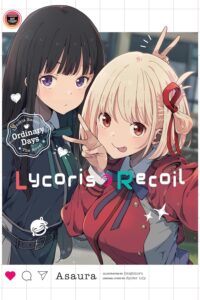
Two girls look at the camera as they take a selfie, One, with long dark hair and a dark blue school uniform makes bunny ears behind the head of a blonde in a red school uniform, making a silly face.Almost exactly two years ago, I wrote a review of Lycoris Recoil Ordinary days (リコリス・リコイル Ordinary days) in Japanese. Today, I am looking at the collection again, this time in English, from Yen Press. I will not lie, I was very tempted to simply cut and paste my review from 2023 to this post, on the assumption that no one but me remembers I wrote it it all. ^_^

Lycoris Recoil Ordinary Days Light Novel is really more of a short story collection tied together by a ribbon story of daily life at the cafe. Written by Asaura, the writer for the Lycoris Recoil anime, this book reads exactly like a series of stories written by a middle-aged male anime fan about teenaged girl assassins, which is, of course, exactly what it is. Chisato is Chisato, ebullient and full of the kind of thinking that teenaged girls only express in stories written by adult men.  Takina is an uncarved and uncarvable block. Mizuki is a drunk and too “old” at 25, which…whatever. Kurumi plays board games and does computery thingies. Mika is, as always, the most interesting character – interesting enough that one of the adult males in the series goes so far to admit that if he were a woman, he’d be into her, which…cool story bro. I really liked the Lycoris Recoil anime for all of it’s delusion, because little girls running around with guns is as much my jam as anyone else’s. ^_^ 

This short story collection is 3/5ths very entertaining. The opening story is a slog since I am not a middle-aged man who wants desperately to believe teenaged girls might be into me. Ugh. To quote myself from my original review, “it will surprise no one that I didn’t care about Doi-san or his shoes. ”

The next few stories wobble between DA activities – y’know two girls, one shooting rubber bullets, somehow taking out an entire gang of heavily armed and armored bad guys –  and coffee, depression, Japanese sweets, and Takina’s inability to understand cooking because literally no one has sat down and explained anything they want to her. I take back my above statement, Takina is not dense, she’s neurodivergent and the people around her are idiots.  But haha, she can’t cook.

“LycoReco of the Dead” remains the best and brightest story in which a dream about a zombie invasion gives us the most fun action segments. And, to quote myself again, “Takina literally awakening to her interest in the idea of being alone with Chisato, forever.” So there is Yuri for those folks who hoped there would be. ^_^

Lastly, the books ends on a story so awful that once again, I quote myself from my previous review, “The final story was the most problematic. More problematic than setting adult men on dates with a young teen girl? Yes, actually. It was problematic in the sense that the bulk of the story forces us to watch a middle-school girl being bullied and tortured, and gives us only the promise of future retribution.” I suggest skipping this story unless you enjoy scenes of a helpless young woman being physically and psychologically tortured.  And I question the age rating for this volume based on that story – there is no 13 year-old that should have to read that. I’m not exaggerating. It was, as Sean Gaffney says in his review of the volume, bleak. It’s a pretty awful way to end a book that feels otherwise like Asaura unable to just let go of his fun characters and use some ideas he had for another season of anime.

Ratings:

Art – 6 Moe heads floating in a panel with largely the same one expression. Chisato smiling, everyone else looking at her.
Story – I would have said 7, but the final story really tanked it.
Characters – Same ones you know from the anime. Mika’s an 8
Yuri – 6, BL – 6 Now that we know Mika’s gay, we do have to mention it. It’s in the contract
Service – No, until that final chapter, then ewww

Overall – 6

Many thanks to Yen Press for the review copy of this book. It was exactly as fun and not-fun as I remembered it being.