Archive for the Live Action Category


Yuri Live-Action: Yuridano Kandano (百合だのかんだの)

October 27th, 2019

There has been a veritable explosion of BL in Japanese Live-Action Drama recently, by which I mean a handful of series. Otouto no Otto has been followed by Kinou Nani Tabeta? , and Ossan Rabu, which was being advertised everywhere in Ikebukuro when I was there in September. I haven’t had any time to watch the latter two, although I expect I will, eventually. More interesting to me was the announcement of a summer 2019 Yuri live-action on Fuji TV. It did play on the terrestrial station and then was sent to FujiTV on Demand (FoD) where it now lives. In 2016, Fuji TV had run a lesbian romance called Transit Girls, but has not has a lesbian series since. Unsurprisingly, folks were both excited and ambivalent about this news.

Yuridano Kandano is…not bad. It is also not good. It was incredibly complicated, with many layers of positive and negative and details I wish I had someone to talk to about for like, 3 hours. And because in this series the devil is in both the superficiality and the details, a summary will not suffice. Nonetheless, I will attempt to summarize fully, aware that I will fail to capture the essence of this series.

Yuri (played by former gravure idol Baba Fumika, which made it really hard to find queer reviews of this series, since most of the reviews were fans of hers) is a young woman who is being harassed by a stalker. Her boyfriend Yuuji is unsympathetic. Her friends might be sympathetic, but she has not confided in them. One day Yuri is surprised to meet an old friend from elementary school, Kaeri, played brilliantly by Kojima Fujiko. Kaeri is a realtor and helps Yuri find an (admittedly adorable) new apartment, but then, a little oddly turns out to be Yuri’s next door neighbor.

Kaeri is exceedingly clever, and funny and generous and obviously (to us) is a predatory lesbian with her eyes set on Yuri. Is she the stalker? Kaeri inserts herself neatly into Yuri’s life, and proceeds to alienate Yuri’s friends. It’s uncomfortable until Kaeri is able to prove that Yuri’s best friends and her boyfriend have been fooling around. Ultimately, Yuri is able to re-establish her former friendships, but ends up being “shinyuu” with Kaeri over her older friends. She is also able to continue to work with jerky boyfriend Shuuji, and still be friends.

Nothing Kaeri does is okay. Everything she does is awkward and intrusive. When she first meets Yuri, she runs up to her and thrusts her face into Yuri’s chest in a way that no one would ever do…certainly not a lesbian.  And yet, she sees the truth faster than anyone else and says what she sees. Kaeri figures out who the stalker is (I mean, so did I, it wasn’t hard, there’s like 8 characters in this drama) and confronts them. In every situation she comes off as selfish, but ends up maybe being right? Kaeri’s own stories which are obviously manipulation and bullshit turn out to be real, and Yuri finds herself growing stronger to help and protect Kaeri. Then the story starts to speed up, as the stalker escalates their behavior. Kaeri breaks boundaries, hurts Yuri, turns out to be right, tells outrageous lies that turn out to be true…over and over.

The end of the series is not romantic, as the two promise to be best friends, almost immediately after which Kaeri breaks another boundary. …

It was a fascinating and complicated series. Kaeri is a horrible person and a good person. Yuri is weak and strong. They make a terrible couple but are good together. The stalker is not a bad person but does appalling things. Every single one of the 8 episodes gripped my attention, made me squirm with discomfort, and occasionally shake my head in wonder.

Even aside from the drama itself there are a few notable things about the series. At one point, Yuri and Kaeri are having a discussion about the word “Yuri” being used for lesbian things. Yuri wonders why and Kaeri tells her about Yurizoku originating in Barazoku magazine. There was Kaeri just casually giving the correct history of the word Yuri on a Fuji Television drama.  It was amazing.

Then that conversation continued, Yuri asks Kaeri “Are you L?”, a moment which was caught on an advertisement on the Yamanote subway in Japan. (If you do click this link, please be aware that this is a complete stranger’s Twitter feed. Don’t be weird at them. Thanks.) So that was also very interesting.

Much like Transit Girls, it’s hard to call this series LGBTQ. In both series, the lesbian character acts in a way that makes “lesbian” people look bizarre. And in both the word “lesbian” is not something the character identifies as, Kaeri here talks about herself as having a “broken” sexuality. Which brings me to the title. The phrase “nandano kandano” comes up in translation as “whatever” but I’d translate it more as “It is what it is.” Yuridano Kandano” kept coming up as “Is it a Lily?” which I thought was not correct, but it is pretty apt. Yuridano Kandano might not be LGBTQ, but it’s definitely Yuri.

Ratings:

Acting – 8 Honestly, if either Kaeri or Yuri had not been well-acted, this series would have unraveled completely. Both were excellent.
Story – Oh gods, I have no idea. It was good, and awful and amazing and terrible. 8?!? 3?!? I don’t know!
Characters – Same as above
Cinematography – 4 Can we ban close up kissing forever? Please?
Song – 8 Sung Si Kyung singing “Hachimitsu” was weirdly romantic for what really was not a romantic show, but it was pleasant

Overall – 7 because it’s not dire and not amazing, but it has both dire and amazing moments.

Also, like Transit Girls, the kissing is super closeup and dreadful. Japanese drama kissing is the absolute worst. Takarazuka absurdly fake stage kisses are better than this. For a romantic comedy, it was neither romantic nor comedic, but it was interesting!

You can check out the trailer on Yudano Kandano‘s FOD page. Ignore the kissing.


Live Action: Batwoman on CW

October 13th, 2019

It’s been said before here on Okazu, but I always feel I must disclaim before I review any DC anything – I really don’t read Batman. I don’t really like Batman. I was a Marvel collector, my wife took care of DC. So you’ll excuse me if I haven’t been following Supergirl with it’s queer storylines (and queerbaiting.) I tried. I watched like three episodes and just couldn’t do it. I’ve attempted to watch Arrow and the Flash and all of them make me feel exactly as I did as a child when everyone loved some movie or music personality and I was like… okay, nice for you. I did try though, honestly! They just didn’t hook me. But I felt an obligation to at least try and watch CW’s newest series, Batwoman, if only to review it.

After one episode, I can say that I think, maybe, I might like it. ^_^

The opening plot is loosely pattered after Batwoman: Elegy, with some fairly significant and much-needed changes. When Elegy was written, Don’t Ask, Don’t Tell, was the law of the land in the United States. Kate’s story was a real story, the story of Lt. Dan Choi, a man whose illustrious military career was cut short merely for being gay. In the last decade DADT was overturned and so it makes no sense that they’d keep that same scenario. Instead, Kate is busted out of military academy for violating academy rules in a scene that makes the point that the real problem is homophobia. Kate, cut off from a military career, and by her father from the career she really wants in his high-tech security firm, is angry and rootless. On top of this base, the Alice storyline from Elegy has been ported, with modification.

Batman was unable to prevent Kate’s sister Beth’s death – and – has disappeared. Gotham is without a protector, crime is rising and suddenly a new villain is terrorizing the city, Lewis Caroll-quoting, Harley Quinn-esque, manic pixie nightmare girl, Alice.  Thankfully for my sanity, the hideously obvious BIG REVEAL doesn’t make it to the end of the first episode, thus fixing the most tedious bit of writing in Elegy. Now we can settle in and see what the story might actually do.

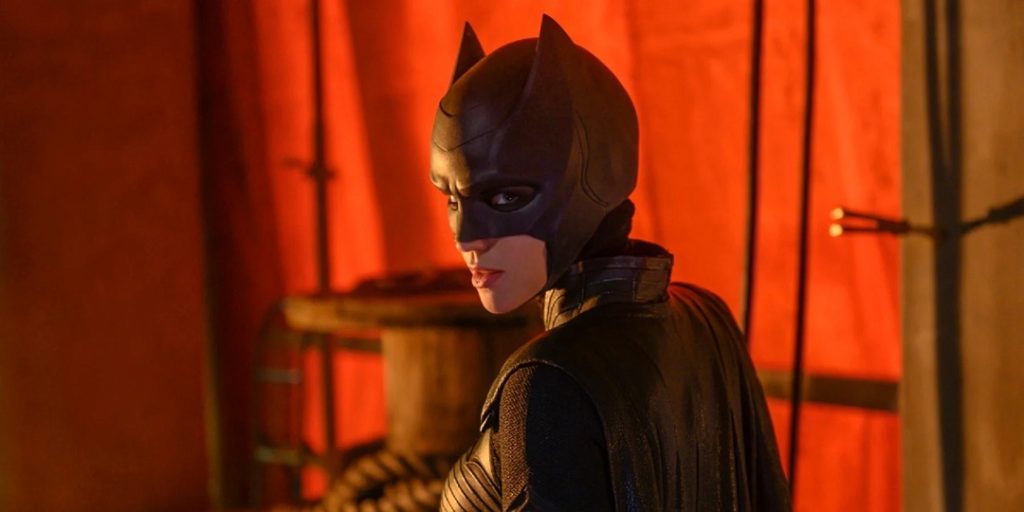
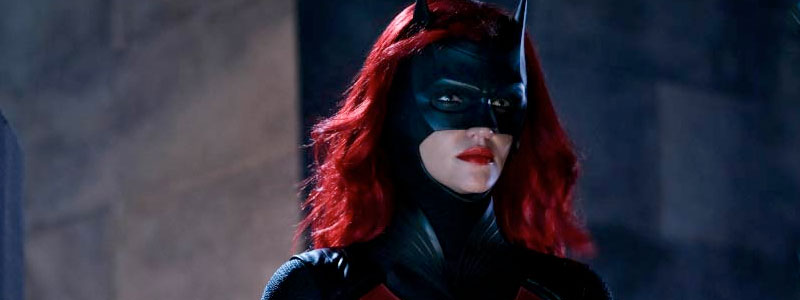
To quote YNN Reviewer, Chris LeBlanc, Ruby Rose’s hair is 80% of this episode – I am in absolute agreement with this. It’s not that I just like angry, violent lesbians with undercuts, it’s just that I want you to tell me the last time you saw a woman in an American television series with this haircut. Take your time, I’ll wait. I’ll wait a long time, because the answer is ‘never.’ I know Batwoman will be getting her scarlet tresses, and I’m okay with that, as long as Kate gets to keep her undercut.  ^_^ The cowl did look a bit weird without something to tie into the cape.

The acting in the first episode was…all right. Everyone felt like they were trying to get a feel for the characters and their relationships, which left me a bit like I was watching a really good read-through. Ruby Rose as Kate smoulders beautifully.  Meagan Tandy as Kate’s ex, now-married to a guy, Sophie is a wild card that can be played in a number of ways – in this first ep, she’s damseled because she’s the one character in the story Kate would put herself on the line for. Both Kate’s father and Lukas are unfortunately written and I hope to heck they fix them both, because blecch. Especially Luke. I need him to stop being clumsy dorky scared boy. One of those things would be fine, but you cannot convince me that Bruce is leaving his entire billion-dollar set up to a fuckup. This and how absurdly dark the filming is, so the fight scenes are almost wholly obscured, were the weak points.

The biggest pleasant surprise of the opener in both writing and acting is Nicole Kang as Mary Hamilton, Kate’s sister by marriage. Everything about her was terrific. She way set up as a loopy-harmless-bubblehead, then given a twist that made sense and was…fun. Between this and the downplay of “the mystery of Alice’s identity,” this first episode gave me real hope for the writing. Hope for the writing is why I’ll be tuning in tonight for the next episode of Batwoman.

I can’t really rate it fairly after one episode, but it’ll give us a point of comparison later.

Ratings:

Cinematography – 4 Who can tell, it’s so dark.
Story – 6 Alice, but with some improvements, here’s hoping
Characters – 7
Service – 5 Some nice lesbian kisses

Overall – 6 with hope for improvement

I just hope like hell they don’t try and get Sophie and Kate together again. Introduce another character as a love interest, PLEASE.


LGBTQ Live Action: Signature Move

September 1st, 2019

I have been waiting for this movie since 2017, when it was making rounds of the film festivals to great acclaim. Amazon picked it up and I finally had a chance to watch it.

Signature Move, directed by Jennifer Reeder and co-written by Fawzia Mirza and Lisa Donato, follows Zaynab, an immigration laywer, who is feeling stifled living with her widowed mother…a mother who, predictably, wants her to be married.  Zaynab copes by taking up Lucha-style wrestling, which she is learning from a client. She meets Alma, and their romance throws her life into disarray.

The acting is superb. Alma and Zaynab have instant chemistry. Alma’s personality is easygoing and garrulous, while Zayna’s pent up emotions make her instantly sympathetic. The scenes with Alma and her Mexican family are full of color and smells and sounds – the life of a happy household, while Zaynab’s Pakistani mother loses herself in Pakistani television dramas and searches for a husband for her obvious-to-us very gay daughter. I very much enjoyed Mirza’s portrayal of Zaynab – cool, but horribly awkward and ultimate goofy, against Sari Sanchez’ gregarious and straightforward Alma.

The dialogue moves fluidly between Mexican Spanish, Pakistani Urdu and English with accompanying background music, which made for a fluid spoken and musical soundtrack. The cinematography never gets in the way of the story, which is set in Chicago, but could be any city in America.

Wrestling here stands as loud, colorful metaphor for Zaynab’s journey of self-acceptance. Zaynab’s mostly closeted, unwilling to be seen as being gay in public. The masks that covers her face in the scene above is a not-very subtle image of the way she hides from life. “I feel like you’re keeping me secret, “Alma says, but Zaynab is keeping herself secret, as well.

I particularly liked that the sex wasn’t more important than the relationship, or the inner lives of the characters. And I loved every single one of the supporting characters. They made the movie charming and wholly enjoyable. A perfect Sunday afternoon watch that left me with a smile on my face.

Ratings:

Cinematography – 8
Characters – 9
Story – 8
Service -1
LGBTQ – 8

Overall – 8

I would totally watch a television series with this cast.


Live-Action: Yuri Short Drama Happy Days

August 15th, 2019

Last spring I reported on the existence of self-described “Yuri Short Drama” Happy Days. Serialized on Youtube, this is the story of a couple, Kozue and Junko, and their sofa.

To call this anything more than an incredibly low-budget B-series wouldn’t be fair. Nonetheless, there are moments when the series is charming – and it is engaging enough that at the end of Episode 4, I was quite unhappy. ^_^

For the first several episodes Junko and Kozue lounge about on their sofa, or the floor in front of it, eating candy and talking about…things. Each episode is somewhere around 15 minutes and little of consequence occurs.  It’s just day-to-day life stuff. But at the end of episode 4, a thing happens. That thing changes the tenor of the story considerably. It also ends up leading the production itself out of the little room in which it has been filmed, into the larger world.

Ratings:

This is so low budget, I feel ratings are not really worth it. This is one-camera, 6’x6′ room, and a bag full of candy low-budget.

Overall – 7

I don’t know what might happen at this point, but I guess I’m going to keep watching to find out!


LGBTQ Live-Action: Gentleman Jack

June 9th, 2019

In a world where every generation of people seem to need all of history explained to them, personally, or they don’t “get” why we need a Pride month, it’s sometimes easy to feel a sense of disconnection from history.

The Stonewall Uprising happened 50 years ago – I recommend the American Experience episode on Stonewall for first-person recounting of what happened and why. If you haven’t read Lillian Faderman’s The Gay Revolution: The Story of the Struggle, consider it assigned reading for this Pride Month, as well. ^_^

The protests we’re seeing this year tend to be about pushing back against rainbow capitalism and corporate overrun of Pride events – and these are legitimate issues, but there is also a welcome renewed “in your face”-ism about Pride, as a whole generation of hate groups show up to the party, enabled by the downfall of empathy in our governing bodies; so we’re back to having fun as loudly and publicly as possible to remind people that we won’t be forced back into the closet.

Most folks are probably not all that clear on the who and whats of even recent LGBTQ history, literature or art, much less events in the distant past. As I’m starting to see a whole generation of young people who are new to the ongoing struggle, I find I do want to re-establish those connections. Especially as we’re once again finding ourselves facing increasing violence and bias. It’s good to remind ourselves that we are not alone now…and we have never been alone.

As I get older, I’m also really finding myself less tolerant of people who believe that because the word “lesbian” didn’t exist, people could not be presumed to be lesbian. (Much as if Indigenous people needed colonizers to name their country before they had an identity. Which, yes, I know colonizers and white supremacists believe.) There have always been words to describe women who, when they look for romantic or sexual partnership, look to their own sex. There have always been words that queer people used for themselves, as well as those that have been used about us. The premise that because the word “lesbian” did not exist means that no lesbian relationships existed before the word is…well, it deserves to be ridiculed. Regardless of the words used, I guarantee that women fell in love and lust with other women before the 20th century.

And so we come to Gentleman Jack.

Gentleman Jack is a fictionalized story based upon the real diaries of a real 19th century English lesbian, Anne Lister. Actual passages from her diary are used in this show, in which the characters are won’t to break the 4th wall and address us in their actual, historically accurate words.

This HBO/BBC production is lovely, and painful and honest and often rather funny. Written and directed by Sally Wainwright, my wife and I are finding it to be compelling watching right now. Wonderfully acted by Suranne Jones, Anne is not all that likable, until she is…and she often is. Funny, snarky and scheming, hyperactive and overachieving, Anne Lister is someone who would be exhausting to be around, but amazing to watching from a distance. Anne’s relationship with the emotionally fragile Ann Walker can be tiresome, but I’m all in for watching this story take us into a second season.

The setting, the clothes, the facts of life in 19th century West Yorkshire are all impeccably researched and presented. Shibden Hall itself is a fantastic member of the cast. Anne’s relationship to the people around is presented as accurately as possible, with interpretation coming in the form of tone of voice, body language, expression, all of which feel real. The music is another cast member, “almost like her companion” as my wife describes it.

As an insight to one lesbian’s life, Gentleman Jack is a terrific story, but since our job today is to understand history and the context of the day we find ourselves in, it’s worth remembering that Anne Lister was not the only well-known 18th century lesbian in the UK. The Ladies of Llangollen were contemporary, preceding Anne in society as lesbians. They apparently knew each other and Anne visited Plas Newyd at least once (as have I, for what it is worth.)

I actually like that the sex scenes are not explicit or extended, but are not coy or childish either. The strongest bits of the narrative, in my opinion, are Anne talking about her gender presentation and sexuality with honesty, a little pain and a lot of self-awareness. These scenes are largely taken from her own words, which give them power and resonance.

Ratings:

Acting – 10
Cinematography – 8, but there have been some controversies.
Story – 9
Lesbian – 10

Overall – 9

Much of Anne’s voluminous diaries remains untranslated, but there are number of abridged editions available, including Gentleman Jack: The Real Anne Lister, by Anne Choma, the historical advisor for the series and a woman who is still transcribing the diaries. Also worth looking into is The Secret Diaries of Anne Lister, a 2010 BBC movie.