Archive for the Live Action Category


Live-Action: Shoujo Kakumei Utena ~Shirokibara no Tsubomi Musical (少女革命ウテナ ~白き薔薇のつぼみ~)

October 10th, 2018

In Spring 2018, to celebrate the 20th anniversary of the Shoujo Kakumei Utena franchise, a stage play musical was performed in Tokyo. Now the Shoujo Kakumei Utena ~Shirokibara no Tsubomi Musical (少女革命ウテナ ~白き薔薇のつぼみ~) is available  on DVD, Blu-ray and streaming on Amazon for folks in JP.

Now, if you have been a Utena fan for a long time, you may remember that in the early 2000s, there had been a Utena Musical stage play. And, should you remember that musical, you will remember that it was, in a word, excruciating. The word “unwatchable” also comes to mind. ^_^;

We set the memory of that earlier musical aside to watch the new musical and found that we generally enjoyed it. 

There were a few glaring weaknesses, primarily that the boys couldn’t sing. This is a pretty major problem in a musical. And, in comparison to all the female leads, especially Anthy and Utena’s actresses, Yamauchi Yuka and Nouji Ami, it was a pretty stark failing. 

But that aside, there were a number of elements that made the play move along well. In Utena”s first duel with Saionji at the climactic moment, they switch swords. It was a low-tech way to communicate a moment of intense magic. Instead of focusing on drawing the sword from Anthy’s chest, which was handled with little subtlety, the focus of this musical is the actual relationships of the characters. Time is given to everyone’s back stories. In the first act we clearly see the delusions that make up Miki’s and Juri’s pasts. And Tatemichi Riona as Juri did a convincing flinch away from B-ko when she got too close.

The second act was much tighter than the first, with a number of highlights. Yokoi Shojiro, who plays Saionji, has a brilliant moment when, defeated by Utena a second time, he creates his own Shadowgirl scenario and enters it himself. It was both a funny and profound moment. It was, my wife points out, very self-aware of the play. As one of the few wholly original moments, it worked beautifully.

The final scenes are extraordinary and moving, as Nouji does an excellent job of communicating Utena’s despair at having been defeated by Touga. Takeuchi Yume is brilliant as Wakaba, motivating Utena to take control of herself.  Nouji notches up the acting with a very emotional climax, where her need to get through to Anthy is pretty darn convincing. (My wife had stepped out of the room and returned as the play wrapped up. She noted immediately that it looked like Nouji had been crying. And she had been, fairly realistically.)

For staging, dueling concepts and acting, it was worth watching. For fans of the Utena story, this was a pretty decent re-telling of the first 13 episodes of the anime.

Ratings:

Overall – 8

 If the boys had been able to carry a tune, it would have definitely been a 9.


LGBTQ Live-Action: Otouto no Otto Television Drama (弟の夫)

August 19th, 2018

Last spring NHK Premium launched a 4-part live-action television drama based on Tagame Gengoroh-sensei’s manga Otouto no Otto (published in English by Pantheon as My Brother’s Husband.) This drama starred Sato Ryuuya as Yaichi, the protagonist and Baruto (Kaido Höövelson) a Sumo wrestler from Estonia, as Mike Flanagan, the man who married Yaichi’s brother and who bring chaos into his quiet life. 

The Otouto no Otto TV Drama (弟の夫) follows the books fairly closely. Canadian Mike Flanagan arrives at Yaichi’s door on a trip to visit his late husband’s hometown. Yaichi’s daughter, Kana, is ecstatic to find she has an uncle and a foreign one at that, and insists Mike stay at their home. With Mike’s presence a palpable reminder of his failure to stay connected to his brother, Yaichi finds his values challenged and is made very aware of his own, albeit passive, homophobia. The harder he is pushed by other’s people more overt homophobia, the more his own implicit homophobia is uncovered. In the mean time, Mike is able to provide a role model and advice to a young man in the town who knows he’s gay, and meets a former classmate of his husband Ryouji’s, a deeply closeted man who own internal fear makes Mike uncomfortable. 

By the end of Mike’s stay, we can see that Yaichi has grown in his understanding and acceptance of his brother and, although it’s too late for Ryouji, it might not be too late for the next kid in town. 

The dialogue cleaves closely to the original, with one notable omission. In the beginning when she meets Mike, Kana says that it’s weird that Japan won’t allow same-sex marriage (not in those words, the line was closer to “it’s weird that they can’t here.”) This line was scrubbed from the drama, presumably as it was too close to a criticism of the Japanese government’s policies and NHK is Japan’s national public broadcasting organization funded by public fees. It is pretty amazing that NHK aired this, but….let’s also remember it aired on a pay cable channel, not one of the main network channels. I had written NHK to ask if they planned on airing this on the USA-based NHK cable network TV Japan, but they said flat out they had no intention of doing so. So I’d count this a half step, rather than a full step forward for representation on Japanese TV. 

The DVD comes with a director interview as an extra. There are no subtitles for the audio track, but if you’ve read the books, you can follow the dialogue without problem.

The cinematography is very small and claustrophic, without being intrusive. It gives a feeling of being in the room with the characters, without being up into their faces. Sato Ryuuya was excellent as Yaichi (and as Ryouji for a few scenes) and really communicated all the many layers of discomfort he was feeling.  Nemoto Maharu was a fantastic Kana. It’s a pretty pivotal role, as she has to say what the audience is thinking most of the time. And Baruto did a pretty good job, considering he’s a sumo wrestler, not an actor and not Canadian. His English is heavily accented, but you know what? Who cares. ^_^

A friend of mine who is deeply embedded in the Japanese LGBTQ community said that they had heard this drama wasn’t that good, but we discussed that this drama wasn’t targeted to the LGBTQ community, as such. It was about them, as so many LGBTQ-themed works are. It was targeted to a straight, mainstream audience of nice people, family people, good people who just happen to have a lot of deeply held opinions about why being gay is bad and will make you live a short, unhappy life (in part, from decades of late-night TV specials about being gay in Japan.) On the other side of this, a Japanese acquaintance – who is admittedly rather more worldly than many other people – commented that they liked the drama quite a bit. They represented the presumed audience much more closely, I believe, than anyone in the LGBTQ community. Nonetheless one cannot draw conclusion from an n of 2 and your mileage may vary considerably, depending on what you expect from this drama.

Ratings:

Overall – 8

From my perspective, as an adaptation of what is a fairy tale about the gap between tolerance and acceptance and how much unpleasant shit lives in that gap, this was a very well done television drama. 


Live-Action: Blue is the Warmest Color (La Vie Adèle)

August 5th, 2018

In 2013, the Palme d’Or, the highest award at Cannes, went to a movie adaptation of Julie Maroh’s comic, Le Bleu est une couleur chaude. That year I was able to review the English-language edition of the graphic novel, Blue is the Warmest Color. It was an uncomfortable read, but for all the right reasons.

This summer, as part of my unusually high consumption of LGBTQ non-print media, I’ve watched several gay movies, including Call Me By Your Name and Love, Simon and the live-action television adaptation of Tagame-sensei’s Otouto no Otto (My Brother’s Husband) , I thought it only fair that I finally make some time to watch the movie Blue is the Warmest Color.

I rented this movie on Amazon Prime Video, but it is also available on DVD, if you prefer a hard copy.

The movie is just under three hours long. The best thing about it is the acting. Both Adèle Exarchopoulos (Adèle) and Léa Seydoux (Emma) do a fine job of making stone soup out of a mostly empty plot. 

Where the comic was nuanced look at Clementine’s spiral into drugs and death, the movie is a very conventional “girl realizes she’s gay” story. Adèle is a typical high school student. Her friends are obsessed with boys and sex and she isn’t. She tries to care about the attractive classmate who wants her, but realizes she’s faking it. When she sees Emma, she finds herself interested and when she meets her, even more so. Emma and Adèle become involved, they move in together and, ultimately after some years, they break up.  As the movie ends, Adèle has become a school teacher and she seeks Emma out once more to talk, hoping, somewhat pointlessly, to get back together. 

All of this would be satisfactory to me but for the director’s specific foibles.  Abdellatif Kechiche, the director, has some serious issues about mouths. Clearly this director wants to be *in* the mucus cavities as things go on. There are many extended, close-up eating scenes, including 3 scenes of eating spaghetti in red sauce. The first one was weird, the second one was gross, by the third one, I just felt like I was being forced to deal with the director’s fetish. All kissing and sex scenes were likewise extended and focused on oral activity.  

What was a fraught tale of dysfunction and emotional pain becomes a nice, slightly bourgeois, weepy romance, with some lesbian pulp moments.

IF you are looking for a lesbian romance with explicit sex, with good acting filling in the many spaces between the dialogue, this is a good movie. If you were looking for an adaptation with any reference to the source comic, this is not it. Adèle is not the comic’s Clem, this Emma is not Maroh’s manipulative Emma.

Ratings:

Acting – 10
Characters – 8 They were all too likable
Story – 7
Cinematography – 1 This movie is a brutal waste of the medium of film. It could have been filmed on a cell phone for all these closeups. No need to take up a movie screen.
Lesbian – 10

Overall – 7 I was hoping for more drug despair, not breakup despair.

Where the comic is about two people who were extremely bad together, this movie is about a woman who met the love of her life and lost her for no particular reason, just because that’s how it goes sometimes. 


LGBTQ Live-Action: Call Me By Your Name and Love, Simon (English)

July 22nd, 2018

If you’ve been a reader of Okazu for any length of time, you’ll know that pretty much the only time I ever watch movies is when I’m on a plane. ^_^ And, as I have spent quite a lot of time on planes recently, I have some thoughts about two gay movies that were released recently, Call Me By Your Name and Love, Simon. Both have received critical acclaim and criticism and, having watched both, I wanted to take a stab at addressing the positive and negative issues I found with both narratives, in the context of  them being a gay movie in 2018. 

First of all, on the very positive side, neither of these movies would have been likely to be made before now. The conflicts are non-existent, external homophobia is all but completely stripped from the narratives. More importantly, look back at that first line – I watched both of these on a plane. In 2018, United Airlines felt perfectly comfortable making these movies available on their flights. For someone who remembers the controversy when an airline let the 1997 movie In and Out on their entertainment system, (a movie with one kiss at the very end) this was a very palpable reminder that things have changed. 

Call Me By Your Name takes place in a somewhat timeless 1980s, as Elio, the talented son of two talented professors summers in Italy with his family. When grad student Oliver stays with them to work on his research and assist Elio’s father, Oliver and Elio fall in love. I had a very hard time empathizing with Elio or liking Oliver. Elio’s infatuation with Oliver is believable enough, but his casual neglect of a local girl he is dating made it very hard to care about him.  The presumption has to be that Oliver and Elio must keep their relationship private, although Elio’s parents are shown repeatedly to be open-minded. When Elio finally admits what he’s feeling, they are completely supportive. The local girl also lets Elio off the hook, which frees him to wallow in his own emotions.

The entire move felt too aloof from itself for me to engender any emotion in me. Even the titular scene simply made no sense to me. No context is provided for why calling each other by their own name might be seen as especially intimate. Additionally, Oliver looks to be in his late 20s and I’m always concerned about stories that portray adults who ‘fall in love” with adolescents. Elio isn’t especially mature. Throughout the movie, he’s an awkward adolescent. I find it hard to sympathize with any adult who looks at a half-baked awkward kid and does not think, “Nope.” On a much more banal note, in scene after scene we are assured that Oliver and Elio’s father are doing “research” but I was unable to identify any particular subject they were researching. Could have been science or mathematics or literature or art or archeology. That was a tad vexxing. Pick one.

The very last few scenes, after Elio and Oliver part, finally, finally gave me some genuine emotion. Elio’s family wrapping around him, allowing him to feel and experience this love and loss were the best part of the movie. 

In the end, I felt that I had witnessed someone’s intensely personal experiences, but that I felt almost nothing about them.
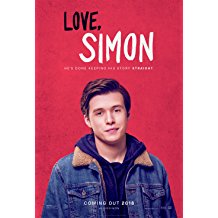
Love, Simon presented a completely different raft of problems. Simon is a closeted teen in an affluent and diverse town. When an anonymous classmate comes out on a school BBS, Simon reaches out, also anonymously. He and “Blue” develop a friendship online, while Simon tries to figure out who his confidant is. Due to a lapse of judgement, Simon’s secret is found out by a manipulative and desperate classmate, who blackmails Simon into setting him up with a friend. To do this, Simon is required to keep his friend from asking his other friend out and to do this, he sets his best friend up with the guy, all so he can sell his female friend’s happiness for his own protection. 

Ultimately the whole thing comes apart, and his friends are rightfully angry at Simon for using them as pawns. But they and the school rally around Simon and Blue and, ultimately there is a happy ending for them. 

There were so many things wrong with this sweet gay romance I wanted to scream. As each of them was addressed in the narrative, I felt a little better, but the main problem was never touched on.

-WHY?-

Simon has an openly liberal, white, affluent family; he lives in a liberal, affluent diverse town. His friends would clearly not reject him, his family would very obviously be 100% behind him. It’s 2018. There’s no stigma. No homophobia. He is protected in every way from any negative consequences of coming out. There is literally not one good reason presented as to why Simon, a presumably nice person, would literally spend weeks manipulating and lying to friends rather than just look at his blackmailer and say “publish and be damned.” The only possible lesson we can take from this is that Simon is….a weak jerk. He’s not a good guy. He’s not a nice person. Simon is a person who, when faced with crisis will literally destroy other people’s lives to protect himself.  And yet, we are supposed to root for him in his romance and forgive him his trespasses against the people who trusted him. Um…

In his review of Love, Simon, Daniel D’Addario asks if we need a gay teen romance. Backlash was hard, as people ran to the defense of the movie – of course, we need gay romances and happy endings! But, I have to ask, do we need them to follow the convention of externalized/internalized homophobia even when no such pressure exists? Why does Simon do what he does? Where does his internalized homophobia come from and why is it enough of a motivator for him to actively attempt to manipulate (and sell! He is selling his female friend to a manipulating jerk!) his friends? 

Love, Simon is a nice romance, if you ignore that Simon is not at all a nice person. It’s practically Shakesperian in scope and plot, and about as satisfying.

There is a lot of room to explore human failings in gay romance. And, I think it’s a very good thing that we have two such stories available to us this year, but neither addresses the nature of those failings except in the most facile way. 

We definitely need gay teen romance, but I’m not sure we need to have them with the lingering vestiges of homophobia that we, as adults, felt, when teens. Kids nowadays are capable of growing up without them. As with science fiction, I believe the role of feel-good-romance movies can (and, arguably, ought to) be showing us a better world; one that exists when these  things are past and we no longer even remember what it was like. 

Both of these movies had good moments, but both really needed to be removed from their makers’ assumption that characters live in fear, self-loathing and self-doubt, for them to make any sense.

Ratings:

Call Me By Your Name:
Cinematography – 8
Acting- 7
Story – 6
Characters – 6 Predictably, I like the local girl best and was glad to see her out of that mess
LGBTQ – 10

Overall – 6

Love, Simon:
Cinematography – 7 Very MTV
Acting – 8
Story – 7
Characters – 8 
LGBTQ – 10

Overall – 7 It would have been an 8, except for that litttttle problem of Simon selling a female friend to a blackmailer for no fucking good reason.

I’m going to make a point of watching Blue is the Warmest Color before the end of summer. While I’m being fundamentally dissatisfied with flawed LGBTQ movies, I might as well go for a trifecta. ^_^ I’ll be back next week with a great summer LGBTQ read to ease our hearts. ^_^




Live-Action: Sailor Moon Musical – Le Mouvement Final on Screen

March 11th, 2018

Sailor Moon Musical – Le Mouvement Final, at a theater near you. That’s something worth getting up and going out for. And so, we did. In a small, adorable, old theater, in a town in my state I had never before visited, I found myself joining about 100 fans for the screening of the final Sailor Moon Musical. 

My relationship with Japanese live-action stage adaptations of anime is complicated. On the one hand, I sort of enjoy them (except for Blood-C The Last Mind – which is on Amazon Prime – and STILL didn’t end! /mumbled cursing/) and I sort of find them excruciating and ridiculous…and boring when the pacing is poor. Because the musicals have naturally grown up in the shadow of the engekidan, the female musical revue troupes like Takarazuka, they have a lot of tropes built in, many of which are hard-coded, like a tendency to be extremely heteronormative. As a result of all this, they can be wonderful and annoying or just plain dreadful. ^_^

Complicating things for this particular musical is a simple fact. I don’t much like Sailor Moon Stars. In the anime, Seiya’s a dick, Yaten is an asshole and Taiki’s a jerk. I don’t find them sympathetic at all. And the end of the story in every version is a train wreck. Takeuchi-sensei had no idea how to end it. So, with all this in mind, I arrived at a small town theater-with-a-marquee all ready to be vaguely irritated. ^_^; 

I enjoyed it very much. It wasn’t excruciating, as such things go, the pacing was surprisingly good for doing an entire season of anime in two and half hours AND they managed to make the Starlights much more sympathetic than I’d ever seen.

In fact, I’d go so far as to say, I actually liked Harukawa Meiku’s Seiya. If they had done this story in the anime, my relationship with Stars would be completely different. 

Of course the Senshi are delightful. Funny bits were funny, not cringe-y, although in several places I noticed the audience I was in laughed at different times than the live audience on the tape. Yamato Yuga in a tux is never a bad thing. Isuzu Coco as Galaxia was fantastic, with excellent “crazy eyes”. The Animamates did a very decent job with their roles – and the costumes were fantastic. It cannot be easy to render 2-D drawings in 3-D with real people. 

Staging was pretty good, and one of my favorite things about the musicals has always been the lighting effects which stand in for all special effects. They were a lot of fun, especially during battle scenes. (As an aside, it dawned on me that anyone who can make cosplay items that have their own Foley will be a millionaire. Capes that go “whoosh” and sleeves that go “pow!” when you punch would be brilliant.) Okubo Satomi, the woman who first played Sailor Moon in this series of musicals, returning as Sailor Cosmos was a really nice touch. We all enjoyed seeing the costume come to life. Kakyuu-hime had a lovely voice, but didn’t have staying power, so the end bits were a little painful. And Natsu Chise as Chibi-chibi was, dare I say it? Cute. She was cute.

But for me, the question was simple – would this be as Yuri as the anime? The answer was…good heavens, yes. I mean like crazy yes.

Haruka and Michiru are touchy-feely throughout the story. Forget dying together, they are all arms around shoulders and stroking cheeks. Haruka explaining her dislike for the Starlights became amusing when – among all other suspicions – Taiki had insulted Michiru’s lipstick color. Michiru got to use the line “Haruka doesn’t like popular guys” and also the “I’ll make it up to you later…in private” line, which made the anime worth watching. That scene was hot enough that the other Senshi all fan themselves and say “hot!” which the translators decided reasonably on as “Get a room.” ^_^ Shiotsuki Syu and Fujioka Sayaka do a great job of presenting a long-term relationship, with multiple affirmations of “as long as I’m with you…” often enough that it was deeply satisfying. Thank you writers of this musical, and Takeuchi-sensei for that. The world – well us, anyway – is more than ready for a Haruka and Michiru who are physically affectionate on stage. 

For the Usagi x Mamoru fans, there was plenty of love-dovey between them, including a wedding scene at the end. That scene, which included all the Senshi in wedding dresses (“Why?” Usagi asks. “Because we wanted to!” replies Minako. “They’re pretty!”) and a dream sequence, were strongly reminiscent of two recognizable images from the artbooks. 


Not the same dresses, at all, but we immediately went there in our minds, at least.

There were a few significant changes from the original story that I thought were notable. In this version, the Outers do not take the position that the Starlights are an enemy, but actually want to work together. That’s a major change – and a positive one, because I really hated that we re-played the “we can’t work together” thing from Sailor Moon S. Setsuna and Haruka instantly grok that the Starlights are Senshi when they touch Seiya in separate scenes. Haruka also notes that they are women passing as men, which is true to the manga and was Takeuchi-sensei’s original intent. (It doesn’t negate the validity of this story as a trans narrative, in any way. However we interpret the characters is valid.) I liked that the story was shifted from “They need our help, but are strangers, so we’ll fight them” to “We’re all Senshi, let’s help them” and Usagi only had to argue that the Animamates were also Senshi, we shouldn’t fight them, either. It’s a much-needed expression of maturity on all of the Senshi’s parts. I assume Takeuchi-sensei has been thinking about this for 20 years, so I’m very glad this was her decision.

The ending of the story was still a trainwreck, but at least it was a completely different trainwreck than ever before. So that was a thing.

There was a short “revue” portion, while Yamato Yuga showed off a number of different tuxedos and the ensemble sang “Koi Suru Starlight,” “Moonlight Densetsu” (I looked around to see if anyone else in the theater was singing, but only the two of us were) and ended on “Ai no Starshine.”

When the movie was over, I stood at the door to ask if people enjoyed the movie, and who their favorite Senshi were. Everyone enjoyed it, and the most popular Senshi in this crowd was Sailor Moon herself. 

We chatted with Allie and her boyfriend who had never seen a Sera Myu before. Allie explained how life-changing Sailor Moon had been for her when she saw it as a kid. Of course we understood. I asked the gathered crowd how many people had been fans forever and most hands went up. ^_^ 

Someone cleverly thought to grab a picture of those of us hanging out in the lobby!

It was a wonderful show and we had an absolute blast. 

Ratings: 

Overall – 9

OH, AND the theater was showing three young-people-, people of color- and LGBTQ-friendly movies: Black Panther, Wrinkle in Time and Sailor Moon Musical that afternoon. The place was full of young people and it was absolutely delightful.