Archive for the Miscellaneous Category


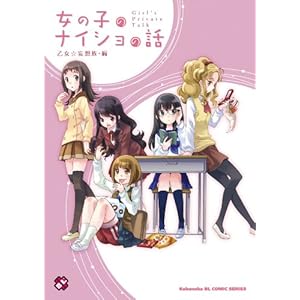
Yuri-ish Manga: Onna no Ko no Naisho no Hanashi

April 5th, 2011

There’s two things you need to know about Onna no Ko no Naisho Hanashi (女の子のないしょの話):

1)  Hakamada Mera’s name has been attached to this book in the way that Stan Lee’s name is attached to ULTIMO, or Courtney Love’s name was attached to Princess Ai. Yes, she does have a single page in the book. Stan Lee appears in ULTIMO too, but you gotta take the name with a grain of salt.

2) Of the three words on the obi, “Love? Lily? Lesbian?”  only two are actually related to the contents and then, only tangentially.

Knowing these facts will not make this book better, but it will temper your expectations.

The translation of the title is presented as Girl’s Private Talk and, just as it sounds, you are going to get ingenuous wide-eyed-ness over not-quite-really-Yuri situations that are presented as memories of youth by the various mangaka. It feels exactly like those cheap little sex magazines sold from under the counters of convenience stores across the nation that were written as if they were personal memoirs and letters but were clearly written by one sad college student with a paucity of imagination…without the sex.

Every story starts with something like this, “Oh, when I was in school there were these two girls who were really close…” and the story unfolds with them maybe being something sort of like a couple, or almost kissing, but not really.

A few of the stories get close to situations that might have become awkward if, say, the two protagonists were left alone in the room for another ten minutes, but they never are and kisses are few and far between in this collection.

This is a book of not-quite-even-Story A: There is a girl. There is another girl. They might like each other, but nothing will come of it…probably.

If what you love best about Yuri is the tense moments *before* the relationship is a thing, or you love ingenuous glimpses behind that girl’s school curtain, then this is the book for you.

Ratings:

Overall – 3 For all these stories are short, almost none of them managed to keep my attention.


Shoujo Manga Magazine Yuri Watch: Sabagebu (さばげぶっ!)

March 27th, 2011

Last fall, there was a veritable explosion of Yuri-flavored shoujo manga in all three of the leading shoujo magazines Ciao, Ribon,  and Nakayoshi. Leading the way was Nakayoshi with Nobara no Mori no otome-tachi. Now that that has been moved over to the seasonal special Nakayoshi Lovely, Sabagebu has stepped up to the plate.

Sabagebu (さばげぶっ!) is short for “Survival Game Club.” The story follows first-year middle school student Momoka, as she is strong-armed into joining the Survival Game Club by the charismatic, popular and insane club president, Miou.

The club – when they manage to get any activities in at all – primarily engage in military training and war games-style activities. To what end, we don’t yet know. Mostly, it seems, because Miou wants to. Momoka comes down to breakfast to find Miou parked at the kitchen table, charming her mother and waiting to drag “Mokarin” to morning practice.

In the April issue of Nakayoshi, the Sabagebu gets a new member – Kasuga Urara. Urara is a hard-ass. She thinks that Momoka is weak and pathetic and more importantly – standing between her and the object of her desire, Miou-sama. Urara is assigned to Momoka as a training partner and, to express just how much she really wants Momoka out of the way, so she can have her beloved Miou-sama to herself, she works Momoka nigh unto the bone.

When, by accident, Momoka succeeds in some camouflage surveillance, she is praised mightily by Miou and the other sempai, and Urara runs off in tears. Only Momoka follows her, and offers the new girl kind words of comfort and a handkerchief. And…a new love interest is born, as lilies bloom around Urara’s head. The next morning Momoka comes down to breakfast, pleased that today she won’t have to go to morning practice, only to find Urara parked at the kitchen table, charming her mother with her loli-cuteness and nosebleedy desire. Bwah~bwah~bwaaaahhhh~~~

It’s a throwaway Yuri character and nothing will come of it, but seriously, who wouldn’t want to read a shoujo manga story about a middle-school paramilitary “club” with Yuri elements?

Ratings:

Art – 6
Story – Seriously idiotic – 6
Characters – Just as seriously idiotic as the story – 6
Yuri – 4
Loser FanBeing – 5

Overall – 7 because it’s seriously idiotic and you cannot possibly be taking it seriously, so what the heck, it’s fun.


Bustician Manga, Guest Review by Bruce P

March 20th, 2011

Erica here. I’m busy chauffeuring Rica Takashima today to the Dykes Draw the Line slide show and discussion at the Bronx Academy of Arts and Dance, and with news, both good and bad, we’ve had few reviews here in the past week. Today we have one of those ever-so-special treats when a Guest Reviewer jumps in to save me from losing my mind and you from having to go a single day without wit and/or wisdom from Okazu. Today it is my very special pleasure to welcome back Okazu superhero, one of my dear friends and best lackeys, Bruce P. with what I promise is a very witty and wise review….

Breasts.

Just practicing. Its a word that will be used an awful lot in this review.

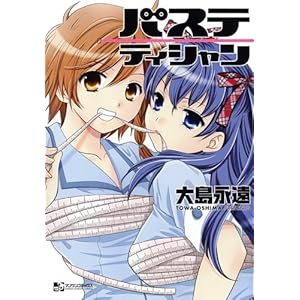
To begin addressing the manga Bustician (バステティシャン) by Oshima Towa, it is useful to refer to an earlier review by Erica of Gokujouu, in which that manga was described as ‘a more nudity-filled, more pervtastic, even MORE stupid version of the same exact set of gags in High School Girls…if Kouda was the lead character.’ Oshima Towa, author of High School Girls, apparently is not one to let such a challenge in the arena of plummeting taste go unanswered. Unfortunately with Bustician she succeeds brilliantly, plumbing the depths of bad burlesque in a fundamentally bizarre manga that centers entirely on the female breast. Incidentally, the term ‘plumbing’ was brought to mind by the manga itself, see below (‘plumber’s helper’).

The word Bustician is a contraction of bust aesthetician, an expert in breast aesthetics. Kokoa and Mami are new busticians working in the salon Bustnia. They are under the tutelage of the lovely and poised Sarasa, and are rivals for her affection (actually, they are less interested in the affection than in the groping, but we’ll get to that). Bustnia is a breast salon. Women who are unhappy with their breasts are treated to various massages and non-surgical treatments to augment, diminish, reshape, or otherwise change them. Each chapter involves a woman (or pair of women) who has a difficult relationship issue or career issue or self-image issue originating with their breasts and hopes that Salon Bustnia is the answer. These issues are serious concerns to the customers and obviously highly personal, but what we are treated to is a barrage of slapstick gags as the two new girls maltreat their customer’s breasts in painful, extended and explicit displays of nominally hilarious, clueless, Kouda-esque ineptitude. You would think the girls had never encountered a breast before. For breast augmentation cases Kokoa is always reaching for the vacuum cleaner. And yes, the plumber’s helper.

In fact Kokoa and Mami are girls only on the outside. They behave in every way like adolescent boys – presumably mirroring the intended audience. They are fascinated by breasts, excited to learn new things about them, unable to keep their hyperactive, groping hands off them. Their prime desire is to see Sarasa naked, and they get all nosebleedy on those occasions when it might just happen. You get the feeling that somewhere along the line they must have been hit on the head by one of those falling spaceships, and since their reconstruction as girls are now living a boy’s voyeuristic fantasy. On one page that will get you some interesting looks on the bus Kokoa is massaged by Sarasa and falls into a trancelike dream where she is lying in blushing, naked, orgasmic bliss in a bulging sea of elephantine breasts. This illustration takes up a full page, in the corner of which a chorus of smiling disembodied SD breasts are singing the happy breast song. You know, the one that goes ‘O, o, o, o, o–, oppai oppai oppai opapaai.’ Yeah, that one.

There is Yuri. Two of the employees have a relationship, one of whom, Asahi, is brought onto the case of the customer with the insensate breasts. Asahi’s explicitly sexual and obviously well practiced massage solves the woman’s problem, only to create another one: a hopeful repeat customer (it’s not that kind of salon, apparently, though it sure looks like it most of the time). A woman with large breasts wants to look more like a man when she is making love to her girlfriend (it turns out that her girlfriend likes her just the way she is.) Then there’s Kokoa’s and Mamai’s desire for Sarasa, but again, it’s more adolescent male lust than anything else.

Ratings:

Art – 7 Typical Oshima Towa, which is not bad. Her breast art is an adolescent’s dream. In this manga she had lots of practice.

Story – 2 Pain, embarrassment and interminable physical abuse can sustain a story only so far.

Characters – 4 It might seem like the customers deserve some sympathy, but they really don’t, because they rarely get up and pound the living crap out of Kokoa and Mami.

Yuri- 6 Some of the secondary characters are definite couples. Kokoa and Mami lust after Sarasa’s breasts. Put it all together and shake and OK, there’s some Yuri.

Service – 90 Breasts. Naked. Multiple. Massive. On every page. Without some of the women’s issues it could have been 91.

Overall – Oh, somewhere below 5. That the translucent first page that allows you to remove the negligee and reveal the breasts of a full color Kokoa actually sums it up pretty well.

Having enjoyed High School Girls, I would like to believe that Bustician was meant to be so unbelievably over-the-top, so tongue-in-cheek in its breast obsession that normal standards were sort of beside the point. But as in the case of Ernest Vincent Wright’s Gadsby from 1939 – a novel written without once using the letter ‘e’ – intense single-mindedness may be a source of amazement, but can make for a pretty lousy read.

Erica again: Hahahahahahahahahhahah

Better you than me, Bruce.


Anime and Manga Bloggers for Japan

March 18th, 2011

In times of crisis, it is completely natural to feel feelings of helplessness and panic as we watch events unfold that are completely out of our control. For those of us not in Japan, there is little we can do in any case. Fans who have strong emotional ties to Japanese voice actors, creators and industry people feel actual panic when we do not hear that our favorites are safe and sound.

But, you know what I feel about this kind of thing – when faced with a feeling of helplessness, the most important thing is to *do something*.  There are many fan-based efforts going on for fundraising – please feel free to post the ones you want to promote in the comments. Today I want to tell you about Anime and Manga Bloggers for Japan. Started by All About Manga writer and Tokyopop Editor, Daniella Orihuela-Gruber, this effort combines the forces of all the many, many anime and manga bloggers and their readers out there into one powerful action to provide support in this time of need.

Anime and Manga Bloggers for Japan provides you two choices of rescue/relief organizations, both of whom provide relief directly where it’s needed most, ShelterBoxes and Doctors Without Borders. Daniella wants to raise $1000 each for these two organizations and she’s more than halfway on both.

If you feel the need to do *something* – do this. Send money, which will provide medical care, shelter, food, water purification, cooking stoves to people who need it. It’s something you can do and you will feel less helpless and panicky when you do *something.*

If you have a blog or a social media profile, please feel free to spread the word, as well.


UBC Lecture Post-Mortem

March 17th, 2011

First of all, I want to thank James Welker for giving me the opportunity to address his class – it was amazing. The questions were good, just as hard to answer as ever, and I thought I’d try and capture a few of my thoughts before they slip away.

As we talk about Yuri, the genre, we have to remember that until like 5 years ago, it wasn’t really anything like a “genre.” Yuri was – and often still is – a series of disparate ideas and elements that serve different purposes for different audiences. What we *now* consider to be the literary antecedents of Yuri (Yaneura no Nishoujo) or early Yuri manga (Shiroi Heya no Futari) was not being created to tell a Yuri story – and perhaps not really even a lesbian story. After Ito Bungaku coined the words Barazoku and Yurizoku, the word Yuri was immediately appropriated by people creating “lesbian porn” as well as being adopted by lesbians. When the word Yuri came to mean “lesbian porn” pretty much to the exclusion of anything else, it was mostly dropped by lesbians and got pushed to the background as “typical” background art indicating a “lesbian” scene. So women writing, drawing and creating for other women still weren’t creating “Yuri” as we know it.

Yuri elements mean different things in different series to audiences. The genre defines certain characteristics, but beyond that the token lesbian character will be perceived differently in a seinen manga and a shoujo manga. Just as what men looking for hentai art of characters in sexual positions mean by Yuri and what I mean by Yuri are two entirely different things.

It wasn’t until a very few years ago that stories that were uniquely “Yuri” were being published and they are – for the most part – romance stories, with little other genre influence at this point. That’s changing a bit and I look forward to that shifting as the genre matures.

Which brings me to something I had very much wanted to say, but forgot to squeeze it in:

Just because you regard something with profundity, does not mean that the creator meant it to be profound. 

I can honestly say that watching Sailor Moon changed my life radically. I have thought, written, talked about it for many years and have parsed everything one can in that series. But…and this is an important but…it’s really just a kid’s cartoon. Takeuchi-sensei may have hit in the gold with this series, but do not suppose that she was seeking to change the world with it. That she *also* changed my world is an added bonus for both of us. I’m fairly certain it was not her intent. ^_^ Shoujo Kakumei Utena is another good example. I had the chance to interview the director once and learned something critical – that he assigned no actual meaning to any of the symbolism in the story. He did things entirely because they looked visually appealing. The train means what you want it to mean, the baseball game, the arrows, the cats…all of it means whatever *you* make it mean. That answer drives people crazy because they insist he had to have had something in his head, but what he was thinking was, “That’ll look cool.” ^_^

Andrew asked what tropes are we seeing in Yuri and how have they changed. Right now, the tropes in “Yuri” are more likely to be tropes related to the larger industry trends for that category of manga. Moe is reallllllly popular, so there is a lot of moe being drawn. It’s not a Yuri trope – it’s a “how can we sell this?” trope. If moe is hot, then we draw moe because people will buy it. The same goes for ambiguity. If we keep a vague possibility, no matter how thin, of Nanoha and Yuuno as a couple, then those people who like them together will buy it *too*. If Nanoha and Fate kiss, it might ruin that sliver of hope for the Yuuno fans, poor bastards. Yuri written for shoujo magazines are going to look like shoujo stories, rather than something uniquely “Yuri.”

One last thing (thank you Andrew for reminding me!) Let’s talk moe for a moment. Moe is, as I see it, a infantilization of female characters. By cute-ifying them, they are rendered as more youthful – and implicitly – more innocent. “Story A” does much the same to their emotions. By placing the story in explicitly “moe” years – i.e., the years just before and into puberty, the creators are  saying that these stories do not reflect adult love or desire. They are childhood crushes. All of this renders the story “harmless.” These are not lesbians – women who will grow up without need of or desire for men, and whose lives will not be dependent upon a man for money or sex – these are little girls “playing” at romance. For male readers who might see actual lesbians as a potential threat (to their status as men in a male-dominated society, which means no matter how low they are perceived by other men, they can still feel superior to the most accomplished woman, and to any preconceived understanding that, in a heteronormative society, no matter who they are or what their hobbies, they can and will get married) all of these are tools that transform the threat into a delightful fantasy that can be enjoyed without any sense of unease. To sum up – any man reading these stories can relax and know that, no matter how passionate this same-sex relationship appears to be, they’ll grow up and get over it.

I think I’m running out of steam here, so I’m going to just finish up with – great questions folks, and it was a genuine pleasure to talk to you all. I hope we’ll get to do it again soon. ^_^