You know what the Japanese national sport is, right? Oh, sure, Sumo is usually given the place of honor, but really, Japan is absolutely, passionately crazy in love with…baseball.
There are a ton of baseball manga in Japan and Major, a baseball anime/manga franchise, has not one but two anime series on Japanese TV. (One follows the older brother and one follows the younger brother.)
It’s true that few of the loads of sports anime and manga ever make it over here. There’s all sorts of theories why, but I wager it’s a pretty simple thing – soccer is not as exotic as ninjas. If American otaku are interested in soccer, they’d play or watch soccer. One of things that appeals about being an otaku is the exotic-ness of the “other.” Ninjas are exotic, service is titillating and lacking from teen literature here and Japan is…Japanese. It is ostensibly not America, or Europe or wherever you are from. Soccer is normal. It’s right out the window. Baseball is what your /insert baseball-obsessed relative or friend here/ endlessly obsesses over online and on TV.
When I heard that there was going to be a baseball anime about girls, set in the Taisho period (1912-1926) I cringed. I thought, great. It’ll be a moe-filled, demeaning “aren’t they cute” series full of typical diminutized and diminished female accomplishment. Well gosh, I was SOOOOO wrong I could not have been wronger. Except for the moe part. It is indeed moe.
The story follows Koume, a school girl during the Taisho (the word is properly pronounced “Tai-shou” but is more commonly spelled Taisho in English) period. The year is 1925. Japan is rushing to modernize and westernize. It is the “S” movement’s heyday, when early feminist sentiment was starting to filter through Japan on the wings of magazines for girls and women.
Koume’s dear friend Akiko asks her to form a baseball team in response to a sexist sentiment from Akiko’s baseball-playing fiancée. Girls, he says confidently, really don’t even need to go to school, because they will just stay home and raise children and run the household. Akiko decides to form a baseball team and challenge his worldview. And so, Koume and Akiko start looking for more players.
The feminism is portrayed in a genuine, real and totally intelligent way in this anime. Nothing cringe-making about it at all. And the sentiment isn’t lost in the moe. It comes back again and again to remind us that it’s just ridiculous to see woman as inherently inferior.
I don’t mind sports manga and anime, although the typical patterns sometimes get up my nostrils. The tropes work *really* well here, so the trials they have in learning the game, working together as a team, finding an opponent and dealing with each new obstacle is, simply, good entertainment.
There is exceedingly mild Yuri akogare (admiration/desire, crushiness) because it is a girls school. Hunky, sis-con Tomoe has a pair of uber-dedicated fans, one of whom stays on the team when Tomoe (coached by Koume) embraces her and tells her she can’t do it without her. Kyouko never had a chance. ^_^
At the beginning of the series, Koume clearly akogares Akiko and, as catcher and pitcher they are told to become like husband and wife. I couldn’t call it closer than shinyuu, best friends, but they are fun to play with. ^_^
The voice cast has some notable “Six Degrees of Yuri” names, including a passel o’ Marimite voices.
But beyond all that, what makes this story work is the story. It’s a *good* story. Yes, I can see some of the issues coming from a mile off, but each episode makes me smile, makes me laugh out loud, makes me sniffle a bit sometimes, and is a rattlin’ good yarn. It makes me remember why I used to love baseball, when it was a sport and not an industry full of over-paid whiny brats. I would not hesitate for a second to show this anime thus far, at least, to anyone of any age.
If you haven’t yet given Taisho Yakyuu Musume a try because you’re hesitant to see moe-ified girls playing baseball, do try it. If you hate sports and sports anime, avoid it. It’s *about* baseball. In my opinion, it is an enjoyable combination of girls, baseball and Japanese history…all at once.
Ratings:
Art – 7 Still too moe for my taste, how I would love a live-action of this series
Story – 8
Characters – 9 My favorite is Kawashima, the de facto team manager
Yuri – 1
Service – 1
Overall – 8
Like A League of Their Own, the ensemble is half the fun and the story the other half, for a total good time.

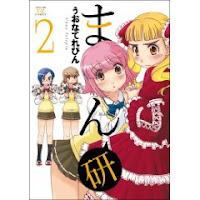 In Volume 1 of Manken (まん研) we learned that the B-team manga club doesn’t so much draw manga, as hang out, make first-year member Saki play dress up and, well…fuck around.