Archive for the Series Category


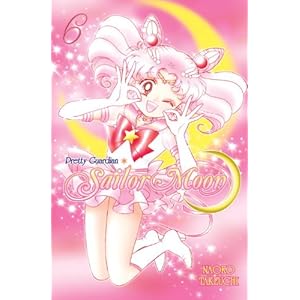
Yuri Manga: Sailor Moon, Volume 6, (English)

July 13th, 2012

You may have noticed that, although Sailor Moon has been out in English for some time, I have not yet written a review of it here. There was no ulterior motive, it’s merely because the first 5 volumes in this edition have no Yuri. It’s not until we reach Sailor Moon, Volume 6, that we’re turning our sights here on Okazu towards it. This is the beginning of what is referred to by fans of the series as the ‘S’ arc – a phrase that comes from the third season of the anime, Sailor Moon Super, or Sailor Moon S. (Those of you familiar with the series knew that, but there may be readers who have never read the manga or watched the anime before – after all, the series is 20 years old. That explanation was for them. ^_^)

Usagi is about to have a moment of unadulterated happiness with Mamoru when they are interrupted. Usagi feels as if, whenever they get a moment of complete quiet for themselves, it’s doomed to be brief. And she is completely correct, as a new enemy appears. With shared dreams and visions of destruction…and vague words about the “Talismans”, the Senshi are once again called upon to protect the Earth, this time from a group with  the ominous name Death Busters.

It’s very hard to read this volume of manga and not flip back and forth in my head to the anime. Eudial’s appearance made me laugh out loud…but there’s no reason why that should be, she’s merely another bad guy to be defeated here. Nonetheless, when she showed up, I immediately flipped over to the Eudial of the anime, who was one of the greatest bad guys in the history of anime, with her terrible driving, her migraines and the best Monster of the Day ever, Doorknobder. (Go ahead, let’s say it and get it out of our systems, shall we? “Doorknobder Desperate Attack!” Okay, there, we can move on now…)

But this is not the anime. The tension is deeper, the bad guys are far more ominous and the good guys are, as well. When Haruka and Michiru arrive, it is impossible for us or the Senshi to know if they are friends or enemies. And they appear, perhaps, to be playing a third side. Haruka gets close to Usagi and Michiru seems to have her eyes on Mamoru, but in their private time they seem to be a couple. Who are they? What do they want? Whatever it is, they know a lot more about the situation (we think), as they carry two of the Talismans.

Haruka is first presented as a guy, but when she’s seen in women’s clothes, then later as a Senshi, she’s understood to be a woman. Usagi will ask her which she is and unhelpfully, she will respond with a question, “Does it matter?” It doesn’t really, but it does matter that Haruka and Michiru are older, sexily hyper-competent and don’t know as much as they think they do about what’s going on.

Artemis and Luna offer useless information (as they always do) about the mysterious new Senshi that have appeared. (I am, and always have been convinced that the only one of the Senshi team with any brain cells to rub together is Diana.)

And what is the role played by the sickly girl, Hotaru?

We don’t really know by the end of this volume. Which means we want to get the next volume. ^_^

Ratings:

Art – 7
Story – 7
Characters – 8
Yuri – 8
Loser FanErica – 127

Overall – 7

I am reminded that the origin of the Yuri helicopters was Sailor Moon. (I should have remembered that Strawberry Panic! had no original elements of its own.)  Phew!


It’s A Woman’s World: Bodacious Space Pirates, Maria-sama ga Miteru and The Bechdel-Wallace Test

July 10th, 2012

Bodacious Space Pirates came to an end and I thought it delightful in every possible way. As I (over)thought how I’d approach a final season review, I started to think about the qualities that made the series stand out for me – and what, specifically, that meant in terms of storytelling. And, ultimately, I started thinking about how the series portrayed women.

Courtney Duckworth on Broad Recognition has a really excellent review of Pixar’s Brave, in which she discusses something that any woman in the corporate world knows…to be a successful woman, you have to be a man. I remember a conversation I had with a young executive who was being groomed for a CEO position in the company I worked for at the time. He was having a little crisis because, in order to be the man they wanted him to be, he had to give up his family life. It was expected, respected and demanded that he not be there to see his kids play in their first ball game, not attend recitals, because his company needed him. I watched him as he talked his way through this, as he justified letting his family drop off in importance and the company become the thing he would care about. In the end, he became a very successful CEO, and I remember this conversation as the saddest one I have ever had with another human being. For women, who are presumed to be primary caregivers, the stress of letting go of family in order to be successful as a CEO is almost insurmountable. Let someone else raise your kids? (Doesn’t matter if it’s your husband…it’s NOT YOU.) You’re heartless. Focused and driven? You’re a bitch. Want to take time off to see your kid’s recital? You’re not dedicated. There is no way to win, because you are not a man with a wife who will watch the kids in the background.

Merida, like Ermina (Paros no Ken), Safire (Princess Knight) and Lady Oscar (Rose of Versailles), excels at men’s skills, in a world that pretty much has one path to excellence – being as brave and competent as a man.

Let’s stop here and take a look at the Bechdel_Wallace Test for a second. As a reminder, the test goes like this.

1. [The media in question] has to have at least two [named] women in it.
2. Who talk to each other
3. About something besides a man

In a recent email exchange with Alison Bechdel, she and I discussed the idea of “would Mo watch it?” as an unwritten, extra factor to measure if a media property follows the letter, but not the spirit of the Test (that is, it fits the criteria strictly, but it’s still not the kind of thing that Mo is looking for in entertainment). ^_^

So what does this have to do with Bodacious Space Pirates and Maria-sama ga Miteru? Everything.

Let’s start with Maria-sama ga Miteru. In the rarified and protected world of Lillian Girls’ School there are no “men’s jobs.” The leaders of the student body are women, the Principal and many of the teachers are women. The presumption with which the entire series is presented to us is that Youko or Sachiko or any of the other members of the Student Council  will move into positions with decision-making power when they graduate – if not effortlessly, then they will certainly be capable of standing up for themselves, because they have been trained to be leaders. No one ever comments that they are as good as men, or that they run the student body with masculine focus. Lillian is a woman’s world and within it, women do jobs women can do, if they are give the opportunity to do them. (This is something that research bears out – given equal opportunity to excel, women will excel equally.)

In Bodacious Space Pirates, Marika is going to school in a woman’s world, but she isn’t thinking about it that way, any more than Yumi was. It’s just…school. Then something changes and Marika is indeed sent into a world that is traditionally inhabited by men – piracy. And here, at last, we get to the point. It’s true that Marika faces some trials based on the fact that she’s y’know, a high school girl, but her gender alone is less of a problem than one might have expected in a series like this. Being a woman doing “man’s work” is pretty much never an issue, except in one or two totally valid scenes. (Two young women trawling the back alleys of a pirate hangout is a completely reasonable use of that kind of tension.)

Both these series star female characters in a relatively female-heavy cast, and so they both fly through the letter of the Bechdel-Wallace Test easily. But…there’s more to them. In neither series is there a focus on turning a sexualized male gaze on the characters. It really doesn’t matter how “strong” a female character is – when we are forced to stare continually at their crotch or chest, there’s a different story being told – “Yes, she could kick your ass, but it’s okay, you could still have sex on her, so you’re still superior to her..”

Let’s think, for a second about the inevitable “beach episode” in Bodacious Space Pirates. In any other series, if I ask you, “What was the beach episode about?” the only real answer you’d have is “It was about reducing the female characters to a series of sexualized visual images.” Now think about the beach episode of BSP. What was it about? The plot was the trial run for the dinghy race, but it was *about* Ai-chan. In any other series, would there have been an entire episode about a relatively unimportant character like Ai-chan? Would there have been a follow-up episode about her? Would she have been developed as more than a name at all?  There was no attempt to turn Marika or any of the characters into a pair of jiggling boobs.  Yes, we absolutely saw the female characters in bathing suits…but we also saw Kane in a bathing suit. He was not ripped, but he was fit. We saw his ass as many times as we saw the girls’. I don’t care about *either* the girls or Kane in a bathing suit, but the service was pleasantly even-handed and blessedly low-key. It would have been hideously easy (and hideous) to simply stare up the Yacht Club members’ skirts all the time, as anime as a genre slides into a low place in which a majority of viewers seem content to huddle – but that does not happen here.

Both these series have female-heavy casts, but not female-exclusive casts. These are not reverse harems, not reverse shounen series. There are brothers, fathers, uncles, male teachers, colleagues and crew in these worlds, just as there are in the real world. A woman’s world in these series does not mean “the exclusion of all men,” as it might in a male gaze fantasy like Strawberry Panic!  These women have society, which is, in my reading of it, the meaning of the third and final criteria of the Bechdel-Wallace Test.

Maria-sama ga Miteru and Bodacious Space Pirates are about strong women as *I* understand the concept. Women who are perfectly capable living in a world populated by men and women; women who can take command of both men and women and be respected as leaders – and who are not judged by a set of standards that are skewed so they can only ever fail. Women who can find their own solutions to issues, not to have to excel at men’s thinking or men’s skills to be considered a success.

In these series, women are shown as being as brave and competent…as a woman.

Would Mo watch these? I think she might.


Bodacious Space Pirates Gets Film Project

July 1st, 2012

Not from Anime Expo, (and many thanks to YNN Correspondent Cryssoberyl for the heads up) announced after the final episode aired, Bodacious Space Pirates is getting a Film project.

Nice….!


Yuri Manga: GUNJO, Volume 3 (羣青下)

June 20th, 2012

The third and final volume of GUNJO (羣青 下) is no easier to read than the previous two volumes. In fact, there are several moments that still manage to shock and appall, even with all we’ve been through.

“What would you kill for?” The brunette, Megane-san, asks the blonde’s, Sensei’s, sister-in-law, and she in turn asks her husband. It is a question that is buried deep in the heart of this volume.

Things we thought we knew, turn out to be not true, and the depth of the despair of Megane-san’s life only becomes truly apparent when she’s all but shed her last layer of emotional armor. Still, it is in moments where kindness manages to be felt for a mere moment, that brutality is the most harsh, and in the middle of the most intense violence when gentleness can be felt most clearly.

One of the questions asked back when I reviewed the first or second volume was – how much time has passed? I can answer that now – it’s been about a week, going on two.

As I read this story, probably about halfway through what would become the second volume, I conceived a wish – a hope. It was an insane hope, because there was nothing at all in the story that lead me to think it could ever come true. I desired, most of all, to see the two characters – the beaten, abused, unloved woman, and the woman who killed for her – smile. It was a ridiculous wish that could never happen.

The final half of this final book is the literary equivalent of lancing an infected wound to get the infection out. There’s really no other way to describe it. Page after page of confession, admission, digression, discussion finally brings the two characters through the last of their despair to the inevitable end of their story.

GUNJO is over and I have nothing left to say about it. It’s been wonderful, it’s been painful, it’s been sublime.

In the end, there’s only one question left for you to ask – Did they ever smile? You’ll have to read it and find out.

Ratings:

Overall – 10

Once again, I want to thank Nakamura Ching-sensei for creating this extraordinary story. 

Without question, GUNJO is the best manga I have ever read, and it encroaches deeply on the “best book I have ever read” list.


Yuri Artbook: Miyabi Fujieda’s Color Illustration Collection 2000-2006

June 8th, 2012

In 2010, you may remember that Kazami Akira-san was very kind to let me know of an art show in Akihabara, featuring the work of one of my favorite artists, Fujieda Miyabi (who sketches live sometimes on his Ustream channel.) We happened to be free that day, and were delighted to be able to see the art we love so much live and in person.

That day I picked up a copy of Fujieda-sensei’s first color artbook collection, 千紅万紫, which would probably translate to A Thousand Reds, Ten Thousand Purples, but it beats me how it might be transliterated, Senbeni Manmurasaki? I have no idea. The title is not the point, so I won’t belabor it.

The book is page after page of delight for the eyes and, to some extent, it’s my own history in Yuri, illustrated. From the covers of ES~Eternal Sisters, the second one of which featured Sarasa and Seriho,  to his costume designs for Himitsu no Angelis, an Iono-sama picture, art for Twinkle Saber Nova and a ton of derivative work from series like Fate/Stay Night, Mai Otome and pages of Maria-sama ga Miteru among others. Not every picture is Yuri, of course, but there’s quite a few that are and others that are simply a delight to see.

Unfortunately, I do not see any legitimate ways of purchasing this artbook outside of Japan, and I’m not going to scan it in, but of all my Yuri artbooks, this one is the top contender for first place. It never fails to make me smile.

Overall – 10