Archive for the Series Category


Yuri Anime: Revolutionary Girl Utena Movie/Adolescence Of Utena (English)

May 28th, 2012

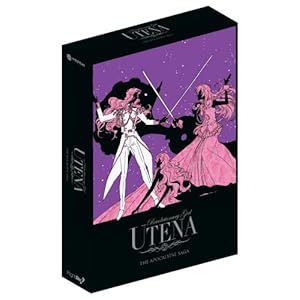
Included with the third Revoutionary Girl Utena box set from Nozomi/RightStuf is the Revolutionary Girl Utena Movie: Adolescence Of Utena.

I credit this movie, specifically, with being the beginning of my “career” as a spokesperson for Yuri. Because of my interest in the movie, my discovery of a Yoshiya Nobuko reference in the movie manga, and my interest in the literary and artistic references drawn upon for the series, I ended up being invited to present this movie at the Frameline Film Festival in San Francisco, the British LGBTQ Film Festival and the Tampa LGBTQ Film Festival back in the early 2000s. I was able to meet and interview Ikuhara Kunihiko at Big Apple Anime Festival and because of this movie, CPM was an early sponsor for Yuricon events. I have a lot to thank this movie for. Not least of which is for being a fantastic movie.

It is a fantastic movie, with extraordinary visuals, and two of the most spectacular scenes I have ever seen on a screen – the dance on the dueling ground, and the castle car. As much as I consider the TV series a more subtle and sophisticated creation, its the movie I watch more often.

I find I have never once published the intro I gave this movie a decade ago when it first came out in English, so rather than explain to you what I said, here is the actual intro I gave the film, in front of hundreds of people who liked anime and the series…and thousands of people who had no idea what the hell they were getting in to.

In 1994, on Sundays at 7 PM, the Shinjuku Ni-chome, Tokyo’s gay and lesbian district would come to a screeching halt. Why? Because for the first time ever, Japan was watching a lesbian couple on their TVs, as part of the popular animated series, Sailor Moon These characters, Sailor Uranus and Sailor Neptune, were very clearly portrayed as a couple – with personal issues to work out, as well as greater ethical dilemmas – all within a framework of defeating the Monster of the Day as sailor-suited magical heroines.

The director of that pivotal season of Sailor Moon had instructed the voice actresses to play the characters as if they were a married couple. In 1997, that same director Ikuhara Kunihiko, along with veteran comic artist Chiho Saito and the creative team at Be-papas, turned their sights once again to the “magical girl” genre of Japanese animation. The result of their collaboration was the wildly popular series Revolutionary Girl Utena.

This 39-episode television series utilized symbolism from earlier popular shoujoai or, “girls love” series – character designs and settings, were inspired by pioneer of shoujoai, Ryoko Ikeda’s Rose of Versailles and Brother, Dear Brother. Ikeda herself had incorporated imagery into her works that were established at the beginning of the twentieth century, by lesbian author Yoshiya Nobuko. Yoshiya’s Flower Tales set the standard for girls’ literature, and ultimately girls’ comics and animation, as well. Yoshiya was also responsible for the creation of the “shoujoai” genre with her story Two Girls in the Attic, another story whose themes and imagery echo strongly throughout the Utena series.

What you are about to see is the movie based upon the earlier television series. It was not meant to be a resolution of the series, it was meant to be a reflection of it – the same story as seen through a slightly distorted lens. The movie highlights the conventions of Japanese animation, even taking them to extremes. The subtle surrealism of the television series has been left behind and replaced with overtly surreal elements, a non-linear narrative and perhaps most confusing, scenes that are wholly dependent upon knowledge of the television series. What does this mean to you, the viewing audience? Well, it means that the best way to view this movie is to simply let it wash over you, like the roses over the dueling ground.

What significance does this movie, this cartoon, have for gays and lesbians? Many Japanese – as do many Americans – see comics and animation as being just for kids. But as we know, as we breathlessly waited for Willow and Tara to kiss on Buffy, the Vampire Slayer; every image, in any media, is progress. And with gay and lesbian youth, images that appear on television or in the movies have an even greater impact. This movie, like the television show it is based upon, adds one more positive image to the library.

In the United States, Yaoicon was formed to increase awareness of the portrayal of gay men in Japanese comics and animation, while at Yuricon, we’re focusing on our own line of translated and original comics, and next year will be holding a ground-breaking event in Tokyo to celebrate lesbian stories in Japanese animation and comics with their creators. We at Yuricon firmly believe that our support, our creativity and our energy will bridge the enormous gap between fans here in the West and in Japan, and feed back into Japanese lesbians’ and gays’ efforts at being recognized openly.

And with that hopeful thought, I’d like to present to you, Revolutionary Girl Utena: The Movie.

***

We did hold that event, and we have continued to bridge that gap. I’ve traveled the world, spoken on several continents about Yuri, presented movies and manga and anime to people in hundreds of countries through this blog.

As I watched the movie this weekend – again – I’m reminded that in many ways, it did give us the power to Revolutionize the World. How cool is that? ^_^

Ratings:

Overall – 10


Revolutionary Girl Utena Anime, Volume 3, Disk 4 (English)

May 27th, 2012

At last, the conclusion to the “Apocalypse Arc” of Revolutionary Girl Utena.

There will be spoilers in today’s post. Please do not read past this if you have not yet watched it, or do not wish to know any details.

***

These final three episodes live in my mind as masterworks anime. And now, more than ten years later, I watched them again, fearing that I had made more of them in my memory than they were in reality.

I hadn’t.

The climactic moment for me has always been and will always be the quiet conversation over tea and cookies, when Anthy says that she’s poisoned the cookies…and Utena keeps eating, then admits that she too has poisoned the tea…and Anthy takes another sip.

Out of context, this moment probably doesn’t seem like much, but for me it is *the* moment of the series. Everything is understood between these two, everything is forgiven, even the betrayals to come.

Akio is revealed for what he truly is…nothing at all.

The revolution of the world comes and goes and only one person notices it.

Once again, as Anthy quietly points out the obvious to Akio, “You have no idea what happened here, do you?” I applauded. Once again, as I watched Anthy step out of the gates of Ohtori, my heart is filled with joy for her.

Fans really didn’t like this ending the first time around. It’s too ambiguous, too open-ended. We don’t know what will happen.

For me, it stands as the best ending to an anime series ever. The possibilities were endless, even the fanfic was extraordinary. Because we didn’t know, we could create a thousand different reuinions, a million different futures. At the end of the story, I wanted only to revisit some of these endings (especially those I wrote for myself, obviously ^_^) because in my mind, I know *exactly* what happened.

As, I hope, do you.

Ratings:

Overall – 10

The final Utena box set contest ends today, at midnight my time. Winners will be announced in a few weeks, because I have some personal stuff to take care of this week. Please get those final entries in!

It is my hope that this re-release of Revolutionary Girl Utena was as much fun for you as it was for me. Thanks, Nozomi/RightStuf for making it possible. And thanks for your donation of a spiffy third box set and Duelist’s Ring as a contest prize.


Revolutionary Girl Utena Anime, Volume 3, Disk 3 (English)

May 25th, 2012

The”Apocalypse Arc” of Revolutionary Girl Utena is going to spend the rest of the anime blowing us up like a balloon and piercing us with pins, just to watch us go “pop!”

I don’t know what to say about this arc other than I wholly wiped it from my memory the first time around and am not at all pleased at having to remember any of it this time. And not to spoil anything, but we learn three things during this arc and not one of them makes us any happier.

The shadow girls tell us what we’ve been guessing for a while, that the true story lay somewhere deep in our subsconscious where all fairytales live – and we’re reminded yet again that the story started with something like a fairy tale. The beginning, which seemed innocent in the beginning takes on a much, much darker meaning now and there is nowhere on the screen to look that does not bring us pain.

I’m reminded of the hatred shown to Akio when fans saw this series the first time. It’s a fair bet to say that he remains the most loathesome anime character I’ve ever encountered.

Of the two things that keep me going towards the end, one of them is revealed in this arc. Knowing Anthy’s true story makes me love her even more, but I do not pity her. Because…

One more disk to go, only a few days left in the contest to win this boxset. Only a few more episodes to the end that I long for, that I cling to like a mirage in the desert. I wonder what my reaction to it will be when I watch it again for the first time in a decade?

My original review for this disk was going to be something like – ARRRRRGGGGHHHHH.

I’ll withhold ratings until the end. I can’t speak of this disk without spitting.


Puella Magi Madoka Magica Novel, Volume 1 (魔法少女まどか☆マギカ)

May 23rd, 2012

Last summer at Comiket, the folks who brought us Puella Magi Madoka Magica put together a two-volume novel series for the franchise through Nitroplus books. Okazu Superhero Zyl sent me those books, and after a lot o’reading, I’ve finally made my way through the first of them. I was in Kinokuniya this past week and I got a chance to look at Puella Magi Madoka Magica – The Beginning Story, (魔法少女まどか☆マギカ The Beginning Story) and it does appear to be the exact same story, so you can buy it now in Japanese, or in English when Yen Press releases it.

The novel follows the anime pretty closely and I honestly didn’t expect anything different. It picks up the day Akemi Homura transfers into Madoka’s class at school.

So…why bother reading it?

Obviously, if you thought Madoka was the most amazing thing you’d ever seen, this will be a great way to enjoy again it in a different format. But I think it’s worth taking a look at anyway, even if you didn’t think that. (If you hated the series, then, no, don’t bother. ^_^)

I find that I have enough distance from the anime that I don’t remember certain things happening, or things that I do remember have not, but I imagine that the inconsistency lies with my imperfect memory.

More interestingly, since the book is told from Madoka’s point of view, we’re getting more information about her state of mind, and less about the other characters, which skews the perspective slightly from that of the anime. In fact, the book corrects something I feel strongly detracts from my enjoyment of many books – the lack of existence outside the confines of the story.

So often when I pick up a book these days, the characters are presented as if they never existed before the story began and as if they will all disappear after the story ends. They have no childhood, no memories at all that exist before the beginning of the story. There’s a lack of depth that is resoundingly obvious in writing like this. An author may never have cause to mention the protagonist’s favorite color, but ought, in my opinion, to know it. If the character is real, he or she has memories, stories, existence beyond just the confines of the story. How did Yuriko spend her fourth birthday? Sulking, because her mother bought her a pretty dress and she had gone outside to play in it, got it dirty and was yelled at. It doesn’t matter, that will never ever come up in the story, but I know it, because Yuriko is a character whose existence is not defined solely by the boundaries of the stories about her.

Madoka has memories of childhood. She can remember when she met Sayaka, and therefore, what Sayaka means to her. She has dreams that make her question reality, she has opinions about her mother’s career and life, and she loves – and likes – her little brother. She is very close to being three dimensional, even in a story that doesn’t need her to be.  For this reason alone, I’d recommend reading the novel.

(The more I acquaint myself with Madoka, the more I am reminded of Nanoha, another magical girl for guys series, in which the characters are remarkably well thought out and given depth.)

As a stand alone book, it’s surprisingly well-written. Unlike some light novels based on games or anime and which really are meant for the already existing audience, this one could very well stand on its own. I’d even go so far as to consider it a good YA book, except for that thing that happens, you know the one. (Oh god, please don’t go and spoil it in the comments, I won’t abide that. It’s tedious in any case and not at *all* clever.) But with YA books these days being all about “dark” and all, and since I don’t have kids and if I did, yes, I’d let them read this, I say it’s a pretty good YA book.  ^_^

Ratings: Overall – 8

Many, many thanks to Zyl for the hours of reading pleasure!

If you’d like to become an Okazu hero, visit my Yuri Wishlists on Amazon and Amazon JP,  sponsor an item for review and be a Hero!


Revolutionary Girl Utena Anime, Volume 3, Disk 2 (English)

May 10th, 2012

This is where the “Apocalypse Arc” of Revolutionary Girl Utena starts to get rough.

First, we have to watch Juri being run roughshod over; offered every single possible outcome except the two in which she can be happy.

Then there’s Akio’s seduction of Utena which, no matter how you slice it, is repulsive.

And last, while there had been a distinct hint of incest about Akio and Anthy since the beginning of this arc, in this disk it is made plain, not so much to shock us (speaking for myself, there is little else Akio can do to make himself more repulsive than he already is) but to shock Nanami. Which leads us to one of the most amazing things in the entirety of this series…when Nanami calls Utena dense.

Think about it.

Nanami has been presented to us, from the very beginning, as naive, selfish and quite dense. For her to stare at Utena in disbelief and scream “Are you dense?” is a pretty amazing moment. In three words, Nanami says, “I’m not perceptive and I just came to this place and I can see what is really going on , but you – you who have been here for a while – you’re blind and deaf and since even *I* can see what is going on you must be denser than a bag of doorknobs.”

I consider this to be one of the most profound moments in this arc.

Terrible things await, and we can feel it. Everything is contracting around Utena, like spiders just about to pull their silk tight. We can feel it, but we can’t predict it. When it comes, it’s going to hurt like no one’s business.

Ratings:

Art – 9
Story – 10
Character – 9
Yuri – 4
Service – 5

Overall – 10

I have two disks left to watch and I fear them. Only one thing drives me forward into the next disk…I’ll tell you what it is when I get there.

Quick reminder, the third Utena box set contest is still ongoing and will be until I make myself watch those last two disks. Send in your entry for a chance to win the third set plus smexy Duelist Ring!