Archive for the Series Category


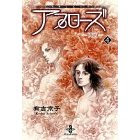
Yuri Manga: Applause, Volume 4

January 27th, 2008

Applause is, you may remember, an old-school Yuri manga from the 90s. I have reviewed volumes 1, 2 and 3 previously, so to catch up the story, go back and scan those.

As Applause Volume 4 opens, “Modern Dancer,” the hit Broadway show starring Shelle and Shara, is a mega-hit. With every performance, they pour their heart and emotions out onto the stage, captivating audiences. But afterwards, their relationship is building to a crisis. Shara cannot stand the double life that Shelle wants. Isn’t enough, Shelle asks, to have our life together in our house on the beach, and be the professionals everyone expects on stage? NO, Shara emphatically says.

Georges appears to “congratulate” Shara with a kiss, but is slapped and sent packing.

At the shore house, Shara asks a question of her own of Shelle – why can’t you just be the Junaque I fell in love with? But Shelle yells at her to shut up – she hates “that woman” and in her mind, the person who was Junaque is dead.

And every night, Shara and Shelle work out their emotions through their dance.

While Shelle’s mother shows up, invited by Georges, to pressure her to marry him, Shara talks to John about his lover Chris’s illness, which is clearly AIDS. Georges tries to force Shelle to sleep with him. She goes completely passive and refuses to look at him. He stops himself before it becomes rape and leaves Shelle, telling her that any next move has to come from her.

Shelle and her mother have a knockdown, dragout fight about her future. As Shelle wrestles with a complete breakdown, Shara appears. They embrace each other desperately in front of Shelle’s mother, who is not pleased at all when she realizes the truth. Shara tells everyone to get out of her way, then leads Shelle out of the house. Their performance that night is spectacular.

Alfie tries to reach Shara, but she and Shelle are spending the night in the shore house. They wake to find the sun rising, and they express their love for one another as the sun greets them. Later that day, Georges goes looking for them – they can’t be found anywhere. Terrified, he heads out to the marina where he takes a speedboat out to look for them. Sure enough, he finds his sailboat adrift on the water and neither Shara nor Shelle to be found anywhere.

Georges accepts the Tony Award on behalf of Shelle, and (though obviously in pain) tells the audience that the show will go on. He flies back to Belgium immediately.

Alfie and Fred attend Chris’s funeral and wonder what happened to Shara.

Our last image is that of a rowboat, with unattributed conversation around it. Shelle says that she has been waiting for Shara since graduation. Shara says that it would be nice to buy a little house, wouldn’t it? And Shelle says that would be lovely.

The volume is completed with two stories of Junaque and Shara as students. The first is a fascinating little ghost story about a dead student who is haunting a teacher. The teacher, when she was a student was in love with the girl who them subsequently died. As background to that story, we see Junaque’s tempestuous family relationships. The second story is a very shoujo and fluffy piece about Shara’s early days with Junaque.

So…the main story ends in the most ambiguous possible way. If you prefer it to be a tragic love, then drowning seems the most likely option. However, nothing in Shara’s personality has ever lead me to believe that she would accept death as a viable alternative to life. While Junaque/Shelle’s life has been one of avoidance and denial, Shara’s has been of acceptance and striving. Also, several times she has suggested that they simply leave Manhattan – run away and start a new life together. It seems obvious to me that the sailboat was a red herring and the two escaped what had become an intolerable situation.

And I can’t help but wonder if the ending would have been different at all, should the story have been written ten years later. Personally, I think not.

Was this a *good* series – yes, it definitely was.

It was certainly melodramatic, and soapy, full of tears and angst and beat-you-over-the-head intensity, but that was the story. I did think Shelle’s hatred of her younger self was much of a muchness, but she was pretty far gone into nervous breakdown-land then, and probably hardly knew what she was saying. In any case it was not inconsistent with her self-absorbed personality.

Would I suggest it? If you like romance, melodrama, stories about performers, josei or shoujo work that steps above and beyond the crowd, yes. If you are a moe fan, prefer your heroines to look six rather than twenty, really prefer action to drama, or can’t stand endings that are not overtly happy (which leaves you with darn little anime or manga that will satisfy you, really,) then no.

But as an example of an excellently drawn, well-written and captivating old-school Yuri, then I do definitely recommend Applause.

Ratings:

Art – 8
Story – 7
Characters – 7
Yuri – 8
Service – 3

Overall – 8

The art, especially, just got better and better as the volumes went on. Both Shelle and Shara come from a world of art that has just about completely disappeared these days, where characters looked their age and more ethereally beautiful than possible. It’s obvious that the current trend of youthifying and simplifying anime and manga art makes it easier to draw and easier to crank out, but I so much prefer this.


Burst Angel Anime, Volume 4 (English)

January 23rd, 2008

Slowly, slowly, I am working my way down the piles of items to review. This item sort of fell to the bottom of that pile with all the new incoming. My apologies to today’s sponsor, Daniel, for the delay.

Burst Angel Volume 4 is pretty much where the series lost my attention the first time around. I was having difficulty holding my attention on it this viewing, as well. Time after time, I had to stop starting a second thing while the DVD was playing. The story just sort of loses focus. Perhaps because BA is really a 13-episode series wearing a 24-episode season? I dunno. I’ll leave that to the philosophers.

The volume starts off pretty strong, with the end of the Osaka arc, complete with tragedy, loyalty, heroism and pride in Osaka that just bursts out of the screen. Thinking about it, if the Osaka arc has been lengthened by another episode, and the entire series was just that arc, I think I would have liked it better. Well, okay, the Bible Black rip-off arc was pretty good too. But the rest of the episodes…meh.

Immediately after the big bang full of sound and fury signifying nothing, we move into a series of filler episodes. The first of these is the backstory when Jo met Meg. It’s a little lighter-handed than the expanded OAV version of the story, so Meg remains a lovable incompetent with bad fashion sense and large breasts that jiggle. Jo saves her.

This is followed by a simply hysterical episode where everyone wears terrifying bathing suits and there is a big monster with tentacles. Meg gets nabbed. Jo saves her.

In the final episode we are treated to heavy-handed Jo-ness. Jo’s past – hinted at in her and Meg’s backstory – is catching up with her. She ends up joining forces with a samurai-esque guy to fight an out-of-control robot. And to be really, really honest, I can’t remember a single thing about this episode.

So, while the anime is in one sense heading towards a climax, the tension that draws *me* into a series has been lost. Too much filler between one arc and the other, maybe? Too much something, or not enough.

Yuri from here on in can be summed up as “Jo seems to be fond of Meg.” (You remember that line? It was from the official Vandread description of Jura. “Jura seems to be fond of Barnette.”) We’ve established just about all the relationship we’re going to get between Meg and Jo, and the series has shifted focus away from them as partners to Jo alone. And while there will be thrills and spills and shoot-outs and giant robots from here on in, somehow…it’s less compelling than the action that was wrapped around utter stupidity. Not *every* action series needs to have a plot. Sometimes we’re okay just watching Jo kick ass. We might even be willing to be kidnapped to have her save us. ;-)

Ratings:

Art – 5
Characters – 6
Story – 5
Yuri – 1
Service – 7 (someone came up with those bathing suits…)

Overall – 5

Last volume I said I was surprised how much I remembered. This volume I’m not surprised to see how much I forgot.


Aria Manga, Volume 11

January 22nd, 2008

Today’s review is based on the thinnest possible excuse. When we actually get there, you’re going to be like, “You’ve got to be kidding me.” ^_^;

I picked up Aria, Volume 11 while in Tokyo, and along with it, a copy of the Aria the Natural Vocal Song Collection. If you are already a fan of the series, I recommend the Vocal Collection highly. It’s is a lovely way to be reminded of random scenes and moments, and especially fabulous bits of scenery, while somewhere not near a TV or computer screen. There’s nothing wrong with having Athena singing in your ear, let me tell you. ;-)

Every single scene in Volume 11 is an indication that the series is drawing to a close. This was obvious even in Volume 10 and, more recently, news that the series is ending was released officially. But really, if you’ve been paying attention, it comes as no surprise at all.

Our young undine-in-training, Aika, Akari and Alice are all thinking about the inevitable day when they will face their examinations for Prima rank. Aika, particularly, is stressing out over her comparative lack of exceptional skills. Alice is clearly superior to her sempai in boatcraft, and Akari has brilliant people skills. Aika can’t imagine that she brings anything to the mix. When she arrives back home at Hime-ya, she finds Akira in the middle of cleaning. Akira recognizes pre-exam jitters when she sees them, and tells the story of when she was suffering from the exact same crisis of identity Aika is now undergoing. Her story involved a plot complication I usually find tedious – that of one character being given a flower by another when they were both younger – but in this case alone, it actually works. Since Akira was training at Hime-ya, it stands to reason that she would run into lil’ Aika from time to time. This once, I will allow it. ^_^

There is a lovely chapter where we revisit the “Wedding of the Sea” ritual, with full-blown scenery porn, and what would make a spectacular poster of the three Fairies of the Water, should it ever be reproduced in color.

The end chapters follow Alice as she graduates from middle school. At last, we arrive at the incredibly thin slice of Yuri I mentioned! On her way out of the school gates for the last time, Alice is approached by a underclassman who has apparently always admired her, and is asked for the second button of her school blazer. Let me point out that this is a co-ed school, so perhaps it is unusual to ask that favor from a female upperclassman, perhaps it is not. (You know that one, right? You ask for the button as a memento from an upperclassman that you like. In a sense, it’s admitting that you had a crush.) But the girl does get all squeal-y and loved-dovey happy when she receives the button, so it’s at least a solid expression of crushiness. That’s pretty much it, but it was a sweet little moment.

To congratulate Alice on her graduation, Athena takes her on a picnic, but asks Alice to steer. We treated to more scenery porn and, if we’ve been paying any kind of attention at all, we recognize the places they visit.

I don’t want to spoil the end of the volume. Therefore, if you know what follows smile knowingly, but do *not* type it in the comments field. I am choosing to not spoil on purpose. If you do not know what happened and want to, feel free to buy the volume and find out (don’t forget the Vocal Collection, too) – it’s *totally* worth it! One of the finest moments in the whole series to date. ^_^

Ratings:

Art – 8
Story – 7
Characters – 8
Yuri – 2
Service – 3 (some Akari sleepwear and skin and the usual bishoujo stuff)

Overall – 8

Of course I’m sad that the series is coming to an end, but I’m also glad to see it doing so with such dignity and joy.


Yuri Manga: Strawberry Panic, Volume 1 (English)

January 21st, 2008

Strawberry Panic, Volume 1 was a fascinating example of translation and adaptation of a Japanese manga into English. Before I get into the details of why I say that, I’ll give you (and the folks at Seven Seas, for whom I have to thank for the review copy,) the sound bite – this was a very entertaining book. :-)

For an overview of the plot, please see my review of the Japanese edition of Volume 1 from June, 2006. This review will cover the adaptation and translation only.

There are a very few small differences in the Japanese and English versions physically – the English cover lacks the tagline “Girls School in Full Bloom” nor does it list the names of the main characters. And the art, both on the cover and the inside appears to have been scanned in from the original. (You would *think* that, when a company licenses a series the Japanese company would send original digital files to works from, but in my experience they don’t. That’s partially why the borders on English translations are often cut off, or have white space when the original pages don’t.) In this case, they opted for small additional white space edges across the whole book. It really doesn’t change anything – I just happened to notice it. And even though the English edition does not have a dust jacket, the original Japanese edition has the world’s most boring under-jacket cover ever, so we lose absolutely nothing by it.

The Seven Seas edition includes the color page, something I think really sets their volumes a step above Tokyopop’s. It’s not like this color page is especially *exciting* or anything, lol, it just looks nice.

Here’s the interesting bit, though. :-) The original Strawberry Panic manga was run in Dengeki’s G’s Magazine, a bishoujo gaming magazine. This is a pretty hardcore “otaku” audience. These are not people with social lives, or indeed skills. As a result, they tend to have little to no sense of humor about their passions. They take anime/manga/games and their obsessions with them *very* seriously. This latter quality is reflected in western fandom as well. And, as I’ve pointed out several times here, *no one* likes to think that the story they love is worthless trash or obviously a joke, when they themselves take it so seriously. (This applies to everyone about *something*. Whether it be sports maniacs, car crazies, people who obsess about the lives of celebrities or royals, whatever.)

So, when Strawberry Panic was first released, despite the obvious parody elements, people took the story at face value. That it involved sexual harrassment, evil psycho lesbians, total memory loss amnesia, former lover dying from an unnamed disease, openly stolen scenes, characters and symbols from more than a dozen other series, etc, etc, was irrelevant. This, I have been repeatedly told, is an awesome story.

*I* can see that it’s a parody. Many *other* people can see that it is a parody. Some people don’t care because they are not familiar with the series being parodied or, they just don’t care. But the majority of SP fans, both here and in Japan, take it quite seriously. They do not see that it is a parody and don’t like it when people, especially me, point out that it is.

Bear with me here – I do have a point. The point is this – Seven Seas knows SP was a parody and they *adapted* it like it was one. Sorry it took me so long to get there, but you have to appreciate the underlying issue. By adapting it the way they did, Seven Seas runs the risk of alienating the majority of their readership. HOWEVER, thanks to cognitive dissonance and the human ability to ignore all facts that don’t fit in with our preconceived notions, most of the people who might possibly be alienated will simply ignore the clues in the text and continue to take the story at face value. So phew for them.

Here’s what Seven Seas did. The first few chapters of Strawberry Panic utilize both italics and bold letters to subtly offer a few “wink, wink, nudge, nudge” moments in the text. It’s only in the first few chapters, then they back off. If it had continued it would have become annoying, but by laying the foundation in the beginning, anyone who *can* see it, is let in on the joke. It’s true that some of the worlds they emphasize are also emphasized in the Japanese text – but not all of them. I’m not sure why they did it, but I think it worked. ^_^

I have only two complaints about the translation itself – can someone explain to me why Hikari says “golly” instead of something more like “oh, no”? It does give her a bit of a provincial aspect, but I never really got that from the original. Maybe I just missed her accent?

Also, I am deeply disappointed in Yaya’s criminally smart “Amane wannbees” (with “wannabees” being the actual word she chose) changed to “Amane nuts.” This is small, but they missed two things by changing it. One, in the context of the story, they’ve missed that Yaya’s understanding of human nature is pretty sharp. But more importantly, they’re missing that it was meant to parody Tsutako’s equally sharp understanding of her fellow students by labeling them “Yoshino wannabees” in Maria-sama ga Miteru: Kibara Kakumei. Seven Seas gets one point off for that and another because the word “wannabees” is so fun, why would anyone ever chose a different one? lol

With those two teeny exceptions, Strawberry Panic is otherwise a very decent translation and adaptation.

Seven Seas regains one of the lost points above for doing something which was technically incorrect, but for which I thank them with all my might. In the original Japanese Nagisa, our preposterous heroine, refers to herself in third person. It was meant to accentuate her childlike naiveté and girlishness. It also made it nigh on impossible to like her. For whatever reason it was decided that she *not* do that in the English edition. And while it changes her personality, it does so for the better. Yes, it’s “wrong.” Thank the gods (woops, I mean Maria-sama,) it was done. Amen.

Ratings:

Art – 7 (too moe for my taste, but not *bad*)
Story – 7
Characters – 7 (Chikaru is rapidly becoming my hero. She really doesn’t care what happens, as long as it’s a good show with lots of fireworks.)
Yuri – 9
FanBoy – 7 FanGirl – a completely different 7

Overall – 8 (7, plus one point for the amusing adaption)

Regardless if you admit to (or even notice) the satirical emphases, Strawberry Panic is an amusing, brainless read full of groping and service among privileged female students. Clearly, something to be taken *very* seriously. ^_^


Yuri Anime: Simoun, Volume 2 (English)

January 19th, 2008

It’s “Hold the Presses” weekend here at Okazu! It is with much thanks that I review the second volume of Simoun today. The fantastic folks at Media Blasters got me a pre-press copy this time, so I could get a jump on this review. ^_& (That doesn’t get you out of giving me a real one, guys! )

Because this is a pre-street copy, I don’t have case, cover or the physical extras (or lack thereof) to comment on, but I’m still asking for all the cover art to be collected into a book or something for the final volume.

(February 25, 2008 Note: I received the street copy – thanks John! – and other than the pretty disk, there’s no physical extras.)

I was assured that some of my suggestions were taken into consideration for this volume. In general, I feel like the subtitling was more smooth all around, but still no romaji or kanji for the opening and ending songs. I’d *really* like to see that. It used to be the standard for DVD releases – when did that stop? No typos at all that I found. Well done! And did I mention that they keep the honorifics? They do. Write them and tell them that you prefer it that way, so they expand it to other titles.

The story of Simoun, Vol.2 is…compelling. Not good. Not interesting, or entertaining – compelling. I had to sit through the whole disk, because just watching one episode was just not enough.

The volume begins with Chor Tempest, now officially on milk runs, bearing up under the spiteful potshots from the other Chors, showing that they are still jealous of what was – and may once again be – the finest of all Chors.

Mamina arrives, with a belly full of arrogance born of desperation and Yun comes burdened with multiple layers of duty and guilt.

A peace conference brings hope, then tragedy, then hope again. And Dominura uses the time-honored tradition of shared suffering to bring out the best in her heterogeneous Chor. Traumatic events make Neviril recognize the one thing that she and Aer share.

I have a lot of notes from this volume, but the one thing I wanted to comment on is that Anubituf may well have put his finger on it, when he says that it might be better for Chor Tempest to not return to the Arcus Prima. I thought that was exceptionally insightful – and maybe even prophetic.

The final episode is so heavy with irony it seemed a bit overburdened and maybe not the best place to end the volume, but then…

The extras include a really fabulous commentary from the director and the artistic director/character designer. The director comments that he quite specifically wanted this series to avoid dramatic formula. So, the last episode’s ironies were laid down *purposefully* to be that heavy-handed. He wanted a realistic, yet contrived world, and one that had many things left unexplained. I was so pleased to learn that that had been done with a specific vision, rather than as some haphazard reflection of lack of time and/or resources. And there’s a couple of great revelations in this extra that would be spoilers, so I won’t share. Just do watch this, even if you don’t usually watch the extras.

The other extra, an interview with Parietta’s and Kaim’s VA would have been good, but kept being interrupted and cut short by the irritating “host” lollipop with eyes, a computer modulated voice and a rampant case of condescension.

Overall though, a slick and pleasant edition of *still* one of the best stories in anime. Now give me romaji/kanji lyrics and the remaining cover art and I’ll be happy. ^_^ It’s a great series.

Ratings:

Art – 8
Story – 9
Characters – 8
Yuri – 4
Service – 4

Overall – 8

Best scene? When Mamina and Yun arrive and Floe snarks that she’ll probably say something like Chor Tempest doesn’t live up to it’s reputation (translated as “is a letdown”) and the giggling when Mamina says it word for word. Very like a passel of girls, war or no. ^_^