Archive for the Series Category


Otherside Picnic Manga, Volume 1, Guest Review by Sandy F.

September 8th, 2021

Happy day! Not only is it  Guest Review Wednesday here on Okazu, we have a brand new reviewer! Today  we welcome Sandy, who is taking a look at Otherside Picnic, Volume 1 manga, out now from Square Enix! I know you’ll give him a warm welcome. Take it away, Sandy!

I am a huge fan of Iori Miyazawa’s Otherside Picnic series of novels. I enjoy following the adventures of Kamikoshi Sorawo and Nishina Toriko as together they explore the wonders and terrors of the Otherside. And at the same time, they also explore the wonders and terrors of human connection with one another.

When I heard that the novels were bring adapted into a manga, I was so excited that even though I can’t read Japanese, I bought the Japanese editions hoping that at least I would enjoy the artwork…which I did. When I finally got my hands on the English translation, it was worth the wait.

Like the novels, Sorawo is our guide to the Otherside. We are given glimpses of her story as text and artwork combine to introduce us to Sorawo’s first journeys into the Otherside where she will encounter the enthralling Toriko. This will lead into their shared experiences of the Otherside; experiences that will change them both.

For example, I particularly appreciated the depiction of the Wriggler also known as the Kune-kune. Not just the Wriggler itself, but how it acts as the path that will draw Sorawo’s deeper into the world of the Otherside and how this impacts her and Toriko. With this artwork I certainly feel that I am being given a glimpse of the Otherside and its mysteries, but not in such a way where I understand everything.

Overall, the artwork and the dialogue between the characters complimented my vision of these people and the Otherside that Iori Miyazawa had created so vividly in the novels. There are moments of the terror that creeps up on you from the Wriggler and the Eight-Foot-Tall Lady. And then there is the wary banter between Sorawo and Toriko as they take their first steps in learning about one another and helping us to understand what brings them into this world.

As well as the banter, through Sorawo’s internal monologue we are introduced to Sorawo’s emerging and complicated feelings about Toriko. Feelings shaped by Sorawo’s response to the nature of Toriko’s quest to find the mysterious Uruma Satsuki, as Sorawo wonders, what are Toriko’s expectations of her?

There are a couple of minor issues, such as the artwork was sometimes a bit cutesy for my taste. I appreciated the work of the translator, though I did miss some of the colourful British words and phrases used in the novel. There is also a bonus original story that gives us some interesting insights into Kozakura and the nature of her relationship with Uruma Satsuki and Toriko.

Ratings
Story – 9
Character – 7
Service – 4
Yuri – 5
Overall – 9

All in all, I thoroughly recommend reading this manga, but don’t forget the novel!

Erica here: Thank you Sandy! I’ve got this on my to-read list and am looking forward to it even more, now. ^_^ Thanks for whetting out taste for more Otherside Picnic.


Otherside Picnic, Volume 5

August 22nd, 2021

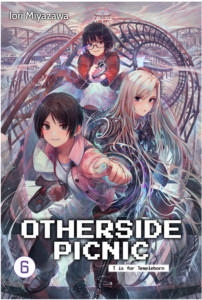
Otherside Picnic, Volume 5 begins in the middle of a story and for the rest of the book, that is pretty much where we stay. A scenario occurs, but it does not feel particularly resolved by the end of the section when it stops. Nonetheless, this novel covers a fair amount of ground, much the same way Sorawo and Toriko travel the UBL – a mapping of the story, rather than the story itself.

The first scenario begins with the continuation of the Love Hotel Girl’s Party set-up from the end of Volume 4. Clearly, in the real world a love hotel girl’s party is meant as a bachlorette /stag party for women. One might expect alcohol and a male stripper and other straight-women misbehaving nonsense. But because Toriko won’t say things and Sorawo was never socialized normally and will avoid all things unless they are said, and often even then, the two of them are joined by Akari, Natsumi and Kozakura. Then…something happens. What happens is interesting, but not for the thing itself. I’ll come back to this in a second.

Before I forget, I want to note that Miyazawa is losing his grasp on Kozakura. She started out as a point of contact for DS, but at this point is merely a grumpy, scared nobody in the story. I feel bad for her.

Following this was definitely the strongest section as Sorawo tracks down Toriko at university to have some stuff out with her. Toriko is, understandably, feeling endlessly rejected by Sorawo. Sorawo even understands that, but just is not capable of returning the feelings. When Toriko accidentally pushes Sorawo into interstitial space, Sorawo finds herself understanding, finally, what she has not been able to look at head-on. Toriko is in love with her. She acknowledges this – and recognizes that it makes her panic.

The third scenario puts Sorawo back in her happy place – investigating the Otherside with Toriko. Planning, traveling, thinking about getting new equipment…this is what she loves. And she loves doing it with Toriko. This is her love language. So, when they meet another person, how will Sorawo react? Not at all the way you’d expect. Todate doesn’t need their help. She and her dog, Hana, are suited to one another, as Sorawo and Toriko are. Todate teaches the two how to spot animals in this world. Her skills add a new tool to their bag and the hunt shows them that the Otherside may well have a logic of it’s own, if the animals have evolved to not be driven mad by it.

By this time, Sorawo and Toriko are starting to think about how lucky they were when they first met. And they are beginning to understand that the UBL has clearly changed them, and not just physically. This becomes part of the conversation in the fourth scenario as the story circles back to the first person the met on the Otherside. Abbarato comes back into the story like a reflection, through what may or may not be his missing wife. Sorawo admit she was always looking for proof of the existence of the paranormal in stories and now, Sorawo’s eye and Toriko’s hand are actual relics of that very thing…but what does any of it mean?

In this final scenario, the two encounter a feral child and again, this triggers Sorawo’s memory of her own, entirely abnormal childhood. This, along with several conversations about disassociative behavior is very clearly meant to remind us that Sorawo is not *just* being dense about her emotions. She had a shocklingly traumatic upbringing and, as I say, has never been socialized. This was pounded on us so many ways in this novel, I wonder if the fandom was being kinda dense themselves and Miyazawa felt he had to be like, “Dudes. WTF? Do you not remember this important thing?”

Which brings me to my point. Her family was part of a cult, she’s always been obsessed by the paranormal. Even Sorawo can see that the Otherside seems to focus on her, but what if it’s not that the Otherside focuses on her, but that she is, in a sense, creating it for us. At the very least, she is an interpreter. A phenomenon occurs and, with her experience of the paranormal, Sorawo tells us what to understand it as. Because of this, we have a way to comprehend those experiences. In a sense, she is telling us how to not go mad. And, in that sense, she is creating the Otherside for us. We’ve seen what it does to people with no point of reference. We can avoid that fate, because Sorawo tells us what we see.

There are two more things I want to note. One was the appearance of more typical Yokai and Tales of Tono in this volume. Up to now, the stories have been rooted in modern netlore, most specifically scary stories on 2chan. Tono Monogatari is a 1910 manuscript by Yanagata Kunio and Sasaki Kizen, which collected a series of folklore and Yokai stories from a town that, to this day, considers itself the home of the strange and paranormal in Japan. Famously, Gegege no Kitarou creator Mizuki Shigeru did a comic of this – which was translated into English by Zack Davisson and published by Drawn & Quarterly. The chapter with Todate is based on a tale from Tono.

And I hope you all noticed the traditional Yokai that appeared at the beginning of the story! Kuchisakeonna is a well-known tale that involves a woman with a face that has split mouth. She is known to ask strangers if she is beautiful…and if they say, no proceed to kill them. I was quite pleased at this scene. We’re big fans of contemporary Yokai here and the use of the story was perfectly done.

The Otherside is, in this story, a reflection, a sight out of the corner of one’s eyes, a unfocused thing you sometimes see. As my old martial arts teacher used to say, it’s all the “Yin” side. We can perceive it and some of us interact with it. It inhabits the same space we are in, at the same time. The use of mirrors and reflections really highlight that in this book.

Lastly, but not at all least, I would like to note the art. The series began with blandly moe-stye art that I did not think accurately portrayed the characters in the least. But now, we’re getting gorgeous, evocative woodblock print-like black and white images that are vastly superior. These images are so much better, I had to check that we had the same artist. So yay for shirakaba being able to give us art that suits the tone and feel of the story much more suitably than one more shitty moe pinup. The art in this book was outstanding.

The book ends a bit abruptly, which makes it feel like a set-up for the next volume. Fortunately Otherside Picnic, Volume 6 will be hitting your electronic devices in November, so there’s not too long to wait. Based on the synopsis however, we’re going to get more questions than answers…again. But that’s why we read this series, after all. ^_^

Ratings:

Art – 9
Story – 9
Character – 9
Service – 7 – Love hotel and stupid
Yuri – 8

Overall – 9

Otherside Picnic weaves contemporary folklore, psychological horror and romance into a compelling adventure.


Watashi no Oshi ha Akujyaku Reijou., Volume 2 (私の推しは悪役令嬢。)

July 21st, 2021

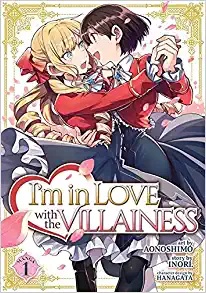
Watashi no Oshi ha Akujyaku Reijou., Volume 2 (私の推しは悪役令嬢。) gets into the first of my two favorite arcs in the first WataOshi novel – Rae and Claire are recruited to the Academy Knights.  One-on-one magic battles! Whee! I absolutely love this arc and the school festival (for obvious reasons when we get there.)

The tryouts for the Academy Knights are pretty much a forgone conclusion – at least two of the three Princes are a shoo-in, Claire, Misha and Rae are competing for the other positions with, sorry to be cold, but clearly its Thane.

But first Rae finds herself examining her own sexuality for real, out loud, at lunch with Claire, Misha and Lene. And when I say “for the first time,” I mean for the first time in both lives. By her own admission, Rae had fallen in love with women, but also mostly unobtainable women, women who did not return her feelings. Rae can see that her interest in Claire is true to her usual pattern, then. Of course we know that that will change, but at the moment, Rae has no idea.

When the students help with taking out magical monsters, Thane and Claire team up to beat a massive slime, but it doesn’t boost Thane’s confidence. It does bring Relaire into our household, so we have a brand new adorable slime monster of our very own.

Then, at last, we get the beginning of the Academy Knights battles! And…the volume comes to a close. Argh! So much good stuff, but we’re still a few chapters off from Rae and Claire facing off. /pouty face/

The art in this volume has settled in nicely and Aonoshita-sesnei’s art is super on point. We already know we love the story…and this volume has the eye-opening discussion about being a sexual minority that sets a tone for the rest of the series. Rae is openly lesbian, and she will stand at the top of a veritable army of queer characters by the time this story is done.

On a different topic, I bought this book from Melonbooks online, for the single reason that if I did, I got a color insert and a bonus comic. Here’s the insert I chose, tell me if you can guess why I picked it. ^_^

Overall, a very strong volume of a series that I fully expect to have nothing but very strong volumes for the forseeable future.

I believe I did not review the Japanese edition of Volume 1 as (due to the delay of material in the Suez Canal,) my volume arrived almost simultaneously with Volume 1 in English.

Ratings:

Art – 9
Characters – 9
Story – 9
Service –  1Very little for this series
Yuri – 10

Overall – 9

I cannot wait to see the battle between Rae and Claire – and their cafe at the festival. ^_^


Battle Athletes Victory ReSTART!, Guest Review by Eric P.

July 14th, 2021

Happy Guest Review Wednesday! Today we welcome back one of our long-time friends and Guest Reviewers, Eric P., who is taking a look at the newest in the Battle Athletes franchise, Battle Athletes Victory ReSTART!, streaming now on Funimation. Please welcome Eric once again. The stage is yours, my friend!

Set in 5100, 100 years after Akari Kanzaki’s victory at the Cosmo Beauty competition, humanity has extended beyond Earth and even further into space, and a new generation of athletes gather to compete in the Divine Grand Games to be crowned Cosmo Beauty once again. Since winning said crown is not just a mere title but grants them Queen-level authority, each athlete has their own goal in making the universe or at least their home worlds a better place. From Venus is Shelley Wong, a physically disabled athlete with prosthetic limbs who wants to especially prove her capabilities. From Pluto is Paglia Raspighi, an aspiring genius doctor who wants to advance her home world’s medical technology. From Mars is Lydia Gurtland, whose father’s company is a supplier of weaponry that instigated a civil war on the moon. There is Yana Christopher, a Lunarian refugee from said civil war, and who gets suspected of plotting terrorist activities within the competition (drawing some rather on-the-nose parallels to Middle East conflicts). And there is also Kanata Akehoshi from Earth, an unassuming potato farm girl (who could easily be besties with Sasha from Attack on Titan) that enters the competition as a promise from the distant past to another athlete. Said athlete is a quiet, mysterious girl named Eva Gallenstein who does not even remember Kanata, but plays the role of a puppet for an evil behind-the-scenes organization called the Solar System Control Committee.

As one watches Battle Athletes Victory ReSTART!, it does not feel so quickly certain whether or not it is a direct follow-up to Battle Athletes Victory, or if it just takes inspiration from the original. Aside from the names of past Cosmo Beauty champions, the events of the original anime (such as the Nerilian invasion) are not alluded to in this new story. Almost all the new characters share the same last names as the original characters, which would imply that they are descendants (as well as imply what may have transpired with everyone in the 100-year gap), but it could just as easily be fan service for viewers who have seen the original. Kanata bears such an easy resemblance to Akari but still does not share the same last name. It really is not until the very end of the series that we finally get affirmed clarity that ReSTART! is indeed an in-universe sequel to Victory, with surprise cameos from both a certain person and song I will not directly spoil here.

My personal fan service was seeing what appeared to be Ichino Yanagida, only it turned out to be Tamami Yanagida who just bears an uncanny resemblance, both facially and in attitude. She works in coaching the athletes at University Satellite, something I imagine Ichino would have likely ended up doing if ReSTART! had taken place a mere decade after Victory. Two other characters that are interesting in a specific way are Shelley Wong, descendant of Chinese athlete Ling-Pha, and male police detective Jeff Natdhipytadd, descendant of African athlete Tanya. Ling-Pha and Tanya were both criticized as ignorant caricatures of their respective nations/continents. Granted I could be over-speculating, I could not shake the vibe that Shelley and Jeff were created as a kind of apology to make up for those past insensitivities. Where Ling-Pha was a conniver whose friendship was shaky at best, Shelley is both driven and loyal to a fault. Where Tanya was hyper-animalistic, Jeff’s only “eccentricity” is that he declares himself to be a warrior for justice with a gung-ho attitude—which is actually fine, since he is competent at his job and plays a key role in trying to protect the athletes and the games from outside evil activities he is investigating.

As far as Yuri goes, where Victory was not just overt with it but was even driven by it, ReSTART! comparably just dips its toes. In Episode 5, Kanata gives Shelley a motivational speech about taking pride in our imperfections (in light of Shelley’s physical disability), saying that perfect people can stay still while everyone else who is not perfect are able to keep running. It makes enough of an impact that Shelley responds with “I might be falling for you.” Despite the complications between Yana and Lydia due to their conflicting backgrounds, the two still form an unlikely friendship and even express their mutual affections. In the last episode,Shelley comments on Lydia appearing angry about seeing (a sleepy) Kanata clinging onto Yana, to which a blushing Lydia insists “Yana and I are just…” but does not get to finish her sentence. And in the closing shots we see Shelley cozying up with a girl back home, who may or may not be her girlfriend. What little we get adds to a bare amount compared to the first time around, but with just 12 episodes to work with, the story’s thematic focus seems to be more on friendship and determination anyways.

When all is said and done, Battle Athletes Victory ReSTART! has turned out to be the kind of follow-up that was made to exist but ultimately does not feel necessary to the original, or even all that remarkable for newbie viewers. At the same time it is still there, harmless, adding nothing to the first series but not taking anything away either. It has an intentional old-school feel to it which often happens with reboots/sequels/homages of older titles. The humor is not as over-the-top this time around, although Yana for whatever reason has a literal boxing kangaroo companion in contrast to Kris Christopher’s cow. This companion series to the original classic can still be a pleasant treat that just manages to have its own charm if given the chance, even if just for a one-time viewing.

Ratings:

Art—6.5 (Neither high or low quality, just serviceable, although some galaxy locations/ships get neat little 3D updates)

Story—6 (At 12 episodes, it does not even try reaching the epic heights of the original, but instead settles for something concise and simple that does the job, even if it is still a little uneven—while it deals with themes of politics interfering with sports, it never really goes deep below the simple, superficial plot)

Characters—7 (The characters and their dynamics/motivations are what really help make the story worthwhile, including Eva’s actual goal, and Kanata as a heroine could be seen as an improvement over Akari in some ways)

Service—3 (Most of it happens in the first episode, with convenient body shots of the athletes and an especially non-subtle one of Paglia being introduced on-camera boobs-first. It is like as if it was all dumped there for the purpose of getting them out of the way so viewers can focus on the story and the characters’ journeys for the remaining episodes)

Yuri—2 (Again, there is not much to go on beyond the little indications that would seem obvious enough, albeit mostly to old-school fans)

Overall—6.5 (Just on account of it not being quite as worthwhile as the original, even if I am speaking from nostalgic bias, it gets scored just a notch less)

Erica here: Thank you so much, Eric!  It’s always a pleasure to have you do a review for us and I really appreciated hearing your thoughts on this series, which I’m watching right now.  I look forward to discussing it with you when I’m done. ^_^


The Rose of Versailles, Volume 5

June 25th, 2021

Today we look at what was, until 2015, the final volume of the grand historical epic The Rose of Versailles, by Riyoko Ikeda.

After the death of Lord Oscar François de Jarjayes, one might expect a final volume of tears and recrimination as the republic she died for turns to wholesale slaughter and a new threat of empire…buuuuuut……..no.

The chapters that comprise The Rose of Versailles, Volume 5 were written a decade after the original story ended and involve Oscar and André as the comedic sidekicks to Oscar’s precocious niece Loulou de Laurencie. These 10th anniversary chapters are an epic unto themselves, known as “The Great Detective Loulou.”

Loulou (and her doll, which functions as something between a backpack and hammerspace) turns out to be incredibly perceptive. Significantly, Oscar recognizes this and after the first adventure, in which Loulou cracks a group of jewel thieves, she takes Loulou’s antics very seriously. Loulou’s influence continues to expand to André, then Rosalie and beyond. It’s a good thing, too, because Loulou proceeds to stop a human trafficking ring and an illicit drug ring.

A little side story here… translator Mari Morimoto and I had a days long conversation about exactly what drug it might have been. I think it was cocaine-laced laudanum based on the chronology and supposed effects. (Heroine wasn’t common for another few decades and opium created a lassitude that any reader of Sherlock Holmes will be acquainted with.) But it’s all speculation and we’ll never really know what Madame Heberra was selling. ^_^

Ironically, the was the first volume of the series I worked on. Mari asked to bring me on since we had been discussing the series already and she wanted someone she knew. It was a lot of fun working on these chapters with her too, as there were so many things that were really left way up in the air after those incredibly detailed, historically accurate earlier volumes.

You might ask at this point if this is where we are meant to leave it all. After all that emotion, all those tears, we’re just walking away on a bunch of stories about a child genius? No, actually. Because in 2015-18, for the 45th anniversary of the series, Ikeda-sensei drew another 4 volumes, all of which I have reviewed here, in fact. I will spoil nothing, except to say two things: 1) I had completely, totally forgotten the one thing at the end of the story and OMG, and; 2) Even as I edited these chapters for the final volume for UDON, I found myself tearing up at Rosalie. Hopefully you will, too.

I don’t know when the final volume will be released, but as soon as I know, I’ll be sure to tell you!

I want to thank all of you who have picked up these books and enjoyed them so much. And my heartfelt thanks to Udon, to Erik for trusting me with these, to Mari and Jocelyne for being awesome to work with and Jeannie Lee, for low-key killing it doing the lettering. Honest to god, she did an outstanding job, matching the s/fx to the shape and feel of the original, and you should notice this kind of artistry.

I’m going to leave you with one more anecdote. After I got the chance to work on this series, I was in Japan, at Mandarake in Nakano, as one does and I saw something I had never, ever before seen – three whole issues of Margaret magazine when Rose of Versailles was running! I was gobsmacked. I grabbed them all and gave Mari and Erik one each as thanks, and kept one for myself.  Here is why.

This is the moment when Oscar, having found and lost her true love, throws herself at the Bastille, to join him as soon as possible. So….yea. I have this volume. It lives on a set of shelves I cleared for the entirely of the Rose of Versailles kanzenban, reference materials, mooks, magazines and…this magnificent collection. It’s just so lovely, I can’t get over it.

Not gonna rate this one, just want to bask in the glow. ^_^

Tell me how much you love this set in the comments!