Archive for the Staff Writer Category


Tsukiatte Agetemo Ii Kana TV Drama, Episodes 1-3

October 2nd, 2026

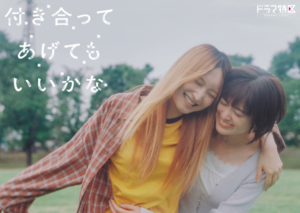
Saeko, a girl with long dyed light brown hair that has exposed black roots, holds her arm in a playfully familiar fashion around the shoulders Miwa, who is sporting a black bob. Both girls are smilingby Matt Marcus, Staff Writer

Over a year after the end of the serialization of How Do We Relationship in Japan, I happened to stumble across a tweet for a casting call for a live action drama with a very familiar premise. A Girls Love story adapted from a popular manga series, set in a college, including members of a light music club. It was a no-brainer to me what series it was.

The Tsukiatte Agetemo ii Kana drama was announced in July, with J-Pop idol Riho Sayashi (originally a member of Morning Musume, more recently a solo artist) playing Saeko Sowatori and Sakurako Konishi (best known for her role in the crime thriller First Love) as Miwa Inazuki. I was equal parts delighted and trepidatious. How much of the story could they cover in one season? Would they be able to capture the essence of the characters? How would they depict The Content?

If you are unfamiliar with the story, the opening episode is a fairly accurate adaptation of the first three chapters of the manga. Miwa and Saeko, both first year college students, meet and join the light music club together. After a night out with their new club mates, Saeko admits to Miwa her interest in women and Miwa responds in kind. Saeko says they should take advantage of this rare opportunity of two lesbians organically finding each other and proposes that they date. Miwa reluctantly agrees, and the two awkwardly spend time together until they are caught kissing in the club room by their bandmate, Mikkun, and have to decide how to navigate being out (at least within the band).

I’ll admit that I have not watched too many live-action adaptations of manga or J-dramas in general, but the handful I’ve seen ranged from passably entertaining (the Death Note duology) to abysmally awkward (GAP the Series, sorry Frank). Sometimes the issue is that the source material reads very unnaturally when acted out with real people; often the issue is that the performances are rather middling. I find that in most cases these adaptations fail to match the impact of the source material, let alone elevate it.

I felt more optimistic when I read that the production was being handled by people who worked on Ayaka is in Love with Hiroko!, as that was one of the better of these adaptations that I’ve seen. So far, there are awkward moments and stiff performances, but I felt that it was at least intended to be so. Saeko and Miwa do not gel, and the one thing I would strongly credit the first episode for is making that awkwardness extremely palpable. 

That said, there are myriad concerns I have, the first and obvious one being the pacing. There are only 8 episodes of 23 minutes each. Of course episode 1 has a lot to establish, so there isn’t much you could reasonably cut, but knowing that the previews show scenes up through volume 6, there is a LOT of ground to cover. Tamifull-sensei mentioned on her Twitter that there are changes to the story, which leaves the door open for a very different (read: heavily truncated) path towards the ending.

The trimming down of the story has already become impactful in episode 3, which covers the summer club retreat arc. The arc is split between Saeko wrestling with jealousy and Miwa struggling to stand up for herself against pushy men who are either hitting on her or threatening to out her. The instigator of the latter scenario, Kan, has been completely cut, which robs Miwa of the opportunity to try, however feebly, to defend herself. This ends up doing a disservice to her, reducing her role in the arc as merely the object for Saeko’s jealousy. It’s focusing the story down to the most core part of the plot, which is understandable given the runtime, but I fear more key character development moments will be shaved down to focus narrowly on the will they/won’t they of the love story.

The other issue is that of, frankly, the sex. Sex and physical intimacy in general play major roles in plot, characterization, themes, you name it. I think if a lot of that content is cut or glossed over, it will rob the drama of one of the elements that made the manga so potent. At least as of this writing, the sex is…there, but it is just off screen. There have been a couple hints towards Saeko’s discomfort with being touched, but aside from that there has not been much “action” depicted, which unfortunately means one of the funniest page-turn surprises from volume 2 is completely absent. You know the one.

If you approach the drama with an open mind and try not to get hung up too much on adaptation changes (I’m trying, I swear), you will find that the show has done a solid job of bringing the manga to the small screen. And there are some fun production details, like how Miwa and Saeko’s guitars were the ones Tamifull bought as reference.

Having a pop idol as one of your lead actresses also has some benefits, like including live performances that feel actually performed live.

So, that leaves me with two questions: will the drama stay in tune, and will you tune in?

Overall – 7

The series is airing in Japan on several TV stations (MBS, TV Kanagawa, Chiba TV, TeleTama, Tochigi TV, Gunma Television) and online via TVer and FOD; it is also available overseas on GagaOoLaLa.

Matt Marcus is a cohost of various projects on the Pitch Drop Podcast Network. You can find him mostly reskeeting Yuri posts and sports takes on Bluesky @hyperartmarcussan.bsky.social



How Do I Turn My Best Friend Into My Girlfriend? Volumes 4+5 and Series Overview by Luce

August 30th, 2026

I’m Luce, procrastinator extraordinaire and- how did I end up with more books than I started??? – book hoarder. You can call me a bookwyrm. Mostly hoarding, but getting back into reading novels. 

In the first three volumes of what I call Best Friend Girlfriend or ‘BFGF’ by Syu Yasaka, we met Minami, who realised she has a crush on her childhood friend and next door neighbour, Yuzu, and decided to try and get Yuzu to see her in a more romantic light – and generally failing in her attempts. We found out that Yuzu, however, also likes Minami, so we were landed firmly in the ‘mutual pining’ section.

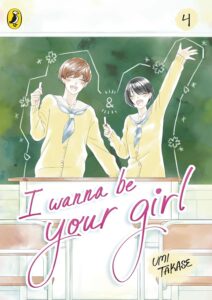
Volume 4 cover, it does Minami and Yuzu sitting against each other in ski gear In volume four, Yuzu gets a cold and Minami looks after her, Kamiya tries her best to talk Yuzu into telling Minami she likes her, and Christmas arrives with all the romantic implications it carries in Japan. In volume five, things get romantic on the school skiing trip, but misunderstandings abound. Can Minami and Yuzu finally just tell each other?

Pining, pining, pining. As a fanfiction reader, and writer, I’ve read it, I’ve written it. The delicious tension of words unsaid, hands not quite reaching the other person. The roadblocks characters will put up to avoid saying anything, only to trip over them and have to catch themselves. The moment it all comes crashing down as they throw over the cliff of no return, yet find themselves flying as the other person returns their affections (at least, in the ones with happy endings). But there’s an art to it. There has to be a compelling reason why one or both wouldn’t just say something. Something has to be in jeopardy if they were wrong about it, no matter how big, and the creator has to sell you on that.

Which is to say, how much you like this will depend hugely on how much you like, or can tolerate, mutual pinning, and people just not spitting it out. I enjoy it… sometimes. It’s a well worn trope for a reason, and can result in breathtaking scenes of self-restraint, where you just want to hug the characters… but it can also leave the reader with frustrations where you’re thinking ‘just kiss already! They obviously like you!’. This tips into the latter, unfortunately. I get that it’s hard to admit you like a friend romantically, and daunting to tell them that. But there comes a point where it goes a little past denial into ‘how thick are you?’. There are various moments in these last two volumes where, in my opinion, there’s no compelling reason for them not to tell each other. Look. If someone is also going in for the kiss, that’s a pretty good sign they’re into you romantically. Don’t then say it was nothing! If someone says ‘I want you’ and tries to kiss you, that’s not ‘getting your hopes up’. Reacting that way is absurd denial, or ‘authorial delaying’. Making pining work as a trope is all about making the reader believe that the character genuinely believed that their feelings were unrequited in that moment. They’re normally not correct, but only the audience should know that.

Volume 5 cover. Minami and Yuzu look happy, hugging each other. I guess my problem with this manga is that the pining was quite cute for the first two or three volumes, after which it got too stretched out. The older I get, the more interest I have in stories that cover making a relationship work – getting over hurdles, managing intimacy and boundaries, and especially when the characters are in school, trying to work out where the relationship fits, if it can, in their futures. Series like Kase-san and… and You and I Are Polar Opposites have both been exploring this to various degrees, and it’s been really refreshing. It makes manga like this, where they dance around each other, and not even particularly convincingly, less interesting.



It also ends up so focused on the dance/mess between Minami and Yuzu that everyone else falls by the wayside. Their friends feel like puppets to react to the dramas rather than people. There was some hints in the early volumes that two of them might be interested in each other, but does it get mentioned here? No.

In total, a cute series that overstretches its premise to its own detriment. There’s a fine line in pining between ‘come on, you guys can get there!’ and ‘get on with it!’. Unfortunately, this series falls closer to the latter.

Story: 6
Characters: 5
Art: 7
Service: 1
Yuri: 8
Overall: 6

Man, I really want to go read some good fics about mutual pining, now. As for manga that give me some of that vibe, Hirano and Kagiura (BL) and If I Could Reach You (Yuri) comes to mind. A Sapphic book, Six Times We Almost Kissed by Tess Sharpe also did pining very well (amongst other things). Any favourites for pining Yuri manga?


With My Own Hand: The Secret Life of Marie Maitland

August 20th, 2026

by Eleanor Walker, Okazu Staff Writer.

Erica is away, so the staff get to play and I’d like to introduce you all to the story of Marie Maitland, Scotland’s 16th century Sappho.

A woman in a 16th century dress holding a quill in one hand and a red notebook in the other

I first learned of Marie a few years ago when I discovered that the National Portrait Gallery of Scotland in Edinburgh was displaying an imagined portrait of her, commisioned by historian and translator Ashley Douglas. Ashley discovered Marie’s lesbian love poetry hidden in the depths of a manuscript long attributed to her father, known as “The Maitland Quarto.” This manuscript is a collection of poetry published in the Scots language (N.B. Scots is a related but separate language from Scottish English, the dialect of English spoken here in Scotland. Both English and Scots are West Germanic languages, unlike Gaelic which is in a completely separate family and very different to both English and Scots. It’s most closely related to Irish and Manx, and then more distantly to Welsh, Cornish and Breton.) Scholars have debated over the years who actually authored the poems in the manuscript, with Marie generally considered to be the scribe for the majority of the manuscript. It wasn’t till much later that Marie’s potential authorship was examined, although one scholar who published many of the poems in 1786 suggested that Marie had at least some involvement in writing the poems, not just transcribing them. Naturally of course other male scholars disputed that a woman could possibly have actually written any of the poems.

Scotland in the 16th century was not a kind place for women of any social class. This is the time of the Protestant Reformation, spearheaded by John Knox, the author of the magnificently titled and utterly misogynistic, even for the era, screed “The First Blast of The Trumpet Against The Monstrous Regiment of Women.” If you were lucky enough to make it out of childhood alive, your best hope if you were middle to upper class was to be married off to a man who would treat you even a little kindly. After that, your job was to get pregnant and produce a male heir. This is the destiny which awaited Marie Maitland too, until fate intervened. The youngest of her sisters, she watched her sisters be married off one by one and no doubt had consigned herself to the same fate, until her father went blind and required a scribe. This afforded Marie a degree of independence and self sufficiency almost unheard of for women in this era, and allowed her to pen her remarkable poetry. Poem 49 in particular was almost certainly written by Marie, and reads as follows (Original Scots language followed by English translation):

And thoucht adversitie ws vex
Yit be our freindschip salbe sein
Thair is mair constancie in our sex
Than evir amang men hes bein

And though adversity us vex
Yet by our freindship shall be seen
There is more constancy in our sex
Than ever among men has been
.

If that’s not written from a lesbian point of view, I don’t know what is.

A pair of hands holding a quill and a red book in front of a woman's chest. The woman is wearing a 16th century dress.

Fast forward to summer 2026, and Ashley’s book is finally available. It’s been one of my most anticipated books of the year and I’m delighted to say that it was as enjoyable as I hoped it would be. Ashley herself is a lesbian and in my opinion, the perfect person to bring this tale to a 21st century audience. Queer people and queer love have always existed, and Marie’s story is a remarkable one of resilience and trying to fit into a world which was not made for her in the slightest. Earlier in the 21st century, Scotland was the first country in the world to introduce an LGBT+ inclusive school curriculum, which includes Marie and other queer figures from Scotland’s history. Her life is an important part of our history, and I’m very pleased that I’m now able to share her story with Okazu readers all around the world. You can order your own copy of “With My Own Hand” from bookshop.org

The only known copy of the Maitland Quarto is in the Samuel Pepys collection at the University of Cambridge. I’d love to see it come home to Scotland one day.

Online sources:

https://www.nationalgalleries.org/art-and-artists/features/marie-maitland-scotlands-16th-century-sappho

https://en.wikipedia.org/wiki/Marie_Maitland


Botan Kamiina Fully Blossoms When Drunk Anime, Full Season Review

August 19th, 2026

Botan stands thigh-deep in a river holding a bottle of sake. She's wearing a plain while dress which is taken on some water from the river. She's mostly facing the opposite shore but is looking over her right shoulder. Her reddish-pink hair is fashioned in her usual dual-ribboned do.

by Matt Marcus, Staff Writer

The Botan Kamiina

1 oz Yume no Kanbai 19 year sake 
0.75 oz strawberry-infused scotch whiskey (Glenlevit base)
0.5 oz Rokudaime Lily shochu
0.5 oz simple syrup
2 dashes of angst–I mean, angostura bitters

Shake with ice, then pour into an absinthe-rinsed coupe. Garnish with a lily flower.

When I first sat down to watch the Botan Kamiina anime, it was like ordering a drink from a cocktail bar’s menu. I knew I liked the ingredients (Yuri? Check. Set in college? Check! With a focus on appreciating alcohol? Check!!) but a menu description doesn’t tell you how balanced a drink will be. Much like a boozy cocktail, Botan hits you up front with some harshness (cough cough episode 3) but as you sip and let the drink dilute, the sweeter flavors come forward and leave your palette more satisfied.

That is to say, it is not exactly a perfectly crafted concoction, but there are plenty of things to like.

As I mentioned in my early review of the series, a new dorm member arrived. Chin-lan Chang, a new student hailing from Taiwan, arrives in the house and immediately throws a sapphic molotov cocktail on the yuri yearning status quo. (You see, her older sister married a Japanese woman, and after accepting her new sister-in-law, she goes “I gotta get me one of those”.) Immediately she puts some moves on Botan, but quickly recognizes that her target already had a situationship brewing. She then pivots to gunning for Gujou-senpai, who is still futilely pining for Ibuki. Nevertheless, her forthrightness pushes the narrative forward by both snagging her senpai for herself as well as getting Botan to confront her feelings and face Ibuki head-on.

Like many others, I’ve found it refreshing how straightforward the series is about the girl’s interest in each other. Chin-lan just asks Botan, “are you and Ibuki dating?” and the question is considered seriously. Botan’s struggle to understand how she and Ibuki feel about each other is centered on whether it’s the alcohol that Ibuki really loves, not handwringing about whether it’s possible for girls to love other girls. And I also appreciated that Botan wants more than pure 100% agave tequila love out of her connection with Ibuki once she emotionally commits to her own feelings.

Akane, Botan, and Yaeka are hanging out in a Yamaha showroom. Akane is playing a red Revstar guitar with cream soapbar pickups, wearing a white denim jacket and navy skirt. Botan is taking a video of her with her phone, while Yaeka looks intently at her with her hands behind her back.

The thing that is so ultimately frustrating about this series is that its best moments belong in a more focused story. Chin-lan’s confession, folding out of Gujou’s metaphor on her uncertainty, may be one of the most beautifully-phrased scenes of its kind in Yuridom. And yet, this sits within a series that dedicates half an episode to an anime-original infomercial for a Yamaha showroom which you can visit in Shibuya (the collab ran through August 17; you would have gotten a clear card if you happen to buy a guitar there). If HEY had this much juice in their writing, I would’ve liked to have seen it occupy more of the run time.

Visually, the show kept the bar high through the end. There really isn’t a point I can say that the production skimped out. It’s visually compelling all the way through, which is fantastic.

The one thing that became more and more apparent is that these girls are bougie. Aside from their interest in pricey bottles of various forms of alcohol, they attend a prestigious college, have ample travel budgets, and namedrop seriously expensive fashion brands like Sakai and Margiela. Hell, when Ibuki borrows a friend’s car it’s not a decade-plus old hatchback, it’s a modern Mazda Miata. It puts the series in a realm of affluence tourism. I personally did not find that aspect distracting but I’m sure some have.

It’s hard to wrap discussions of the series without feeling like an important detail is getting filtered out. The story highlights are strong but the story is so lightly sketched that it feels more like an aperitif–not to mention that the storyline for tertiary couple Akane and Yaeka gets left hanging. It’s hard for me not to appreciate the craft that studio Soigne put into the series, and I beg that more Yuri works get this level of treatment; at the same time, only talking about its production and potent yearning glosses over the unevenness around its primary subject matter: drinking. But given the fanart and discussions I’ve seen about the series, alcohol is the least-discussed part of the series. I mean, I certainly had questions about it when the girls drank straight absinthe on more than one occasion.

All that said, I think the show is well worth checking out if you haven’t already taken a sip or two. What I hope it does most is broaden more viewers’ palettes for something with a bit stronger of a yuri kick.

(While I did not try to source a single drink that is featured in this show except for absinthe, it did reignite my interest in mixology which has been fun but a bit taxing to my wallet and liver.)

(Also, I cannot vouch for the quality of the cocktail described above. It’s probably terrible.)

Art – 9
Story – 8
Characters – 8 
Service – 4
Yuri – 9

Overall – 8

Botan Kamiina Blossoms Fully When Drunk is (for now) still streaming on Crunchyroll.

Matt Marcus is a cohost of various projects on the Pitch Drop Podcast Network. You can find him mostly reskeeting Yuri posts and sports takes on Bluesky @hyperartmarcussan.bsky.social


Pink Candy Kiss, Volume 5

August 10th, 2026

Two women stand close to each other in an intimate way, both facing the camera. The one on the left has long hair, the one on the right has short hair.

by Eleanor Walker, Okazu Staff Writer.

This review WILL contain spoilers.

It’s taken 5 volumes of Pink Candy Kiss, but we finally got the confession. It’s mutual, it’s as messy as everything which has come before and it’s all the better for it. The author says in the afterword “If it feels rough and ugly to you, then as the author, I’m pleased.” This is what I like so much about this series, it does feel rough and ugly sometimes, but it feels real because of that.

I worried in my review of volume 4 also here on Okazu that there was only so long the story could go without a confession, so I’m glad it’s finally happened. It happens at the end of the book and the rest of the volume leading up to it is mostly Ema and Takara talking to other people about their situation and feelings for each other. There are some other important moments though, like when Ema finally tells her mother she doesn’t want her in her life any more, which really shows how much she’s grown.

Hario comes to Takara’s office and they end up going for lunch together, when he voices his unease about Ema to her. We learn a little more about how he and Ema ended up getting together, and how he feels now. Whilst he is grateful for her new found confidence since Takara came back into her life, he also feels uneasy but can’t think why. He’s probably too naive to think his wife is in love with another (wo)man, but it’s going to have to come out eventually.

Pink Candy Kiss continues to be one of my favourite ongoing series. I will, of course, be picking up the next volume to find out what the fallout  is, but at this point, I have to wonder if anyone is going to get a happy ending.

Ratings: 

Art – 7. It’s still a shame there aren’t colour pages with the chapter art on.
Story – 7. Not a lot happened but at the same time an awful lot happened
Characters – 10 
Service – None. It still doesn’t need it. 
Yuri – 10

Overall – 8