Archive for the Matt Marcus Category


SHWD: The Complete Yuri Collection

July 21st, 2025

by Matt Marcus, Staff WriterTwo women line on the ground smiling at each other. They are both wearing SWAT-like outfits that are covered in black gore. One woman has red hair, a fit build, and a mechanical arm. The other has short black hair and a broad build

CWs: death, gore, child murder, attempted suicide

If these reviews had bylines, this one’s would be “the perils of world building”.

In SHWD: The Complete Yuri Collection, major cities are plagued by the Dynamis, a bio weapon made during the previous world war. Those exposed become immediately violent and attack all of those near them. Airi Koga, a bulky, muscular 22-year-old woman is the newest recruit at the Special Hazardous Waste Department, a private company that specializes in the neutralization of Dynamis.

Koga gets paired up with the Tokyo division’s ace Shino Sawada, a steely woman who seems purpose-built to fight the Dynamis. Koga is immediately smitten with her new boss, and spends the duration of the story wagging her tail at any scrap of approval from Sawada.

In general, I like the dynamic between the leads but I didn’t find it strong enough to bear the weight of the whole series. The problem ends up being that neither character changes very much over the 16 chapters. Koga pushes through every red flag and warning given to her about Sawada, but she is too ensorcelled to acknowledge them. The emotional climax of their story is simply Koga asserting that her puppy-love for Sawada is real in defiance of a big reveal that should otherwise cast extreme doubt on Sawada’s character. It also doesn’t help that this climax lands in the middle of a messy exposition dump that feels like set up for a longer series that we will never see (more on that later). Nevertheless, if you love Yuri where the leads show their affection through their fists, you’ll likely be plenty pleased with their arc.

There is also a secondary pairing from the Fukuoka branch: Leone “Leo” Cass and Nonaka. The former is a hunky, affectionate operative from the US; the latter a short-tempered ex-yakuza. I felt this pairing had the strongest thematic resonance: Leo lost her 8-year-old daughter and has become viscerally nauseous at the sight of children, while Nonaka lost family members and school friends to an attack that left her body unable to mature, forever stuck in the form of a child.

Leo is by far my favorite character in the series: she adds both levity and pathos, both with her playful-but-caring nature and her vulnerability. Despite appearing in control at all times, she has an emotional weak point that, when exposed, sends her immediately into deep despair. It really highlights how the Dynamis’ mental pollution leaves even the strongest operatives balancing their sanity on a knife’s edge. Nonaka, unfortunately, is as half-baked in her characterization as she is in her physical appearance. Despite her, dare I say, shitty demeanor towards Leo, there is “dere” under that “tsun”, but we are never told whence that affection came which leaves her feeling a bit hollow. That said, the way that Nonaka offers herself as Leo’s safe space to recover from mental pollution feels surprisingly sweet. However, it comes with the obvious caveat that while Nonaka is mentally mature, the optics of her and Leo together has some notable ick factor.

One of the draws of a sci-fi setting is the ability to explore themes with extreme precision. SHWD has a clear setup to explore how people process and react to grief. Every named operative was motivated to join the company because of someone they lost to the effects of the Dynamis—and we are shown enough of those gruesome moments to give bite to the characters’ feelings. The problem is that the story doesn’t follow through with this angle, and instead shoehorns in a conspiracy plot in the final stretch that ends up undermining those motivations. As it turns out, SHWD is secretly the causers of the Dynamis outbreak (due to an unnamed disgruntled evil scientist, natch). Leo drops one line about staying with SHWD simply to minimize harm, but it. It’s the equivalent of someone joining an addiction center run by Perdue Pharma after a loved one died of an opioid overdose.

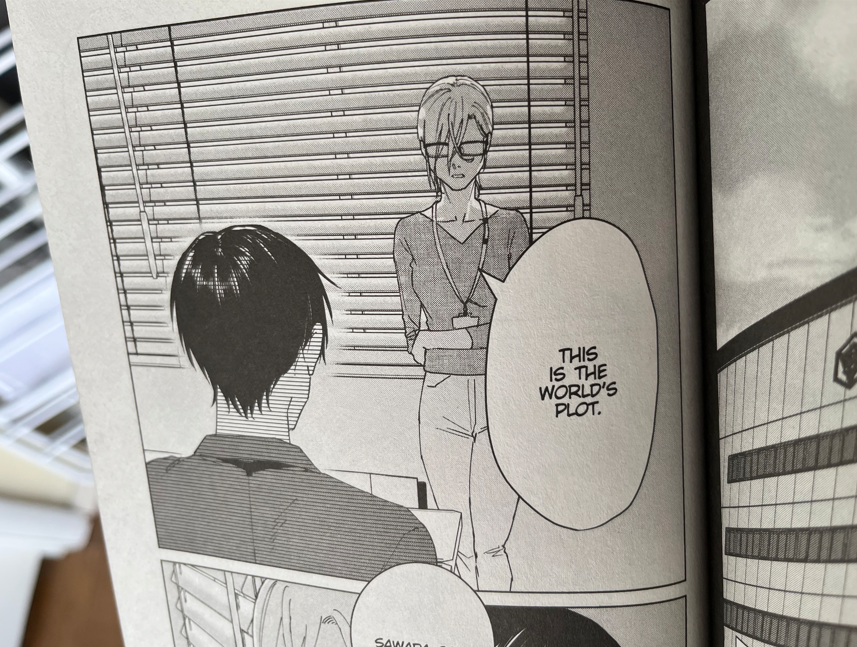
Sawada stands ominously in front of closed blinds in her office, telling Koga in the foreground "This is the world's plot."

When she ’bout to tell you the world’s plot.

What also doesn’t help the final narrative twist is the way it is written. The pages where Sawada explains the Dynamis’ true history is, to be frank, very incoherent. The grammar and sentence structure doesn’t flow at all, or at best does if you squint really hard. One section reads:

“As world wars became more frequent, the weapons needed to end them became increasingly more radical.

In other words, soldiers lost their fighting spirit.

A weapon that affects the spirit of enemy soldiers is difficult to reproduce.”

I think the meaning here is supposed to be something along the lines of: “Constant world wars with escalating weaponry began to seriously erode the morale of the military rank-and-file. With their existences on the line, many governments developed methods to combat the emotional tolls of war, but their effects were short-lived.” What’s on the page feels like a very rough-cut translation that took me multiple reads to parse.

I don’t want to make any firm claims, but given that Seven Seas decided to forgo separate volume releases after the first one and instead pivoted to an omnibus format coupled with the fact that this wasn’t a problem anywhere prior to the Volume 3 sections makes me wonder if shortcuts were used for the later chapters. It could also be plausible that it’s just as confusing in the original Japanese. Either way, you can tell that sono.N was wrestling with fitting in “the world’s plot” in the limited space of the back of this series. It’s as if the world-building was too good for the space that was given, leaving me wanting the themes and character motivations to be more consistent and clear than they are.

I would say that I do like sono.N’s art. The Dynamis are formless but very creepy, the character designs are fun (props again to body diversity), and the action is well-conveyed. Occasionally, though, characters do look off model in a way that messes with their scale relative to each other: case in point, Koga looks a lot less beefy on the cover compared to inside the book. It’s a minor gripe, though.

If you are looking for a short Yuri sci-fi story with badass women in it, and you can stomach some bad things happening (mostly to children), this meaty omnibus is an easy book to recommend. I just know that a lot of meat was left on the bone. 

Art – 8 Plenty creepy when needed
Story – 6 A lot of potential that was left unfulfilled and a bit grim at times
Characters – 7 Koga and Leo are plenty loveable, the rest…eh
Service – 4 Mostly if you like muscular women (plus one bath scene)
Yuri – 8 / LGBTQ – 8 The imprint is called “Girls’ Love” for a reason

Overall – 7 A snack that could have been a four course meal

Matt Marcus is a cohost of various projects on the Pitch Drop Podcast Network, as well as the writer for the blog Oh My God, They Were Bandmates analyzing How Do We Relationship in greater depth.


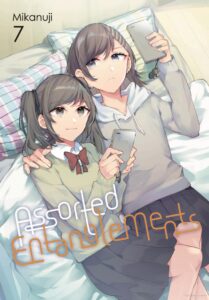
Assorted Entanglements, Volume 7

June 30th, 2025

The cover of Assorted Entanglements volume 7. Shizuku and Saori lie in bed together in their school uniforms, both looking at their phones. Shizuku has her arm around Saori's shoulders and is looking over at her. You can see their matching gorilla phone charms hanging from their phone cases.

by Matt Marcus, Staff Writer

I ran into an ex once at the public batting cages in Arlington, VA. Well, she wasn’t really an ex, more like the other half of a pseudo-situationship. I spied her out of the corner of my eye as my then-girlfriend-now-wife and I looked for an open spot. If I were punching up this story, I would say we locked eyes through the wire fence. In a moment frozen in time, I’d be shot through with the pain of regret of decisions not made sooner, words left unsaid. My date would notice I had become quiet and distracted; I would shrug off any questions about it despite my soured mood, kicking off a downward spiral that ruins our date. But nothing so dramatic happened; we simply found an open cage, hit some dingers, and had a lovely rest of our evening.

In the previous volume of Assorted Entanglements, Shizuku was rattled by seeing a woman we haven’t seen before while walking Saori back to her house. Saori noticed, but couldn’t bring herself to ask. Turns out that the garishly-dressed woman is Shizuku’s ex.

A notable amount of Assorted Entanglements Volume 7 is dedicated to Shizuku’s past with this woman, Miki, and what Saori decides to do in response. This is the most seriously dramatic tone that Mikanuji-sensei has gone for in this series and I think that it pays off. We thankfully get no more detail about the abuse she suffered from her parents (and the violent reaction that landed her in juvvie), but her story with Miki, a hairstylist who took Shizuku in after she ran away from her foster parents, is tantamount to grooming. We don’t know much about how Shizuku extricated herself from that relationship or how she feels about it now (though she still wears her hair with the cornrows that is Miki’s personal style), but the effect of the encounter in the present makes her retread into her prickly Bad Girl shell.

Thankfully, what could prove to be a setback in “progress” turns into the opportunity for Saori to finally admit her honest feelings–that despite all her bluster and dismissal, she does indeed love Shizuku. Shizuku tacitly accepts this, and another ship sails. To be honest, I’m still iffy on the recurring theme that these so-called delinquents (read: abused young women) who have severe self-worth issues need to be whipped into shape by the normie girls/women who happen to love them. If I am being charitable, I’d highlight that the point being made is that they (Shizuku and Minami) are indeed worthy of the love they receive, which is good and true. I just wish they weren’t punished by their lovers for struggling with accepting affection.

Let’s not forget that this is still an ensemble story. Iori and Minami are up to their normal hijinks (this time they go to an onsen!). We get one short chapter of Sugimoto at her part-time job glowing about her aquarium date and not taking heed of her boss’ advice not to get her hopes up. Unfortunately, Heke-sensei and Shinohara-san finally succumbed to Mikanuji-sensei’s love of “slapstick” violence for one gag, but otherwise their chapters continue to be a sweet love story of a failgirl nerd and her blunt-but-secretly-tender lover/boss. It’s all solidly entertaining stuff.

If you have been waiting, nay, shouting at the pages for Shizuku and Saori to finally just get over themselves and have it out, then you will be pleased as punch here. With 3 out of 4 couples established, that leaves one last problematic pair to wrap up.

Art – 8
Story – 8
Characters – 8
Service – 1
Yuri – 8 / LGBTQ – 8

Overall – 8 Somehow made me “happy” for the worst couple here

The story of these mismatched women continues in Volume 8, coming our way in August.

Matt Marcus is a cohost of various projects on the Pitch Drop Podcast Network, as well as the writer for the blog Oh My God, They Were Bandmates analyzing How Do We Relationship in greater depth.


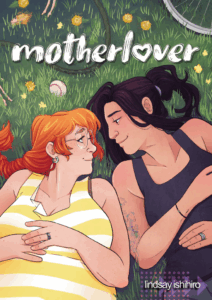
Motherlover

May 11th, 2025

Two women lie in the grass looking deeply into each other's eyes. One is a heavy-set white woman, with bright orange hair tied in a braid wearing glasses and a yellow-and-white striped tank top. The other woman is Asian with black hair, tied back in a high pony tail, wears a dark gray tank top, and has tattoos on her right arm.By Matt Marcus, Staff Writer
Where would we be without our mothers? As a parent myself, I’ve felt starved for stories about parenthood within the world of Yuri media. In fact, a large amount of Yuri centers on characters that explicitly reject the notion of having children and raising a family, and not without good reason. That’s valid and I support it. But it leaves out a few avenues for telling new stories, which is why I was excited to discover the topic of today’s review.

Motherlover is a spinoff comic (launched on Mother’s Day, of course) centered on two random characters from Lindsay Ishihiro’s long-running autobiographical comic How Baby. After creating them, she felt compelled to give them their own story. The first leading lady, Imogen, is a quintessential Midwestern homemaker, managing a household of four kids; her counterpart is Alex, a Cool Artsy Queer mom who has moved back into her parents’ house after their recent deaths.

Both leads are well-rounded characters. Imogen became a mother at 19 and flunked out of college before meeting her current husband. Her inexhaustible capacity to care for her children is only matched by her insecurity about her limited life experience. Alex, meanwhile, pushes away people who love her as a result of the emotional abuse she suffered from her extremely strict parents.

The core of the story is the dynamic between Imogen and Alex. Their friendship feels lived-in and believable, which further sells you on their compatibility as their feelings for each other deepen. You could even say that they are a bit too accepting at times; even when one is venting ugly honest feelings, the other never takes offense. It’s as if they are committed to each other before they are committed to each other. There is no moment of doubt that their connection will break, which makes for a breezy read even when the topics get heavy.

Putting my Serious Critic hat on, I would say I wish the children had more space to be characters. For instance, how did Alex’s daughter Nolan feel about her mother’s previous partner? How does her feelings parallel Imogen’s kids feelings about their parent’s divorce? The only one of the five children who is given any spotlight is Imogen’s oldest, but their arc is so siloed from the core of the story that it could have been cut without affecting the plot at all. I’ve read enough of How Baby to know that Ishihiro knows how to talk about motherhood in a raw, vulnerable, and hilarious way, but not much of that transferred over to this story.

I also find myself wishing that the issues around Imogen’s marriage didn’t boil down to cheating. I thought Ishihiro did a great job sketching Imogen’s husband as a man who is controlling and withholding, but not in a domineering manner. The way he perpetuates Imogen’s insecurity by shooting down her ideas of going back to school is compellingly insidious; it felt so strong to me that I found myself disappointed when the breaking point of their marriage turned out to be infidelity. It’s believable, but a bit expedient.

One thing that occurred to me is that this is a queer love story where very little of the challenges center on queerness: Imogen never struggles with her gay awakening, Alex doesn’t encounter hostility from the community for being loudly out, a young character comes out as trans and basically no one bats an eye. It represents a kinder world than the one we live in, and I’m sure many readers will love that part of it. (Yes, there is some queerphobia represented in the text, but it’s treated with a light touch.) My feeling is that, in a story where being a parent is the premise, I would have liked to see it tackle what it means to be a parent who is queer, AND what it means to be the parent of a queer child (though I felt the coming out scene was well-handled). To be clear, all of these critiques are quibbles for what is an easily enjoyable story.

While the comic is complete and free to read online, I was unaware of it until seeing an announcement of a physical release from Iron Circus Comics. It’s a lovely softcover book with glossy hearts embossed on top of the matte finish of the cover. The art and paneling is solid and translated well to the printed page. Also, I was pleased to see Abby Lehrke in the credits as a proofreader, given her involvement with A Certain Manga Series Set In College that I am fond of.

If you are looking for the perfect sapphic comic for Mothers’ Day, this would be one to pick up, but I’d say it can be enjoyed and celebrated on the other 364 days of the year as well, just like your mother. (And would it kill you to call every once in a while?)

Art – 8 Solid and clean
Story – 8 Tightly paced; could have been expanded but would have required a longer page count
Characters – 9 Everyone is well written, though some characters could have had more to do
Service – 1 Domestic snuggles is as spicy as as it gets
LGBTQ – 10 70% of the named characters are queer, so it gets high marks

Overall – 9 The best Mom-meets-Mom story on the market

Yes, Ishihiro is aware of the SNL skit of the same name; it’s mentioned on the comic’s About page.

Matt Marcus is a cohost of various projects on the Pitch Drop Podcast Network, as well as the writer for the blog Oh My God, They Were Bandmates analyzing How Do We Relationship in greater depth.


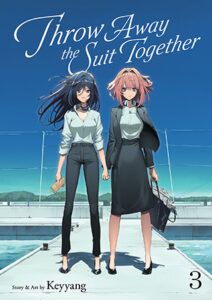
Throw Away The Suit Together, Volume 3

April 2nd, 2025

By Matt Marcus, Staff WriterTwo women in business attire stand on a boat pier hold hands, looking out at the reader with serious expressions

“…This has been a really great conversation. We’re really excited for the possibility of you joining our team here at Island Industries.”

“It’s a fantastic opportunity,” I hear myself say. I clench my jaw, thinking It better be, after six interview rounds.

“We just have one last question for you. More of a case study, really,” says a man with closely cropped hair and narrow rectangular glasses. I’ve already forgotten his name, but I do know that he is some kind of VP. “We dug into your background and found your little, ah, ‘side hustle’ at Okazu.”

I chuckle nervously. “Oh it’s more of a hobby, really—”

“We were hoping that your review of…that series with the android would give us some insight about your skills in the field of AI, but, alas.” My eyes dart quickly between him and the two other members of the interview panel, looking for some kind of reaction. None show any readable expression. “What we found more interesting was that you have yet to review Throw Away The Suit Together, Volume 3.” 

My pulse accelerates, and I can feel perspiration dampening my shirt under my suit jacket. “Um, yeah, that’s a strange one. Hard to get a handle on it.”

“Well, we feel like this role requires someone who is able to forge a clear path in the face of ambiguity. It’s a demonstration of decisive leadership.” The man pulls out a paperback book from behind his chair and places it on the conference room table. He spins it around so I can see the cover properly and slides it towards me. Two young women are dressed in office clothes, holding hands and looking straight at me with resolute eyes. “I want you to tell us, what is Keyyang-sensei trying to say with this series?”

I try to swallow the panic that rises in my throat. This is crazy, I think. The recruiter didn’t tell me there was going to be ANOTHER case study. And what the hell does this have to do with this job??You know what, fuck it. I need this job. Just remember your interview training. My voice shakes slightly as I begin. “O-OK, so let me start with laying out the situation.

“In Volume 2, Haru and Hinoto lucked into some part time employment at a dive shop, which manages to buy them a few weeks of time before needing full time employment. However, neither are willing to actually make a realistic plan for the future. Instead, they revert to trying to hunt for the same kinds of jobs they were running from and find it impossible on this remote island. Haru overhears Hinoto call the college and ask about readmission, clearly setting up a conflict.

“So, their relationship begins to break down because each side is feeling more and more desperate and are failing to communicate. Both manage to get interviews but neither land a job, so they rip up their marriage contract and go back to Tokyo and return to the grind they tried to escape.”

They also have a lot of desperate, sad sex, but I’m going to leave that part out

“So, do you think the story is about the dehumanization of people who are forced to participate in capitalism?” asks a stern middle-aged woman, her hair pulled back into a tight bun that accentuates her sharp facial features.

“I mean, that is one part of the story, clearly. But that doesn’t sit fully right with me as the central theme. The story is so laser-focused on these young women and their misguided decisions. A lot of escape stories like this would lead to the main couple living with little money but a lot of joy, and instead neither partner can give up the idea of joining a large established company. Not only is being, um, ‘low income’ off the table for them, but they both tried to get jobs without going through proper channels or getting the credentials that would qualify them for those positions. It’s like, they feel that they have the privilege to skirt around the issue of qualifications and merit, if only because they find doing things the ‘proper way’ too stressful.”

“Do you think capitalism is inherently meritocratic?” The VP asks.

“We sure like to pretend it is, but obviously those with money—and therefore power—circumvent the rules all the time. Maybe in this case, these girls simply weren’t wealthy enough to pull off this plan of theirs.”

My last words hang in the air. Thirty seconds pass as we all sit in thought. Then, the third panelist, a stout, balding man with small, deep-set eyes who had been oddly quiet this entire interview, leans forwards and asks, “What do you think about the marriage license?”

I reply reflexively before I can formulate my thoughts. “I…I think it’s treated as the albatross weighing both Haru and Hinoto down, but also because it represents a non-legally binding relationship due to the lack of marriage equality in Japan, it kind of also represents nonconformity? It’s, like, more radical than just bailing from the bustle of Tokyo and trying to make a life somewhere else.”

My pupils begin to dilate as the words flow out faster and faster. “It’s as if the problem isn’t the girls’ impulsiveness or the economic system. The core problem is more fundamental than that. It’s simply that they don’t follow the basic rules of society. They decided to stick out, and society punished them for it. So they must conform. Go back to Tokyo, get those degrees, throw out the dream of legal partnership. But that message is so hollow, isn’t it? ‘Don’t get too big for your britches’? ‘Know your place’? Sure, their relationship survives this ordeal. But you could almost see a breakup down the road because the ‘dream’ will always be too heavy a burden to bear. It tries to end on a hopeful note, but it ended up leaving a really sour taste in my mouth.”

The small man stares intently at me, but then leans back in his chair and presses no further. Mr. VP chimes in, “I think that’s all we have on our side. Do you have any questions for us?”

Yeah, I do, like what the fuck just happened to this interview. “So, I guess Yuri is pretty popular in the office, yeah?” I try to joke. “It’s an essential part of the job, it says so right in the posting.” the woman replies. I look down at the printout next to my notepad on the table. Reading the page, I knit my eyebrows in confusion. Yuri Solutions Architect? The hell is…?

After a beat, the VP says, “HR will be reaching out to you for our final decision. Thank you for your time Mr. Marcus. Oh, and don’t forget your scooter.”

“My scooter…? I don’t own a….” I look to my right to see an old, well-worn moped revving up in the corner of the conference room. I recognize in terror that it’s Hinoto’s scooter, threatening to drive me toward ruin like it did it’s owner. Startled, I scramble out of the swiveling office chair and back away until I hit the full-length exterior window covering one wall of the room behind me. The scooter accelerates towards me, and the scream doesn’t have time to leave my throat before—

My iPad falls onto my face, startling me awake. I am on the living room couch in my apartment. I groggily tap the device to be greeted by my lock screen, an illustration page from Otherside Picnic. In the stark black and white image, two young women carry assault rifles down a side street of a derelict Japanese town. Superimposed atop the picture is large text that reads 3:12 a.m.

As I go to put the iPad away, I briefly see a LinkedIn job posting notification for a role at some company called Island Industries. I pay it no mind as I half-consciously shamble off to bed.

Art – 5
Story – 6
Characters – 5
Service – 3 
Yuri – 9 / LGBTQ – 4

Overall – 5

Matt Marcus is a cohost of various projects on the Pitch Drop Podcast Network, as well as the writer for the blog Oh My God, They Were Bandmates analyzing How Do We Relationship in greater depth.



How Do We Relationship? Volume 12

March 12th, 2025

By Matt Marcus, Staff WriterA young woman with shoulder-length black hair and wearing a red dress stands in the middle of a college school festival, holding a plastic container of food in one hand and a plastic bag with more containers in the other. She is looking back over her left shoulder with a slight smile

I’ve long held a preference to mouthwash. No, not the electric blue-green swill with flavor names like “arctic” and “alpine”, describing some slightly different formulation of wintergreen. I’m talking about the unadulterated, sickly amber kind simply called “Original.” Unlike its minty counterparts, the Original burns as it works. I liked that about it. It told you not only that it was working, but where it was working. I always found the lack of feedback from the other flavors disorienting, as if I were trying to walk on numbed feet. I feel the same about aftershave, hydrogen peroxide, and so on. Pain exists to direct your attention to places of need.

How Do We Relationship?, Volume 12 brings the pain. A cleansing, healing pain that is much sorely needed.

Last we left our cast, the plot had taken a heavy-handed nosedive into some serious subject matter. Miwa was left broken after a traumatic encounter with Tamaki, while Saeko’s relationship continues to be more and more strained by Yuria’s need for space.

There’s no sense being coy about it: this is the volume where the girls break up. Again. None of this should be a surprise, as we have felt the cracks starting to form two volumes prior, but unlike before, I feel like the pangs of heartache here are growing pains rather than seeping wounds.

I emphasized in my last review how critical I was in how Miwa and Tamaki’s conflict about sex played out. The first few chapters here help add some context to the fallout that I think takes some of the worst sting out of it, but without lightening its impact. For Miwa, she felt shame that her sexual desire was so strong that it overpowered her emotional needs, and that Tamaki felt repulsed by the intensity of that desire.

Miwa breaks up with Tamaki. The decision is a major sign of growth for her; instead of clinging desperately to a flawed relationship like she did in the past, she realizes that despite their mutual love for each other, it would be mentally and emotionally better for her and Tamaki to part ways as lovers (put a pin in that, it will come up again). I think the breakup and their later run-in at the school festival were emotionally impactful, and it left me thinking that both of them will be OK as they move on in their lives.

It does, however, resurface an underlying issue: this is another example of Miwa feeling like she owns all the blame for a failing relationship. At no point does she give Tamaki any ownership in what transpired in their relationship, much like she did with Saeko before. This seems like a character flaw that will continue to not be treated as such. I can accept that even at 21 she is not a fully-formed adult yet, but her martyr complex is a blind spot that is a bit troubling.

As is typical in this medium, we get to see into Tamaki’s backstory for the first time right before the end. I think that the segment was effective in further humanizing her…but it was a struggle for me to want to empathize with her after the last volume. That queasy feeling from chapter 103 is just never going to fully go away, as if it were some kind of trauma (put a pin in that).

I had mentioned in previous reviews that I wish we saw more of Miwa and Tamaki’s happy moments together. The characters clearly express that their love was deep and genuine, but very little of that made it to the page in favor of anxiety and stress—and not even just around the sex. The way they interact here shows me their feelings, but I was not given the opportunity, with a rare exception or two, to feel it for myself.

There is another moment of growth here for Miwa that I found particularly impactful. When Miwa is casually outed at a social gathering for the Light Music Club, she takes the moment in stride and is able to smoothly redirect the conversation away from her queerness being the topic. This inspires a baby gay first-year to approach her after the event and tell her that he admires her strength in “living her truth”. Miwa reflects for a moment before telling him that she falls in love with women who are “bold and cool”, and she looks to their example as her source of strength. It’s a powerful moment of self-reflection that is demonstrative of this series at its best. Watching Miwa mature from the timid girl who couldn’t handle Kan in Volume 2 to now is one of the most satisfying character arcs I’ve witnessed in manga.

Meanwhile, Saeko and Yuria struggle to find a compromise between Saeko’s desire to spend as much time together and Yuria’s emotional need for space. Saeko struggles with not being able to see Yuria when she wants, but when Yuria begins making more time for her, she feels bothered that she’s making a sacrifice. They are coming from too far a distance apart for meeting in the middle to feel good. That’s a big bummer for a couple that we’ve seen work through troubles and arguments before and come out the other side stronger.

I could say a lot more about this, but in the end, they both agree to go back to being friends (at their favorite spot, the playground, of course). Like this series is fond of doing, the breakup doesn’t mean cutting themselves out of each other’s life. I wish they could’ve worked it out, but if they were going to break up, it would be hard to ask for a better way for it to go for them.

I’ve been praising the art for a while now, but this volume has a few standout panels that are some of my favorite drawings of the series so far, along with a beautiful color image for the cover. Abby Lehrke’s localization continues to get top marks from me.

I believe this volume is a return to form from the trajectory it had been taking over the previous two volumes. Both Miwa and Saeko shed their tears, but they leave their relationships stronger and with a hope for the future. There are hints here as to what that future is—and if you are paying attention at all, you know where this is heading—but for now, the slate is clean. It’s a real palette cleanser, the kind for those who prefer to avoid the mint.

Ratings:

Art – 9
Story – 9
Characters – 10 
Service – 0
LGBTQ – 10

Overall – 9

The final chapter of the series was uploaded on the VIZ app on February, 28; Volume 13 will hit shelves in September 2025.

Matt Marcus is a cohost of various projects on the Pitch Drop Podcast Network, as well as the writer for the blog Oh My God, They Were Bandmates analyzing How Do We Relationship in greater depth.


