Archive for the Staff Writer Category


How Do I Turn My Best Friend Into My Girlfriend?, Volume 1

May 24th, 2024

by Luce, Staff Writer

Imagine you are a Japanese schoolgirl, and you’ve just realised you have a big crush on your friend! What do you do? Your options: 

A: pine ad infinitum. This crush goes to your grave. This is a pretty safe option, filled with yearning gazes and trying to hide your feelings, but someone more proactive might get there first, leaving you in a world of angst!

B: confess immediately. It’s a high risk option, but if you’re the gambling kind, it might pay off. After all, you’re already friends, so you know you get on. But be careful – it might make things pretty strained between you if they don’t return your affections…

C: try and win then over. You’re pretty sure they don’t see you romantically… yet. But there’s plenty of time for that to change, right? All you gotta do is show them how great you’d be as a couple – put on that winning smile, take them out on that date, and woo the heck out of them! 

How Do I Turn My Best Friend Into My Girlfriend?, Volume 1 which tells the story of Minami and Yuzu, who have been childhood friends since elementary school, firmly picks option C. They’ve been very close, physically and emotionally, for a long time, but when Minami accidentally overhears plot device guy confessing his love to Yuzu, she’s suddenly hit with the revelation that she’s in love with her. 

She has one chapter of panicking about this, notably absent of ‘but we’re both girls!’. After she admits it pretty easily to her other friend, Hinori, that she works with, who is thankfully supportive, she decides that the only option is to try and get Yuzu to think of her romantically. 

Not to say this necessarily goes that well, but she’s trying. It’s the thought that counts. Minami hasn’t ever liked anyone romantically, and has never dated anyone – and like any studious person in manga clueless on a subject, turns to textbooks! Hinori points out that none of those books are ‘textbooks’, and acts as a sensible hand to try and help. 

They end up on a date to the planetarium, because Yuzu is very into space. I now want a Saturn plushy. The date is cute and goes pretty well, but Minami feels like it’s getting her heart rate up more than Yuzu’s. Nonetheless, she does try to confess at the end, interrupted by some of the other friends…? 

This isn’t exactly a ground breaking manga, but it was quite refreshing in so much as Minami is actually trying. I love a good bit of pining, but sometimes it is nice to see someone going for what they want in a relationship. How I feel about it in the long term will largely ride on how long the ‘cannot spit it out’ continues. The situation presented at the end could go several ways, but it’s probably going to end up being a big misunderstanding for some conflict. Rather than drag its feet on getting them together, I’d actually like this manga to explore the transition from friends to lover, or focus on Yuzu a bit more – she doesn’t really show any signs of romantic affection for Minami, so it would be interesting if they explored that. 

All said, I will check into the next volume – it’s not the strongest Yuri manga out there, but if you like a more proactive protagonist and a complete lack of ‘but we’re both girls’, you could do a lot worse. 

Ratings:

Art: 7 
Story:
Service: 3, solely for an imagine spot where Minami is considering her feelings towards Yuzu, and one page says, without showing anything explicit, that is definitely sexual as well, or could/will grow that direction
Yuri: 9

Overall: 7

The translation and lettering all felt normal, that is too say I didn’t notice any glaring errors or oddities, which was done by Matthew Johnson and Giuseppe Antonio Fusco respectively. Volume 2 is due out in late September, as per the Seven Seas website.


Okazu Staff takes on Yuri Is My Job, Volume 12

May 13th, 2024

Two girls in green, old-fashioned Japanese school uniforms embrace. A girl with blond hair and glasses tenderly holds a girl with blue hair, who holds on tentatively.Yuri Is My Job, Volume 12 came out in English from the fantastic team at Kodansha and it was…a lot. I had reviewed it in Japanese almost a year ago, and it was a lot then, too. After discussion with Okazu Staff Writers, I decided that it was big enough and complicated enough that no one person ought to have to shoulder it. So, welcome to the very first Okazu Staff Writers Group Review. Here you will find 5 perspectives on this volume, each from people whose opinions you trust, but who are all quite different people.

CW for this volume and these reviews: sexual assault, emotional manipulation, trauma.


Reviews by:

Luce | Christian LeBlanc | Eleanor Walker | Matt Marcus | Erica Friedman


Luce

Goeido had always been a divisive character, I imagine. Since she was introduced back in volume four, she was shown to be manipulative and callous, something only expounded upon every time she showed up. Last volume, her and Kanoko went to a hotel together – just to ‘talk’. This volume, we get the culmination of that interaction, and boy howdy is it uncomfortable. Not happy getting Sumika and Nene to think that her and Kanoko are in a relationship, she essentially comes on to Kanoko, to prove to her that kissing and sex are important in a relationship. Kanoko is stuck, because admitting that kissing might be important means that Yano kissing Hime meant something, but if it was important, that implies that Hime didn’t mind this from Yano, something Kanoko cannot bear.

The sexual violence warned about on the contents page, I think, (although I’m concerned it’s a bit too easily missed, though I’m happy it’s there) refers to two separate incidents in this volume. The first with Goeido and Kanoko – where Kanoko unwillingly has her skirt and top taken off, and as far as the reader can tell, that’s as far as it goes (however, Goeido is at least twenty, but probably a little older, and Kanoko is 15/16). Equally uncomfortable was the second incident, where Kanoko, on the same day, forces a kiss onto Sumika, and feels up her breasts, without asking for any consent. Sumika pushes her away, and ultimately it shows up Kanoko’s extremely warped thinking, which honestly I have some trouble following. But they talk about it, which is good.

Goeido’s actions are reprehensible, definitely, and as an asexual person, extremely uncomfortable, but not for the reason you might think. I am fine with sex scenes in manga. It’s her implication that love cannot exist without sex, which I would like to vehemently oppose. I feel like this is meant to represent Goeido’s views rather than necessarily the mangaka’s, but it still sticks out as uncomfortable to me. For her, love and sex are completely linked in a way that no one else in the manga thinks about – and I can’t help but wonder if she might be aromantic allosexual, albeit terrible representation for an extremely underrepresented and demonised orientation. But to me, in many ways, it makes sense – her insistence that love is impossible without kissing and sex. Her ability to walk away from Nene when her job requirements changed. Nene states that every time they met up, they ended up in a hotel, having sex.

Honestly, I don’t even really like this interpretation, but it equally makes sense to me. I don’t like it because alloaros, as they are coined, are forgotten, or the characters that might most likely be alloaro are the ‘players’, the assholes who use people for sex then leave without a second thought, which is definitely not defining for the entire group, the same way other stereotypes are not indictive of entire other orientations. But in a manga where romantic love has been shown to tear people up, make them blush and just react in general, Goeido has always felt calculating and calm. Maybe she’s just in control of her emotions, apart from a few surprised expressions. But even with Nene, she’s always shown to be in control of the situation, never reacts much outside of a general pleasantness that she shows to almost everyone bar Sumika.

I think she’s a bit similar to Hime, actually.

Perhaps they are two sides of the same coin – Hime as the ‘good’ side, and Goeido as the ‘bad’ side. They both have a facade of innocent pleasantness, whereas their true selves are far more manipulative and callous. The difference is that Goeido seems to want to stir chaos and hurt people (especially Sumika), whereas Hime, when push comes to shove, wants to help and keep people together. Hime, though, has been forced to grow and change over the series, pushed by the immovable rock of Yano, refusing to back down and let her get away with her manipulations. Goeido hasn’t changed a single bit. She’s stuck on getting back at Sumika – and I’m pretty sure that’s why she came back to Cafe Liebe in the first place. Either to bait Sumika, or to get an in to get someone else to.

Perhaps Nene was onto something – maybe she was attracted to Sumika. As a beautiful lady, perhaps someone not being attracted to her heated so much she wanted to take revenge against everything that meant something to Sumika. Maybe she was just mad that Sumika saw through her facade. Who knows – part of me thinks this won’t be the last we see of Goeido, not that I especially want to see her again. I think I’ll be glad when the air starts to clear, as it might do next volume between Kanoko and Sumika, and we return back to Mitsuki and Hime.


Chris LeBlanc

I will admit, reading Volume 12 a second time to gather my thoughts felt even more uncomfortable than reading it the first time.

I have this idea that most online arguments could be resolved if people would just understand that different things work for different people. Goeido would disagree with this theory, however – I get the feeling she believes everyone else on the planet feels the same way she does about sex and romance, and anyone who claims to have different ideas about these things is being delusional. It feels like everyone in Yuri Is My Job! are on different pages when it comes to this, though, and while that usually makes for enjoyable dramatic conflict, let’s just say that Goeido crosses a lot of lines in this volume.

There’s a part later in the book where Kanoko claims to have been unharmed by Goeido, but this is clearly not the case, underscored by the black gutters and panel borders in this section (a technique normally reserved for flashbacks in manga). Happily, the visual tones eventually turn much brighter as Sumika tries to help Kanoko through this chapter, even leading to a cute bit where she tries slipping into Schwester-speak for a moment before dismissing it.


Eleanor Walker

There are many different kinds of love, and Goeido, one of our central characters for this volume believes that sex and love (and possibly violence, I would argue) are intrinsically linked, and one is not possible without the others. Moreover, anyone who disagrees with her is automatically wrong and must be shown the error of her ways. I am not generally a fan of sexual assault used as a plot device, but this volume handles it pretty well, and it works within the context of the story. However, the full colour spread of Goeido posing in lingerie to open the volume left me viscerally uncomfortable, especially in a series which hasn’t been terribly focused on fanservice. But my favourite moment was when Saionji shows up and reminds Goeido that not everyone thinks like she does.
 
 
Kanoko pretends that’s she’s alright after the event, but she definitely seems off to me, and I hope the next volumes have her getting help to deal with such a traumatic experience.


Matt Marcus

I struggled a lot with this volume. On the one hand, I understand exactly what Miman chose to do: they decided that Kanoko needed an extreme push to break her calcified conception of Hime and her relationships in order to drive her character arc forward. Narratively, it’s a sound maneuver, and it is effective insofar as it demonstrates how some people will desperately hold onto a belief despite knowing it will do them tangible harm, and how in turn they can reflect that harm onto others. On the other hand, I think what Miman chose to do was in poor taste and has negative implications to the themes of the series.

Goiedo was an interesting character to me. Sure, she was a bad person, but she was for the most part honest in her intentions. She was very clear with Nene that they were fooling around to make Sumika jealous and to have a bit of fun: nothing more, nothing less. It’s not really her fault that Nene’s feelings developed into romance…OK it kind of is, but she could have continued to exploit Nene’s feelings for her, but that wasn’t the contract they made. Yes, the relationship ended once it was no longer convenient for her which is a shitty thing to do, but nevertheless I found it compelling that she was a villain who meant what she said and held herself—and Nene—accountable.

What Goeido does to Kanoko, however, is simply beyond the pale. It’s one thing to play around with the heart of a sensitive girl, but it’s another to enact targeted psychological violence at the threat of serious intimate violence. To me, at that point she stopped being a believable plot device and turned into a plot contrivance. She is instrumentalized as a mouthpiece of a certain viewpoint on romance without any explanation as for why she believes it. There was an opportunity for this, as she is very familiar with A Maiden’s Heart and no doubt should have opinions on how it depicts relationships between girls and what it represents. As we see on the page, she has feelings on how the characters acted within the confines of the story, but does not take a viewpoint of how the story itself relates to the real world—in a series that is all about meta-narrative.

What tweaks me more, is that Miman wants us to believe that the assault happened…until Kanoko reveals later that it didn’t. And then Kanoko assaults Sumika. It all feels very emotionally manipulative, playing with very triggering subject matter. I think the same narrative turns could have been accomplished without it. Goeido can still be the villain; Kanoko can still panic and flail; Sumika can still be angry and hurt. It just didn’t need to be this.

This narrative turn also unintentionally creates problems for the meta-narrative structure of the series as well. There was always an ongoing tension between the sanitized, pseudo-romantic Class S performances in the cafe and the messier real relationships that were occurring simultaneously. So far, Goeido is the only character who transgressed the Class S “purity” by introducing sex into the story. Given how she’s also now unequivocally a predator, coupled with Sumika’s statement that she has no interest in a physical relationship with Kanoko, frames sexual desire as only a corruptive weapon. It aligns the “real” world with the fictional world of Liebe in that the relationship between girls is only good when it is the pure bond of the Schwesterns. It’s a turn that feels regressive, reminding me specifically of the muddled messages from the Yuri Kuma Arashi anime.

Hell, when you look at the whole of WataYuri, every kiss we’ve seen was given without consent—Yano on Hime, Goeido on Nene, and now Kanoko on Sumika. Physical romantic intimacy is thus represented as always a case of someone imposing their desires on another, starting at its origin (it’s worth noting that five of the six characters mentioned were experiencing their first kiss in this context). When Kanoko offers herself to Sumika, she says, “you have to hurt me as much as I hurt you,” clearly framing sexual intimacy as harmful. Obviously, one can have romance without sex—and that’s a great thing—but Miman seems to be saying that romance, at least between women, should only be without it.

We have had some great discussions about WataYuri in the Okazu discord, and one of the viewpoints raised by Erica and others is that one can read this series as celebrating the potential power of the bonds of sisterhood from Class S stories rather than rejecting it, which is an argument I can support; however, if the series also drags along the negative aspects of those tropes with it into the modern day, I’d rather such stories be left in the past.

Also the hotel should’ve been called Best Schwestern. I mean, c’mon.


Erica Friedman

I have now read these chapters three times. The first in the pages of Comic Yuri Hime magazine, where they were a genuine shock, again in the collected volume where I could take time to be truly angry at Yoko. As an adult, her actions are morally repugnant and criminal. I sat with my feelings about no one in the Cafe being able to see what kind of person Yoko was and, I’ll admit, considered dropping the story. I was that angry.

Now I have read the chapters for third time, this time in my native language and it allowed me a chance to delve into all the nuanced ways this arc has made me uncomfortable. Primarily – I do not like Kanako. I have never liked her as a character. Her obsession with Hime blinds her to everything and everyone else. When she hurt no one but herself, she was tolerable. When Sumika became involved, it was not. I am not a fan of “obsession” in literature, as it has been co-opted by serial killer/stalker “thrillers.” I have been trained to keep waiting for Kanako to snap.

Sumika’s own delusion is pretty high – she imagines that she is above romantic love and attraction and when intimacy with Kanako forces her to rethink that, she does not handle it maturely. Because she, too, is a child. We look at Kanako and see an innocent, naive girl, but forget that Sumika is only a teenager, as well. Kanoko’s inability to “see” other people and understand their motivations is a complicated matter. Yes, Kanako absolutely pings neurodivergent (as does Mitsuki,) but I, personally, have a belief that if you read that much, surely you begin to understand something about people. I did not understand people my own age, but I understood human nature as a whole at Kanako’s age, purely from reading books by and for adults.

So as we watch Kanako walk into Yoko’s hotel room, of course we are screaming at the pages of the book…but also I am screaming at Kanoko. How have she read so much and is unable to see that Yoko is not okay?

Yoko, too, has an obsession. Her only goal is to hurt Sumika. The why is not all that critical to the story, and it will be handwaved into an almost unbelievable act of hurting the thing one loves, as if Yoko is a child in kindergarten aggressively teasing someone they like because they don’t know how to act appropriately. As Matt points out, even though the why is not critical…there should have been an attempt at giving us a why.

This third time, I sat with all the layers of discomfort – not liking Kanako, but also forced to sympathize as she deals with all-too-real trauma.   Not liking Yoko, on multiple levels, including the way she is presented to us as a sexual creature (encapsulated in a very uncomfortable-making two-page spread of Yoko in lingerie ), then her words and actions to Kanako making no real sense, as if she’s a cult member trying to proselytize. And Sumika, whose desire to protect Kanako is bifurcated into competing needs for intimacy and responsibility, with no clear understanding of how to do either. And back to Kanoko, who will deal with this trauma…but maybe not take the right lesson from it?

This is a rough volume, about characters making bad choices sometimes for good reasons, sometimes for appalling reasons. But it is an important volume to move both Sumika and Kanoko out of their childish delusions, into more adult delusions. The question I am left with is…is this what we needed or wanted from Yuri Is My Job!?

For such a silly premise, this story has had more than it’s fair share of me shouting at the characters.


Blank The Series, Guest Review by Frank Hecker

May 1st, 2024

Viewed from above, a girl lays her head on her homework on a table. She is holding hands with an older woman who sit next to her, listening to musicA young woman on the cusp of adulthood latches onto an older woman and pursues her, but a sheltered adolescence causes her to come off more child-like than her age might suggest. The older woman, burned by past relationships and not looking for another, thinks of the younger woman more as a daughter than a potential lover, but eventually finds herself reconsidering what they mean to each other.

Wait, didn’t I review this story several weeks ago? But, no, this is not Monthly in the Garden with My Landlord, Volume 2 , it’s season 1 of the Thai live-action yuri production Blank: The Series.

Blank: The Series is an adaptation of a novel by Chao Planoy, the author of GAP: Pink Theory, and is set in the same universe. It’s squarely targeted at fans of GAP: The Series, although its age-gap premise has occasioned online controversy among some in that fandom. 36-year-old Neung (the older sister of Sam from GAP) is a mature woman burned out on relationships, four years on from ditching rising politician Chet at the altar in the series’s opening scene. As previously seen in GAP: The Series, Neung is estranged from her grandmother, has rejected her place in the Thai aristocracy, and is pursuing a life on her own as an artist (partially subsidized by Sam).

Into her life comes 20-year-old Neung (the identical names are not a coincidence). Young Neung (or Aneung, as older Neung refers to her) is a young woman denied a normal adolescence; she’s still in high school, held back by ill health. She has no friends her own age, and her only family is her demanding and censorious grandmother. Aneung’s only escape is reading yuri novels, and when she meets older Neung (whom she calls Ar-Neung or “Aunt Neung”) she immediately sets out to win her over, alternately flirting with her and pouting at the older woman’s rejection of her advances. As for Neung herself, she goes from finding Aneung annoying to struggling with her ambiguous and growing feelings toward her.

“Faye” Peraya Malisorn is excellent as Neung in a role that calls for subtle acting to show Neung’s slowly evolving emotions. “Yoko” Apasra Lertprasert generally acquits herself well as Aneung, although her performance at times threatens to become repetitive. “Ice” Papichaya Pattaralikitsakul and Marissa Lloyd have the thankless jobs of following in Freen’s and Becky’s footsteps as Sam and Mon respectively, but they are very much the side couple here.

Like GAP, Blank has its share of melodrama, especially involving Chet (“Kun” Kittikun Tansuhas) and Phiangfa (“Ploy” Preeyaphat Silahom), Aneung’s long-absent mother. The producers toned things down somewhat from Blank the novel — for example, they aged up Aneung — and hopefully will continue doing so with the second season, which apparently has even more melodrama. They could have toned things down even further, for example getting Aneung out of a high school uniform and dialing back her childish aspects a notch or two. In terms of production values, the major problem with the series is the mediocre to poor English subtitles, which sometimes left me struggling to figure out the meaning of certain lines.

Despite that issue, Blank season 1 is a welcome addition to the GAP extended universe. The core relationship is handled well (except for Aneung going overboard at times), and there’s minimal “service”. I liked it enough that I’ll watch the second season, which begins airing in May. It will presumably deal with the fallout from the final episode of season 1, which ends on a cliffhanger.

Rating:

Story – 7 (unless you hate age gaps)
Characters – 7
Production – 5 (the subtitles drag it down)
Service – 2
Yuri – 6
Overall – 7


Assorted Entanglements, Volume 3

April 10th, 2024

A woman in pink hair and headphones sits in front of a keyboard, in a gaming chair, while a woman with blue hair leans on the desk next to her.by Matt Marcus, Staff Writer

Previously in Assorted Entanglements Volume 2, sparks and virtual bullets flew as we met mangaka Heke-sensei and her editor Shinohara, who not-so-anonymously play an online First Person Shooter game together while harboring mutual crushes. Meanwhile, Shizuku and Shiori slowly float closer to each other, somehow.

For Assorted Entanglements Volume 3, Mikanuji-sensei must’ve thought “hmmm the last new couple was a little too wholesome. It’s time to spin the Wheel! Of! Problematic! ‘Ships!” A giant prize wheel rolls in and is vigorously spun. Plasticky ratcheting sounds burst out then slowly decelerate as the selection arrow slowly passes over OL x JK, then Sister x Sister (Adopted), and finally Sister x Sister (Not Adopted) before landing on: Teacher x Student. A sizzle reel plays for the winning couple. For some reason they are riding jet skis at a Sandals Resort.

That’s probably not how it happened (I’m sure there was an editor involved somewhere). However, it is less dire than you may be thinking. For now.

Our new pair of star-crossed acquaintances is the stoic gym teacher Kujou and one of her students, 3rd year Sugimoto. Every day after school, Kujou stands outside the door of a lesbian bar, too afraid to enter. Inevitably, she chickens out and instead frequents the maid café next door where Sugimoto works. Sugimoto, who is a bit of a misanthropic loner despite her good looks, decides seemingly on a whim that she is going to help Kujou on her quest to enter the bar and finally find herself a girlfriend.

It becomes clear pretty quickly that Sugimoto is on her way to catching feelings for Kujou; blessedly, her gym teacher doesn’t even register her as an option, despite noticing that her student is pushing the boundaries of a proper teacher/student relationship. (I hate that I find this refreshing.) Regardless, the comedic dynamic between these two works. Sugimoto’s acerbic tongue is a fun foil to Kujou’s sad puppy vibes. I’m just mildly concerned about where the story is going to take them.

Aside from these two, there are still three other “couples” to check in on. Not too much has changed between Minami and Iori, however the same can’t be said for their “jilted” hangers-on. In fact, Shizuku’s hard-assery has softened considerably towards Shiori, much to the latter’s chagrin. You can see the little dance they are doing, inching towards each other then repelling apart mostly because Shiori likes to throw Shizuku’s feelings back in her face to goad her into anger for a laugh. Despite that, progress is being made. For some reason, I’m rooting for them.

Meanwhile, Heke-sensei and Shinohara begin spending more and more time with each other, often pretending to be lovers for “material” to inspire Heke-sensei’s storyboarding. Each time Heke-sensei tries to close the gap, Shinohara’s bluntness and desire to hide her crush ends up unintentionally sending the wrong signals to her coworker/secret gaming buddy. They are the goofiest and most wholesome pairing in this series, so it’s always a nice reprieve when they show up.

I mentioned the art’s Same Face Syndrome in my review of Volume 2, but somehow the issue has now spread to entire characters. You can’t have your characters say a line like “you should be able to recognize your students” and then give multiple characters 99% the same face and haircut.

These are three different characters. Two of them are 12 years apart in age. No, I can’t tell them apart either.

Also, every now and then there’s some weird body proportions. There’s one panel in particular where Shinohara’s right arm appears to have grown 30% too big for her body.

The thing that continues to hold my interest is the humor (again, shoutout to Eleanor Ruth Summers for the excellent localization). Unfortunately, there are still moments of “yikes” that keep me from truly singing its praises. It’s like eating that PB&J sandwich you packed with you to the beach: no matter how careful you are, you will get a bite or two of sand that feels like it’ll crack your teeth. In one notable case, Minami is acting passive-aggressively and Iori has no idea why, and it turns out that she is grumpy because the night before, Iori, who was blackout drunk, did something out of pocket in bed. It’s supposed to be a reversal joke, but there’s enough “ick” to it that it is hard to handwave, let alone laugh at it. The series continues to be one that has enough rough spots to make it difficult to recommend.

But despite my complaints…I am still reading it. This is perhaps the funniest volume so far, and there’s plenty of joy to be had in cropping out panels as reaction images or meme fodder. You just have to be OK taking your Yuri with a grain of sand.

Art – 6 Seems like the art has regressed a touch, and the sameness of the character designs is not helping
Story – 7 A handful of questionable choices hurt it, but the humor stays sharp
Characters – 7 This really is a manga for people who like Women/Girls Who Suck
Service – 4 Iori and Minami’s sex life is still present, and it is a little uncomfy in a couple places
Yuri – 9 / LGBTQ – 9 You did hear me say lesbian bar, ya?

Overall – 7 I’d tell it to run a few extra laps

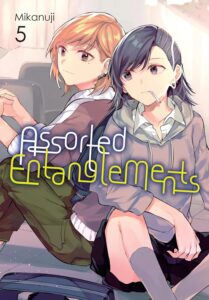
Volume 4 is currently available in English from Yen Press, with Volume 5 arriving in June. A twisted Yuri comedy with some punch.

Matt Marcus is a serial enthusiast whose range of appreciations include guitars, watches, and a particular genre of Japanese popular media named after a flower. Outside of writing for Okazu, he cohosts various projects on the Pitch Drop Podcast Network, where he frequently bloviates about video games, anime, and manga. He also hosts a blog Oh My God, They Were Bandmates analyzing How Do We Relationship in greater depth.


A Sheep Princess in Wolf’s Clothing, Volume 2

March 29th, 2024

A wolf girl in a dress decorated with black trim, and a sheep girl in a flowery frock embrace in an ethereal bedroom setting.by Luce, Staff Writer

In Volume 1, we met Aki, a Wolfa butler, and Momo, a Sheepa princess who announced her intent to enter a relationship with Aki. They went on a date with Momo in disguise. Here, in Volume 2 of A Sheep Princess in Wolf’s Clothing, we see the end of that date, where the queen’s friend, a dressmaker, gets Momo to try on a load of outfits that reveal a fair amount of skin, leaving Aki pretty flustered. They also prepare for an event to celebrate Momo’s coming of age, wherein Aki is reminded that Momo will likely have to marry someone soon… and that won’t be her. Just how does she feel about Momo anyway?

The idea of either marrying into royalty or being long lost royalty had been a trope in fiction for centuries. The escapist ideal of being a lost princess, or being the (usually) woman to get to marry a handsome prince, is the older fantasy version of today’s ‘if I win the lottery’. It’s understandable – for the vast majority of people both then and now, royalty and wealth was something far out of reach and only attainable through fiction. You could argue that wish fulfillment is one of the oldest reasons to make stories.

This is sort of one of those. Aki is a commoner, albeit a servant in the royal castle, which must be a relatively high up position, while Momo is the princess that fell in love with her. In real life, this would be a horrendous power imbalance. In fiction, Momo barely acts like a princess, her maid ships them, and it’s clear they’ll get together by the end of the manga, so the politics is just a complication between their happiness, rather than anything to get too bogged down in.

The thing that amuses me is that the fact that Aki is Wolfa and Momo is Sheepa is made very little of. The royal family is Sheepa, and they are in the land of Sheepa, but many of the commoners are Sheepa, too, and while the influence of the moon on Wolfa is noted and commented on several times, this isn’t seen as a problem, just a consideration. If you like girls with animal ears, you have plenty of them here – the mangaka states here that the story started from a one shot, so we get the author ‘wish fulfillment’ here; it’s not stated, but I suspect they just wanted to draw cute girls with animal ears and made the story around that.

This volume actually introduced other ‘races’, although most are in the background, except a hyena character (Hyenaa? It’s not mentioned) Kunya, a princess from another country, who looks similar to Momo’s first love, the reason she shut herself away in the first place. We also get a glimpse of a troubled part love of Aki’s, although no details. Perhaps in a future volume.

I’m not in love with the fact that the first love of Momo’s is darker skinned and clearly not a great character, nor that the Hyena princess, Kunya, feels like she’s set up to be a third member in a love triangle – but at least she seems to be nicer than the other character of colour we see. I’m hoping that Kunya isn’t just a plot device.

Art – 9
Story – 6
Yuri – 8 (I mean, there really aren’t even many men given page time, there are two budding lesbian relationships and previous ones)
Service – 8 (Momo tries on some slightly scandalous clothes, and has a bath. It doesn’t feel super salacious, but it’s there.)
Overall – 7

If you liked the first one, there’s plenty more here to keep your attention. I’ll be continuing to read – hopefully Kunya will get a bit more development, I enjoyed her character.

Luce is collector of books, part time reader, identifies as a book dragon. I can be found on Discord as farfetched1235. I also have a Goodreads as Luce where I do mini reviews on the manga and graphic novels I read, and a Storygraph as farfetched where I do the same with novels and light novels. I hope you enjoy this review today!