Archive for the Yuri Anime Category


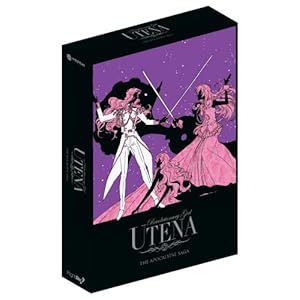
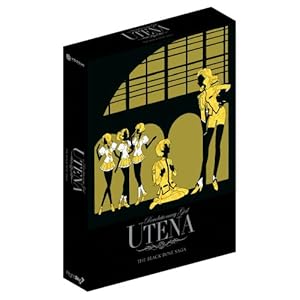
Revolutionary Girl Utena Anime Box Set – Volume 2, Disk 1 (English)

November 29th, 2011

The first episode of the first disk of Revolutionary Girl Utena, Volume 2, or what is commonly referred to as the Black Rose Arc, is that staple of long-running anime, the clip episode. Clip episodes became so common around the turn of the century, that in some infamous series, clip episodes were practically more common than actual story episodes.

In this case, the clip episode is welcome. Not only does it highlight each duel from the Student Council Arc, (which gives us a chance to relive the duels and their wonderful background music) but it provides an apparently objective perspective of each duel, allowing us to understand the motivation behind the duel, behind any discussion of the End of the World, a World Egg or Revolutionizing the World or other important-sounding nonsense.

The story of Nemuro Hall and the Mikage Seminar is set up, and we are quite suddenly dropped into a new, even more obscure arc than the last. Where the Student Council fights to possess Anthy, these new, derivative, duelists, seek to remove her completely from the game.

It’s not often I find myself incapable of half-watching an anime. Most of the time I watch something while simultaneously reading or writing. I wander off do a chore, come back and pick up the story wherever it’s taken me… it’s easy enough to do this if one doesn’t much care about the exposition. When Utena is on the screen, I do nothing else. There’s too much happening, too many symbols (both substantive and imaginary) and above all, there’s Anthy. This is the third or fourth I’ve watched this series and this time, I find myself watching Anthy intently. The joke is on me, because she rarely does anything. So every little nuance I perceive is me making it up in my head. ^_^

Of the many important things that happen on this disk, I consider most important the involvement of Kozue. It appears to us that her relationship with Miki and his with her are significantly dissimilar. Her Black Rose duel to me says that they are not, actually, that dissimilar at all. It’s simply that in those relationships, each holds a slightly different place in the other’s relatively similar world view. For Kozue, Miki holds the place of sibling, sempai and beloved, where for Miki, these are three separate positions. (I’ve always imagined that, post-series, it is Kozue who has the highest chance of becoming the next Rose Bride, despite it being a meaningless position by then.)

Also important is Nanami’s episode. These appear to always be the comedic relief episodes, but it’s important to remember that both Miki and Nanami are younger than Utena, and are working even harder to build a world that makes sense, with the fractured people around them. Miki appears to be the most innocent, but if we understand that innocence functions in part as a block to be carved, it’s instantly apparent that Nanami is the most innocent character in the series.

Two duels in to this arc and we still have no idea, really, what Mikage is after. However, if you’re adept at reading the signals here, you can see where at least two things are headed. Several key symbols have been introduced -the pointing fingers, the planetarium machine (which could spawn an essay all by itself) the pupa/moths (which return in the movie with a vengeance) and the elevators, both up and down, which Ikuhara uses again in Mawaru Penguindrum.

Two duels in and already the relationship between Utena and Anthy has radically altered. Anthy is something else to someone else and Utena begins to not note the obvious, in the most obvious manner. If Miki is clearly turning a blind eye to Kozue, how much more is Utena shuttering her eyes and ears?

The Black Rose Arc has always been my favorite. It is apparent to me that what Ikuhara does best is create tension. Scenes here are so fraught, so tightly wound, that we spend the episode watching wildly, waiting for the first blow. I described it recently as if, when we watch an Ikuhara production, we are standing in the middle of a ring of people with slingshots drawn, ready to shoot, not knowing where the first shot will come from, but knowing it will come. This tension makes us read into every comment, every scene, every background, whether there was something there to be read into or not. Every episode we’re standing on pins and needles, and Dios inhabiting Utena to win the duel fills us with the relief of predictability.

DVD extras are a pleasant addition for those who like production art, and the pamphlet this time is perhaps less distressing that the one that came with the first collection. Ikuhara’s episode commentary, and the discussion of the creation of Be-Papas and the anime and manga for Utena are equally full of pretension and insight. There is some discussion of the scene in which the sword is drawn from the Rose Bride’s chest and how the instructions were to make it look like a love scene, something that I think has stood the test of time. Of particular interest to me was the comment by one of the creators discussing the brief thought of redoing this anime, and realizing that it stood up so well and was so unique that there was no need. I agree completely. More than 10 years have passed since this series first aired and it still has the power to compel and enchant. Most series upon rewatching seem a little dated, maybe a little sentimental…not this one. I watch with the same creeping sense of…something… this time as I did the very first time. This series was one that I had on my personal top ten, but I presume, always, that nothing is as good as you remember it to be. This series is. Possibly even better.

Ratings:

Art – 9
Story – 10
Character – 9
Yuri – 3
Service – 3

Overall – 9

Stay tuned – we’re going to have a contest to win the second Box Set from Nozomi/RightStuf shortly! ^_^


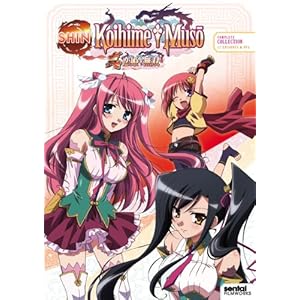
Yuri Anime: Shin Koihime Muso (English), Disk 1

November 4th, 2011

In 1951, photographer Ruth Orkin had an idea for a photograph. When she met student Jinx Allen, she knew she had found her model. The resulting photograph “American Girl in Italy” is now iconic. (For the full story of this photo, read An Image of Innocence Abroad from Smithsonian Magazine.)

Take a look at this photo. Click it to see it as large as you can.

Note the look on the woman’s face. Does it look pained, concerned? Scared? Now look at the men around her. Note them staring openly at her, with what they probably think is admiration.

Women readers – how does this picture make you feel? Men, how about you?

The feeling I get upon viewing this picture is the same feeling I feel when I watch Shin Koihime Muso. It makes me cringe.

There is Yuri in Shin Koihime Musou. Sousou only takes women to bed, she’s got the hots for Kanu. Kakuka lusts after Sousou. But that doesn’t change the fact that there are people out there getting turned on by the excruciating service in this series and it just makes me cringe with embarrassment for them, and for myself.

The Chou brothers have been turned into the Chou sisters who become pop idols. By episode 5, after we had heard that one song 6 times in less than 30 minutes, I put the sound on mute for a bit. That helped.

Ratings:

Art – Moe
Story – Peasant uprising against despots/fans of pop idols rioting. So similar.
Characters – It’s not their fault
Yuri – 3
Service – There are not enough numbers in the universe

Overall – For me, an excruciating 3. For fans of the series 8

I just have to keep reminding myself that, of the three Koihime series, this was by far the worst, and that, although it was hardly good, Otome Tairan was less bad and had better Yuri.


Mawaru Penguindrum (輪るピングドラム) Anime

October 30th, 2011

Three young people – a sickly sister, Himari, and her two older bothers, Kanba and Shouma, who love and adore her, find themselves cast into a spiral of ever-weirdening events when Himari dies in the hospital.

A bizarre hat confers life and power to Himari, elaborately transforming her into…well, we’re still not sure who she is now…. Shouma and Kanba are required by this entity to find the “Penguindrum.” The story of what the Penguindrum is, and why it is important, is the entirety of the plot and I refuse to attempt to simplify it for this review. ^_^  The quest for the Penguindrum involves Shouma’s classmate Ringo, Ringo’s late older sister Momoka, a teacher in Shouma and Kanba’s school, and his wife, Takarisienne (or something awfully similar) Yuri.

If you are among those who find Mawaru Penguindrum (輪るピングドラム) confusing, please take a moment to read this post first. The Tl;dr version is – read more. You will learn allegory, symbolism and how to follow an non-linear plot. Reading helps us understand storytelling. In this case, the plot is a series of puzzle pieces that are shifting around and will, with time, resolve into a picture. Don’t be impatient, don’t try to second-guess. Just sit back and let the story be told.

For those viewers who have seen Revolutionary Girl Utena, many of the stylistic properties and several of  the memes illustrated in Mawaru Penguindrum, will be familiar. This is not surprising, as they share the creative impetus of Ikuhara Kunihiko (@ikuni_noise on Twitter.)

Of course I wouldn’t be reviewing this series here if there weren’t at least some Yuri. Yuri, voiced by Noto Mamiko – who really gets to stretch her range here – is not randomly named at all. That’s all I’ll say, to avoid spoilers that are impossible to talk around. These episodes were pretty much the turning point in the series.

There also a number of other elements I like in this series – no one will be surprised to learn I like murderous Natsume Masako, the Takarazuka parodies, the “best of” cast. Seriously, this voice cast has one of everything. Inoue Kikuko, Fukami Rica!!!! (Sailor Venus to all of you….) of course we’d expect Koyasu Takehito somewhere in this and he is, Paku Romi and Noto Mamiko, and Ishida Akira, and Horie Yui…… So clearly, he’s drawing from 6 degrees of Yuri, past, present and probably future.

So…what is Mawaru Penguindrum about? Well, like so much of Ikuhara’s work, it’s about the delusions in which we wrap ourselves, and the effects those delusions have on the people around us. And, it’s about the veil of those delusions being stripped from our eyes.

When I was in Japan just last month, this series was everywhere, so clearly a raging marketing success. I’m really hoping that someone brave will pick it up here for license. I favor TRSI, as they’ve already gotten us Utena, and I’d love to see them pick this up. I never say this, but, I’d cough up for the Blu-Ray even. The animation is good to awesome.

Ratings:

Art – 9
Story – 10
Characters – 9
Yuri – 7
Loser Ikuhara Fan – 8

Overall – 9

I’m so glad to Ikuhara is stretching his wings on this series. It feels un/comfortable in perfect proportion and I am looking forward to it with the same edge-of-my-seat anticipation I had for Utena. I wonder where it will go next?


Yuri Anime: Yuru Yuri Guest Review by C. Banana (English)

September 30th, 2011

One of the great joys for me as curator here at Okazu, is when our readers escalate into advocates and reviewers in their own right. It’s been my pleasure on multiple occasions to present to you reviews by readers who have decided to commit themselves to a higher level of engagement. Today’s Guest Review is especially wonderful, as it was written by long-time Okazu reader and commenter, C. Banana, someone whose views rarely match mine, but whose perspective I appreciate.  CB is writing about Yuru Yuri, a slice-of-life anime available legally and for free on Crunchyroll. As the first “Yuri” anime from Ichijinsha (publisher of Comic Yuri Hime magazine) this is a significant anime for Yuri fans. The story is a very understated “wacky adventures of four girls goofing off.”  As this was a series I myself did not enjoy, CB offered to step up and write a review for us.

Please welcome our newest Guest Reviewer with all the warmth I expect from the Okazu audience!

Ah, the Yuru Yuri anime series. By my own anecdotal evidence, this would seem to be the most polarizing series among Yuri fans. Considering that it seems to have beaten the polarization of Kannazuki no Miko, it’s quite an accomplishment. I seem to fit in between those who adore and those who despise the series as Yuru Yuri’s episodes for me, ranged between mediocre, alright, and pretty decent. I really didn’t have that strong a reaction to any of the episodes. The fanservice, while not something, I would seek out really didn’t bother me.

One good quality of Yuru Yuri is that while it is definitely in the moé slice-of-life comedy genre, it does mix it up enough to not feel like a rehash of others. In some episodes, it follows more of sitcom formula than a slice-of-life formula, and its wacky hijinks are played up more than in most other shows of the same ilk. Another thing is that some of the characters were allowed to have traits that escaped from moé templates. Also, while not as self-aware as their manga counterparts, the cast is certainly more self-aware than the characters of other moé series. Of course, for better or worse there’s also the fact that the Yuri fanservice is up a couple of notches compared to something like K-ON! or A-Channel.

The Yuri, as a whole in the series, is actually a notch higher than it was in the manga. More effort is put into the characters being portrayed as having genuine crushes rather than it being just some random Yuri gags. However, the sparse development in any of the relationships will definitely turn many Yuri fans off of the show. Himawari and Sakurako in particular would benefit from some character and relationship development rather than being stuck in their double tsundere gag.

Kyouko definitely steals the show for me. She got the most laughs with her suitably punchy and absurd theatrics. A lot of the time, you’ll be wondering why the other characters are friends with her since she’s really a big jerk (but admittedly that’s part of the joke). Kyouko’s character does underline the fact that the show places wacky hijinks as its highest priority. However, the humour taken overall can be a bit hit and miss. It’s not briskly paced enough to be a laugh riot and sometimes relies a bit too much on slapstick.

Overall, while the show has some good qualities going for it, it would need better comedic pacing and/or character development to get closer to being one of my favourite shows. The show definitely leaves itself open for having iterative seasons so if the show is reasonably successful, I’ll likely sign on to the next season to see if show builds on itself or stagnates. From my point of view, it could go either way.

Ratings:

Art – 6
Story – 7
Characters – 7
Yuri – 4
Service – 8

Overall – 7

Erica here. Thank you so much for the review of a series I wish I could like, but have never been able to. The superficiality of the comic doesn’t stand up to too much analysis, and any anime that included underwear gags in the first 10 minutes has already lost my attention. It is obvious that Ichijinsha is putting money and effort into promoting this series which both pleases and distresses me. I’m not seeing polarization in the fandom here, though. Mostly I’m seeing the same kind of ambiguous “it’s okay” that this review expresses. I’m in a minority (as always!) in feeling very negatively towards it.

Nonetheless, we should acknowledge that Crunchyroll did as decent a job as I’ve seen on the localization, and they have made it available as widely as they were allowed, so each of us can decide for ourselves what we think of it.

Once more, thank you to C. Banana and to all of our Okazu Guest Reviewers!


Yuri Anime: Yuru Yuri (English)

July 6th, 2011

I would like to begin this review with a sincere apology to the fine people at Ichijinsha. I know that a lot of work and energy went into the making of Yuru Yuri and I wish, I truly do, that I could have liked it. But, I did not. If you habitually like the kinds of anime and manga I dislike, If you love series like Lucky Star and A Channel, then do not read this review, just hurry over to Crunchyroll and watch Yuru Yuri – you’ll love it.

I have spent more than a decade promoting Yuri, highlighting series that focus on women in love with one another, pointing out over and over that “Yuri” is not, really, anything like the fantasies creepy loser guys have about girls. Yet with Yuru Yuri, the creators go right to Fanboy territory, then crawl slowly steadily down to wallow in the most banal, most creepy possible tropes. I’m genuinely frustrated by the choices made here.

Yuri Yuri is the story of four girls who hang around and do nothing. These four are all very typical moe types, so forget having any kind of personality. Less than 5 minutes into the anime, there were already 4 underwear gags, the main character had forgotten that school started that day (which is totally likely if you have no family or friends, live in a box and have no media access, I suppose.)  The entirety of the second half of the episode is a systematic destruction of the protagonist’s ego. As a *joke*. Because making fun of a friend until they cry is absolutely hilarious, as we all know.

At 8 minutes in, I had a crisis and almost gave up watching altogether. It was so horrible, so tedious, so completely un-fun. My number one criteria for entertainment is that it ought to, you know, entertain me. Watching Yuru Yuri was the anime equivalent of a dentist’s appointment.

There is “Yuri” of course. Of the most excruciating kind. Kyoko likes to look at panties and wants to possess the cute loli. Chinatsu, the loli, crushes on Yui, the moe equivalent of the cool princely character. And let’s not forget the implication of a deep, pathological, stalking sister complex Akari’s sister appears to have for her. That’s always good for a laugh.

The one thing that really wasn’t terrible was Crunchyroll’s subtitling. It’s not perfect, but it was definitely one of the least objectionable jobs I’ve ever seen from them. So that, at least, is something positive to note.

I’m sorry, Namori-sensei. I’m sorry, editors of Comic Yuri Hime. I’m sure that Yuru Yuri will be very successful, but I won’t be watching. As much as I want it to succeed, I actually like the anime less than I do the manga. And I don’t like the manga very much at all. I came into the anime with very, very low expectations and this managed to not meet any of them.

In the end, Kyoko described this series best when she described the protagonist Akari with “A lack of outstanding qualities is your most outstanding quality.”

Ratings:

Art – 5 If you like moe you will probably think it a 6 or 7
Characters – 4 See above
Story – 3 See above
Yuri – There is no real affection, love or desire here. Just gags.
Service – 10

Overall – 4

Pain upon realizing that Comic Yuri Hime‘s first “Yuri” anime ever is everything I have fought to get rid of, in order to be able to tell stories of women in love with one another – 100