Archive for the Comic Yuri Hime Category


Yuri Manga: Yuri Hime, Volume 18 (Part 1)

November 15th, 2009

Volume 18 of Comic Yuri Hime once again has cover art from Eiki Eiki and Zaou Taishi’s “Love DNA Double X,” series and wow, have they laid the lilies on thick. Literally. The lily flowers practically crowd Sakura and Aoi off the page. In case you love the picture a lot, the extra for this volume is a postcard of the cover image.

The first story begins with a girl recounting her many, all female, loves.

We then break for some advertising and a chat with the Sasamekikoto voice actresses, in which they say the typical things about a Girl’s Love story.

Back to Shiroishi explaining to her friend that, yet again, she has fallen for a female classmate – this time the stylish, popular and apparently cold-hearted Midori. Tsubaki is incensed – she confronts Midori only to have the obvious pointed out to her – Tsubaki likes Shiroishi. I’m thinking of calling this plot complication “Crisis in Infinite Schools.” What do you think?

Mistue Aoki’s “Bankara Otome Gakuen” details the relationship between Yanki girl Shio and her ditzy friend Makiko. Smart, rich Yuka wants Makiko in the worst way – and is willing to kidnap and tie her up to get her. But Shiho saves the day and Makiko gets the girl. I so so so wish this would continue. It’s a perfect setup for Shiho to be cool and keep re-winning Makiko over and over. But it was so goofy and condensed, I’m thinking one-shot.

“Love DNA Double XX” does three things. It establishes Aoi and Sakura as friends, introduces Sakura’s posse, and gives us a glimpse of the backstory that sets Sakura up as Aoi’s enemy and reason she’s here at the school – to gain revenge.

Takase-sempai is the object of Mashiro’s interest and desire, but is having a hard time wrapping her brain around it in “Sayonara Folklore.”

“Delicious Time” was a great “Story A.” A girl stops by the bakery every day to get a single mini-croissant. The baker’s daughter, finds “mini-cro” fascinating. It’s obvious that the girl attends the same school she recently graduated from so, when an opportunity to attend the school festival presents itself, she takes it. Of course they meet up and share their darkest secrets – as the daughter of a baker, the protagonist prefers rice and, Sakura, who is the daughter of a rice dealer, prefers that morning mini-croissant…and, the woman who sells it to her. As a way of expressing her own feelings, the baker creates a rice-bread to celebrate their meeting. Brava! Encore!

The essay and “Para Yuri Hime” remains unread. I have had several weeks of hard labor and simply haven’t had time.

The next story is kind of odd and interesting. “Roku Tatami-han Shukai Osore” follows the relationship between a very outgoing, extroverted high school girl and the older shut-in she’s seeing. Ito-chan, the shut in, finds herself inevitably pulled outside by Hatoko.

Arare and Kiri have a fight in “Tokimeki Mononoke Gakuen” and as Arare runs after the creature she loves, she finds herself – and Pero – unexpectedly back in our world.

In “Chinchin Puipui” bar Mama Michiko appears to magically transform into a cute, young woman and whisk miserable Kana away on a series of dates. Only, it wasn’t that kind of magic at all.

Morishima Akiko continues her new series about adults with “Renai Joshika.” It initially appears to be one of “those” series, where everyone in the series is going to be paired up. But, the first story belies that. Hirano falls for Shirohane, but finds out that she’s already got a lover. Hirano realizes that her choices are not limited to one gender and that Shirohane is really a good person that she would, potentially, like to be with. She decides that her love battle has just begun.

This is a good place to stop for the day, I think.

I’ll do my best to finish this up tomorrow!


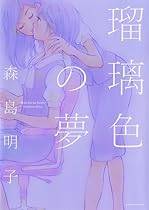
Yuri Manga: Ruri-iro Yume (瑠璃色の夢)

November 9th, 2009

In Ruri-iro Yume (瑠璃色の夢) Morishima Akiko gets to realize a dream of hers – one that I happen to share. She is able to draw a series of stories about adult women in relationships with other women.

I’ve been saying over and over how she’s the one Yuri manga creator that consistently pushes at this particularly truculent line in the sand. Most “Yuri” stories lie firmly in a world of schoolgirl crushiness or some equivalent fantasy space. The understanding is that, while the emotions are real – the relationship is ephemeral. Women don’t stay with their school days female lovers, it’s “playing at” romantic love. Of course they will go on to marry a man and have children, thereby giving up any pretense at a professional life. This would all sound like me being sarcastic, except that it is very much the prevailing attitude in Japan. Women work until they find a man, then sequestor themselves in a life as a domestic caretaker until their kids leave. Everyone knows that’s how it goes.

Morishima takes a few quirky looks at lives that don’t fall into this stereotypical life plan by first dealing with someone whose dream is, in fact, very stereotypical. Ruri is an OL, a Office Lady. Office Ladies are a kind of mix between an admin, a hostess and a maintenance worker. They do random odd jobs around the office, including copies, serving coffee and changing light bulbs. It is stereotypically a job that a woman would take in order to meet and marry a nice salaryman. (Since she is naturally going to stop working when she gets married, there’s no conflict about office romances.)

Ruri has a dream of finding a nice guy, getting married and having a child she names after herself, a hint that this dream is at least a little narcissistic. But she finds herself instead involved with a female co-worker, Mitsukuni. Ruri mentions her dream of a typical life one night at dinner and is *shocked* to be rejected by Mitsukuni. Next week, back in the office, Mitsukuni admits that that dream repulses her – she wants nothing of the sort. Ruri has to decide what she really wants…and ultimately decides that Mitsukuni’s love is more important that her childish dream.

I found this story to be rather ironic, myself, since Ruri casts aside the typical dream of a pretty boring, repressive life as if it’s childish and unrealistic, instead embracing what is traditionally seen as an “immature” love.

In the next story, although the two women are college students, their love is still an exploration of childhood dreams, in which one is the long-suffering Prince to the other’s selfish Princess.

And then there’s “Honey & Mustard,” which started a new series that’s now running in Yuri Hime. This series deals with adult women in adult jobs and a variety of relationships. In my review of this story when it ran in the magazine, I pointed out that it was significant for using the phrase “kocchi no kei,” i.e., “one of us,” thus for the first time in the pages of Yuri Hime acknowledging that there is an “us.” Us, of course, being lesbians. The main characters are women who were once lovers and are now good friends, but no less lovers of women, despite the fact that they have put aside their schoolgirl days.

The next story explores the idea of “alternative family” from a slightly different perspective than usual. Kyou has been in love with Konomi since she was a child. After Konomi’s husband died, she took over being Konomi’s companion and ultimately became her lover. But there’s a gap somewhere in the relationship and it makes Kyou uncomfortable. Ultimately she decides that being Konomi’s family means more than being her lover and they start all over again.

A continuation of Eri and Keiko’s May-December romance provides some classic Unresolved Sexual Tension and a look at what love means when you’re “over-the-hill” by Japanese standards.

And finally, in a side story from Hanjuku Joshi Chitose’s older sister Chie goes to Chie’s school festival looking for Yuri, but is shocked to find love.

It might not seem like much to you, reading these one at a time, but I know what Morishima-san read as a young woman and I know why this is all an amazing shift to a much more realistic look at lesbian life and love.

In “Story A” a schoolgirl is usually portrayed only in the school setting. She is in love with the idea of another girl and the story ends when they to recognize their mutual interest in one another. Even when she is doing this, Morishima adds layers to it. Chie’s search for Yuri was semi-professional, but her feelings for a younger girl totally bowl her over. Kaori and Mitsuki are adult women, “careerwomen” as they say in Japan. They have already acknowledged their love for women and its just another part of their lives. Keiko finds herself dealing more with her age issues than issues about Eri’s gender, and Kyo decides a different relationship will bring her closer to Konomi, not further apart. And then there’s Ruri, rejecting the childish dream and embracing a reality that is still often shoved into the closet to fulfill other people’s expectations.

These are not your usual Yuri stories. That having been said, Morishima’s art is *extremely* moe. Even when her characters are 28, they look round cheeked, fresh-faced and cute, as opposed to cool or mature. This is Morishima’s style and it fits nicely with Yuri fandom’s need to keep Yuri out of the realm of reality and strictly in the realm of fantasy. Imagine the consternation of those 30% of Yuri Hime readers if the magazine didn’t just say, “Men Not Allowed” (as it does on the cover in a way that is clearly designed to drawn men to it like flies) but instead had realistically drawn and told stories of lesbian drama. Think about it.

It would be hilariously dull.

In any case, Morishima’s art is super-duper cute. But her stories are smart, poignant and often very real. And, okay, sometimes her stories are super-duper cute, too. ^_^

Ratings:

Art – 8
Story – 8
Characters – 9
Yuri – 9
Lesbian – 7
Service – 7

Overall – 9


Yuri Manga; Hanjuku Joshi, Volume 2

October 14th, 2009

Ladies and Gentlemen – we have a winner.

I never doubted for a second that Morishima Akiko-sensei would be the one. I had faith in her, in her ability to gently nudge the boundaries of “Yuri” until they started to blur the lines into “lesbian.” I’ve commented that several of her stories have started to shift in that direction. Notably, her story about the two office workers with a crush on the grease truck chef, and the unprecedented use of the phrase “Kocchi no ke.”

In Hanjuku Joshi, Volume 2 (半熟女子), Morishima has actually written a story that covers that last little piece – the gap between lesbian content and lesbian identity. Let me be very clear here – I do not meant that the characters identify as “lesbians.” I do mean that they acknowledge the challenge that loving another woman brings, and they struggle with the idea of loving that other woman in public. THIS is what I mean when I give Morishima the “Golden Lily” prize.

It’s not like Hanjuku Joshi is the first book ever to cover this area. It’s the first “mainstream Yuri” (if you will allow that) to do so in many years.

Because other reviewers will focus on the sex, let me sum that up in a line: there is sex in Hanjuku Joshi. It’s not actually the point of the story. It’s the icing on the cake.

The point of the story is acceptance – of one’s self, of one’s love, of one’s desire to live a normal, happy life with the person one loves…who just happens to also be female. And the point of the story is that it takes a LOT to get to the point where you can accept that, much less be fearless about expressing it in public. *That* is the point of this book. If you didn’t notice, because you were obsessing about the fuzzy handcuffs, that’s okay. The other point is that Morishima has integrated the main point seamlessly into a smut-filled story, for people just like you. ^_^

Ratings:

Art – 8
Story – 8
Characters – 9
Yuri – 9
Service – 7

Overall – 9

Hanjuku Joshi turned out to be a pretty interesting series. I prefer Mari x Ran to Chitose x Yae, but some really critical conversations happen in this book and those were definitely worth the price of admission.


Yuri Manga: Ame-iro Kouchakan Kandan, Volume 1

August 31st, 2009

At last.

In a small, friendly town, down at the end of the main street, in a spot just by the edge of the park, is a shop where you can sit and relax and have a cup of excellent tea. It’s called the Ame-iro Kouchakan, The Amber Teahouse, and the series is Ame-iro Kouchakan Kandan (飴色紅茶館歓談). This volume tells the story of this store and the people who make it so wonderful.

The store owner is Seriho, a sweet, somewhat helpless woman. Luckily for her, she is assisted in the day-to-day operations of the shop by one very intelligent young lady, Sarasa. Sarasa, it is soon apparent, has a second agenda. It is not just the tea shop she loves, but the tea shop’s owner.

This first collected volume follows Sarasa and Seriho as they wrangle with the complexities of running the tea shop and with their feelings for each other. The story of how Sarasa became an employee, originally told in the second [es] Eternal Sisters anthology is gathered here, as is the fateful story in which Sarasa and her friends forever change the destiny of the Amber Teahouse with a Tanabata special, that originally ran as a Yuri Hime extra comic.

Seriho seems to be a natural doofus, and one is never *quite* sure if she is aware of Sarasa’s feelings for her but, then, one is never *quite* sure what her feelings for Sarasa are, either. She likes her, that much is obvious. When Seriho comes right out and asks Sarasa to be by her side for 50 years, it’s really hard to know if she means it the way we think she does.

Sarasa is besotted, full stop. She changes her college plans to be by Seriho’s side for those 50 years. I think if they were to actually kiss, she might pass out. In fact, I really try hard to not think about that inevitable moment. I leave it in the future where it belongs. I did very much enjoy the part where Haru physically holds her back from using her free time on the school trip to run back to town, just to see Seriho. Also kudos to her parents for suggesting she stay out all night with her friend – Go Mom and Dad!

Sarasa’s classmates Haru, who runs the website Jinx, and Hinoka, are a not-quite couple. Hinoka seems to be sure that Haru has a thing for her, and Haru is just as sure that she does not. ;-)

The final chapter of this volume is the inevitable cross-over with Alice Quartet, so Fujieda can play dress up with his characters. A harmless little obsession of his that I forgive because he’s got good design sense.

This is quite possibly the most moe thing I like, and I chalk it up to Fujieda’s great characters because, let’s face it, the story goes like this – Seriho is cutely helpless and Sarasa helps her out. ^_^ However, the tension between them is undeniable (so much so that characters from other Fujieda series point it out all the time!) and while they are unlikely to share more than that damnable chaste kiss, I do not care one whit. (From the Anglo-Saxon wiht, for “amount.” Let it never be said that Okazu is not educational.)

Yuri in this series is a pervasive atmosphere, rather than a single event or couple. The teahouse may be called “Amber” but it is the scent of lilies that flows through the door onto the street. Despite their age difference, Sarasa and Seriho make a good couple and I look forward to seeing them getting together body, mind and soul, since they already have two out of the three covered. :-)

What was left undone in my review of these stories uncollected can now be done:

Ratings:

Art – At its nadir 5, at its zenith 8, but forever and always very moe.
Story – There is no story, but it’s an 8 anyway. ;-)
Characters – 9
Yuri – 8
Service – 2

Overall – 8 with a hope that future volumes push up to 9.

“At last” I said, and I meant it. It’s nice to have the whole story in one handful now, and not running about all over the place in pieces. ^_^


Yuri Manga: Yuri Hime, Volume 17 (Part 2)

August 24th, 2009

The second half of Volume 17 of Yuri Hime (コミック百合姫) starts off with another very doujinshi-style story.

Which makes me wonder…why do I think of them this way? Probably because I first encountered them when I began collecting original Yuri doujinshi. These stories that I think of as doujinshi stories are almost always high school settings, almost always kind of imperfect, good-but-amateur-ish art and almost always about those first steps to admitting that the characters are in love. They end with the moment that both characters acknowledge that they feel the same way about one another. Rarely do they go much further than that, but I do tend to like it when the stories do. Kimochi no Katachi (originally published as the Tact series) by Sakuraike was one of those series, Volume 1 and Volume 2, but then spent more time looking back before Satsuki and Kino got together than forward.

In any case, in “Watashi no Kawaii Hito,” Ika met Sempai a while ago and, after Sempai confessed to her, they’ve been going out. But, when the other girls in class star trashing talking onna-doushi, and the teacher talks about “playing pretend” with same-sex relationships, she thinks she might be the only one who is serious in their relationship. She nabs herself a beard to stave off her own breakdown. Sempai fights back – literally, with a palette over the head of Ika’s hapless male companion, and the two of them have to face each other’s feelings head on.

Rina wants older neighbor Kana to take her to the festival in “Mizu Fusen, Kingyo, Ramune” but Kanna, who had a past relationship with another woman, doesn’t want to relive those days. When she gives in, her worst fears are realized, as she runs into her former lover.

“Tsumugi Ito” by Uso Kurata wins. It is something I’m not sure we’ve ever had in Yuri Hime yet – an adult couple who is together, has been together and is dealing with a very real and very grown up issue. (One story an issue – do you see the pattern? One story an issue is about adults, edging slowly closer and closer to that “L” word….) Kae plays the housewife to Nao’s businesswoman, but new responsibilities at the office keep Nao later and later, and she starts pulling away from Kae. Kae forces the issue and they face their actual, real, very grownup relationship problem – together. I love Kae laying it out on the line to a totally stressed out Nao. Great story, drawn well with a really satisfying – if slightly pat – ending. More of this, please!!

Kind of harsh story in the new “Nekodomekan” chapter. Suzune and Emi are lovers, but Suzune’s untimely death plummets Emi into depression, until she visits the Black Cat Mansion.

Sumika comes right out and asks Takase-sempai to be her lover in Kowo Kazuma’s newest, “Sayonara Folklore.” Sumika has grown to hate their school, which has really weird rules and traditions, but has definitely come to love Takase. They have an argument, but when they make up, Sumika gets her answer.

Amane fell in love with Yuki back in school and, after they became lovers, had to admit that she loved women. When “Sore ga Kimi ni Naru” takes place, Amane has been years out of school but, when an accidental meeting on the train platform brings her face to face with a Yuki look-alike, it all comes back to her.

The art of “Soulphage” repulses me. The characters look 5. I don’t care what they do or why. They could all get hit by a truck. Instead I have no doubt that the genki lead will get her sempai. Bleah.

Tae is still laboring away to be near Yui (and pay her back for he lost necklace) in the next chapter of “Mizu-iro Cinema.” Tae insists on doing something summer-vacation-y, but thinks it’s all coming to an end when Yui is told she’s returning to Tokyo. Tae’s all ready to say goodbye when Yui says, “What are you talking about? You’re coming too.” Well, DUH, Tae. ^_^

Class appeal rankings are the source of much contention in “20, 21” but after some wrangling with the numbers, Asagao and Fuji find each other.

In “Apple Day Dream,” Kaoru, with longer hair these days, makes the same jokes as she always has…

And in the Hana Monogatari-themed story of the volume (also a pattern I’ve noticed) “Cosmos no Saku Niwa” a sprit and a girl meet, then the girl finds the real girl behind the wandering spirit, for a happily-ever-after ending.

So, there was some really good, some really good that was also really bad and some really okay. Overall, an excellent volume, I just wish the cover story wasn’t so stabby-making.

Overall – 8

If some of those one-shots actually continue, I think the next volume (out October 18) should be quite good.