Archive for the Yuri Manga Category


Yuri Manga: Seasons (シーズンズ)

February 12th, 2012

At the end of last year, I voted a trio of Takemiya Jin-sensei’s works in as the #1 manga of the year. Of those three, Seasons (シーソンズ) is quite possibly my favorite.

Like so many of my favorite manga artists, Takemiya-sensei started her career as a doujinshi artist. There are several ways in which a doujinshi artist can transition into a professional career, but the one that seems to be the most effective is this – draw original work. Manga publishers are less likely to want to publish look-alikes than, say, US book publishers, who so often are running after the latest trend, rather than creating the next one. Artists I first encountered as doujinshi artists include Hayashiya Shizuru, Morishima Akiko, Morinaga Milk, Nanzaki Iku, Nishi UKO, Mitou Kana and Kitao Taiki and many, many others. There’s only one, in fact that I haven’t seen make the transition to pro that I expected to, and weirdly, he’s gone the other way, from really well-conceived derivative serials to kind of crappy porn. Oh well.

So when I saw Takemiya Jin, who I have been following for years as Junk Lab, take the leap into the pro world, I was thrilled. For her – and for us, the readers. She’s got great short-story ability, honed by years of standalone doujinshi and can carry off a series with some chops.

Seasons is a collection of several doujinshi…a few of which I have. It gives the collection a feeling of meeting old friends and making new ones in one book. ^_^

The first few chapters follow Shirai-san and Kurozawa-san as they do the usual fall in love, be incoherent about it, not get together and get together in the end. Nothing ground-breaking here. What I found especially good about this series is Shirai-san’s friend, Asaki, who (maybe) inadvertently causes a massive crisis between the two main players. Asaki, it turns out, has a female lover and a whole life that Shirai-san is unaware of. And, Asaki is clearly part of the lesbian culture in Japan, as she and her lover both use slang in their conversations. Asaki gave it away to us, the readers, when she tells Shirai-san that Kurozawa-san is “nonke” (i.e., straight.) At that point, my slangdar pinged. Straight people do not refer to each other as “nonke.”

Let’s back up for a sec. I believe I’ve referred to this before, but here’s the deal about “nonke.” When a person is part of a culture in Japan, they are referred to as being whatever”ke” or “ka”, for instance a person who does Judo is a “Judoka.” You may remember we discussed the implication of “Kocchi no ke” in relationship to “Honey Mustard,” Morishima Akiko-sensei’s story for Yuri Hime that was collected into Ruri-iro Yume. “Kocchi no ke” is pretty much analogous to an American gay person saying “that person is ‘family.'” (The “ke” kanji is similar, where “ke” or “ka” 家 – as in mangaka 漫画家- means “house” as in the “House of Windsor.”)

So, “nonke” (ノンケ) is non-“ke,” i.e., “not one of us.” It’s use always implies that the user is, by default, “one of us.” So, when Asaki calls Kurozawa “nonke,” it’s pretty much saying that she is ke.

Asaki and her lover also use reba, neko and tachi, all slang words. For definitions, feel free to check out my Okazu Glossary of Terms. (I just added “nonke” there, as well.)

Following this story are a number of shorts, one- and two-shots that deal with a variety of “Story A” scenarios, and a few stories of couples dealing with a crisis in their relationship. A multi-part story about a girl falling in love with her class representative is a pile of well-used tropes (dress them up, then get jealous of them, the group date gone bad, misunderstood feelings, etc) that was nonetheless charming.

Almost the entire second half of the book is a look at a high school girl and a middle school girl who meet on the train (when a pervert starts to harass the younger girl) and their relationship over the next year. Unsurprisingly, the younger of the two is relatively immature, and causes no end of difficulties, but ultimately, there is a happy end that allows for the presumption of a happy future.

As I said in my write up of Takemiya-sensei’s work for the Top Ten list, the inclusion of gay slang in this book is one of the qualities that catapults her work to the top for me. Anyone can write a Yuri story, but it’s still pretty rare when we get a Yuri story with visible ties to Japanese lesbian community.

Ratings:

Art – I’ve always liked her art, so for me, 8, but your mileage may vary
Story – Variable, we’ll round it to 7
Characters – In most cases, I would invite them over for lunch – 8
Lesbian – 10
Service – 2, there’s some nudity and presumption of sex

Overall – More than the sum of its parts, Takemiya-sensei’s Seasons is a 9.

I’m so happy she’s gone pro. Here’s to more great work from her!


Yuri Manga: Yurikan Miel (百合缶 Miel)

February 9th, 2012

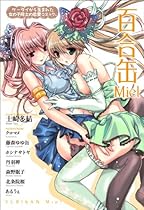
Yurikan Miel (百合缶 Miel) is the second in a trio of Yurikan ~something~ Yuri anthologies. The first was Yurikan Feuille,  with opening story by Morinaga Milk-sensei.  Yurikan Miel doesn’t bring that much star power to the floor, but it’s not entirely worthless, either.

The cover is pretty effective Erica-repellent. Two baby-faced female-shaped creatures with disproportionately sized breasts did not give me a good feeling about the contents. But the first story, “Rabu*Buri” was a silly and over-long single paragraph about a Princess in love with her female knight, which made me feel more kindly, until the totally un-sexy sex scene. So, now I was in a 50/50 mood.

A story or two passed without much notice, but…then!

We reach “Hyoko Zumai” and all was right with the world once again. This tells the story of a couple who have moved to the big city together; one a first-year college student and the other a newbie in a company office. The story shows how they grow from ugly ducklings into beautiful swans, and lo and behold! I loved this collection. This short was absolutely worth reading. The stress of their situations didn’t threaten their relationship, per se, but the lack of communication between them did.

This story was a lovely little break into realism from an anthology that otherwise pretty much stayed firmly mired in “I like her but she doesn’t like me the same way,” territory, with some really un-sexy sex scenes.

Ratings:

Everything variable, but overall, probably a 6.

“Hyoko Zumai” was worth the price of admission, though. I’m glad I read that story and will keep an eye out for others by Fujimori Yuyukan.


POOR POOR LIPS, Volume 1 debuts on JManga!

February 7th, 2012

Okashi Nako is a young woman living in poverty. When she applies to work at a Gem store, she learns that store owner, Otsuka Ren, is a lesbian. Ren promises that Nako’s not her type, but she may be lying…. Nako takes the job and so begins a comedic tale of rich and poor, sickness and health, for better and for worse!

http://www.jmanga.com/poor-poor-lips/1

Yuri comedy 4-koma manga, POOR POOR LIPS, by Goto Hayako, now on JManga, in partnership with ALC Publishing.

***

That’s the PR. Here’s the real message. I need your help.

Folks who are not in North America are blocked from this and I think it’s a BAD idea. I am trying to convince the folks at JManga that a globally accessible Yuri portal would be a GOOD idea. You can help simply by contacting JManga and letting them know what country you are from and that you would *love* to be able to access their Yuri manga.

You can contact JManga:

On Facebook: https://www.facebook.com/jmanga.official

On their website: http://www.jmanga.com/contact (Kathryn adds, “if people are trying to access the JManga site from outside North America, all they will get is a blue splash page essentially saying “You are not allowed in here.” For people who therefore can’t access the “Contact Information” section of the website, their email address is:

info at jmanga dot com”

Thanks Kathryn for the heads up!)

On Twitter: https://twitter.com/#!/JManga_official

Of course, please be polite. Express your interest in accessing Yuri manga. Even if you get a “we can’t do that at this time” email, please don’t get discouraged.

Also, fans in North America, you can help too. Send a message to JManga telling them how you support JManga’s efforts in getting Yuri to a global audience.

The goal here is to stop the gerrymandering policies that Japanese companies still work under. It’s time to let them know that the world is full of Yuri fans. ^_^

I think we can make this change, if we work together!


Yuri Manga: Comic Yuri Hime, January 2012

February 6th, 2012

Having concluded Fukami Makoto’s story about girls and guns in the November issue, the January issue begins inauspiciously with looking in a window at girls getting dressed. This will be the new novel carried in Comic Yuri Hime (コミック百合姫) and in a mere blink of an eye, I was already uninterested in it. The author will be Namori, creator of Yuri Yuri, so that seals that deal. It’s pretty much not for me.

The magazine begins with loads of colors pages, this time, asking us to determine which of the 4 Yuri Danshi type we are and suggesting manga based on that. As I am a Yuri Joshi, this pretty much missed the mark entirely for me, but between that, the cover novel and the many pages about Yuru Yuri, it clearly communicated that I am, once again, not their audience. It was with some genuine relief, then, that I found a number of excellent stories within.

Kazuma Kowo’s “Recalculation” is that moment when you realize that what you thought that the other person thought is not true, and they do like you after all. ^_^

I still have no idea where “Rock It Girl” is going, but this chapter was pretty silly, as all the musicians get together and find they haven’t a single artist/song/style in common.

I’m finally getting the feel of “Kimono Nadesico,” and still pretty much think it’s a Noriko x Shimako fanfic in disguise. ^_^

I haven’t had a moment to read either of the short stories. So far none of them have been to my taste, so I haven’t really made the time, to be honest.

“Cirque Arachne” by Saida Nica has begun and I’m already feeling it’s a cross between one of those women-only 70s scifi books, Kaleido Star and something French and/or Dada. Then again, circuses always make me feel that way.

“Fu~Fu” strays back into real territory, for a moment. Kina, terrified at the confession by some strange woman that she’s in love with her, runs back to Su-chan’s arms, only to find that her normally together lover pretty much falls apart at the idea of losing Kina. “For an entire year, I’ve been worried,” Su-chan admits. Any of us who look at our lovers/wives and think they are obviously wonderful and desirable may have felt this, so it was kind of charming to see it verbalized.

Amano Syuninta’s series about college women, (with a name I have yet to transliterate, because I am lazy and think of it as “Amano Syuninta’s series about college women”) is not comfortable.  If find that I cannot empathize with anyone, and keep hoping one of the characters will say something that makes me like her. In any case, Remia is starting to find Fueko’s relationship makes her jealous, and Sachi’s boyfriend is really starting to piss her off.

Morishima Akiko wins the world. I give her the Stargazer Lily Award, for telling the realest tale ever about lesbian relationships. Two women, who have been together for ten years, provide comfort and a positive example to a young woman, but more importantly, are the snuggliest couple I have ever seen in manga, which makes them closest to my life and therefore totally true and real. ^_^

The story of Kuro-sempai and Mayu and their online/real life different relationships continues in Takemiya Jin’s “Ki ni Nachatte Gomen Nasai.” Mayu comes to a conclusion that she’s sure will ruin a friendship, but Kuro seems to be more together than that.

Hime Cafe this time is narrated by editor Nakamura-san and Minamoto Hisanori-sensei (Fu~Fu).

A section on “Yuri anime” is really a section on moe anime with some Yuri in it.

“Love Gene Double XX” uses one of the oldest gambits in the world, mouth-to-mouth resuscitation, in order to make both Sakura and Aoi even more aware of their feelings for one another. (Oh, shock, oh horror. Two Adams in love.) Erika-sama is obviously going to try and ruin Aoi’s life now.

And I am done with “Yuri Danshi.” It’s, well, not terribly interesting. At least this chapter it actually had some Yuri in it that wasn’t in Hanadera’s imagination. Perhaps if the Yuri plot deepens and the deranged screaming of the Yuri Fanboys is toned down….

As always, there were other stories, but these felt worth mentioning for one reason or another and the rest didn’t. They may, of course, appeal to you, so please remember to support the artists you like by buying Comic Yuri Hime!


Ratings:

Overall – For Morishima-sensei’s story alone, this volume is a 9.


Yuri Manga: Green

February 1st, 2012

In my review of Otomo Megane’s Himitsu, I commented that the artist has about three characters types. In Otomo Megane’s Green, the three character types are solidified into three characters, who sort of retell a lot of the Himitsu vignettes, only they are all connected in a more intrinsic way.

Tsugumi is a rather serious young lady, who falls in love with straightfoward Megumi. Megumi falls in love back back but, at first only because Tsugumi looks like her older sister, Megu’s teacher from Middle school. The story here is a love triangle, because Tsumugi’s sister did indeed have an affair with Megumi, and Megu’s not really over it, yet.

There’s a bit where Megu and Tsugumi are having some communications issues, but they work it out. The epilogue shows the two of them older, more comfortable with themselves, living together in Tokyo as a couple.

Nothing here is new or unique. The vignettes from Green feel very much like corresponding vignettes from Himitsu, which gave me a weird feeling of deja vu, until I managed to make myself understand that this was a stand-alone story.

The one notable thing about this book is the rather comfortable way we are led to understand that Megu and Tsugumi have slept together. It’s merely a panel or two the next morning, no service and no pandering, but we can tell. Their relationship shifts notes at this point, as it would, which provides the impetus for what passes for crisis here, but everything is handled with a laid-back, low-key, lack of drama that felt refreshing.

Green is a sweet coming of age story rather than a powerful one. There is no coming out, or confession, the relationship develops kind of naturally. Likewise, there is very little conflict, with the exception of Megu’s unresolved feelings for Tsugumi’s sister.

Ratings:

Art – 7
Story – 7
Characters – 7
Yuri – 7
Service – 1

Overall – 7

I can’t say I’d recommend Green as standing out in the category, but for fans of the “school girls in love” trope, it’s a pleasant way to pass the time.