Archive for the Yuri Manga Category


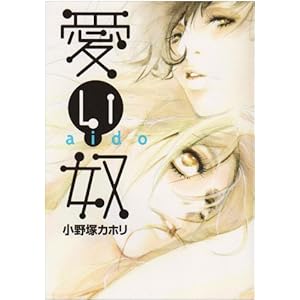
Yuri Manga: Aido (愛い奴)

July 4th, 2011

Aido (愛い奴) by Onazuka Kahori, follows the life and loves of Ureha, a young woman who had some years earlier had an affair with another woman, but is now seeing a young man who is quite serious about Ureha – he’s even proposed, but she has yet to answer him. She’s sure she loves him, but something is holding her back. And then she meets Saori, a woman who lights Ureha’s passion in a way that Ichiru, her boyfriend, never has.

When Okazu Superhero Katherine H. sent me Aido,  she suggested that it very much seemed to her a more modern version of Moonlight Flowers and I can totally see that. Both are about finding one’s true self and rejecting expected roles, so one can become the person one truly wants to be. Unfortunately, where Moonlight Flowers does this with elegance, Aido wallows in vulgarity.

Ureha, as a high school senior had already had a passionate love affair with another girl, and had set it aside as one does with childish things. Ichiru is clearly in love with her, but he starts off dissatisfied at Ureha’s lack of commitment and spends a great deal of the story acting suspicious, mean and churlish. He eventually falls into the time-honored pattern of “if I can’t get what I want, I’ll just take it.” A classic scoiopathy. Here’s a relationship tip – if you go on and on about how you’re *sure* the other person’s going to leave you – they will.

I don’t want to say I object to Ureha and Saori’s relationship, but I can’t say I see a lot of positives in it. Saori’s first act is to humiliate Ureha and that pretty much is their dynamic throughout. It makes it hard for me to like Ureha when she’s put herself in the position of choosing one jerk or another. Unlike Sahoko in Moonlight Flowers, she’s not escaping one demeaning relationship for a relationship between equals – she’s escaping a perfectly acceptable relationship for a demeaning one. Where Kaoru in Moonlight Flowers is cultured, elegant, successful, Saori is a name in the gay bar scene; big fish, small, desperate pond.

The difference between the classic Yuri of Moonlight Flowers and Aido is also reflected in the art. Flowers is, as I said, elegant, classic, clean, where Aido is messy and hard to follow.

Ultimately, Ureha’s choice could seem like a great middle ground to many, but in the end I was unable to find any real enthusiasm for Ureha raising a child whom at a young age, already seemed pouty, cynical and selfish, just like her mother.

There are some positive messages to be gleaned from Aido, though. The main clear and present message that is directed at all straight women is that they really had better never have lesbian sex, because it is just so much more amazing than anything they will ever have with a guy. ^_^

Ratings:

Art – 4
Story – 5
Characters – 4
Yuri – 9
Service – 4, unless you’re into scat, then 9

Overall – 5

Where I found Moonlight Flowers romantic, elegant and beautiful, I found Aido‘s treatment of the same theme to be merely crude.


Yuri Manga: Saigo no Seifuku New Edition (新装版 最後の制服), Volume 2

June 20th, 2011

We left Volume 1 of the new edition of Saigo no Seifuku (新装版 最後の制服) with two unresolved relationships.

In Volume 2, the situation instantly becomes more complicated, rather than less, with the addition of…a boy!

Boys are causing no end of trouble in the dorm in fact. Kimiko’s boyfriend dumps her and, upon overhearing him and his friends being unkind about her dorrmmate, Tsumugi punches his lights out.

In the meantime, Aiko is vexed because Fuuko has decided to date some guy for whom she really has no feelings. This prompts a sudden confession from Aiko. Now that Fuuko knows the truth, what will she do?

In the meantime, Asagi is still planning on gaining Beniko’s affection, but completely fails to even gain her attention.

This brings us to the end of Volume 2 of the original 3-book series. For those of you who bought and read the Seven Seas translation, here is what you missed:

Upon graduation, Asagi calls Beniko out during her speech, for never having noticed or cared that she had feelings for her. Beniko is surprised, partly because she really hadn’t noticed or cared and partly because now *everyone* in the school is watching her.

Fuuko finally admits that she loves Aiko too, but they will not be able to be together, as her mother has taken ill and she is transferring schools. They have mere hours together before they must part. But they continue to write one another as time passes. Aiko is struck by momentary doubt about Fuuko’s feelings, but a visit in person from Fuuko sets her straight. They plan, upon graduation to attend the same school and live together.  For them, the book ends with a rose-colored future.

Meanwhile, Anzu does manage to convey her feelings to Tsumugi, although she knows her cause is hopeless. But she knows that Tsumugi loves her cooking, and she decides she’ll continue to work on it, so she can one day make something delicious for the one she loves.

Asagi remains a selfish ass right to the very end. Why Tama doesn’t punch her in the gut, I will never, ever understand.

And, finally, we get the epilogue we hoped we’d get for Beniko and Tsumugi, as they move in together and Beniko *finally* has her way with Tsumugi, once again proving my theory that in Yuri, the butches are the uke and the femmes the seme. It was quite nice to see them both grown up. This was, in fact, the ending I’d hope we’d get…and we got it, so yay us!

Ratings:

Art – 7
Story – 8
Characters – 7
Yuri – 9
Service – 2

Overall – 8

This series may well be the best example of my opinion changing over time. I started off really not enjoying Hakamada Mera’s art and now, as I read the end of this series at last, I find it was no longer a distraction. I was able to simply enjoy the story for what it was – a high school Yuri story with two happily-ever-after endings and a little sex and candy for good measure.


Shoujo Magazine Yuri Watch: Blue Friend (ブルーフレンド) 2nd Season

June 17th, 2011

Beginning in the July issue of Ribon magazine is the newest addition to the Shoujo Magazine Yuri manga scene, Blue Friend, 2nd Season (ブルーフレンド 2nd Season). You can read the synopses of the “first season” in my reviews of Volume 1 and Volume 2 of the manga.

The second season begins, as so many series do, with the excitement of the first day of high school life. “Today my high school life begins,” says Shimizu Kanako. Kanako is thrilled to be attending a girls’ high school, making new friends, etc. She quite accidentally slams into another girl who reacts, despite her cute appearance, with unusual aggressiveness. Kamei-san is small and cute, but her personality, Kanako learns, is blunt to the point of rudeness.

Kanako quickly makes friends in class, but is startled to find an underlying selfishness in her new friends. They ask her to give them things she bought for herself, and copy her homework. Kamei-san is, in the meantime, quite rude to Kanako’s friends. At first Kanako is angry and frustrated with Kamei-san’s attitude. When Kamei-san speaks the brutal truth about one of the girl’s new boyfriend (“He looks like a llama.”) Kanako wisks her away to dress her down. Instead, she finds her self admitting that she wants to be able to speak plainly, as Kamei-san does.

Her friends desert her and, in retaliation for her new relationship, nominate Kanako as class representative. Kamei-san volunteers to join her. They start becoming closer – Kanako goes so far as to elicit a smile from taciturn Kamei-san when she admits to feeling happy when Kamei-san stood up to be the other class rep.

Kanako decides that she will be more like Kamei-san, and speak plainly what she feels, rather than playing the other girl’s mind games. When two of her former group try to bring her back into the fold, Kanako rejects their overtures, politely, but clearly, explaining that she did not take kindly to the way they treated her.

The chapter ends with Kanako looking at her future as class rep with Kamei-san and thinking, “Today my high school life begins.”

Of interest to folks who care about such things, this series premiered at the front of the magazine. That’s a sign that the previous series did pretty well. Good news, I think.

I admit it – I’m waiting for the boot to drop. There is no way this story is going to be this positive, this empowering, is there? Can it be that the heroine will manage to learn to speak up for herself and be rewarded with getting the girl, too? Nah….

Time will tell what horrible, tragic backstory and what icky-making trauma will fill in the lines here, but I have no doubt that Ebon Fumi is cooking something up.

Tune in to the same bat magazine next month to find out!


Yuri Manga: Saigo no Seifuku New Edition, (新装版 最後の制服) Volume 1

June 13th, 2011

 Reading Saigo no Seifuku, New Edition, Volume 1 (新装版 最後の制服) was an exercise of a sort for me. When I first read The Last Uniform in 2006, the art absolutely repulsed me. So much so that I struggled for years to give Hakamada Mera any respect. Her stories were always cute, slightly bland, but the oversize heads drove me batty. As time went on, the heads got a little smaller, moe became more common and far worse giant heads on little bodies were thrown at me and now, years later, I find I barely noticed the giant heads anymore. I think, honestly, some re-drawing was done here, because the heads weren’t nearly as huge I remember them being. In fact, there were one or two pages where I found myself staring at a weirdly drawn jaw, the way I used to, but only a few.

So, here we are, many years after Saigo no Seifuku originally detailed the love triangles at Tsubakigaoka Gakuin. But before we get into the original stories, we’re given a few new ones, establishing both Ai and Tsumugi as completely, goofily besotted with their respective objects of affection.

The first couple we “meet” are Ai and her roommate, Fuuko. Fu-chan is that kind of cheerful, apparently doofy girl that we’re never really sure means “like” the same way Ai does. Well, the new edition clears that up. And Beniko and Tsumugi are as close (and as far) as ever to some kind of an actual relationship.

The original tales are retold – how Anzu arrives at school and is assigned to Ai-chan and Fu-chan’s room, thus throwing Ai-chan into a tizzy. And how Tsumugi admires Beniko from afar (well, as afar as the next bed over) until Asagi tries to mack on her girl. Meanwhile Anzu has a crush on Tsumugi that she really doesn’t communicate properly to the upperclassman.

Without a doubt, my favorite part of the book is Asagi’s friend, who wears braids, so is referred to as “braids,” who writes slash fanfic about the dorm residents.  Asagi asks her to pair characters up for a little thrill. Included in this new edition are a few of those fanfics.

Ratings:

Art – 7
Story – 7
Characters – 7
Yuri – 7
Service – 2

Overall – 7

Add character pages with uniform and character discussion and you have a shiny new deluxe edition of an “old standard.”


Yuri Manga: Pure Yuri Anthology Hirari (ピュア百合アンソロジー ひらり) Volume 4

May 5th, 2011

You know all the stuff I keep saying about Rakuen Le Paradis? That the stories are written for an adult audience who wants to be treated like adults, and it takes couples beyond happily ever after? Well…none of that applies to Pure Yuri Anthology, Hirari, Volume 4 (ピュア百合アンソロジー ひらり).

In fact, very few of the stories even read “Yuri” to me at all. If they called it “Pure Friendship Anthology Hirari,” I would say it was more accurate that calling it Yuri. In fact, if anything, calling it Yuri stretches the definition of Yuri even past what I’m willing to admit Yuri is. Hirari is, mostly, stories of girls developing emotional closeness with other girls. Call it best friends or, maybe, in some cases, more…but not really. Almost every story in this collection is so removed from love or desire that I find it honestly ridiculous to call it that. Maybe a few stories have some light crushiness, but most of them sound like this:

In Hakamada Mera’s “Black and White,” creepy-looking, magic-user Kurosawa enters a new school and resigns herself to being alone as she always has been. Until another girl becomes her friend. But, when Kurosawa gets good grades on a test, she is accused of using magic and is ostracized. Until her friend comes and rescues her from class-imposed solitary life and forces the other kids to apologize. And…that’s it. It’s a great story of a nice friendship. Perhaps, maybe, it will develop into more, but after several chapters, referring to it as Yuri is just stretching the truth.

Ratings:

Overall – 6