Archive for the Yuri Manga Category


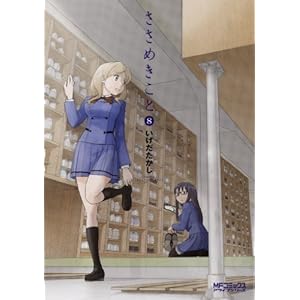
Yuri Manga: Sasamekikoto, Volume 8 (ささめきこと)

March 11th, 2011

Here we are at Volume 8 of Sasamekikoto (ささめきこと). And we are just about as far from where we started as we can be. Instead of layering Yuri tropes and riffing on fan expectations, Volume 8 is a straightforward look at what happens when two people decide to be more honest with their feelings, with the strong subtext of “taking responsibility.”

We left Sumi on the cusp of running for Student Council President and facing a smear campaign about her sexuality. To counter this, she is set up on a date with Akemiya-kun as a beard, but when he shows up as Akemi-chan, the more important message becomes one of personal responsibility for one’s choices. This is brought front and center when Mayu punches out a classmate for her unkind words and Sumi, as Karate team captain has to bear the responsibility. Ultimately, to save the Karate team from being disbanded, Sumi pulls herself from the election…only to have Ushio step in to replace her. Ushio, determined to be as responsible a member of the Student Body as Sumi is, wins. The Karate team remains intact, and Ushio does not back down from her own new responsibilities.

Throughout this volume, Ushio’s brother is being pressured by their grandmother to take responsibility for his own future and for Ushio. After she falls and is injured, he bites the bullet and confronts Kinuta-san about his responsibility to his grandmother and Ushio. The scene where he asks Kinuta to marry him was, IMHO, one of the funniest, most realistic scenes we’ve had in the series (and the reactions of the people around them remind me strongly of a night in a restaurant in England during which everyone in the room was visibly listening in on a breakup at a table in the center of the room.)

And then there’s Sumika. Sumi has been under a tremendous amount of stress recently. She’s pulled herself from the election, but had attention focused on her personal life in a rather unnerving way. Then she had to deal with Mayu’s situation. But what pushes her to the point of breaking is Ushio saying that she’s leaving to go take care of her grandmother. Smear her, blame her, make her the brunt of what you will…the one thing Sumika cannot tolerate is the loss of Ushio.

And that brings us to the end of a very excellent volume of a manga that is not what we could have expected, but has become everything it could be.

Ratings:

Art – 8
Characters – 9
Story – 9
Yuri – 7
Service – 1

Overall – 9

Where will Volume 9 lead us? I don’t know, but I can’t wait to find out!


Yuri Manga: Strawberry Panic Omnibus (English)

March 3rd, 2011

91Bt+QH8+zL It’s been practically an eon since I first encountered Strawberry Panic! in the pages of Dengeki G’s magazine as stand-alone scenarios of Yuri couples. Since then, both I and the series itself have changed a few times. The series underwent an adaptation to manga, in which the initial pairs were expanded to an entire cast, and adapted into an anime, which reached deep into Yuri memes and roots and pulled out a love story with a satisfactory ending. The Light Novels, with their melodramatic stylings, served to complete the unfinished manga in an over-the-top way.

For my part, I began with pretty much nothing but loathing for the series which wallowed and pandered in a way that completely turned me off. There was nothing in the original stories that was created with me in mind and the manga was decidedly shaped for the lowest common denominator. As the anime shifted from “stolen meme of the week, which we present with a straight face and no real desire to tell a story” to “stolen meme of the week, which we present with a wink and a nod and –  we can’t help ourselves –  a bit of character development and plot, too” my opinion began to change. (I consider this a positive quality in myself, even if fans have a somewhat difficult time accepting that. I still get angry letters about reviews I wrote 7 years ago.)  And then I read the novels.

I have to say, very frankly, anyone who cannot “hear” the overt campiness of the novels, the hyper-melodramatic tone in which they were written, is really, honestly missing the point. In my review of the first LN in English, I tried to illustrate this with a few of the quoted passages. My comments were not me being snarky, but me commenting on the snark embedded within the lines of the novel. Of these, this passage really stood out as a tell:

Of course, most of the young ladies used their judgment when they heard those legends. But there were some who really believed them. …And yet those same young ladies grew into fine women.

Really read that, please, and note the subtext which (for those of you who cannot see the flashing lights,) says, “DO NOT TAKE THIS STORY SERIOUSLY.”

At the moment I read that line in the Japanese edition of the Light Novel, I ceased to take any of Strawberry Panic seriously and was, at last, able to find affection for it in my heart.

This week I found myself re-reading the manga as the Strawberry Panic Omnibus, put out recently by Seven Seas (who are now more active on Twitter. Go say hello.). My primary emotion upon completing it was that I was a little sad that it ended so soon. There were so many good bits yet to come and at least one helicopter would surely have been included! But no, this story was terminated at the equivalent of the end of the first novel.

Technically, the omnibus looks good. The translation is as it was; the translation notes are short, but enough. I like the size of the book, which is A5 – this gives it the feel of a typical seinen manga. It feels good in my hand and isn’t going to break a foot if I drop it, as Cardcaptor Sakura might. The one thing I will continue to say about Seven Seas is that they really do a great job of giving us, the readers, an authentic manga reading experience.

The story is very Yuri. There is nothing else to be said about that – there are multiple pairings in this manga but, of them, there are two entirely romantic romances (which almost no fans cared about, instead focusing on the hopeless losers in the rivalries…which has got to be some kind of commentary on something, don’t you think?)

This we can say about Strawberry Panic in all its iterations: Shizuma is queen-like, a veritable goddess on earth who is inexplicably (even to herself) attracted to a humble, down-to-earth energetic, cheerful girl, Nagisa. And Amane is a Prince-like being who is inexplicably (especially to herself) attracted to humble, angelic, cry-baby Hikari. And those two romances fill the pages of this collection with melodrama, tears and kisses.

Love it or hate it, Strawberry Panic was a gateway Yuri series for a generation of fans last decade. If you have not already picked up a copy of this omnibus, please do. And get an extra for your library, to spread the love of Yuri love to the next generation.

Ratings:

Art – 6
Story – 7
Characters – 8
Yuri – 9
Service – 10

Overall – 8

Foreshadowing: I have had the opportunity to see the Strawberry Panic Light Novel Omnibus and it is also quite good. More than it being good, though, you need to read it to get the end of the story! If you liked/loved/tolerated the manga and 1) want to know what happened or 2) really, really want to read about the helicopters, get it! I have to say, I laughed through the novels all over again as I read them. The language is breathtakingly campy in places.

Postscript: Today we have the genuine pleasure of thanking our own candidate for Etoile, Okazu Superhero Eric P., for his sponsorship of today’s review! As always, Eric, thank you kindly for your generosity. If you’d like to become an Okazu Hero, just click on the Yuri Wish List links on Amazon and Amazon JP on the right-hand sidebar and purchase something for review and you’ll be a Hero to Okazu readers world-wide!


Yuri Manga: Kyoumei Suru Echo

March 1st, 2011

Kyoumei Suru Echo (共鳴するエコー), by Kigi Tatsumi, is a collection of shorts from Tsubomi magazine,  that are intertwined by mutual acquaintance but otherwise don’t intersect. In this case, the connections have very little impact on the story and serve only as a thread that links them.

In “Runner’s High,” a horrible trauma turns out to be less of an issue than we might have expected, and once Yuki faces the truth, she’s able to move on.

Yuki’s coach Ayami deals with life and love when she was in high school in the second story. Nothing new, but cute nonetheless.

The third story covers a day in the life of the Yuki and her twin sister Hibiki, their older sister and the drama that makes a family a family.

It is the final, multi-part story that sets this collect a little apart from others of its kind. In “Lonesome Echo” Yuki and Hibiki’s older sister, Ritsuko joins the staff of a school as a new teacher. Ritsuko encounters a strange slacker student Yohko, who lounges around the music room and asks embarrassing questions of the new teacher.

As time passes, Yohko learns that some thing is not at all right with Ritsuko. She is being abused by her lover. A lover who, Yohko finds out, is female, older and Ritsuko’s former music teacher. Yohko stands up for Ritsuko, only to be brushed off by the arrogant, abusive lover. But Yohko is not a shrinking violet – she is the granddaughter of the school chancellor and has strings she can pull and the clout to protect Ritsuko. The end of the story is a handwave, but a perfectly acceptable one.

I thought this last story was interesting – if pat – because it illustrates a trend I notice in any maturing genre. Once every possible iteration of “Story A” is told, writers start to branch out. Depending on the genre, they may reach into more and more extreme perspectives, which why “suspense” novels are now filled with serial kidnappers/torturers/killers. In the case of Yuri, it means that along with some silly fantasy scenarios, we’re getting some looks at “lesbian life” outside the romance part. In the case of “Lonesome Echo” we got a glimpse of a real issue, abusive relationships. Yes, it’s true that the ending was not realistic, but the expression on Ritsuko’s face and the words she spoke about how her lover is really a good person, it’s her fault…those were real.

Ratings:

Art – 7 (I wish, in collections like these, that authors would include a cast of characters page, so I don’t have to guess at names and relationships)
Story – 7 overall, but 8 for Lonesome Echo
Characters – 7
Yuri – quite low, until Lonesome Echo, in which we see an actual couple in crisis – 6
Service  – 1

Overall – 7, Lonesome Echo – 8

If we want Yuri to mature as a genre, we must be willing to take a look at the bad along with the good.  This was a reasonably gentle entrée’ to a topic that would be distasteful to some and inexplicable to other readers of Yuri. The audience of Tsubomi magazine are used to their Yuri being dished up in palatably sweet flavors of schoolgirl crushes. A story like this would have a sour taste for many. And for that, I applaud it.


Yuri Manga: Wildrose Re:Mix disk a and disk b

February 26th, 2011

Yuri Hime Wildrose was a 6-volume anthology of Yuri manga by Ichijinsha, the publishers of Comic Yuri Hime. Those six volumes were extremely variable, and tended to focus more on “Plot, What Plot?”-type stories than those being serialized in the Yuri Hime magazines. Wildrose has been re-launched as Girls Love (and the missing apostrophe has been the subject of many a Japanese Yuri blog post, something I admit I find amusing.) I have reviewed all 6 of the Wildrose volumes:

Volume 1 – Volume 2 – Volume 3 – Volume 4 – Volume 5 – Volume 6

You’ll note that I did not much like them, precisely because they focused on stories where the extremely thin plots were meant only to barely cover the sex scene. It’s not that that kind of story can’t be done well, it was just that mostly, these weren’t. In the end, I gave away the entire set.


The two Wildrose Re:mix disc-a and disc-b volumes are exactly what they sound like – some of the (presumably most popular) stories from the earlier collections, focusing on artists that are working within the pages of Comic Yuri Hime. As with all collections, there is good, bad and ugly, and your opinion might differ strongly from mine, depending on what you like. I did not like most of these stories the first time, and was no more thrilled the second time. However, there were a few from each volume that I found enjoyable enough, even though I’ll admit to finding explicit, bodily fluid-filled sex not all that appealing, really. I guess I’m just a romantic at heart. (I wrote that in hopes of getting you to spit-take. Did it work? ^_^)

If you’re one of the crowd that prefers your Yuri manga to be short, uncomplicated and full of sex, this would be an excellent two-volume collection to purchase. There’s even a few cute stories in it.

Ratings:

Overall – Everything varies widely, let’s be generous and say…6

Probably the most interesting thing about these two volumes was the mystery of who bought them. Some anonymous Okazu Hero sent them to me and did not include a message, or a name. (Anonymous Porn would be the best band name, wouldn’t it?)

26 Feb Note: Mystery solved! Today’s review was sponsored by Okazu Superhero Dan P. Thank you very much Dan, for letting me relive some of the better Wildrose stories.


Yuri Manga: Blue Friend, Volume 2

February 24th, 2011

In Volume 1 of Blue Friend (ブルーフレンド), we met Ayumu and Misuzu. Ayumu is popular, athletic and smart and although Misuzu is cute, she is the class outcast.

At the end of the first volume, Misuzu’s horrible past is revealed to the entire school and Misuzu collapses from stress.

In Volume 2, we learn more about Misuzu’s horrible past trauma and it’s pretty much what we guessed (dead mother, neglectful father, sexually abused by an adult.) Bizarrely, Satsuki, who showed up in the role of gadfly who knows all, turns out to be on our side, although she does it in the meanest, most tedious way possible.

It turns out that the culprit in the serial harassment of Misuzu was someone who should really be ashamed of themselves – an adult who was there during the past circumstances. It was really hard to understand – from my perspective, anyway – why anyone would blame *Misuzu* for anything that went on. It was more and more obvious with each new indignity, that she was the victim in the past and was being victimized again, now.

And, indeed, the student body seems to sort of think that too. So, when the school festival rolls around and the class choses a play, they rally behind Misuzu, as she struggles with the lead role. By the time she’s managed not only the lines, but the body language and the final embrace – of a boy! – the class is 100% behind her.

At which point, I thought – there are two ways this story could go and the one that seems “happy ever after” would be the worst choice possible. Because, at this point in the book, Misuzu is happy because she is making Ayumu happy. Even worse, Ayumu is starting to convince herself that Misuzu *needs* her – in a way that would never allow Ayumu to have her own life.

Amazingly, the story did not go there. Instead, the story chooses the harder road – the road in which Misuzu and Ayumu do not go walking off into the sunset happily ever after, in a horribly unequal and co-dependent relationship. Misuzu, having finally been allowed to shed her past, chooses to become a person on her own, so that, should she and Ayumu continue as a couple, she can stand on her own as an equal partner. I admit, had the story gone the other route, I would have been disgusted with it. This ending is less apparently “happily ever after” but it is definitely more “healthily ever after.”

Ratings:

Art – 7
Story- 8
Characters – 7
Yuri – 6
Service – 1

Overall – 7

Blue Friend was a throwback to some of the classic shoujo Yuri of the 90s, with a fresh, healthy, hopeful perspective on their future. Whether they move on as friends or lovers, we can smile, certain that Ayumu and Misuzu will both be okay.