Archive for the Yuri Manga Category


Yuri Manga: Nobara no Mori no Otome-tachi, Volume 1(野ばらの森の乙女たち)

November 11th, 2010

Hatsumi and Sakura are best of friends. They have done everything together for years, including studying for and being accepted to the prestigious Otoha Academy where, because of the wild roses that grow around the school, the students who study there are known as the Maidens in the Forest of Wild Roses.

Otoha Academy buildings are luxurious, the dorm rooms are spacious and the furnishings are gracious.The students are polite, graceful and well-mannered. The elite of the school are a beautifully groomed couple – Top Star Otokoyaku Izumi-sama and her Musumeyaku companion, Mayuko-sama.

Hatsumi and Sakura are walking around the grounds, enjoying the rarified atmosphere into which they have been admitted when they come across Izumi and Mayuko in the garden. Unseen by the older girls, they can tell that Mayuko is crying and unseen, they watch as Izumi and Mayuko kiss.

Overheated, Sakura and Hatsumi go back to their room where after a tense moment of recollection, Hatsumi finds herself shockingly close to kissing Sakura. She pushes her friend away and they laugh it off as a moment of overstimulation.

But now Hatsumi can’t take her eyes off Izumi-sama, and it appears that she is of some interest to Izumi. Hatsumi and Sakura are asked to be year representatives in the dorm association and find themselves involved in the school festival (the Maria-sai) planning. More importantly, Hatsumi finds herself in the company of Izumi more and more… and even though she’s said she can’t like Izumi that way, because they are both girls, it’s becoming apparent that she does indeed like Izumi, that way.

Sakura, for her part, has become morose and possessive. She challenges Hatsumi about her feelings for Izumi-sama, and is belligerent when she discovers Hatsumi alone with her.

Hatsumi and Sakura draw lots and end up being the ones to shop for materials for the school bazaar. But Sakura goes down with bad menstrual cramps and Izumi accompanies Hatsumi…their first date, she calls it. They get caught in the rain, and end up back in Izumi’s room, drying off. The lights go out. Hatsumi finds herself in Izumi’s arms, and she’s moved to confess her feelings for Izumi…. When the lights go back on, Mayuko-sama is standing there. Hatsumi runs back to her own room, but won’t tell Sakura what happened – except to say that yes, she does like Izumi-sama! Sakura looks sad, but says nothing.

The school festival comes. Hatsumi learns that Mayuko is being accompanied by her fiancée and suddenly, Hatsumi is obsessed by the need to protect Izumi from the news. She runs Izumi around the school trying to avoid the issue, until they run into Mayuko and her fiancée in the hall. Izumi greets the young man with the air of someone who knew all along and Hatsumi is mortified, realizing that she knows nothing about either of them.

That night at the dance, Mayuko and Izumi make the perfect couple…until Izumi congratulates Mayuko on her engagement and is slapped for it. Hatsumi runs after Izumi…even after Sakura asks her not to go. Hatsumi finds Izumi and tries to comfort her. Before she knows it, Izumi kisses her. In the shadows, Mayuko watches them.

Nobara no Mori no Otome-tachi野ばらの森の乙女たち)is definitely the lesbian love child of Maria-sama ga Miteru and Strawberry Panic!, with shades of aunt Himitsu no Hanazono at the table. Izumi is Amane and Shizuma and/or Sei all rolled up together, while Hatsumi is Hikari and Yumi smooshed into one character. The parallels are not exact, but are striking enough, all with a Yuri coating so thick (and not getting any thinner as the story progresses!) that even if we resolve one of these relationships straightly, there’s just about no way that all of these couples go away. Our only question, really, is whether we root for Hatsumi and Sakura or Hatsumi and Izumi.

The plot thickens in the next chapters, so I’m just *dying* to see the current volume!

Of everything I bought while in Japan, this was tops on my wish list. And it was this volume I opened up on the plane to read, which prompted the nice Japanese woman next to me to ask if I understood Japanese (“Enough to read children’s manga,” I said.)

This manga is great so far. Even if they do something stupid, like Izumi’s really a guy, that doesn’t lessen by one iota how gay this story is. ^_^

Ratings:

Art – 8 It’s the art that really reminds me of Himitsu no Hanazono, has that 90s shoujo manga look
Characters – 8
Story – 9 You know this one
Yuri – 8
Service – Unintentionally, probably a 5 or so

Overall – 9

Another candidate for this year’s Top Ten. It has all the bells and whistles and is targeted at a young female audience for added oomph.


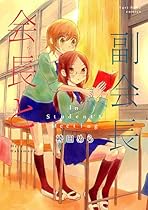
Yuri Manga: Kaichou to Fukukaichou

November 2nd, 2010

Kaichou to Fukukaichou (会長と副会長: In Student’s Meeting) by Hakamada Mera, tells Story A all over again…but does it pretty darn well. President of the Student Council Fuji-kaichou and Vice President Nashizuka-fukukaichou are, without the other realizing it, attracted to each other.

There’s nothing specific keeping them apart, except the fact that same-sex desire is not the norm and therefore is accompanied by a lot of soul-searching angst.

The first chapter introduces us to the couple in question – and the situation between them – from the perspective of Fuji-kaichou. But the bulk of the book takes place from the point of view of Nashizuka-fukukaichou, who is a smart, competent, driven and very serious young woman. She struggles daily with her attraction to the President, tortured by her lack of context or role model, and by the fact that the President is very popular among the other students in the school. “She doesn’t love me,” Nashizuka thinks to herself at some point in the story, “Why would she?” I thought that line neatly captured the second hurdle anyone who has ever found themselves attracted to someone has to get past. We’ve acknowledged our feelings…but what reason, really, do we have to think that those feelings are returned?

For her part, Fuji-kaichou is torn between a complicated family life and a pleasant school life that she uses to bolster her peace of mind. When her family life begins to leak out of the box she’s put it in, it causes some crises in her school life. But through all of it, she’s convinced that Nashizuka is the one person she can turn to.

Ultimately, it’s the forthright President that pushes the issue, by publicly proclaiming that Nashizuka is *hers,* dammit…in front of the entire student body, teachers, administration and guests, at the school festival. And then there’s just enough time for a sweet wrap up and the volume comes to a close.

For a story that had such small crises, there were a lot of tears. I remember friends in high school who seemed to cry rather often about relationships, so, that’s pretty realistic. The characters were also fairly real – no wildly out of proportion skills or powers or situations.

Kaichou to Fukukaichou is about a girl who likes another girl who likes her back.

Ratings:

Art – 7
Characters – 8
Story – 7
Yuri – 8
Service – 1

Overall – 8

You’ll notice that I didn’t mention Hakamada’s trademark giant carnival heads. Either the heads were smaller or I’m getting used to them, or the story was good enough that I didn’t notice or something else.


Yuri Manga: Sasamekikoto, Volume 7 (ささめきこと)

October 26th, 2010

Years ago, when Ranma 1/2 dominated the world of anime/manga – related fanfic, authors quickly discovered something critical about writing comedy. Writing farce was impossibly difficult, as it relied heavily on visual gags. And, if authors took the other road and went all serious with the characters, they instantly encountered roadblocks like sustainable characterization and the drama of emotions.

Everyone knows that tragedy is easy, comedy is hard. It is especially hard when the comedy morphs into a drama, and things that were funny when it was a comedy now have to be integrated into a serious plotline. Someone switching genders as a comedy might be a hoot and a half…as a serious character point…do you go all maudlin and self-retrospective with them? Or do you deal with everyone else’s reactions? Or do you delve into the emotional life of not knowing who or what you are?

All of which brings us to Sasamekikoto, Volume 7, (ささめきこと). As I mentioned in my review of Strawberry Panic!, there comes a time when, as a writer, you have to just write, dammit. Comedy, potboiler episodic standardized whatever all have to be tossed out so you can make a strong story which characters that are real…or the readers will simply stop caring. (In reality, some will stop caring when you try to make your characters real, too, because they *liked* the two-dimensionality of the characters, but if you’re a writer, those people are an acceptable loss when weighed against your sanity and pride.)

Unexpectedly, Volume 7 begins with a look at Ushio’s brother and his lack of a life – and the choices he made that put him in that position. This story sets the tone for the rest of the volume, as the underlying theme is surely “choices made have consequences.”

We also meet a new “couple” – Koi and her friend Mayu, whose story somewhat echoes Sumi and Ushio’s, with a slightly different outcome. Their story segues into the story of the big Karate match, and Ushio joining the team as manager. Victory is not ours, but that’s all right, as not winning is a far more real experience for most than winning. Another indication to me that this series has shifted focus away from fantasy-comedy.

And finally, we are allowed some time alone with Sumi and Ushio…and we can see that having finally acknowledged their feelings for one another are the same, they are not jumping into bed, but are dating. Another sign that this series is taking itself rather more seriously than it was.

And then, reality…seriousness…*drama* strikes.

Sumi has decided to run for the student council. As class representative, a good student and excellent athlete, she’s a natural – her striking figure and height only help to sway the boys to feel that she is almost one of them. Until one of her opponents takes the low road and outs her as a lesbian. She and Ushio had not been hiding their relationship…it had never occurred to them to do so. Now Ushio, who remembers what it was like to be ostracized in middle school, says she’ll back off Sumi and the rumors will stop. After all, Ushio says, Sumika is the one “normal” member of the Joshibu. Sumika doesn’t know how to respond to this, and allows the moment to pass without comment.

In a misguided attempt to promote Sumi’s heterosexuality, Akemiya-kun is chosen as a beard for Sumi. He accepts happily because, as we remember from earlier chapters, he likes Sumika.

In the wake of the deaths of LGBTQ and other youth in part due to bullying, I can’t help but feel that this will not go well…not the author’s fault, per se, but I guess anything written about anyone being bullied or mocked for a sexual or gender identity right now will push that button.

For the first time, I find myself considering the next volume with trepidation. I realize that Sasamekikoto is still largely a comedy. But the possibility for comedy (in the classic sense of living happily ever after) is significantly lower than the possibility of tragedy (in both senses.)

Would I like Sumika to stand up in front of the student body and admit to liking Ushio and tell them to vote and be damned? Yes, of course I would, but I’m not delusional and I don’t *expect* it to happen. I want to trust the author to take that rein and tell the “right” story, the story about being whoever you are is okay…I really want to trust him.

What will happen?

I don’t know.

That’s why I keep reading.

Ratings:

Art – 7
Characters – 8
Story – 9
Yuri – 7
Service – 1

Overall – 8

Thanks be to Okazu Superhero Mari K. for her generous sponsorship of today’s review!


Yuri Manga: Pure Yuri Anthology Hirari, Volume 2 (ピュア百合アンソロジー ひらり)

October 24th, 2010

Yuri Anthology Hirari, Volume 2 has some good qualities and some less good ones.

Many of the stories don’t actually seem to be “Yuri” at all. Two girls meet and, um…they meet. But there are others that are less preliminary and a few even go so far as to lightly touch upon some semblance of emotion.

The best of the bunch, in that regard, was “Yubisaki no Koe,” by Maeda Tomo. Not because it was a good story, per se, but unlike many of the other stories in the collection, where we have to just assume that the two girls are interested in one another *because* this is a Yuri anthology, there was a palpable feeling of tension between the two characters.

Also, “Nanami-sempai to Arisa-chan,” while I didn’t like the art at all, did a shift halfway along that created some unresolved (and kind of unresolvable) sexual tension. When Arisa learns that her interest in one upperclassman is hopelessly unrequited, she simultaneously learns that what she thought was a rivalry with another upperclassman was nothing of the sort.

The most unique story, although not necessarily the most satisfying, was Minagi Asaoka’s “Anata to Ireba”‘ when a young woman accidentally encounters her namesake, who is a famous figure skater. They end up having a heart to heart talk. We get a rather sudden epilogue ten years later, when the skater asks her namesake to marry her. This story was indicative of the collection as a whole. “Here’s two girls,” we’re told as we’re handed two girls at random. “This is a Yuri anthology. Therefore they must like each other.” Even if we never actually see or feel that. Or, in something like Scarlet Beriko’s “Mine,” we’re shown a friendship that, at some barely-anything kind of provocation, suddenly is love (and desire.)

As a perfectly fitting ending, there is a short story by Sakaki Kazuki, illustrated by Hirao Auri, the creator of Manga no Tsukrikata. I haven’t read the story yet, but I felt that the choice of illustrator was somehow characteristic of the collection as a whole. Manga no Tsukurikata is also a series in which the interest and tension between the characters largely has to be assumed by the audience, because we see little actual sign of it in the story itself.

Ratings:

All things Variable. Overall – 6

It’s not that it’s a bad collection, it’s just sort of still in prep stages and not quite ready to be cooked.


Yuri Manga: Nobara no Mori no Otome-tachi

October 22nd, 2010

I remember the moment I first discovered desire in shoujo manga.

I was reading Sailor Moon, raw, with very little Japanese comprehension, accompanied by a script translation created by a dedicated fan. There was Usagi, our charmingly naive and sweet heroine, in bed, wearing Mamoru’s shirt…and nothing else. It wasn’t explicit, but the art clearly indicated “nothing else.” And it was the morning after. Mamoru was likewise at least partially unclothed. It was obvious to anyone who could see, that they had spent the evening together and had slept together. Usagi was, at that point in the story, about 16. Objectively speaking this is not an inappropriate age for sex. But Sailor Moon ran in Nakayoshi, which was for girls 11-14. It kind of made my head explode a little.

Desire, as I once wrote in a story, is a terrible thing. It is *the* thing that irrevocably destroys innocence. Kissing, hand holding, riding off into the sunset – these are totally innocent expressions of love and marriage and happily-ever-after. But sexual desire – the recognition of desire – is the thing that changes one’s vision of happily ever after, forever.

We could see Usagi and Mamoru kissing – we knew what it meant. But we could retain a indirect innocence as long as we pretended that they didn’t *want* one another. In the middle of Sailor Moon Super S, we now have to admit that Usagi has become a woman not because she lost her virginity (we have no idea if this was their first time and indeed are lead to believe that it is not, as they are both quite natural about it,) but because we have to admit that she *felt sexual desire.* (The sad little eulogy for K-ON! from a 2chan fan who referenced his disappointment in Nagi from Kannagi sleeping with a man, is reacting to the same thing, although in a different way.)

Which brings me to Nobara no Mori no Otome-tachi, which also runs in Nakyoshi. It begins with Hatsumi seeing Izumi and Mayu kissing in the forest. In effect, it begins with the loss of innocence, as Hatsumi is introduced to the idea of desire in herself and in others.

The first volume is not yet out and I will be reviewing it when I get it, but last night I read the most recent chapter and once again had my head explode. ^_^ Because I have been expecting this manga to stop being as Yuri as it is any second and in the most recent chapter, it actually *ups* the Yuri.

This series begins with Hatsumi being aware that two girls have desire for each other…then it morphs to her slow recognition of desire in herself for another girl. In this month’s chapter her innocence is shattered as she is forced to realize that there is someone who desires *her.* That’s the last straw in innocence, I think. When we confront the idea that we *want* someone else, it’s not really a loss of innocence, but when we look into the eyes of someone who *wants* us – it’s all over. We can never really see the world innocently again.

And let me be very clear here…I’m not discussing innocence as a quality that is to be admired or preserved, but as a stage of personal development. “Innocence,” in this case, is a way we perceive the world.

So, at the end of this chapter, when Hatsumi’s best friend forever kisses her, passionately, with obvious desperation and desire…it’s a shock to Hatsumi (not so much to me, as I had seen it in her all along.) What was a shock to me was how blatantly the mangaka exposed this as desire, and not something else – and how they did not shy from the expression of desire between two girls. That was the head exploding bit for me this time.

Nakayoshi is, as I said, a magazine for the pre-pubescent to pubescent girl audience. Again, objectively speaking, it makes a lot of sense that this audience would be fairly obsessed with the idea of desire. Objectively speaking, but in reality we all have screaming hissy fits at the idea here in the west. The awakening sexuality of young girls is sold heavily as titillation for men, but heaven help an actual young girl who is perceived to have sexual desire. We try to shove her back in the baby box as fast as we can.

Nakayoshi does not shy away from desire. It recognizes that 13-year-old girls are interested in things like, y’know, boys. There is less sex in Ribon and Ciao, but Nakayoshi skews, in my perception, just slightly older, more like Margaret. There’s a surprising amount of desire in shoujo magazines, which forces manga companies here to often rate shoujo as Older Teen.

I’ve got no conclusion to this essay (which I expect to ultimately rework into an article for Hooded Utilitarian) but I really just wanted to talk about Nobara no Mori no Otome-tachi and let you know that you should definitely get Volume 1, because it is very, very Yuri.