Archive for the Yuri Manga Category


Comic Yuri Hime, July 2026 (コミック百合姫2026年7月号)

July 5th, 2026

On a black background, surrounded by purple staging, a girl in black and purple, get her toenails painted, held in a woman's hands. The cover for Comic Yuri Hime, July 2026 (コミック百合姫2026年7月号) by Chiriko is a deep contemplative black and purple. The words on the cover are in Latin “Nihil Valet, Ioc Ludus Est Sol Nobis Duobus” which roughly becomes “Nothing matters, the sun is just a joke for the two of us.”  Again, there’s a backstage vibe. I don’t know what any of it means, and the random mannequin heads and bodies make me uncomfortable. It’s giving Yuri version of Something Wicked This Way Comes.(No link, I bet your local library has it.)

As usual, there are any number of series I am not reading, and this issue begins with one of them, FLOWERCHILD’s “Utsushicha Damena Kao” with color opening pages.

This time around there are a number of horror, pyschological horror and toxic Yuri series, most of which I’m not reading. I find unentertaining to watch the emotional suffering of high school (or younger) girls, but you might find those more interesting than I do. 

One of the horror stories I am reading is “Hina-chan Ikiterunara” by Tsumugi Meme. In this story, a girl who has been missing for several years returns..unaged, with no memory of those years. In this chapter, Sora had befriended Minori who is an occult enthusiast. As Minori starts to look into Hinako’s disappearance, things get weird.

In “Sasayakuyouni Koi wo Uta,” faced with imminent stardom, Hajime looks back on her life, on how she put hr feelings for Momo aside, about her desire (or lack of?) to be famous and maybe for the first time to admit what she wants to herself.

Kashikaze’s “Kimi ga Hoeru Tame no Uta o” is picking up tension as LUPINUS work towards a goal…and they reach out for advice.

“Watashi no Oshi ha Akuyaku Reijou.” by inori. and Aonoshimo is giving some useful depth to Lily’s character and the way Salas was able to embed Alter so deeply within her subconscious. By using Lily’s frustration, and feelings of rejection by Rei, Alter is able to use Lily more easily. I really liked in this chapter how Lily and Alter are starting to phase together and are less separate personalities than two sides of a fractured soul.

Touma’s “Kimi no Seinandakara, Sekinin o Totte you ne” is not going where I expected, as Mitsuki, juggling feeling for Sui-chan decides to try some paid dating as the vendor, not the client.

And again, “Hareta Hi no Dress Code”  is also not headed where I expected, which is great. The sports Festival is upon us and a hair scrunchy seems to represent the something building between Natsuki and Miwa, but the more immediate crisis is a creepy dude visiting the school taking pictures of first-years that Miwa passes off to Okita to handle…and he picks up what she is laying down right away.

“Zangai Shoujo, Kirakirana Sekai no Soko” continues to world build the future-ish city around a bunny girl android and the people who repair her…and become her friends, of course.

In “Muryoku Seijo to Munou Oujo ~ Maryoku Zero de Shoukansareta Seijo no Isekai Kyuukokuki ” by Tamasaki Tama, it appears we have tracked down the story of the source of the miasma, at last!

“Rounin Nante Roku Demonai!” was a very sweet one-shot by Tsuchiya Usagi about a girl falling into despair and a cram school buddy who drags her (kicking and screaming) into hope. 

Koharu and Minato sign up for a workshop to make their own  wedding rings! in the autobiographical comic by Daruma and Hiarron.

Ten and Lulu are back in “Chouuchyuu Yori Ai wo Komete,” by Ashidaka Woz. A marriage for Lulu and Ten’s past both come rushing into their lives at the same time.

And this month’s “Film ni Saku Yurinohana wo Atsumete Kimi ni Okuritai” column by Kobara Yuuko our protags watch  Asagao to Kase-san.

This was a particularly good volume. I’m reading and enjoying more than half the current series/one-shots, which is an amazing stat for a manga magazine.

Ratings: 

Overall – 9

The Back cover repeats the Latin from the front cover, but also say, “Tu Tantum Spectare Debes Unde Es” which tranalator tooltells me means “You Just Have to Look Where You Ar From.” 

Okay, then.

The August issue is out now!


Koushaku Reijou No Rouraku Misshon ~ Maou To No Seiryaku Kekkon Ga , Jinrui Saigo No Kirifuda Desu ! … ~Tsu Te , Maou Ga Onnanoko No Baai Wa Dousureba Ii No Desu Ka ! ?, Volume 1 (公爵令嬢の籠絡ミッション~魔王との政略結婚が、人類最後の切り札です!…って、魔王が女の子の場合はどうすればいいのですか!?~)

June 25th, 2026

A black-haired, black tentacled Demon girl with a black crown stands back to back with blonde girl in white in front of an elaborate frame.Koushaku Reijou No Rouraku Misshon ~ Maou To No Seiryaku Kekkon Ga , Jinrui Saigo No Kirifuda Desu ! … ~Tsu Te , Maou Ga Onnanoko No Baai Wa Dousureba Ii No Desu Ka ! ?, Volume 1 (公爵令嬢の籠絡ミッション~魔王との政略結婚が、人類最後の切り札です!…って、魔王が女の子の場合はどうすればいいのですか!?~) is a deeply weird little manga I found on Bookwalker JP. With art by Akio Kawada, written by Ringo-ame Third, this is the Young Champion-est thing I have read all year.

Cecilia, the daughter of the Duke, is told that she will wed the Demon Ruler, in order to bring peace between the humans and the demons. Cecilia has one magic skill – the “Evil Eye,” that allows her to see magical power in movement. Unsure what she can do, she is sent to the Demon Ruler’s castle, where she is almost instantly attacked by one of the Ruler’s four lieutenants. With her “skill” Cecilia is able to survive to meet the Demon Ruler… a cute, if en-tentacled – girl named Milfina. Cecilia is thrown for a loop. Yes, demons don’t really get “marriage” (or cease-fires, or humans) but Milfina seems nice, and more importantly, sincere about making this work. Cecilia is speaking with Milfina, when a black mist envelops the Demon Ruler…and she thrusts her hand into Cecilia’s heart.

Cecilia wakes up, the day before, once again ready to be sent to the Demon Realm, when a fairy tells her that not only is her marriage supposed to save humanity, which she knew – she only has 5 more times to try and save the entire world!

Cecelia is determined to save Milifina from whichever lieutenant is controlling her, but as volume 1 ends, she is down yet another life.

Deaths here are graphic and pretty brutal. I don’t doubt Cecilia is going to marry Milfina and be a damn good Queen of the demons, but as of volume 1, I have seen more of her internal organs than I am comfortable with.

Ratings:

Art – 8
Story – 6
Characters – 7 No one has had time to develop
Service – Violence is a form of service, 10
Yuri – Set-up only

Overall – 7

Will I keep reading? I don’t know. I kind of want to find out…I kind of don’t. I’m reading this on Bookwalker JP, so it’ll probably remind me until I give in. ^_^


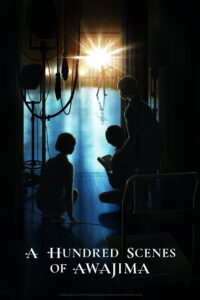
A Hundred Scenes of Awajima, streaming on Crunchyroll

June 17th, 2026

From a dark backstage, three girls look out upon a brightly lit stage where a young woman acts as a male character, blindingly bright as she lifts her arm.Are you comfortable? Have a drink, maybe a snack? Good, because this review is going to be 95% exposition and 5% review. Okay, maybe 85/15. But still. 

To understand A Hundred Scenes of Awajima, let us begin with a rather famous book called Fugaku Hyakkei, (富嶽百景) One Hundred Scenes of Mt Fuji, by the rather famous artist Hokusai. And, the equally famous Meisho Edo Hyakkei (名所江戸百景) the One Hundred Famous Views of Edo by the equally famous Hiroshige. From these titles, we see that hyakkei (百景) means “one hundred views.” This is clearly a trope. One understands that this word means “various perspectives from various angles.”  Hachiko used this trope in their Yuri Hyakkei (百合百景) volume in 2017.

Awajima Hyakkei, the manga series for which today’s subject is an anime adaptation, began in 2015.  I reviewed Volume 1 and Volume 2 here on Okazu and, although I kept reading I did not review other volumes. Yuri, while a part of this manga, is not a major part.  But it is a fundamental part, as we shall see.  The story is set in the preparatory school for girls who want to perform with the all-female famous Awajima Revue. 

Some of you will have understood immediately that this is mean to represent a fictionalized version of the second cultural relic in this series…a very famous, very real, all-female Revue Troupe school.  In a long ago post, scholar Rachel Thorn did a breakdown on the many visual, cultural, linguistic, geographical and organizational similarities between Awajima Revue and the real school. There are also other similarities, as well.

One of the similarities of the Awajima Musical Revue School and the school upon which is is based, is the constant refrain of bullying and power harassment within the organization. This is a real, and very front-facing issue in the story, but it has a sad truth to it. Unfortunately both the school and the troupes themselves have a history of power harassment against junior students and members, likely stemming from the para-military organization of the student body. This bullying is alluded to in the documentary Dream Girls, where one can visibly see actresses struggling as they remember their “strict” seniors at the school. So, as we watch our characters move from first to second year in the anime, speaking of being better seniors to their underclassman, we understand that the bullying was significant. 

Another similarity is the intense, intimate and sometimes romantic relationships formed by the students. Jennifer Robertson’s 1998 book Takarazuka: Sexual Politics and Popular Culture in Modern Japan, touched on this topic and, for her efforts, she was banned from the organization’s archive. The organization has still avoided any formal recognition of lesbian performers, bun there is a less rigid perspective in fandom where queer readings and female intimacy are more acceptable. (Nobuko Anan’s “Performing Female Intimacy in Japan’s Takarazuka Revue” and “Transcultural Desires and Lesbian Fandom: Takarazuka Revue in Taiwan” by Lucetta Y.L. Kam are interesting in that regard.) In that old and lost (and if you find it anywhere, DO NOT POST A LINK, this was deleted by Thorn and should remain lost out of respect. I have the original, but I will not share it, nor should you) post, Thorn noted that the real school was not at all comfortable with the idea that any of their girls form pairs, despite at least one well-known out lesbian who was a member. You may remember Higashi, who was one of the women whose marriage at Tokyo Disneyland caused the resort to change their policies. 

The manga, written and drawn by Takako Shimura, is available from Yen Press in English as Scenes From Awajima. This title is, in part, why I take time to explain the meaning of “One Hundred Scenes”. Sure you could read the book without understanding the whole thing behind “hyakkei” but if you know what it means and where we know it from, the series makes more sense. Knowing is half the battle. ^_^

All of which brings us, finally, to A Hundred Scenes of Awajima, streaming on Crunchyroll, the anime adaptation of the manga. The manga suffered a bit, as Shimura had not yet quite matured into the storyteller we saw in Even Though We’re Adults. This anime adaptation is the best adaptation of a Shimura work to date. 

Artistically, the animation captures her watercolor pen art in a way that feels true to her work and also somehow feels realistic. Each episode begins with a “scene” that moves into a story that is multi-layered. First-year students, their parents, the teachers, and predecessors all move through the school in one time or another. Shadows from prior years’ successes and failures, loves and losses are all presented as they impact the present. The present, however is treated differently. Students, current and former, try to heal wounds, and change the culture for the future. We see girls who were loved and hated, girls whose family was supportive, and those who were not.

The story begins and ends with a girl who was bullied into leaving the school and ultimately taking her own life. It’s a sad story made sadder when you see how strong she was, and how good she might have been. That shadow lingers into many other of the stories, even when the girls in them don’t know that. 

These are the “one hundred scenes” of Awajima. A place, a person, a story may look different when seen from another angle, but Awajima, like it’s real-world analog, is still there. Still dealing with the good and the bad.

Ratings
Art – 9
Story – 8 
Characters – 8
Service – 0
Yuri – 2?

Overall – 9

I would never suggest this story for someone new to anime, but if non-linearity and beautiful art is enough to interest you, I especially recommend watching the anime before reading the manga. It’s easier to follow for having been simplified a bit.  One Hundred Scenes From Awajima is streaming now, on Crunchyroll.


Monster-Colored Island, Volume 2

June 15th, 2026

Two girls wearing bathing suits, bathed in bright light, look startled at our appearance.Having set up a tale of ritual scapegoating and relationships with a genius loci from the ancient past that bleeds into the present, Monster-Colored Island, Volume 2, turn up the volume on the thin, wavering line between then and now.

Kon and Furuka, both strangers to the people on the island, take refuge in each other, while the island beckons them deeper into it’s secrets. They enter a cave that should not be entered, and find a fantastically large pile of shells. They fall even deeper into the cave, trying to avoid who or whatever is watching them. But more mysteries are occurring. 

A new player enters the game and there’s no way to know if she will uncover things that need to be uncovered, or end up being hidden away herself.

This manga is very much a tone pone. Moody, creepy, slightly overblown with analogies to puberty and self-awareness, but mostly just creepy. I feel like both art and story are trying to do too much as once and are suffering ever so slightly.  Having read it twice now, I’m still not sure what I think of it. I guess I’m just going to keep reading, and see. ^_^

Ratings: 

Art – 8
Story  – 7
Characters – 7 
Service – There is, yes
Yuri – 9

Overall – 8

Volume 2 is out now from Yen Press!


The Delinquent and the Transfer Student, Volume 1

June 10th, 2026

A girl in school uniform kneels properly and smiles gently, next a delinquent who squats in the same uniform, with a long skirt, dyed hair and a scowl.If you are a regular reader of Okazu, you are probably aware that one of my greatest pleasures in manga is reading stories about the worst people. I love lesbian assassins and psychotic queers, woman who have just fucking had it, and women who cause trouble. I especially love the tradition of girl gangs, delinquents and girls who rule the school. 

It is very apparent to me that Fujichika feels exactly the same way. In The Delinquent and the Transfer Student, Volume 1 we are indulged in our love of this stereotype, with a broad stroke of attraction between our protagonists.

Riri is a recent transfer student into this school and, from the moment she met Atsuko, a girl with a reputation as the fiercest fighter among all the school, Riri is captivated. She loves listening to Atsuko, in her gruff gang patois, saying the most ridiculously cute and fluffy words.

As Riri and Atsuko come in to contact with one another in class, and handling school activities, they start to find that their feelings for one another are maybe more than just friendship. They both realize that they really, really, want to hang out with the other…a lot. All the time. Maybe, forever?

This is an impossibly cute book. Not only are Riri and Atsuko fun, the students around them seem pretty normal…except when Atsuko’s second takes exception to Riri taking up so much of her time. But even she has to admit that Atsuko gets to make her own decisions. 

You don’t need to be steep in girl gang lore to follow this book, but if you are…it won’t hurt. There are a few jokes that land better if you get the reference. 

Because I do love the world of  1980s Japanese girl gangs and delinquents, I was always going to like this series. ^_^ I had read some of the chapters when it came out in Japanese, but forgot to keep up, so I am very thankful to Seven Seas for picking it up in English. As I said of this manga in my ANN review for the Summer manga guide, my only criticicsm is that they didn’t bother trying to approximate the gang patois. It is a reasonable choice to avoid that, but it is kind of the key point in Atsuko saying words like “giggle” and “tiny” in that rough way. Even with that, this is a very enjoyable, shockingly wholesome, series.  

Ratings:

Art – 8
Story – 8
Characters – 8
Service – Delinquents are service for me, YMMV
Yuri – 3, with plenty of room to grow

Overall – 8

Thanks to Seven Seas for proving the reviewer copy to ANN. 

Delinquents and Yuri are a perfect match. ^_^