Archive for the Yuri Manga Category


Yuri Manga: Mermaid Line

April 18th, 2008

In the face of the continuing moe-fication of the manga world in general, and the Yuri world in particular, it’s nice to know that there are a few men who can buck the trend. Like Kishi Torajirou’s Mars no Kiss, Kindaichi Renjurou’s Mermaid Line is a Josei-style book by a male author.

Mermaid Line is a collection of stories that ran in Yuri Hime magazine. They are collected together as short mini-series, done in an episodic, almost soap-opera-y way.

In “Megumi and Aoi ” Megumi confesses to her friend Aoi that, despite her ungainly swimming, she feels as if she is a mermaid. Aoi finds herself fantasizing about being the prince to Megumi’s mermaid, but Megumi runs to the arms of a boy, trying to put a beard on her feelings. Aoi is turned into the class target, but Megumi realizes that she’s made a bad decision and once more approaches Aoi. Eventually, they go out and, over cake, come to agreement that it’s not male or female that’s important, but that you like someone.

Ayumi, in “Ayumi and Aika,” wants to get married to her boyfriend so naturally, she’s shocked when he tells her that he wants to become a woman. She learns to cope with this and reconnect to him as a friend, but when he comes back into her life, as gay bar hostess Aika, friendless and homeless, Ayumi rethinks everything. It’s not marriage, but Ayumi’s pretty confident she can love Aika as a woman.

“Yukari and Mayuko” are both OLs. Mayuko’s between boyfriends and bored, so she asks Yukari to pretend to be her girlfriend. It works out well, until Yukari realizes that her feelings for Mayuko are more than just pretend. When Mayuko gets a new boyfriend, Yukari lets her go, but there’s no happy end for her.

And finally, in “Miura-san and Me” Okabe loves Miura’s beautiful hair. When Miura-san cuts it all off, Okabe learns to love her for herself.

Overall, the stories deal with feelings that are more complex than just “I like her.” There’s a sense of the characters being realer and deeper than the normal “Story A”types. There is angst and there’s bullying, and being outcast, but there’s also acceptance and growth and of course, love.

While none of these narratives are breath-taking, “Ayumi and Aika” stands out as the best of the bunch. By far and away, the strongest of the series in this book. I liked this series the first time around and it’s just as nice this time. Where something like Kashimashi plays the gender change card as a handwave you just need to go with, this miniseries looks at it with a light hand, a humorous touch and a sensitive heart.

Ratings:

Art – 8
Story – 7
Characters – 7
Yuri – 9
Service – 1

Overall – 7

The tagline on the obi says, “Love doesn’t come in only one form” which I think it a fitting, and pretty, summation for this book.




Interview with Yuri Translator Erin Subramanian

April 15th, 2008

Here’s the second entry in our industry interviews! This time, we’re talking to Erin Subramanian, a freelance translator and the much beloved Rosa Chinensis of Yuri scanlation group Lililicious. Erin also reviews Yuri manga, mostly stuff I don’t review here, at her Livejournal. I recommend it to you, if you don’t already have it bookmarked.

Anyway, welcome to Erin, and let’s get started with today’s interview!

1) So let’s start with the most obvious question – tell us a little bit about yourself.

I am a yuri manga fan who translates for a yuri publisher (ALC Publishing) and translates and copyreads for a BL publisher. I also translate for free in my spare time. I have a B.A. in Japanese from the University of Rochester, and have been translating manga for around seven years now, though most of that work has not been for pay. I am a bisexual woman in a long-term relationship with a woman, and though yuri has a special place in my heart, I also love (male) gay and straight romance stories.

2) Are you a manga reader yourself? How did you get into manga? Did that lead you into working in the manga industry? Or do you just do it for the fame, glory and chicks? ;-)

Yes. I got into anime first–Sailor Moon–and then into manga from that. It was my enjoyment of manga that lead me to seek a job in the industry. Fame and glory don’t sound particularly appealing, and I think my partner would disapprove of the chicks (and dudes). :-/ However, when people ask me what I do, I get to tell them that I translate gay porn. It’s hard to top that.

3) Are you a fan of Yuri manga? Did you know it existed before you started working on a title? What were your thoughts upon seeing your first Yuri job?

Yes, yes, and “Cool, a yuri manga in a historical setting” (this was Morishima Akiko’s short one-shot “Ichigo-Hime,” from Yuri Monogatari 4).

4) Not every Yuri series is equal. Some are better than others. What, if any, thoughts do you have about the series you’ve worked on. Silly? Serious? Quality? Not?

I particularly like the works I translated for Yuri Monogatari 5–they’re a mix of silly and serious stories, and I’m glad that there is some sort of market for works like that here too. Not that I think they’re the only sort of works that should come over here, of course–there are a lot of great yuri titles of all kinds that I would love to see do well here.

5) Which Yuri titles would you like to see make it over here? Anything you’d like to get to work on?

Yamaji Ebine’s works. More titles from Yuri Hime, particularly “Kisses, Sighs, and Cherry-Blossom Pink,” “Strawberry Shake Sweet,” “Rakuen no Jouken,” and “The Miko’s Words and the Witch’s Incantations.” “Kaguyahime,” “Love Vibes,” “Maria-sama ga Miteru,” “Pieta,” “Plica” (and I’d love to see the “Plica” movie on something like Logo’s “Alien Boot Camp” series), “Shibuya District, Maruyama Neighborhood,” and “Sweet Blue Flowers.” More works from artists like Tadeno Eriko and UKOZ. No surprises there, I’m sure. As for the second question: All of them, I suppose. However, as long as the English edition is done well, it doesn’t particularly matter to me whether I personally get to work on it. There are always plenty of other titles out there that are in need of attention, and plenty of other things that I would enjoy translating.

6) What’s your favorite and least favorite thing about your job?

My favorite thing is getting to share something I enjoy with others. Those moments when the perfect translation of a line just comes to you are right up there too, though. My least favorite thing is agonizing over the best way to convey a line, particularly when I need to convince someone else to agree with me on it. Also, translating rape scenes.

7) Anything else you want to tell our audience?

I’m pleased to see more yuri coming over here, and hope it sells well. We’re fortunate that so much good yuri manga is being created; I try not to take its existence–or that of the artists and publishers who are taking a chance on it–for granted. That’s not to say that we should have lower standards when it comes to yuri, or praise yuri works when we think they’re mediocre or worse–I just think we’re lucky that there are enough of us to constitute a fanbase and that there are so many talented people out there who are creating yuri works. Let’s hope that state of affairs continues.

Thanks again!

It was my pleasure.


Yuri Manga: Mars no Kiss (マルスのキス)

April 14th, 2008

Many Yuri fans are already familiar with Maka-Maka, the two-volume full-color manga by Kishi Torajirou. (Here are my reviews of Volume 1 and Volume 2 for thems as are interested.) The synopsis of Mars no Kiss (マルスのキス), Kishi’s newest manga, didn’t fill me with glee; it’s basically a “Story A” type story – that is, girl falls for girl, nothing happens. But, Mars no Kiss is well constructed, nicely drawn and surprisingly sweet, so the execution more than makes up for the fact that the plot is the same old thing all over again. The fact that the obi advertises this as a “Girl’s Love Comic” was kind of interesting, but what really pleased me was that synopsis on the obi described this as a first “real” love story.

Yukari is a “bad girl.” She rebels against her controlling mother by dyeing her hair, polishing her nails and having an older boyfriend, with whom she has an intimate relationship. In fact, as she notes, that’s kind of all they have right now. He never takes her anywhere; they just go to a karaoke box, sing a bit, and have sex.

Miki is a “good girl.” She’s tall, and has classic Japanese beauty. She’s quiet and bookish and smart. And a bit aloof.

The two are forced to share a double desk at the beginning of the term which annoys Yukari no end. Like most bad girls, her initial reaction is disdain and derision for the good girl’s behavior. But, one day, after school, she sees Miki in the Art Room, gently kissing a statue of Mars and her heart starts to race. When someone comes up from behind, both Miki and Yukari know that they’ve been seen, and everything changes between them.

Yukari and Miki talk in the library, and Yukari promises to never tell anyone what she saw – and she means it. She’s more worried about her own reaction – why did her heart start to pound at the sight? Miki admits that her reason for doing it was to see if her glasses would get in the way when she kissed someone. Yukari thinks this is hysterical. ^_^

A friendship quickly develops between the two. Miki also has controlling parents – being bookish is her way of escaping. The two start to walk home together, and meet in the library for heart to heart talks. More and more, Miki is in Yukari’s mind…even when she’s with her boyfriend.

When Miki excitedly tells Yukari that she’s got herself a boyfriend, Yukari has to stop herself from being unkind. The boy is a nerdy-looking kid Miki knew in middle school, so Yukari unkindly jokes that if they both are wearing glasses when they kiss, the glasses might get tangled up. She leaves Miki, not wanting to be spiteful, but totally unhappy about her friend’s good fortune. Eventually, she realizes that her feelings for Miki are well past that of “friend” and she recognizes that she’s jealous, plain and simple. In a moment of shock she realizes that what’s she’s feeling, is love.

Here’s what makes this story work. In most cases, we’d expect that the bad girl would tease the good girl at this point, trying to seduce her – or worse, toying with her. Instead, Yukari finds that her feelings for, and friendship with, Miki start to rekindle her own sense of youthful innocence. She cuts her nails, takes off the polish, dumps her boyfriend and softens the hard, cynical edge of her personality. Even Yukari’s expression changes, as she looks on Miki with a whole new perspective.

One day, Yukari brings Miki to the library again, where they talk about Miki’s kiss with Mars. Yukari reminds Miki of their earlier conversation about glasses getting tangled. She shyly pulls out a pair of glasses that she bought, she says, the day before, special for this purpose. She offers to kiss Miki to see if it’s really a problem. The next few panels are especially great, as we see Yukari’s view of Miki through the frames of the glasses, which sit unevenly on her face.

They kiss. The glasses don’t get tangled. Accidentally, Yukari confesses that she likes Miki. Miki’s reaction is to reply that she likes Yukari too, but it’s clearly a different use of “like.” As she removes the glasses from her face, Yukari confesses to herself that she loves Miki.

The story ends there, with the two of them moving to new desk partners the next semester. But they see each other in class and wave. On the last page, Yukari thinks that this love will always be her precious memory. It has a decidedly sweet, rather than bitter, flavor and it leaves one with a good feeling.

In a lot of ways, this story reminded me of the main plot of Hen. It has the same set up – girl in relationship with a guy falls for another girl. But where Hen played everything for high over-the-top-ness, Mars no Kiss is a more realistic look at a similar situation. The lack of seductive pervyness and/or emotional manipulation that we’ve come to expect from “girl loves girl” stories is very refreshing.

The splash art between the chapters is also quite sweet, as it tells a shortened version of the story. In the first chapter, Yukari and Miki sit, openly sulking, next to one another, not looking at one another. By the end, they walk hand in hand.

For fans who want a little more, the novelization of this story appears in the short story anthology Confession, along with, presumably, other stories of love confessions. ^_^

Ratings:

Art – 8 (particularly those last few pages)
Characters – 7
Story – 7
Yuri – 4
Series – 4

Overall – 8

Yukari likes Miki. The End.


Yuri Manga: Yuri Hime S, Volume 4

April 10th, 2008

Last week, I briefly mentioned that I found this fourth volume of Yuri Hime S soulless. I wondered why that was, so I spent some time today, in between sneezing my head off, to re-read it and ponder what my problem was with it.

In short, my problem is that most of the stories end where they should begin. The endlessly rehashed tension of two barely pubescent girls who “like” one another is, well…boring. About half the stories in this volume are just that – girl likes girl. Girl confesses, other girl doesn’t push her away, the end. Let’s call it moe Yuri “Story A” for short. That will save me from having to keep typing it over and over.

Cherry Lips – “Story A” with cat-eared, kimono-wearing loli urchins. Three fetishes at once.

Cassiopeia Dolce – Alternate end to “Story A,” in which Anna’s confession to Elsa-sensei is met with “Great! I like you too! Let’s work hard together!”-type, wrong interpretation of “like.”

Kotohana Link – “Story A” setup in which girl fails at romantic scene in school play and the director confesses her feelings.

Flower Flower – Nina continues to abuse Shu physically and emotionally, while Shu continues to try and woo Nina. This is a comedy manga, FYI.

Peach-colored Sigh – “Story A.”

Secret Stream – “Story A” with a twist. They *both* are torturing themselves with their feelings about the other one.

The Two of Us Under the Sky – This iteration of “Story A” is a continuation of last issue’s “Himawari Saita,” as Nasuna tries to decide on a classmate to pursue. Her friend Ma-chan volunteers with a really sloppy (I mean gross sloppy) kiss.

Minus Literacy – Miharu has left. I have no idea why.

Honey Crush – takes a complete turn away from Kyouko and the ghost stressing about Madoka, and instead has the ghost stressing about the existence of the *other,* cuter spirit that lives, bathes and sleeps with Kyouko. Ghost tries to scare cute little Mitsu away, but fails and learns to play nice.

Otome-iro Stay Tune – Arise and drinking buddy Tomoe show up at Hinako’s place where, through drunken stupidity, Arise’s “Story A”-type concern is blurted out. Arise jumps Hinako, insisting that her interest is real.

Fragments – “Story A” between two sisters, one of which looks 8. So a double whammy of negativity for me.

The People Who Are Near Her – Continues from last volume’s “Kaichou and Fukukaichou,” this time from the Vice President’s point of view. Every time she wants to help the President out, or be near her, other people are already there. She manges to share her lunch and take care of Student Council business, and the President comments that she’d be nowhere without her. Happy, happy, joy. joy. Not yet at “Story A” point, but crawling slowly there.

Model Maiden Gretel – continues from last volume, as Yuu, Mariya and Nagi continue to bond as a team through sleeping, bathing and destroying beasties together, with the occasional sloppy kiss. Looks like Mariya is developing a “Story A” type crush for Yuu, while Yuu is completely gaga over Nagi, with her no personal boundaries and mean kissing skills. A second team of three girls tell them to get a grip and become a tighter team already, then show them up with sparkly Orb powers.

Nanami and Isuzu – Valentine’s Day and general “Story A” wackiness

Hime-chan is a Shy Girl – “Story A” buildup, with a side trip on the seven school mysteries and playing someone else’s recorder.

So, as I was saying, in all but a few of the stories, the formula is pretty static. Stories end when the two girls decided to be together, which is basically the same thing that annoyed me about fairy tales as a kid. All that sound and fury for not much pay off. Of the few continuing series, “Gretel” is the most original (which isn’t saying much, but at least it’s something!) and “Otome-iro Stay Tune” is the only one with adult women who like women.

Ratings:

Overall – 5

If you are a fan of moe Yuri, this book is made for *you.* I’m about 1/8th satisfied with it, myself.


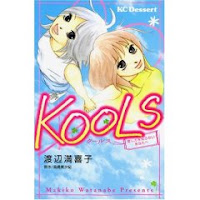
Lesbian Manga: KOOLS

April 6th, 2008

KOOLS is a collection of three one-shot josei manga stories. They make a perfect lead-in to today’s digression – the difference between josei manga and Ladies’ Comics.

Here in the west josei manga is categorized as manga targeted towards women 18-30. However, if you look at Japanese publisher websites, you’ll see that they often market their magazines in four flavors – “For boys” “For girls” “For women” and “For men.”In reality, shoujo magazines target an audience of (roughly) 7-12 year olds and anything older than 12 becomes josei. And even some of that shoujo stuff runs older that I’m comfortable with. In other words, teen, older teen, mature readers all are lumped under “women,” not “girls.” The upper age limit for josei is also approximate. For many years I read Feel Young magazine, in which there were constantly comments by readers much older than 30 – sometimes even as old as me. ;-)

Now, while josei manga can be translated as “Lady’s Comics,” they are in no way the same things as Ladies Comics, which is an entirely different genre in Japan. Ladies Comics are “adult” titles, by which I mean that they are smut. Aurora Publishing, which is the western imprint of Oozora Shuppan (the publishers of the lesbian-themed Ladies Comic Mist,) are putting out the first translated Ladies Comic – Luv Luv. Here’s what Aurora has to say about the title: “Aurora Publishing, Inc. brings “passionate manga for women” to America with their new Luv Luv imprint. Extremely popular in Japan, but never before available as a genre in the U.S., Ladies Comics, or Redikomi, are romantic, hot and sexy manga about modern women and the men they love.” I love the use of “modern” there – the codeword for post-sexual revolution women who think sex is fun and not just a marital obligation. The term is so 70s. ^_^

To sum up, most of what we think of shoujo, is actually josei. And josei manga is in no way the same thing as Ladies Comics.

Which brings me to today’s topic, KOOLS. This book came out under the imprint KC Dessert comics – all of which are targeted towards older teens, but have “adult” situations. Because high school girls like to read about sex, too. These are josei manga, not Ladies Comics. KOOLS is, as I mentioned, a collection of three stories, all of which are sincere, have genuine moments of sweetness and are about as “After School Special” as I’ve ever read in a manga.

The first story, “KOOLS,” which stands for “Kiss Only One Lady,” is the story of Sae, who slowly, but steadily comes to grips with the fact that she is lesbian. She meets, fall in love with, joins a softball team with, moves in with, breaks up with and then gets back together with Tomo, who is quite possibly the best lesbian ever in the history of manga. The subject matter is told as a story, but there’s a definite edge of educational about the thing – the moral of the story is, “it’s okay to be gay.” Along the way, the audience is also introduced – gently – to other sexual minorities, and the unique forms of discrimination that can occur, even within a small community.

Sae is not a bad person, Tomo just has the misfortune of being her first, so when she all of a sudden has a crisis of identity, its Tomo who bears the brunt. But Sae, with the support of their softball team, (named the KOOLS,) comes to grips with herself and we are lead to believe that the end looks bright and rosy for them. It’s a very pleasant ending to what, ten years ago, would have been a tale that ended in tragedy or marriage.

The two stories that follow are gritty reminders that we genuinely cannot confront issues of rape and abuse enough times. In the rape story a party girl is gang raped, but does not report it, because she is sure that no one will believe her or that they will make it out to be her fault. Through the tough love and friendship of a total stranger, she moves through the pain, and into a new life, where she is able to once again face the idea of being with a guy. Eventually, she finds the strength in herself to testify against the men who raped her, when they are arrested for another rape.

The last story is set in high school, where a nice girl is going out with the hunky guy – who beats her. The story covers all the ways women lie about their abusers, to themselves and to other people. The violence escalates, but again, someone else intervenes. In this case, as the abusive boyfriend goes off the clock and starts to take it out on the woman who has stepped in to protect the girl, she is told to run and get the police.

The last two stories are rough. Nothing is held back. There’s no implication or whitewashing – these are brutal situations told brutally. And the advice is stated just as brutally – it’s up to you to stop it. Now. Hotline phone numbers and crisis center information is given plainly and simply in the notes.

I admit to finding the first story less satisfying since it was lumped in with the latter two. It gave the whole book a sense of it being a “things girls might have to deal with” handbook. For obvious reasons, I would prefer to simply see a story about two women who fall in love, with no teacher’s guide for discussion attached. However, as an educational story, it was a pretty good narrative with characters that didn’t stand out as silly stereotypes or behaviors. No Takarazuka butches, no lipstick lesbians behaving like old men – just a bunch of women, who happen to love other women.

Ratings:

Art – 8
Story – 7
Characters – 7
Yuri – 10
Service – You know, I really don’t want to think about that. In a perfect world, 0.

Overall – 7

KOOLS a refreshing contrast to Yuri series and makes a nice story to give a friend or relative without sounding too preachy. Once again, thanks to Erin who pointed this out to me.