Archive for the Yuri Manga Category


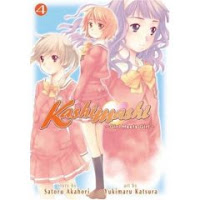
Yuri Manga: Kashimashi Girl meets Girl, Volume 4 (English)

April 2nd, 2008

Let’s recap the story so far in Kashimashi ~ Girl Meets Girl:

In Volume 1, Tomari has difficulty coming to terms with the fact that her best friend, Hazumu, has become a girl.

In Volume 2, Tomari has difficulty coming to terms with the fact that she has always loved Hazumu

In Volume 3, Tomari has difficulty coming to terms with the fact that she is *still* in love with Hazumu and is willing to fight Yasuna for her.

And now, in Volume 4, Tomari has difficulty coming to terms with the fact that Hazumu’s life may be coming to a premature end.

Looking at it this way, it sort of seems like Tomari’s really the protagonist, doesn’t it? ^_^ And, in a way, she is.

Hazumu, by her own admission, is incapable of making any decisions. Yasuna has made her decision, but will not do anything change the status quo, as befits her gentle, “proper girl” personality. Which leaves Tomari holding the whole ball of wax in terms of crisis, climax, angst and any other random emotions wandering around.

To my surprise, I find that I never originally reviewed this volume in Japanese, probably because it felt like, at the time, that the story pretty much screeched to a dead halt, and we were waiting for the series to run out of chapters so it could end. Now that I’m looking at it from a different perspective, it pretty much just looks like the next plateau of a fairly formulaic series. In every volume so far, the basic premise of Kashimashi has been watching Tomari tortured by something everyone else appears to have haphazardly accepted. Of course they haven’t, they’ve been wracked with doubt and despair, but as our focus is turned primarily upon Hazumu and Tomari, we’re not able to see it any more than Tomari does.

Just as Tomari finally does come to accept her (and Hazumu’s) feelings, Yasuna forces the situation to become more complex, by existing. She ends up acting as a catalyst for Tomari’s and Hazumu’s growth, without every really doing anything specific. In this case, it is the rumor of her leaving for New York that makes Hazumu scoop her up and kiss her. The irony of course is that Tomari has just learned the lesson “If you give in to the fear of losing something, you’ll never be able to keep it safe,” but Hazumu hasn’t.

As always, the adaptation and translation for Kashimashi is superb. Tomari is now, along with everyone else, referring to Hazumu as “she.” Tomari has also stopped speaking like an old man, which is nice. The page tones seemed to have reproduced a little roughly, leaving some moire patterns on pages with large toned areas, but unless that’s important to you, it’s easily enough overlooked. Once again, I really want to say, this book has the smoothest, most natural translation/adaptation I’ve ever encountered. It never fails to impress me.

Other than the fact that nothing really *happens* in this Volume, it’s quite excellent. If one took the essentially ridiculous plot complications away (aliens, time running out, etc), it would be a nice slice-of-life piece about a newly transitioned girl and the girls (and boys) who love her.

Ratings:

Art – 8
Characters – 7
Story – 7
Yuri – 9
Service – 4

Overall – 8

My thanks to Ted the Awesome (new nickname, as discussed at Anime Boston,) for sponsoring today’s review!




Interview with TOKYOPOP Editor Hope Donovan

March 31st, 2008

In 2005, when Shoujocon and Yuricon teamed up to run Onna!, the focus of the event was women in the comics and animation industries. We wanted attendees to meet these women and see what kind of advice they could impart about breaking into and making a life in these notoriously competitive (and male-dominated) fields.

Recently, I have been able to talk with other women who are working on Yuri manga titles in one way or another and, just as with Onna!, I wanted you to meet them, learn from them and support their work. :-) Over the next several weeks, I’ll be posting interviews to give you, the readers of Okazu, insight into the industry and introduce you to some of the women who work on the Yuri we love.

I’d like to open this week with an interview with fabulous editor Hope Donovan of TOKYOPOP. I met Hope at last year’s New York Anime Festival, where I learned that Hope is working on the TP edition of Kannazuki no Miko.

1) So let’s start with the most obvious question – tell us a little bit about yourself.

Hope Donovan here. I’m an editor at TOKYOPOP and have spent the entirety of my professional life there.

2) Are you a manga reader yourself? Did that lead you into working in the manga industry? Or do you just do it for the fame, glory and chicks? ;-)

My path into manga is backwards. I liked the sexual freedom and alternative gender roles in manga, but until I began interning at TOKYOPOP, I didn’t know I liked manga for anything other than straight-up porn. I’ve since been touched by many manga stories, and have come to appreciate the diversity, heart and earnestness of the medium.

As for the internship itself, I had some experience as the editor of my college’s satire magazine, DUIN, and couldn’t bear the thought of another summer at home. I applied online and was accepted for an editorial internship during the summer of 2004. TOKYOPOP ran on the power of slave-labor interns at the time, so I was thrust into a real job situation. I learned a lot. Fortunately, I was hired as a copyeditor after I finished school.

3) Tell us, in general terms, what you do – where does your job fall in the process of producing a translated manga?

An editor of licensed manga oversees the translation, English adaptation, proofreading, layout and quality control of a book. To a certain degree they prompt the marketing of the book and write all kinds of various copy. They are the point person responsible for a book. But editors don’t translate the manga themselves, and most of the editorial staff at TOKYOPOP does not speak a word of Japanese. What’s important to the job is a love of comics.

4) Are you a fan of Yuri manga? Did you know it existed before you started working on a title? What were your thoughts upon seeing your first Yuri job?

For me, getting to edit a Yuri title was the golden prize. Many of my friends from high school and college have gone on to more illustrious careers in science, but I sincerely hoped that through manga I could help show young queer teenagers representations of other people with common experiences and feelings. We’re woefully underrepresented in the media and every little bit counts. Knowing that I finally got to make a contribution was very meaningful for me, even if the subject matter was something rather exploitive, like Kannazuki no Miko. Even that can make a difference.

5) Not every Yuri series is equal. What, if any, thoughts do you have about the series you’ve worked on?

The title I’ve worked on is Kannazuki no Miko. Kannazuki no Miko shows what happens when the earnest desire of two women to be in love is twisted by the circumstances of their world. In the case of Kannazuki no Miko, the circumstances are extreme. Chikane and Himeko are reincarnated priestesses hounded by a squadron of mecha as well as an annoyingly irrepressible hero. Chikane is also a deeply scarred individual, who truly believes the only way she can ever be with Himeko is by raping her. For her part, Himeko’s just a confused teenage girl. Twisted as it may be, I bought the pain at the core of the story, even while recognizing that Kannazuki no Miko offers, at best, an impossible ideal of a relationship that literally cannot exist at the same time as the world.

6) Have you gotten any fan feedback? Anything you want to share?

I’d sure like to get some. Go buy it, starting May 2008! It has color pages~

7) Any Yuri titles you’d like to see make it over here? Anything you’d like to get to work on?

Honestly I’m not as versed in Yuri manga as I should be. But I get to read Yuri Hime magazine for free at work. I really like “Tokimeki Mononoke Gakuen.” It’s weird, and I feel like it has more to offer than “two girls fall in love.”

8) What’s your favorite and least favorite thing about your job?

Favorite things: would I be off topic if I said the Rising Stars of Manga? I love getting to see new artist’s work. Niki Smith, who was featured in Yuri Monogatari 5, was a finalist this year. Besides RSOM, I’d say being in a workplace environment where the office decor is manga posters and everyone has dozens of volumes of manga on their desk is pretty sweet.

The least favorite part would have to be that there are limitations. You can’t license every title you want. You can’t make every correction you see. You can’t afford to work with every artist you want.

9) Anything else you want to tell our audience?

There’s a lot of manga out there that isn’t worth your time. Find the titles that matter to you and love them. Buy them.

Hope, thank you so much for your time and your insight. I know many folks, including myself, are looking forward to seeing Kannazuki on the shelves. :-)


Yuri Manga: Lesbian Shoujo Ai

March 29th, 2008

This is the last post for “crappy crap” week, but don’t worry – I have plenty more crappy crap in my pile of stuff to read and review. It’s just that my brain is melting and I need to stop reading all of the crap in a row like this…it burns, it freezes!

Like Battle Club, I went in to this book knowing that it would pretty much be crap. I love Senno Knife’s work, he draws pretty lesbian manga with lots of qualifying characteristics like penises, alien creatures, incest, rape, prostitution, etc. So I knew perfectly well when I got this book what I was in for. (Incidentally, I met Senno Knife way back in the dawn of time when he was being translated by Steve Bennett’s Ironcat Studios. He’s a really nice guy with a really cool wife. If you get a chance to meet him, do.)

For the record, Lesbian Shoujo Ai has no lesbians. It has girls who have lesbian sex, in between being raped by fathers and stepfathers and having sex with their brothers, total strangers and local hermaphrodites. Some of the girls are also sisters, which will appeal to the crowd to whom that kind of thing appeals.

Miyako hates her half-sister Misato when she’s brought to the house, but when she finds that she can pass Misato off as herself and not have to have sex with the guy her father sold her to, she likes Misato way more. They dress alike and have sex with themselves. They live happily ever after, fu fu fu.

Marina and Mio meet in a water town, and become lovers on the night of the festival. When Mio sees Marina having sex with what she thinks is the local god, she runs away, but Mio assures her it’s just her very girlish brother. The three live happily ever after, in this water town of dreams.

In a Meiji period girls’ school, Haruna has fallen in love with the beautiful “holy mother” Ayaka as she dances. She writes Ayaka with her confession, then the letters get more and more explicit. When Ayaka sees Haruna leave a letter, they become “sisters” only, Ayaka says, she is definitely not holy in any way. Haruna presses for the kind of relationship she expressed in the letters, but Ayaka rejects her. We see why, when Haruna follows her home one day and watches Ayaka’s stepfather have sex on her. Haruna insists that she loves Ayaka and they do become lovers. When Ayaka graduates, she leaves a letter and a train ticket for Haruna, who gladly runs off with her her beloved onee-sama.

Maria is depressed because the male teacher she has a crush on is getting married. She skips school and finds herself in a falling down school building where she meets ethereal beauty Tsuta, who tells her about her quest to see an angel. They kiss, which wipes the lovesickness from Maria’s heart. She goes back to see Tsuta, and when they make love on the roof of the condemned building, Tsuta confidently says that she saw an angel afterward, so she gets her wish – to have a wonderful lover.

Yuuna has always been in love with Miki but, when Miki kissed her back then, she ran away from her feelings. They went to different middle schools, but now they are in high school together and Yuuna keeps her feelings in a journal. The other girls in class find the journal and start to read it out loud. Mortified, Yuuna runs away, but instead of being disgusted, Miki follows her. They reconcile and make love. If only it could stay like that forever.

In the final two-part story, Kana is hired as a maid to take care of the beautiful Ageha, but the mistress of the house takes Kana as her lover, when she is not making love to Ageha. After a lot of mixed messages and misunderstandings, it turns out that the woman who runs the household was in love with Ageha’s mother, and is injecting her son with estrogen to turn him into a woman she can love. When she realizes that Ageha and Kana are in love, she kills herself and leaves them to live together in peace. As Ageha and Kana watch, a naked, youthful woman who looks just like Ageha appears and she and the spirit of the dead mistress walk off together, hand in hand.

This manga is from Comic Garo, which is one of the notable few indie manga magazines in Japan. They have a great website where they talk about how their mission is to allow manga artists to draw they way they want to, with freedom, but good editorial guidance. This was the same magazine for which Usamaru Furuya of Short Cuts drew his debut work. (I’ve never reviewed those two volumes here, because there’s no Yuri at all in them, but I absolutely *love* Short Cuts manga for the utter wtf-ness.)

And this kind of Yuri-colored hentai is exactly what Senno Knife is best at. Despite it being questionable porn, there’s heart at the center of each story which is lacking in much of what passes for Yuri (like the most recent issue of Yuri Hime S, for instance, which is practically soulless.) In Lesbian Shoujo Ai, the lesbians are brutalized by men and not actually *lesbian,* although they love other women, but at the core of each story you find love – love that frees them from their past.

Ratings:

Art – 6 everyone looks exactly the same in a doll-like way
Story – variable, averaging out at about 5
Characters – same
Yuri – 9 (10, with a point off for all the other stuff)
Service – 9

Overall – 6

Don’t get me wrong – I’m not saying this is good. But for crappy crap, it ain’t bad. ^_^


Yuri Manga: Magie Paire, Volume 2

March 28th, 2008

In Volume 1 of Magie Paire, we met Reina and Maria, students at a school for powerful mages, who “pair” with one another to practice their magic and defeat demon-y things in between exhausting amounts of dressing and undressing.

In Volume 2, because Maria clearly needs the practice, they step up the dressing and undressing, adding pool, ocean and bathing duties to the usual hours of dressing and undressing.

In between all the time spent semi or totally naked, attacked by various tentacle monsters, and failing to gain a single new skill, Maria and Reina keep working on their bond as Master and Suite.

Also, we learn that Maria can’t do magic without “cute” creature Unyuu-chan on her head. However, Maria’s mother tells Reina, there’s no way a powerful Master like Reina could have possibly chosen a completely magic-less Suite, so it’s just a matter of finding the trigger. Then they all get back to the pressing business of undressing and dressing.

The one male character in this series seems a reasonably pleasant sort of background character. He’s one of the Masters, and we don’t see him perving or anything, and he does pitch in and fight from time to time. Finally, a male character that doesn’t look or act like an idiot. Quick, bronze him!

Magie Paire is pretty much a typical Takagi Noboyuki Yuri series, which is to say, he picks a fetish and beats it to death in between tiny little plot points. This volume’s fetish of choice is bathing suits and baths. At least we know the characters are all clean.

Ratings:

Art – 6
Story – 5
Characters – 6
Yuri – 4
Service – 7

Overall – 6

This volume has significantly less plot than Volume 1, and tons more service. I’d hoped it would get better, but…not.


Yuri Manga: Eternal Alice Rondo, Volume 3 (English)

March 27th, 2008

Perception without conception, is blind; while conception without perception is empty – Immanuel Kant

Volume 3 of Eternal Alice Rondo Key Princess Story slams us smack dab into a wall of the same theme, if you will, with which we were beaten soundly about the head and shoulders in Kannazuki no Miko – obsessions are bad.

Speaking as a person whose life is, at this juncture, greatly enriched by an obsession, I’d like to clarify that. *Bad* obsessions are bad. Good obsessions are easily rationalized as dedication, specialization and/or subject expertise. ^_^

In the case of the characters in Eternal Alice, obsessing about your best friend who never notices you, or your inexplicably adopted otaku half-brother or your dead best friend you accidentally killed while playing hide-and-seek or power or a fictitious character means you will be attacked by girls with questionable fashion sense and their own boring obsessions.

…that’s the lesson I got out of this book, anyway.

(The wife says, “woo-hoo! sign me up!)

That, and Aruto may die a raging bore, but not a virgin. Go, all you otaku – if Aruto can get some, surely there’s hope for you! Ignore the fact that he is a badly-conceived 2-dimensional drawing. Pretend he is real – then you will be just like him pretending Alice is real. Isn’t that ironic?

The art in Volume 3 is a train wreck, what passes for the plot is a thorn whip of angst and the characters become less and less interesting as we learn more about them.

There’s Yuri. Kirika and Lorina aren’t actually in love, but since they obsess so intensely over one another, they are no doubt paired in most readers’ minds. Kisa still has the hots for Kiraha. And Mika and Suwa, uh, yeah, them too.

Oh, and according the the color page, Kirika wears underwear. Were you as worried as I was?

Ratings:

Art – 4
Story – 4
Characters – 3
Yuri – 7
Service – 8

Overall – 4

I just finished re-reading the Kyoshiro manga yesterday. I can’t help but wonder if the artist half of Kaishaku went and got some art lessons or something – it’s miles better than this.

I find it eternally amusing that fangirls get angry with me for hating Kannazuki, which I don’t, and liking Kyoshiro, which I don’t, but only the fanboys seem to care about Alice.