Maria-sama ga Miteru DJCD 1 and 2

February 16th, 2007

While we waited breathlessly for the anime 3rd season OAVs to be released, the cast and staff of Maria-sama ga Miteru were working hard to keep fandom stimulated.

There were, of course, the Marimite Drama CDs that I love so much, and live events were held in which fanboys were able to write haiku as if they were one of the characters, among other things. Also filling in the gaps were web radio programs, which were released on a semi-regular basis at the Animate TV site. The web radio program host is Ueda Kana, the voice of protagonist Fukuzawa Yumi.

In each “episode” Ueda Kana chats with one of the other voice actresses, they eat cake and tea, and giggle a lot. ^_^ Fan mail is read and responded to, and for many of the episodes an original radio drama completes the set. The web radio shows were originally distributed as streaming audio.

The “DJCD”s are collections of the web radio shows, which is especially nice as I know I missed three or four in the middle there.

The segments of the DJCDs are split into the chat with one of the other seiyuu, a segment called “Tell me, onee-sama” in which each VA is asked which character she would pick as the best sister, bride, teacher, high-class woman, friend, etc. And, of course the radio dramas which are often insane and frequently laugh out loud hysterical. If you have seen fanart over the last several months of “Magical Girl Shimako” – the radio dramas are where that comes from.

Along with “Mahou Shoujo Shimako” segments (always sponsored by Satou Sei-sama), there are many and varied Yumi x Sachiko stories that considerably up the Yuri factor between them, and also provide a chance for Yumi to be heard giggling in a terrifying way, and Sachiko to sound scared for her life. ^_^ But the winner has got to be the very wrong story in which Rei dresses in a bear costume in order to appeal to Yoshino. I KNOW I was chortling in a way that made my work neighbors worried as I listened to that one.

You can of course get these CDs through Amazon JP: DJCD 1 and DJCD 2, but in this case, they were part of my questionably large purchase of CDs from Animate in Ikebukuro.

The voice actresses talk very fast (and giggle alot, did I mention that?) but the radio dramas and the “tell me onee-sama” segments are easy enough to follow.

One thing I want to mention, just because I found it fascinating, was that several of the VAs do impressions of other VAs as their characters – and by and large they are very good at it. It’s kind of funny, and definitely fun.

Ratings:

Art – Original covers, to make them more appealing to hardcore fans – 6
Story – Casual, giggly chat, and crazy, yurified dramas – 9
Characters – Did I mention that the Yuri quotient was upped? – 8
Yuri – 8
Service – We have seen fandom and they are us – 7

Overall – 8

Oh, and “roll cake.” That’s all I’m saying about that. If you want to know what I mean, you’ll have to listen to the CDs. ^_^
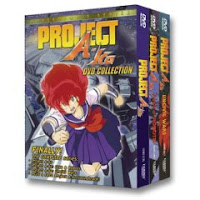


Yuri Anime: Project A-ko

February 14th, 2007

Here’s why, until recently, I had never seen Project A-ko. ^_^

In the dawn of time, MTV was carrying extremely late night anime, (they were dubbed, and mostly old-school. This was long enough ago now that the current anime/manga boom could not have even been predicted as a possibility,) and I was working three jobs: a full-time day job, teaching martial arts at night, and on the weekends, selling swords at a RenFaire. I’d get home Saturday night at about midnight and be completely fried. The wife was working two jobs (day job, and doing henna in Soho in NYC on the weekends) and while waiting for her to come home, I’d stare at TV.

I watched Urusei Yatsura: Beautiful Dreamer, which was so screwed up it put me off the series for years, until I watched some of the TV series for review purposes years later, which put me off it forever.

And I saw one teeny, tiny, wee bit of Project A-ko. The dub voices sliced through my exhausted nerve endings, leaving me shaking. I turned off the TV and never again even tried to watch A-ko. I should have tried again, of course. I mean, history, and all that. But the dub left such an unpleasant impression, that I’ve just sort of skirted the issue all these years.

And that’s where it might have stayed, except for a recent barrage of cajoling and wheedling by members of the Yuricon Mailing List, which culminated in Jen hoisting me with a quote of my own, from my Kekkou Kamen anime review, praising the voice acting skills of Shinohara Emi. Well, Jen won. I caved. I watched.

It is an apparently well known fact that A-ko was originally supposed to be part of the Cream Lemon hentai series, but was not, in the end, included. It has much of the same kind of art, and a great deal of fanservice. It also has a strange edginess that I find hard to explain. It’s not desperation, it’s almost…like the voice actresses found the story so bizarre and laughable that they just decided to go ahead and do it as over-the-top as they could.

I’m kind of glad I watched it when I did, because I was sick and heavily medicated, which made it more enjoyable, I’m sure. ^_^ Seriously, it was…inexpressibly bad, in that totally kitschy funny way. The writers clearly knew what they were spoofing, and why, and did it in a way that *just* rode the line between being godawful and hysterically funny.

B-ko, voiced by Shinohara Emi is, as many people pointed out to me in their campaign to entice me to watch it, a very Evil, very Psychotic Lesbian. As EPLs go, B-ko provides an exquisite example for the young EPLs-in training of the world, like Miu from Ichigo Mashimaro – except for her execrable taste in women, as C-ko is quite possibly the most annoying creature to ever grace any anime ever.

A-ko, ironically, was voiced by a young Itou Miki. She and Shinohara Emi have recently been working together again as part of an anime you may have heard of – Maria-sama ga Miteru.  Is there a less likely pairing for Youko and Sachiko’s voices than B-ko and A-ko? It’s almost surreal to imagine.

Which leads me to this comment I made on the YCML, “My last thought was that the dub must have been pretty good, since the level of nerve shredding in the voice acting was consistent with what I remembered from that aborted late-night attempt at watching it.”  How’s *that* for a compliment? ^_^

The music is also quite excruciating, even surpassing the oh-so-80s music from the original Bubblegum Crisis for cringe making.

If you already are a fan and don’t already own it, the box set, pictured and linked above, is a genuinely good deal (2022 Update: The new link goes to the Diskotek Perfect Edition with remastered animation and extras. The edition I reviewed here is long out of print.).

Ratings:

Art – 4
Story – 4 realistically, but 7 for crackheadeness
Characters – B-ko – 8, everyone else – 6, C-ko owes me points
Yuri – 6
Service – 8

Overall – can you even do an overall for this kind of crap? Let’s say 6

You know, A-ko wrong in so many ways, that we had to show it at Yuricon’s 2007 “Yurisai” event. ^_^


Live Action: Sukeban Deka Codename=Asamiya Saki

February 13th, 2007

Some series are simply too good to let die. Not just franchises like Gundam, but the actual series themselves. I don’t think it’s any accident that all three of the insanely popular girl-gang series that I love, Yaji Kita Gakuen Douchuuki, Sukeban Deka and Hana no Asuka-gumi keep coming back like Asuka’s gold coin.

Sukeban Deka began life as a manga, which was then made into an anime OAV and, in the 80’s, a popular three-season live-action TV show, all of which I have reviewed previously. For the basic plotline, general Yuri-ness and links to manga and anime on Amazon JP and Amazon respectively, click the link to the past review.

Last year, Sukeban Deka came back once again as a new live-action movie. And I was *dying* to see it, let me tell you. :-) It took a while, but I finally did manage to watch it and it was probably the best 90 minutes I’d spent in a long time that involved me doing nothing more than staring at a screen.

The movie starts with a young woman chained and gagged in a cage. Her rage at her condition is apparent, and she does everything she can to escape, eventually dislocating her own shoulder to escape the strait jacket she’s been put in. She does escape, but a momentary fit of humanity as she stops to comfort a lost child puts her back in the hands of the coppers.

We never learn the girl’s real name, but the cops offer her an ugly deal – her mother is in New York illegally and will be deported back to Japan, where all sorts of warrants are out for her, unless the girl helps them out. She’s given a yo-yo with the police’s chrysanthemum seal as a weapon and a new name…Asamiya Saki. Armed and decidedly dangerous, Saki heads back to Japan to infiltrate a high school at which several mysterious deaths have occurred. She’s also warned that there is another undercover operative – but they haven’t heard from that other operative in months.

Saki runs into institutionalized bullying almost immediately and, also immediately, saves the damsel in distress from same. The leader of the bullies is Reika, a girl with classic shoujo evil girl ringleader hair. I completely approved.

So, Saki takes on the entire school, from teachers, to pathetic manipulated geeks to evil henchmen and women, all the way up until she faces Reika once again in a battle of the yo-yos. This scene was SO awesome, I cannot express it in mere words. Where Saki is wearing full body armor leathers, Reika is kitted out in studded pleather miniskirt. I said to the screen, as she pulled out her own evil yo-yo, “Please let it have blades…” and you know, it did! I was so happy, I stood up and cheered.

Of course the final battle is meant to be poignant, as Saki faces a guy who kind of sort of was her love interest, and it was an okay fight until he, quite inexplicably, pulled off his nice hair to reveal and incredibly stupid looking wig underneath. I guess he wanted to die blond. I don’t know.

In the end, Saki and the damsel in distress actually had a sweet moment, where said damsel admitted that she liked Saki, although I really think it was in a “friend” way. But it was still sweet and more heartfelt than the bad guy’s quasi-sexual schmoozing.

Amazingly, this movie almost completely lacked any of the usual Japanese live-action pacing problems. I was quite impressed.

Throughout, the cop who becomes Saki’s keeper keeps saying things that implies that Saki is the daughter of the “real” Asamiya Saki. So it was a pleasure that Saito Yuki, who played the first Saki in the TV series, appears as this Saki’s mother. Total “fanboy casting” but it worked.

This movie did such a great job of capturing all the qualities of the original (manga) series, while still having a personality of its own. And even as it updated the myth, it never once lost sight of its roots. An outstanding adaptation of a classic story.

Ratings:

Cinematography – 7
Story – 9 for the sheer faithfulness to the original concept
Characters – 9, ditto
Yuri – 3, but just right
Service – 6

Overall – 9

This movie is da bomb. A great way to resurrect what was the grandmother of all girl-gang series. (Now if I could only get a picture of Matsuura Aya with a lowball and a cigarette. ^_^)


Yuri Manga: Steady Beat 2

February 12th, 2007

Steady Beat, Volume 2, is a continuation of the story from Steady Beat, Volume 1 (well, duh…). At the end of my review of the first volume, I wrote, “…I think it might be worth emailing the author Rivkah and asking her to make sure the girl gets the girl, as a preventative measure.”^_^

Well, after reading Volume 2, I went ahead and emailed the author. And here is why.

Volume 2 continues to be “wackiness ensues” as Leah tries to learn the gasp-making truth about her “perfect” sister, Sarai. (I will return to this in a second.)

During the course of this wackiness, we follow Leah as she becomes closer to a possible new love interest, Eli. Who would be extremely fine as a love interest if he weren’t seventy different minorities all rolled into one. That is to say, he *is* a fine love interest and kind of cute, if he shut up once in a while. But, I found it a tad exhausting that he’s a half-Jewish, half-black son of a gay Dad. The only thing he’s missing is being wheelchair bound. And part Native American. It was a just a bit of too much.

Which is pretty much the major weakness of the entire series so far – Rivkah is working so hard at making it celebration of diversity and love, that it comes off as trying a *wee* too hard throughout.

But let us return to the plot – the great mystery of whether Sarai is gay or not.

(Wait a second, something just occurred to me. Isn’t Sarai the Student Council president? Somehow I remember that she is. Score another for the stereotype! Boo-yah! )

…Anyway, when Leah finally catches up to Sarai, the truth appears to be exactly what she thought/feared – her perfect, flawless, overacheiving older sister is in fact…gay! Shock! This wouldn’t be much of a plot if Leah and Sarai didn’t belong to a strict Christian family in the middle of Texas. Except that, as we’re given a travelogue of Austin, we learn that it’s really pretty collegiate and liberal for a Texas city. So we’re back to it not being much of a plot complication…unless it *isn’t* the plot complication. So by the time I finshed the book, because I have a chronic case of “advanced student syndrome” and can’t take things at face value, I broke down and wrote the author.

I can’t tell you what she told me without spoilers. ^_^ Which is it? Do you want to know what she said? Or not? Write in – the majority vote wins.

The series is not bad, really. The art, while manga-informed, has as much in common with Archie as it does with manga. The characters are likeable, if a teeny bit preachy. The tone lacks condescension, but has a bit of that “Look, this is a teen book, for teens, starring a teen!” feel that occasionally inhabits teen lit. But I also think that the tone is a fairly natural one for the author, who seems like a genuinely happy sort of person.  Maybe it’s just that I’m naturally more, erm, pragmatic…or east coastern, or just plain jaded. ^_^

Ratings:

Art – 6
Story – 6
Characters – 6
Yuri – 6
Service – 1

Overall – 6

If I did have a teen who was in a situation regarding the question of alternative sexuality, I would have no trouble suggesting this book. That having been said, if I was a teen in that situation, I might find the book a bit silly. As I neither have a teen, nor am a teen, it’s a cute enough read for a cold winter’s curl up.


On Light Novels

February 9th, 2007

This past summer I had the pleasure to be asked to participate in the creation of a manga encyclopedia. The editor and writer, Jason Thompson, asked me to do some reviews, interviewed me for the “Yuri” article and eventually had me write a short article on “Light Novels” for the book.

Manga: The Complete Guide, is now available for pre-order on Amazon. It is, alas, without my article on Light Novels. Due to time/space/existential issues, it was left out. I hold no hard feelings, these things happen. But it was a *good* article and I worked hard on it. As the Light Novels (LNs) that got me into reading LNs, and that I have been reviewing here for some time are the Maria-sama ga Miteru series, and those I have yet to read are also Yuri, I thought I’d share the article with my readers here. Let me just note quickly that the translation of Tsutako’s quote from Ibara no Mori was done by Erin Subramanian. The full passage can be found on Erin’s Livejournal.

***

LIGHT NOVEL (ライトノベル)

Light Novel is a term used for short novels, typically with illustrations, written for and marketed to a teen/young adult audience. Light, or non-serious, novels average around two hundred pages, and are smaller in dimension than “literary” novels. The phrase Light Novel came into use in the eighties and early nineties in the Japanese Science Fiction community – the term, originally “karui noberu” or “non-serious novel,” was coined by a Japanese SF/Fantasy online forum. Light Novels were heavily influenced by anime, manga, games and other youth culture staples in Japan. In return, many Light Novels are now being turned into anime, manga, games, etc. One of the earliest Light Novels, Mobile Suit Gundam, helped expand the famous dynasty of anime, manga, games and model kits. Vampire Hunter D was another early Light Novel that has remained popular in many media.

A wide variety of Japanese publishing companies are involved in the production of Light Novels. These include classic book publishing houses, groups that also publish manga, mixed-media publishers and software houses, such as Kadokawa, Mediaworks, Shueisha, Kodansha, Square Enix, Hobby Japan and many others. Each publisher may have several imprints that range over a variety of genres.

In the west, the interest in Light Novels has been driven by manga translation and distribution companies. In 2004, Tokyopop developed their own imprint for Light Novels, which they call “Manga Novels.” Other western publishers such as Viz Media, Seven Seas, DMP, Dark Horse, and CMX (DC Comics’ manga imprint) have already entered the field, and Del Ray has announced their interest in doing so. ALC Publishing has published an original English-language Light Novel, Shoujoai ni Bouken.

Although they were first created to increase interest in Science Fiction, it is not uncommon to find Light Novels for Fantasy, Mystery, Horror and Historical genres and, of course, Romance, which includes “Boy’s Love” (see: Yaoi) titles. To distinguish the different genres publishers will use differently colored covers so readers can quickly identify their genre of choice.

Illustrations are one of the key features of Light Novels, marking them as “young adult” reading. The illustrators for Light Novels are not always the artists for those series’ manga, but may be (or become) well known in their own right. As Tsutako, a character herself from the untranslated Light Novel “Maria-sama ga Miteru: Ibara no Mori” says, “…the illustrations serve as a clue to what the books are about…. Even if they’ve never heard of the author, they might pick up a book if they have a good first impression of it based on the illustrations.” (Oyuki Konno, Cobalt Shueisha, 1999.) However, not all Light Novels are written for a YA audience and not all Light Novels are illustrated. Novels written to appeal to an older audience and Boy’s Love novels – although intended for a teen audience – often have no illustrations.

In Japan, interest in Light Novels is fueled by Internet fandom, reference books about the genre and by anime and manga based upon popular titles. The increasing interest in Light Novels has spurred the creation of a Light Novel Festival, held annually in Tokyo since 2004. (http://www.light-novel.com). Here in the West, as manga fans look for the source material for popular anime and manga, readership is certain to grow as well.

Sources:

http://d.hatena.ne.jp/
http://ja.wikipedia.org/wiki/ライトノベル
http://en.wikipedia.org/wiki/Light_novel
http://www.j-lit.or.jp/e/programs/newtrends/takashi_ogawa_en.html
http://shinkan.main.jp/
Light Novel Festival
Tokyo International Anime Fair
http://d.hatena.ne.jp/sinden/20030919
http://www.icv2.com/articles/news/4367.html

***
Just as a coda, of interest to Yuri fans specifically, will be the upcoming Seven Seas translation of the Strawberry Panic Light Novels and of course, ALC’s Shoujoai ni Bouken: The Adventures of Yuriko.