Boogiepop and Others Anime (English)

March 12th, 2019

2019 dawned with me being the proud subscriber to more streaming services than I could imagine. Or need. Or want, really. As media goes, visual media is my least favorite, as it takes more time and concentration than I care to give to staring at a screen. Which is why I end up watching movies on airplanes, where I’m a captive audience. ^_^

Because I’m paying these services for access to anime, among other things, I thought I’d better, y’know, use them to watch stuff I didn’t want to buy. I’m all for buying the 20th anniversary Blu-Ray box set of Revolutionary Girl Utena – and watching it again. ^_^ Crunchyroll has been a staple for me for years, Hidive has been pretty good in providing access to Sentai Filmworks‘ titles, which I tend to enjoy watching once, but don’t really want to own (although there have been exceptions,) with Netflix coming in a distant third in anime for me, but it turns out to have Master of the 36th Chamber of Shaolin, so I forgive it all its failings.  Amazon Prime has been sort of interesting too, although I keep it around more for the free shipping than the anime. Nonetheless there are titles I’ve watched on that service. And of course, I’m trying to stay current on Yuri and Yuri-friendly series like Bloom Into You– but sometimes you gotta watch something new!

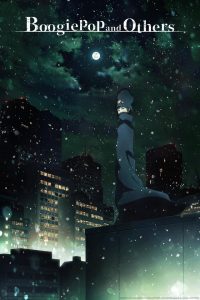
In an attempt to watch something out of the usual for me and something new, I turned to Boogiepop and Others, streaming on Crunchyroll.  This series looks at the light novels that precede the Boogiepop Phantom (this link goes to the Nozomi Entertainment Official Youtube channel dub) light novel.

Boogiepop and Others is not a Yuri series. Just to be very clear. There are, however, elements that may appeal to Okazu readers.

The opening credits include a same-sex kiss between the main character and herself, but I am not convinced that that has relevance to the story. The fact that it exists at all is merely indicative of the kind of Yuri one gets in this series.

The story centers on a supernatural being, a Shinagami known as Boogiepop who appears periodically to combat evil. Boogiepop, who refers to itself as “he/him,” manifests in the body of a high school girl, Miyashita Touka, who has no idea that she even becomes Boogiepop, although in a later arc, her mother does recognize that Touka is being possessed by a “strange man.”

In the first arc, there have been disappearances and murders, someone is killing high school girls (a repeated theme within the story.) Again there is some same-sex kissing. These kisses lack affection and are more a means of transmission of a compulsion than anything else.

Most interesting to me is the character of Kirima Nagi, whose backstory takes up the the bulk of the “Boogiepop at Dawn” anime arc (and, presumably, the light novel it is based upon.) When we first encounter her in the “Boogiepop and Others” arc, she has exceptional skills and fights Manticore, just as Boogiepop does…but they are not on the same side. They will encounter each other over and over throughout the series.

Miyashita, Kirima, and a third girl, Suema Kazuko, who has a strong interest in criminal psychology, form a triumvirate of main characters, around which the plots swirl. With the addition of a criminal organization, supernatural and alien influence, there’s always a lot going on in any given arc.

The animation is both good and not moe, with a number of adult characters. It’s been, frankly, a pleasure to watch, even with all the deaths.

I quite like that the series is always low-key horror even when what’s going on is actual horror. ^_^ Gruesome murders are presented with layers of narrative and artistic rendering to give us the thrill without too much of the grotesque. There’s a lot of pretension to psychological horror, but just as the tension rises, the arc comes to an end. This makes most of the arcs seem rushed, but if we spent any more time in the arc, the endings  – which mostly consist of Boogiepop talking the bad guy to death, then killing them – would be even less impressive than they are.

Ratings:

Art – 9
Characters – 8
Story – 8 Every arc is a lot of story crammed into a little space
Service – Yeah, there is some egregious undressing and the Yuri is clearly meant as service
Yuri – 2? It’s nothing more than window dressing and not why you should watch this series
Overall- 8

As I said, this is not a Yuri series, Yuri is merely a feature of some of the story arcs and is presented as a throwaway fetish. If you’re looking for well-developed Yuri relationships, this is not a place to look. However, if you are interested in a horror series with intriguing characters, decent people and terrible people, both male and female, adult and teens, strong female leads and a teeny dash of gender switching, this might appeal to you.


Yuri Manga: Still Sick, Volume 1 (スティッルシック)

March 11th, 2019

Shimizu Makoto has a secret – she’s a Yuri doujinshi artist  – and no one in her office knows. No one, that is, until coworker Maekawa Akane sees her selling her Yuri books at a comic market.

Shimizu is terrified that Maekawa will blow her cover, Naturally, she assumes Maekawa will hold this secret knowledge against her. When Maekawa doesn’t do any such thing and, in fact, seems to be encouraging her, Shimizu has no idea how to handle it. Maekawa seems to be genuinely supportive of this hobby, but what Shimizu doesn’t know is that Maekawa Akane has a secret of her own. And what a secret it is!

In Still Sick, Volume 1 (スティッルシック) by Akashi, Shimizu is completely at a loss for what to do or how to deal with Maekawa’s apparent goodwill, but when she learns her coworker’s secret, Maekawa turns stone cold towards her. Since she’d let Maekawa into her life, Shimizu feels doubly uncomfortable for being cut out of the other woman’s life, and offers support but, if anything, that seems to make things worse. Even more difficult, Shimizu is starting to feel sincere affection for her coworker. When Maekawa kisses Shimizu after they have a minor confrontation, and Maekawa passes it off as a joke, Shimizu is left wondering what she’s really feeling. 

Volume 1 was marginally uncomfortable to read, mostly because Shimizu is a mostly always uncomfortable character. The story was not at all what I expected based on the synopsis, but I like the story more than I expected to based on that synopsis! Maekawa’s big reveal totally blind-sided me and now I definitely want to see what happens with the two of them. 

Ratings:

Art – 7 Solid, not outstanding
Characters – 8
Story – 8
Yuri – 3, with a lot of potential
Service – 0 so far

Overall – 8

Still Sick is a digital comic that has been collected by MAG Garden’s Blade Comics, a name I haven’t heard in years. Volume 1 sold out quickly on Amazon JP for the first order, and was one of two books that were on my must-get list when I was in Japan last month. I’m really glad I got it, and look forward to the next volume.


Liz and the Blue Bird Movie (English)

March 10th, 2019

I haven’t seen so much symbolic bird flight since Oniisama E. ^_^

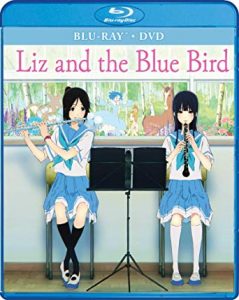
Liz and the Blue Bird is a complicated and fascinating look at the habit of loneliness, obsession, affection and human relationships. If you were paying attention last summer to Japanese theatrical releases for animation, along with Asagao to Kase-san, you’d have come across Rizu to Aoi Tori (リズと青い鳥 ), which often shared a theater with Kase-sanLiz and the Blue Bird is the official release of this movie from Eleven Arts.

The movie follows two young women who play woodwind in their concert band as the band competition nears. Nozomi is popular, easy-going and wears her position as sempai to the flute section comfortably. On oboe, Mizore is a loner who avoids any connection with the other double-reed players, leaving the undergrads wondering what they are doing wrong. They are doing nothing wrong, Mizore simply has no room in her existence for anyone but Nozomi. As pressure is put upon them to play the key movement in a competition piece called “Liz and the Blue Bird,” based on a children’s book of the same name, Nozomi’s and Mizore’s relationship starts to buckle.

The movie’s structure is complex, with two stories-within-a-story, three separate animation styles and acting parts for the voice actors, the foley and the music.

I said in yesterday’s news report that you could, if you were so inclined, see Mizore’s relationship with Nozomi as Yuri. In fact, its hard not to, as Mizore declares that Nozomi is everything to her. That said, this is not a romance and this obsession Mizore has with Nozomi is not the end goal, but an obstacle that must be set aside for them both to thrive. To do so, Mizore is required to break out of the habit of loneliness that she has developed for herself as an identity.

The characters outside Nozomi and Mizore are excellent. We don’t spend much time with them, but we get to know a fair number in that short time. I liked them all, from Yuuko, the band leader and Natsuki, another third year, to the first-years, especially Kenzaki Ririka, the only other oboe in the band, and the amusingly bad-tempered library club member.

Nothing in this movie is simplistic. The children’s story of “Liz and the Blue Bird”, it’s relationship to Mizore and Nozomi, their relationship to one another and to the people around them are all fully developed and realistically complex. In fact, after watching this movie through once, I went back and watched it again to pay attention to details I knew I had missed the first time, especially in the animation and soundtrack.

I had gone into this movie cold, with absolutely no knowledge that it was part of the Sound! Euphonium franchise. Once I did, my sole complaint about the movie was instantly given context. So many people I know and trust have told me I would enjoy Sound! Euphonium, but I was unable to get through the first episode, as we spent almost the entire time watching the girls’ legs. In Liz and the Blue Bird, the one thing I found distracting and, ultimately exhausting, was the way the camera dissected the characters, separating out body parts endlessly, so we watched legs, then arms, then an eyeball so close we could see the curve of it, then feet, a lap, rinse, repeat almost as a non-stop compulsion, which if we weren’t also moving back and forth through the fairy tale would have been as intolerable as I found the Sound! Euphonium anime. It was so much of a problem that the few times the “camera” backed up in order to show us a whole person, it was a physical relief. This is not an animation style I enjoy and I will be very glad when it falls out of favor.

The three animation styles are, as I mentioned, wholly unique. The main story is the kind of thing Kyoto Animation is best known for, with higher production values than a TV series, and faces and bodies that are mostly similar, with realistic backgrounds (although thankfully not hyper-realistic which would be out of sync with the character designs.) “Liz and the Blue Bird” is told in an animation style that is strongly reflective of a children’s picture book come to life. Any frame of that animation could have been used as is in a picture book. It was very fitting to the tale and fun to watch. The third animation style comes in later in the narrative and is abstract, colorful and modern, and wholly suited to the scenes in which it is used.

The soundtrack was my favorite part of the movie. As a former woodwind, it’s nice to hear them get some love in the music. ^_^ But more importantly, the climax of the movie is not only centered around the music , it is a moment in which this viewer suddenly realized that the best acting of the movie had come from the musicians playing the piece, as they had throughout the movie played it wrong every time. Not, badly, not broken, they’d hit all the notes…it was just wrong. It was a masterful performance and one that I hope you will appreciate when you watch it.

Ratings:

Art – 9
Story – 10
Characters – 9
Yuri – 3
Service – 6 That whole bodypart-staring is a form of service which I do not care for. It feels dehumanizing to me.

Overall – 9

In the end, I think the thing that best captures my feelings about this movie is that it was worth watching a second time and that second time made me appreciate it more.


Yuri Network News – (百合ネットワークニュース) – March 9, 2019

March 9th, 2019

Yuri Anime

From Senior YNN Correspondent Verso S, we have the news that Japanese subscription satellite channel Wowow will be  broadcasting the TV debut of Asagao to Kase-san at 11:45 on March 29! Another great piece of news for this series that has accomplished so much.

Sailor Moon Super S The Movie is now out, with its moments of Haruka  and Michiru wonderfulness as the Senshi  battle a threat from outer space. The music isn’t as epic as “Moon Revenge,” but any moment we can intrude on Haruka and Michiru on a date is a good moment. ^_^

YNN Correspondent Eric P wants to let you know that ANN’s Mitch and Steven covered an under-the-radar Yuri anime called Mysteria Friends. High production value and tits, so if that’s your boom, you ought to like it. ^_^

Speaking of high production value, I watched Liz and the Blue Bird yesterday thanks to Verso,  (I plan on watching it again today before I review it tomorrow) and you could argue that it is a Yuri story, if you were so inclined. It certainly was an interesting and thought-provoking story. The US release is out from Eleven Arts and I think its worth a watch. 

Yuri Manga

Couple of new items on the Yuricon Store, where we are rapidly approaching 1000 Yuri items!

Mochi Au Lait’s Rental Shop Onee-san wo Rental no Suru Hanashi (レンタルショップでお姉さんをレンタルする話) looks fun. I sincerely hope it actually is.

Yuino Chiri’s werewolf feudal fantasy Scarlet, Volume 1, (スカーレット) is violent and bloody, but hey, Yuri werewolves and vampires, oh my.

Itoshi Koishi, Volume 1 (いとしこいし) by Takemiya Jin is sweet as cream. ^_^

I have no idea yet what to make of Watagiri Saya’s  Sunami Yuko to Yurina Hitobito (須波優子と百合な人びと). I presume its a comedy, but that’s always a questionable premise for me. ^_^;

And here’s today’s important thing of note: You may recall that My Lesbian Experience with Loneliness‘ Japanese title is Sabishi-sugi Rezu Fuzoku ni Ikimashita Report (さびしすぎてレズ風俗に行きましたレポ).  Well, this week I see that Ichijinsha, publisher of Comic Yuri Hime in an all out race to put out as many Yuri anthologies as Kadokawa, has listed Lesbian Fuzoku Anthology (レズ風俗アンソロジー) No contributors listed yet, but one Pixiv creator is talking about being part of it. Based on that one creator’s comics, it appears to be a collection of stories about not-queer women having a “lesbian experience,” with a sex worker not about the lesbian experience of life.  I’ll let you know as I get more info. 

Speaking of things happening in Yuri – the pre-order for Yen Press’ English edition of  Kurukuruhime’s Yuri Life – about the daily life of a cute happily coupled couple – is up for pre-order!

Seven Seas weighs in with Naoko Kodama’s I Married My Best Friend to Shut My Parents Up which is slated for a July release and the preorders for all four volumes of Our Dreams at Dusk: Shimanami Tasogare! (Volume 1 May 2019 | Volume 2 July 2019 | Volume 3 September 2019 |  Volume 4 December 2019). 

These two rivalries (Ichijinsha/Kadokawa and their English localizers Seven Seas/Yen Press) are going to be something to watch…and also the market reaction to this veritable flood of Yuri manga. I take a look at this major moment in Yuri’s development as a genre – and the trend in Japan that spawned it – on this week’s Okazu YNN Podcast


LGBTQ Comics

Sparkler Monthly ran a successful kickstarter for Yuri comic Before You Go and now they are releasing the ebook for LGBTQ comic For Peace by Alexis Cooke about Bebe and Lillian, who meet on a forum for truckers.


Kickstarter Watch 

The third Dates! An Anthology of Queer Historical Fiction kickstarter from Margins Publishing is live. If you enjoyed the first two volumes (which I totally did: Volume 1 and Volume 2 reviews here) this third one looks to be just as much fun. 


Do you have questions about Yuri? Write in and ask and I’ll do my best to address them on the Okazu YNN Podcast, Become a YNN Correspondent by reporting any Yuri-related news with your name and an email I can reply to!

Thanks to all of you – you make this a great Yuri Network!


Yuri Manga: Philia to Eros no Aida, Volume 1 (ピリアーとエロスのあいだ)

March 8th, 2019

Welcome to the end of “vaguely dissatisfying week” here on Okazu. ^_^ Today we’re wrapping up the week by taking a look at a manga by an artist I like, for a magazine I like,with a series I just have not been able to like.

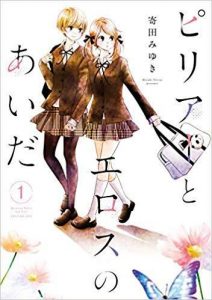
Philia to Eros no Aida, Volume 1 (ピリアーとエロスのあいだ) by Yorita Miyuki, runs in Galette (ガレット) magazine. This volume is one of the second round of Galette Works collected releases, following Kurumi and Nikaido, a couple that I wish I could be rooting for.

When we meet them, Kurumi still has an interest in a guy, Mishima, but Nikaido is there for her. And Nikaido’s emotional support helps Kurumi  good about herself, which becomes affection towards Nikaido, even though she’s still kind of interested in the guy. Nikaido doesn’t seem to mind, even if her other friends do. Her gentle, persistent “being there” for Kurumi is their bond and Kurumi convinces herself, at least a bit, that she likes Nikaido back.

I don’t see this relationship ending well. If it does, it’ll just be annoying. I’m with Hibiki, Nikaido’s friend who is incensed over this relationship, going so far as to punch Kurumi for having the nerve to pretend to care for Nikaido while pining over Mishima.

Ratings:

Art – nice
Story – argh
Characters – ergh
Yuri – ugh
Service – nah

Overall – 6, but I really wish it was higher.

I’ve enjoyed Yorita’s doujinshi over the years, but like Hibiki, this relationship makes my teeth grind.