Why Is It Always Catholic Schoolgirls in Yuri?

December 16th, 2018
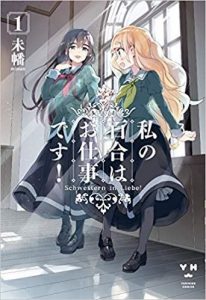
I’ve talked a lot recently about “secret projects.” One of my secret projects was this essay, which was orignally written for the first volume of Yuri is My Job, by Miman, available in English in January 2019 from Kodansha Comics.

***

From the Diary of a Catholic Schoolgirl – “Dear Diary – This morning began with cheerful greetings echoing through the clear blue sky. Today we girls, dressed in our tidy uniforms, passed in ordered lines under the tall gates, greeting Maria-sama as she smiled down upon us.” Or something like that. As manga fans – as Yuri fans – in the west, we surely have asked ourselves “Why is Yuri so often set in a Catholic school? And why “sisters?” surprisingly, there is an answer to this question. Around the time Japan entered the international stage, schooling for adolescents of both sexes was a prominent social cause in the late 19th century. In Japan, just as in America and Europe, it was often religious organizations that oversaw this education. Single-sex schools became popular for children of the growing middle class. In order to curb adolescent passion in these schools, traditions were founded that focused admiration-tinged-with-desire on strictly maintained hierarchies. Influenced by sexology studies in the early part of the century, scientific research delved into the psychology of them same-sex relationships.
“As a result of our studies, we can say that there are two kinds of same-sex love {dousei no ai).The former … is a case in which the females make a vow of sisterhood and promise to be with each other in life or death. This is nothing more than a passionate friendship, and there is nothing in this relationship that is shameful or despicable. Thus, in this case, the love is a mutual love but is no more than an extremely close friendship.”
(Quoted in Yoshikawa Toyoko. 1998, from Suzuki, Michiko (August 2006). “Writing Same-Sex Love: Sexology and Literary Representation in Yoshiya Nobuko’s Early Fiction”. The Journal of Asian Studies. 65 (3): 575) Girls’ literature of the early 20th century in Japan focused on these relationships, presenting them as passionate, yet platonic bonds of sisterhood. Intense emotional relationships between older students and younger were transformed into sisterly feelings. Japanese girl’s magazines were filled with letters and stories of these heart-pounding feelings for older or younger “sisters.” While some Japanese feminist writers were working in the context of social change, in magazines and literary publications, like Seitō (Bluestocking) other feminist writers, such as Yoshiya Nobuko took their work to popular culture outlets including these girls’ magazines, and wrote “Class-S” stories to create a literature by and for women and girls. Yoshiya’s 1920 novel Yaneura no Nishojo established many of the tropes we still see expressed in literature and manga. It takes place in a boarding school, run by a religious organization. The protagonists are sharing an isolated attic room, there is a piano duet, and a moment when they choose to leave that protected world and go “outside.” Other writers pursued the ideal of passionate platonic relationship, focusing on the sisterly aspect. Kawabata Yasunari and Nakazato Tsuneko wrote Otome no Minato, a classic girl’s novel that focused on this “extremely close friendship” of an older girl and younger, modeled on the Japanese sempai-kouhai relationship, but with the added affection of “sisterhood.” In the late 20th century, this foundation of girl’s literature became fixed as Yuri was born amidst the upheavals of the 1970s. Popular literature had detailed these affairs of the heart, mostly set in Catholic schools – so, when girls’ manga later wanted to tell this same story, immediately these tales were given the “exotic” setting of private religious schools. The, arguably, first Yuri manga, Shiroi Heya no Futari by Yamagishi Ryoko, is set in a Catholic school in France. When passions run high, desire is not redirected into sisterly affection…with tragic consequences. At the turn of the 21st century, Konno Oyuki’s novel series Maria-sama ga Miteru (the anime of which made it to English as Maria Watches Over Us) resurrected the concept of the intense platonic connections between “soeur” in a Catholic school. In this series, Konno gave a whole volume to the consequences of romantic love between two girls, placing “love between girls at a Catholic school” among the firmament of Yuri tropes. This launched a renaissance of Yuri at private girls school stories, both serious and parody, from Sweet Blue Flowers, to Strawberry Panic!. In the meantime, in fandom-focused areas of Japan, maid, and then butler, cafes began to spring up. Catering to fans’ desires to be taken care of, these cafes are still a fixture in parts of Tokyo – and at fan events across the globe. Visitors to Akihabara and Ikebukuro will be greeted by cute girls and dashing young men on the street in fantasy-inspired uniforms,  ready to pour tea or decorate pancakes with grace and charm. So it makes perfect sense that Miman-sensei combined the two for a trope-filled Yuri romp in Yuri is My Job!. Welcome to a salon where maidens with pure hearts serve you delicious sweets, admire their “schwestern” and vie to be the Blüme, the most popular girl at the school. Welcome to the salon at Liebe Gakuen, where you will always be greeted with “Gokigenyou” and able to enjoy the sisterly affection of the young women who serve you. *** Publications mentioned: “Suzuki, Michiko (August 2006). “Writing Same-Sex Love: Sexology and Literary Representation in Yoshiya Nobuko’s Early Fiction”. The Journal of Asian Studies. 65 (3): 575 quoting Yoshikawa Toyoko. 1998, ‘Nihonhon no ‘lezubianizumu’: 1910 nendai no shōsetsu ni egakareta lezubiantachi”   [Lesbianism in Modern Japan: Lesbians Depicted in Novels of the 1910s}. In Sei gensō o kataru {Talking about the Myths of Sex/Gender),vol. 2 of Kindai o yomikaeru {Rereading Modernity}, ed. Kondō Kazuko, 75-110. Tokyo: San’ichi shobō. Seitō (Bluestocking). Literary journal. Tokyo, Japan. 1911-16, Seitō-sha. Yaneura no Nishojo. Yoshiya Nobuko,Tokyo, Japan: Kokusho Kankoukai, 2003. Originally published 1920. Otome no Minato. Kawabata Yasunari and Nakazato Tsuneko, Tokyo, Japan. Jitsugyo no Nihon Sha, Ltd. 1938. Shiroi Heya no Futari, Yamagishi Ryoko. Tokyo, Japan. Hana to Yume Comics 1971 Maria-sama ga Miteru, Konno Oyuki. Tokyo, Japan  1994-2012. Shueisha Maria Watches Over Us. Grimes, Iowa, 2008-2010, RightStuf. Sweet Blue Flowers, Shimura Takako. San Francisco, USA, 2017, Viz Media. Strawberry Panic!, Kimino, Sakurako, Los Angeles, CA, USA, 2007-8, Seven Seas Entertainment. Strawberry Panic!, New York, NY, USA, 2007-8, Media Blasters.


Yuri Network News – (百合ネットワークニュース) – December 15, 2018

December 15th, 2018

This week’s report is going to be super short, as I have a ton of stuff to work on this weekend. But do not worry, you will get to read all of it as it appears. ^_^

First, let me thank all our Okazu Patrons for the wonderful time we had last night at the Okazu patron holiday party! Many thanks to all of you. We’ll do that again. If you want to be a part of our next Okazu patron /whatever/ become an Okazu Patron for 2019! $2/ month makes a huge difference for the Guest Reviewers and events reporters.

Yuri Manga

Super squee-making adorable adult romance Oui Pikachi’s Hayama-sensei to Terano-sensei ha Tsukiatteiru, Volume 1 (羽山先生と寺野先生は付き合っている) hits shelves this week. It is so sweet.

Also out this week is Akashi’s Still Sick, about a covert otaku working as an Office Lady and her colleague who discovers her secret. Oh, okay.

ANN has the news that Saburouta’s spin-off, Citrus Plus will start in the February issue of Comic Yuri Hime.


Other News

Also reported by ANN, Bloom Into You’s Nakatani Nio, and Riddle story of a Devil’s Kouga Yun and Minakata Sunao talk Yuri in January’s Newtype magazine.

In a first, Japan’s SF Magazine will have a special Yuri issue! Chck this link for some of the cover images. The February 2019 Issue is a collection of Science Fiction Yuri stories.  I’m not familiar with any of the creators, so it remains to be seen what we’re in for. ^_^


Do you have questions about Yuri? Write in and ask and I’ll do my best to address them on the Okazu YNN Podcast!

Become a YNN Correspondent by reporting any Yuri-related news with your name and an email I can reply to! 

Thanks to all of you – you make this a great Yuri Network!


Monthly Dengeki Daioh, January 2019 (月刊コミック 電撃大王 2019年1月号)

December 13th, 2018

One of the most fascinating aspects of 2018 for me is the fact that I am once again reviewing individual magazine issues much more often this year than I had for years previously. And typically, with mainstream manga like Yagate Kimi ni Naru/Bloom Into You, once it gets established and popular I tend to not bother, since I’ll review the collected volumes.

However. The January 2019 issue of Monthly Dengeki Daioh (月刊コミック 電撃大王 2019年1月号) contains something so extraordinary and – for me – so important – that I felt it was worth a special call out. And it had a clearfile. ^_^

To begin with, I will remind you that I have had several reservations about the narrative and characters of Yagate Kimi ni Naru, since the beginning. I have also trusted Nakatani-sensei to have good judgement and have trusted her to tell a compelling story that holds up to scrutiny. I feel that my trust has been well-placed, which is really refreshing.

I will also remind you that I have long desired the portrayal in manga of adult role models for younger characters, so they are not left to struggle with feelings of same-sex love in what they believe is isolation. This is one of the things that keeps me coming back to this particular series, as we’ve seen Kodama Miyako, the cafe owner, befriend high school student Sayaka and take on this role. 

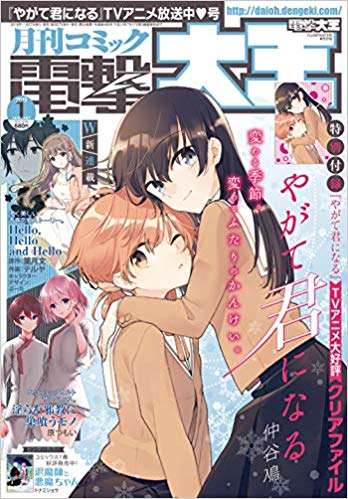
In this issue, we learn how Miyako and her lover (a teacher at Yuu’s school,) Hakozaki Riko, met. They met in college and while their story is not groundbreaking, it is pleasant and realistic. What is groundbreaking is that we see the two getting ready for bed and chatting – and Riko-sensei says to Miyako that it must be strange for her to be a role model to Sayaka. Miyako says that it is a little weird to be guiding the girl, but it must be harder to be a teacher. 

This exchange is mind-blowing. Not only is there an established female couple to exist as role models for the young woman who knows well enough what she is, but is still looking for who she is, they talk about it. I have never before seen that in a Yuri manga. In the real world, most of the older LGBTQ folks I know do, in fact, talk about this. We talk about the importance of being out and being role models precisely for this reason. But even in manga where characters openly identify as LGBTQ, I have never before seen a character say, well, yeah, it’s weird that I’m a role model, but I’m glad to be able to help a young person find their way. Which Miyako basically does.

And that, my friends, my dear readers, is the “cut, scene,” moment for 2018 for me. We have come so far in such a short time. I cannot *wait* to see what 2019 has to offer!

Ratings:

Adult Role Models who know that that is what they are doing for the fucking win. 10

I’m going to spend some time this weekend working on the end-of-year- Top Ten lists and I have never before looked forward to them so much!  ^_^


Yuri Manga: Nettaigyo ha Yuki ni Kogareru, Volume 3 (熱帯魚は雪に焦がれる )

December 11th, 2018

Nettaigyo ha Yuki ni Kogareru, Volume 3 (熱帯魚は雪に焦がれる ) is, honestly, a very frustrating interlude in a story that had been developing so sweetly. 

It’s summer and the whole town really digs in and does the summer festival. Konatsu is looking forward to going to the festival with Koyuki – and she convinces Koyuki to participate with a show at the aquarium. 

Koyuki is, as usual, reticent to get involved. But she’s finding herself becoming more and more focused on Konatsu and is dragged along by her, until she agrees. They meet on the night of the festival, but they are both avoiding talking about what is developing between them. 

Konatsu is able to show Koyuki the fish show she’s planning for the next day and Koyuki is genuinely moved by her passion and enthusiasm, but as the next morning dawns, Koyuki is sick in bed.

It felt like the brakes were applied on an already slowly-moving story in this volume…for not much narrative payoff. It was both disappointing and frustrating. 

Ratings: 

Art – 8
Story – 7
Characters – 8
Service – 1 on principle only, there really isn’t any
Yuri – 4

Overall – 7

I enjoy this series and was hoping to see it move forward, not backward in Volume 3. Here’s hoping Volume 4 picks up .


She-Ra and the Princesses of Power, Season 1

December 9th, 2018

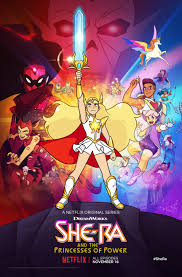
Okay, okay! I went and signed up for Netflix, fine. Sheesh. For the last couple of years I have been hearing about dozens of series that didn’t make me want at all to subscribe, but finally there’s one series that motivated me to sign-up. 

That series was She-Ra and the Princesses of the Power. With Noelle Stevenson (co-creator of Lumberjanes) as showrunner, and a promise of wholesome queerness, how could I not want to see it?

In this iteration of the story, Adora is an orphan who has been raised by Hordak on Fightmoon to be a leader of his armies, known as “the Horde” as one might expect. (Put a pin in this naming scheme). Her best friend Katra and she vie to be the next group captain, but when Adora discovers a mysterious sword, she learns that she is meant to be the next She-Ra and fight the Horde. She’s taken to Brightmoon by the leaders of the restance and finds everything she grew up believing is a lie. As she grows more convinced that the Horde is evil, she’s put into the position of  facing Katra as an enemy, a situation that is not resolved by the end of Season 1.

In this season, we meet the other Princesses of countries being attacked by the Horde. Their powers are primarily elemental and their personalities aren’t always good or kind. Most of them float in a range of being quite annoying in one way or another, in fact. Except for Entrapta. Pull that pin out of the naming scheme. “Entrapta” does not sound like a good-guy name. And, indeed, while the resistance Princesses have elemental (i.e., “natural”) powers, Entrapta’s powers are in mechanical design and makership. Her creations are often evil and she doesn’t seem to much care what they do as long as they work. When she find herself left behind because her friends think she is dead, Katra welcomes her with open arms and, frankly, Entrapta, with her evil name, chaotic evil creations and disinterest in people, finally finds a home, Frankly, I was kind of relieved for her. The resistance Princesses are, well, kind of jerks to her. Good for Entrapta – the Horde suits her much better.

Adora, Princess Glimmer and Bow manage to unite the Princesses despite obstacles and Adora learns a bit more about the title of She-Ra before the season wraps up. 

The story itself is simple, allegorical and adheres very closely to the kinds of writing I am used to in American Cartoons For Kids TM. In fact, this was my main complaint about the series. I wrote on Facebook, “It’s got all the problems of conventional cartoons, in which basically every single plot is “no one says what they have to to the person they have to say it to.”

The characters were the weakest point for me. The only character I genuinely like is Scorpia. She’s an absolute delight. Everyone else I find annoying in one way or another. I find several of the Princesses intolerable.

I was also quite confused about the queerness, as many of my friends were singing paeans to how queer it was…and I was not seeing it at all. Yes, in the Princess Ball episode, Katra came off all butch and she and Adora have a friendship/rivalry sprinkled lightly with some romantic tension, but this was not even as gay as the first season of Sailor Moon. In the final few episodes, we are at last introduced to Princesses Nettossa and Spinnerella, who are very overtly a couple. So yes, there is queerness, and it is absolutely suitable for a small child, which hits the brief this cartoon had. 

There was controversy about the character design, but only if you count the grunting of animals as something to be commented upon. I do not. This was, from the first, a cartoon designed explicitly for children, with a focus on girls. I mention all of this only to note that if you are over 12 years old and have some complaint about the art or character designs, you’re welcome to make a fool of yourself in the comments, but you will be making a fool of yourself. ^_^ I’m not saying you can’t dislike the art, just that if you want it to be sexier, it is explicitly designed to not be for you. ^_^ It gets good marks from me for body type, race, gender and romantic diversity. 

As an adult watching She-Ra and the Princesses of Power, I was not as blown away by the series as I am regularly by Steven Universe, but for what it is – which is to say, for children 50 years younger than I am – it is a pleasant cartoon. 

Ratings:

Art – 8 Honestly, I like it. 
Characters – 4 Scorpia ftw
Story – 6
Service – 0
Yuri – 6

Overall – 6

I am 100% supportive of the effort to bring empowering characters, body and race diversity and complex emotions into children’s cartoons so I’ll keep watching new episodes, but not on a loop, the way I watch Steven Universe