Western Comic: Mean Girls Club Pink Dawn

April 22nd, 2018

Sometimes, for no reason, the universe conspires to make a really amazing comic book show up on my front step.  One day, recently, I came home to a package that contained Mean Girls Club: Pink Dawn by Ryan Heshka. It is a really amazing comic book.

You may recall that in 2016, I had the pleasure of reviewing the original Mean Girls Club comic and I absolutely loved it. Blackie and Pinkie and Wendy and Wanda, Sweets and McQuaalude vandalized and fought and partied their way into my heart. 

But now, the coppers are on to them and Mayor Schlomo want those bitches out of his town. Assisted by the creepy priest and corrupt sister that are preaching away the play for the girls of the town, the Mean Girls Club is facing their greatest challenge. The Mayor extorts mechanic Roxy to spy on them until she realizes that she’s being double-crossed and joins the Mean Girls Club for real. This synopsis doesn’t do justice to the gonzo antics, the violence, the drugs, drinking, death destruction and monster mutation of the story. 

This is my kinda comic.

Originally part of Nobrow’s 17 x 23 project, which was designed to springboard new artists into print, Mean Girls Club is both entirely derivative of the mid-centry pul novels I love so much and wonderfully unique, with an overly modern political take. Mean Girls Club: Pink Dawn is a gorgeous hardcover volume with 100 black, white and pink pages of mayhem and hope for the future as the Mean Girls Club spreads globally. The Mean Girls give a “swift stiletto-stab to the crotch of the patriarchy” and if pisses you off, good. ^_^

Ratings:

Art – 7 Who knew pink could look “bloody”
Story – 9 Drinking, drugs, beating the innocent, torture, Pinky 
Characters – 9 Roxy’s got moxie
Service – 1 Slinky dresses and kicking the patriarchy and Pinky
Yuri – 0 Pinky is group leader and harem queen, though. And Wendy is still hanging on her leg. So, 1

Overall – 9

Drinking, drugs, violence, creative cursing and destroying civil order. The Mean Girls Club is the villainous organization we need right now.

I will now write a a little Pinky x Roxy fanfic in my head.

Thanks so much Nobrow for this review copy, I will treasure it always. ^_^


Yuri Network News – (百合ネットワークニュース) – April 21, 2018

April 21st, 2018

I have so many great news items to share today, but I wanted to, once again, start with….

Yuri Events

Next week the Yuriten Yuri Exhibition hits Tokyo and I plan on being there. At the same time the Animate in Ikebukuro is doing the 1st anniversary Yurimate event! Once again, the third floor of the headquarters in Ikebukuro will be turned over to a Yuri-focused space, with special Yuri manga promotions. I’m also planning a visit to the other Tokyo area Yuribu at Gamers and Shosen Book Tower in Akihabara. All three are doing a joint Yuribu member recruitment, which is cute.  When I get back, I will be doing a bunch of Lucky Boxes that are going to be amazing~~!! (Hear this spoken in Oprah’s voice. ^_^) 

The Toronto Comic Arts Festival is guaranteed to be full of great queer content, as well. I’ll be moderating, I can’t wait! I’m so excited. And I’ll be talking to queer comics creators and other folks that you’ll want to hear from, so join me if you can.

Support Yuri News, Event Reports and Interviews!

Yuri Anime

YNN Correspondent Su L wants you to know that Rightstuff is putting out Sweet Blue Flowers as a Blu-ray box set – for only $23.99! Gawd, I remember when that was cost of one episode of anime on a VHS tape, two if you were lucky. We’ve come a long way.

I’m pushing the limits of “Yuri Anime” pretty far here, but…Sailor Moon Super S, Part 1 will be hitting shelves this month! The Outers have pretty limited roles, but Haruka and Michiru  are increasingly gay as the series goes on. Stars is where they hit peak gay.^_^

The folks at Asagao to Kase-san are slamming out the cool goods right now – this June will see an original soundtrack CD for the movie with an original epilogue mini drama! Check out the news about Ashita e no Tobira on the official page.


Yuri Manga

Webmagazine Yawara Spirits has made Nighty-night Sheherezade (おやすみシェヘラザード) by Shinofusa Rokuro available for reading online (in Japanese).

The English-language Yuri manga anthology, Éclair: A Girls’ Love Anthology That Resonates in Your Heart, will be available in June, from Yen Press. Featuring stories by Canno and Nakatani Nio, you’ll want to put it on your wish list.

We’ve added Koi ni Urusai (恋に煩い), a collected of Yuri manga by Gotou Yuuki from Ichijinsha on the Yuricon Store.


Other News

Alex Myung has written an interesting piece for Our Queer Voices, Where are the Gay Voices in Animation?

And Michele Kirichanskaya talks about Anime and It’s Contribution to LGBTQ Media on Blendtw.

Okazu Hero and author Louis P shares this: Celebrating the characters of the fantastic erotic comedy visual novel Ladykiller in a Bind its Ladykiller in a Zine

Jutin Hall’s brilliant anthology No Straight Lines is being made into a movie. No Straight Lines – The Story of Queer Comics with Vivian Kleinman directing. 

And we’ve added the pre-order for the gorgeous, but quite expensive at $270, Korra and Asami in the Spirit World figurine on the Yuricon Store!


Become a YNN Correspondent by reporting any Yuri-related news to anilesbocon01 at hotmail dot com with your name and an email I can reply to!

Thanks to all of you – you make this a great Yuri Network!


Magical Girl Ore Anime (English)

April 20th, 2018

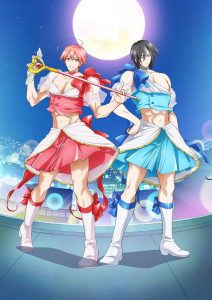
Magical Girl Ore, streaming free and legally on Crunchyroll is simultaneously Yuri and BL, and not really either, all at once. 

Saki is in love with her friend, Sakuyo’s, brother Mohiro, an idol singer. She and Sakuyo are aspiring to be an idol group, but frankly, Saki sucks. Saki learns that her mother has recently retired from being a magical girl, and when her crush Mohiro is attacked, her mother’s “mascot,” a vulgur Yakuza dude, encourages Saki to transform to become a magical girl by proclaiming her love.

So, Saki proclaims her love for Mohiro and promptly transforms into a buff handsome guy in a magical girl costume. When she is likewise in distress, Sakuyo proclaims her love for Saki and transforms into an equally buff, handsome young man who saves Saki from the creepy cat-headed demons that are the enemy. The love triangle becomes even messier when Mohiro appears to be crushing on Saki’s boy form.

Sakuyo is very plain about her interest in Saki – she wants her physically she says, (in a boy’s body to Saki as a boy) because of course it’s Saki she’s in love with, not the form.

So kind of Yuri and kind of BL and all goofiness. There’s nothing that can be taken seriously here. Even serious scenes have their own parody built in, and the magical technique they use against the demons are to beat them to a bloody pulp.

Ratings:

Art – Kind of “too good” for this, if you take my meaning
Story – ????? 
Characters – I respect Saki’s seiyuu for singing poorly on purpose
Service – Panty shots and chest ogling…when they are magical boys
Yuri – Sakuyo

Overall – 7

I’m not going to say this is “good” but I’m still watching it after three episodes, so….  I can call it “entertaining,” without any judgment about quality. ^_^ 

The actual reason I started watching this at all was that Ogata Megumi announced she was in the series starting in Episode 3. She is…kinda. ^_^


Torikaebaya Manga, Volume 13 (とりかえ・ばや)

April 19th, 2018

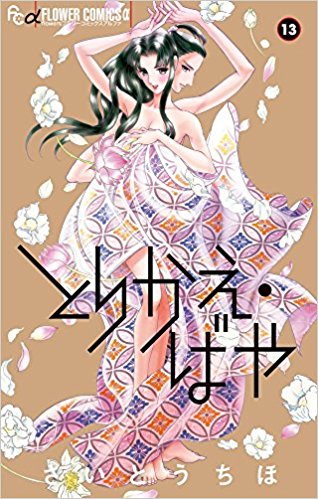
And here we are, at last. The final volume of Saitou Chiho-sensei’s magnificent edition of the Heian epic, Torikaebaya. Before you read this review, please make sure you read Jason L’s review of Rosette Willig’s translation of the source material, The Changelings, which we published yesterday on Okazu. I ask you to read it because a great deal of what Jason said about the Willig book is true for this manga version as well.

Quick note: The names of the characters in Willig’s translation are more properly their positions. Chuunagon is a counselor of the second rank in the Imperial Palace, a Middle counselor. (Sei Shonagon is so known because her father held the rank of Shonagon, lesser counselor). Naishi no Kami is the something like a head position among the women of the Imperial court.  In the manga, Sarasojuu was a Chuunagon, and Suiren was Toguu’s Naishi no Kami. Now, at the end of the book, Suiren is Chuunagon and Sara is Nasihi no Kami. Got it? Good, now forget it, because…..

Torikaebaya Manga, Volume 13 (とりかえ・ばや) begins with the malevolent spirit of the evil priest Ginkaku causing a fire to be set in the Imperial palace. Both Sarasoujuu and Suiren leap to assist, but in order to do so, Sara must once again put on men’s clothes. Tragedy is averted and, at last, the Emperor is confronted by both Suiren and Sarasojuu dressed identically as Chuunagon. Suiren and Sara finally get to tell the Emperor the whole story and he, because he is an ideal Emperor, accepts the story and the two siblings and that is that.  The Emperor, because he is an ideal Emperor, then uses the magical abilities the gods have bestowed upon him to bring rain from heaven and quench the flames. 

And here is where almost everything Jason said about gender and sex in Willig’s book is relevant for our tale – except for the focus on sexual violence. For this series, at least, sex is consensual. After Sara’s sexual encounters with Tsuwabuki, which were consensual but left her feeling dysphoric (not that that word was used), all the sex is entirely consensual and, at least in these final pages, welcome.

In the final pages, the conniving head of the women, Umetsubo, takes orders as a nun. The Emperor takes Sara, who now uses her given name, Suzushiko, as a wife. She bears him a male child and heir, thus solving the issue of succession. Suiren, who will forever live as Sarasojuu, marries Ichinomiya-hime (the former heir, Toguu-sama,) and they, too have a child. 

Undoubtedly, the straight, cisgender readers of Flower Comics understand this ending as a happy one. The ending is absolutely a happy one…unless you care about the lead characters’ gender identity. Everyone will be blissfully happy, except for readers of this blog. It is understandable, I think, that we find this ending less than perfect, because, like Jason, we do care that the characters get to be the gender they know they are.

It’s not like it could have ended another way, I knew that from the beginning. I mean, even in Heian Japan, Sara might have had a happy ending if he had been honest with Yon-no-hime and they kept his birth gender hidden, but there would have been no such luck for Suiren. As I finished the pages, I indulged in fantasizing a 21st -century update in which they could have remained the sex they were, and not the one they were assumed to be, and still had a happy ending. But it still wouldn’t have worked, because now they could live as the gender they were and it would have taken all the drama out of the story. 

Ratings:

Art – 10
Story – 9
Characters – 9
Service – 2

Overall – 10

As I’ve said repeatedly, Saitou-sensei’s art has been sublime from beginning to end here. Her storytellng has kept me on the edge of my seat. The ending was happy and beautiful and…still left me unsatisfied.  I guess there’s a lot of limitation to updating classics from a thousand years ago.

My sincere thanks to Jason for his review and to Saitou-sensei and her team at Flower Comics for one of the most beautiful manga I have ever read.


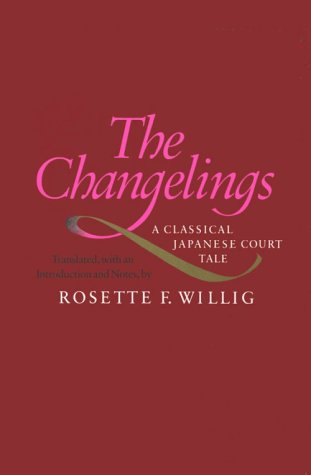
Japanese Classic Novel: The Changelings by Rosette Willig, Guest Review by Jason L.

April 18th, 2018

Welcome to Guest Review Wednesday!  Today we have another exciting review and another new Okazu Guest Reviewer, Jason L. As you may remember, I have been reading and reviewing the Torikaebaya manga series by Saitou Chiho. Tomorrow I will be reviewing the final volume and today we have a discussion of the source material, how wonderful is that? 
Before I had the mic to Jason, I want to mention that this book, while available in print, is absurdly expensive generally, so if you want to read it, I recommend you go to your local library and ask for an Interlibrary Loan of it from another library that has it. If you have never done ILL before, no worries, the Reader’s Services desk will help you, just nab the ISBNs, author, year, publisher from this link and they’ll have all the info they need to find you a copy to read. 

So please give your attention to Jason – and buckle in, it’s going to be a bumpy couple of days!

Upon my first viewing of Maria-sama ga Miteru season 4, I was intrigued by the play, Torikaebaya Monogatari, put on between the joint student councils at the school festival. So I did what I always do, and went in search of a copy of it in English. I discovered that it had only been translated once, originally in 1978 as Rosette Willig’s dissertation, and then released with some modifications in 1983 under the title of The Changelings: A Japanese Court Tale by Stanford University Press.  It took several years to find an affordable copy but I finally laid my hands on one in January and it has felt like I brought, if ever so small, a piece of Yumi’s world into my own life, something quite precious to me.

The Changelings tells the story of two half-siblings, the born-as-a-girl Chunagon who chooses to lead his childhood and young adult life as a man and the born-as-a-boy Naishi no Kami who leads her life as a woman. Other than their parents, no one is aware of their biological genders. Both are thought to be extraordinary in beauty and talent. Chunagon becomes an ever more prominent member at the Emperor’s court. Their father however, refuses the Emperor’s entreaties for Naishi no Kami to be introduced at court. He knows that the Emperor will insist on taking her as his wife thereby uncovering her biological sex. As their story unfolds, what has been a melancholy treatise on gender nonconformity to this point, goes somewhat off the rails and into quite upsetting territory. I was not expecting this given the comedic version done on Marimite.

One of Chunagon’s friends/rivals, Saisho, forces his way into both siblings’ lives with disastrous consequences. Chunagon has married Yon no Kimi with whom he shares a bond but no intimacy. Saisho enters their home and rapes Yon no Kimi ultimately resulting in a pregnancy that nearly destroys her marriage to Chunagon. Following this, Saisho rapes Chunagon, having discovered his secret. Chunagon becomes pregnant and Saisho forces Chunagon to hide in his rapist’s country home, to deliver their child in secret. With the beloved Chunagon now missing at court, his sister, Naishi no Kami, leaves in search of him. Upon being reunited, the two siblings decide to switch places so that their biological sex will match their social roles. This is kept hidden from Saisho, who is now ostracized  by society for his relationship with Yon no Kimi and by the new Chunagon (the former Naishi no Kami). Unfortunately the author spends what feels like endless scenes on what can only be described as whining by Saisho, for whom I struggled to have any empathy. And still the sexual violence does not end, but is furthered by other characters now that the leads’ roles have been switched.

So, clearly this is not the comedy that Marimite presents, but they were not alone in this interpretation of the Torikaebaya monogatari. The sexual violence by powerful males that drives the plot forward has often been played as erotic comedy in many productions of this work. There is, in fact, a routine parallel made to many of Shakespeare’s gender swapping comedies, as Willig notes in her commentary. But nothing could be further from the truth. Mistaking The Changelings for comedy says more about the people encountering, performing, and reviewing the work over the years than it says about the story itself or the pain the characters experience.

And yet as a tragedy, there could have been value in telling such harrowing experiences if done with a grander purpose in mind. However, the author chooses to reconcile these tragedies by marrying off all the characters who are now newly in gender conforming roles. This is done as if none of the violence really had any lasting consequences. Even the new Chunagon marries Saisho off to the younger sister of his second wife. Any historical validity to such an ending is insignificant to me as a modern reader wishing that there was some greater moral purpose for the story.

Making my disappointment in this ending worse, the first third of the story was delicate and empathetic in its handling of the characters’ gender identities. Initially, the author seemed sensitive to the emotional toll and the social stakes of the gender switch. Both Chunagon and Naishi no Kami frequently worried about being discovered and wished to either live in seclusion or leave the world completely, reminding me that the high rates of depression and suicide within the LGBTQI+ community is not new to our society, a powerful message from a 900 year old text. Complementing my initial impressions was Willig’s decision to use the characters’ preferred pronouns throughout, with the female-born trans-male Chunagon being referred to with masculine pronouns and the reverse for Naishi no Kami. In the original language, gendered pronouns are not used as they are in English and so it was Willig, in her translation, that honored the characters’ self-identities with her pronoun choices, a brave decision in the 1980s translation community.

So then I am left with complex feelings.  The book is an important tangible connection for me with Maria-sama ga Miteru, and yet, that too treated it as a comedy, which it most certainly is not. The prose itself is mediocre at best, the translation readable but not artistic, sort of like a middling YA novel. But all my initial confusion over whether it was a comedy or a tragedy, and the weak writing, would not have mattered if the story rose to the potential it displayed early on. Unfortunately, without any comeuppance to the three men who commit rape, or some unambiguous moral judgment rendered by the author, I simply cannot recommend this book. I am left uncertain as to its value for others. However, when I see it on my shelf, I still feel as though I have somehow materialized a piece of my favorite anime into existence in the real world. For me, that might be enough.

Ratings:

Writing: 4 (serviceable and mostly clear if uninspiring)
Story: 5 (beautiful poetry exchanged between characters, deeply moving emotional exploration of trans lives in the beginning, but unacceptable resolution and no final moral judgment)
Characters: 8 (We care about the main characters and hurt alongside them)
Service: 2 (there is little to no textual description of the sexual acts themselves, beware that most sexual encounters in the story are overt rapes)

Overall: 5 (if the conclusion had been morally stronger I would have gladly overlooked the poor prose quality)

Erica here: Wow. What a fantastic review, Jason. When I end up saying about 80% of the same things all over again tomorrow, I’ll make sure people know you said it first. ^_^ Thank you so very much for this review!