Yuri Manga: Yubisakikara Suberiochiru Valetta (指先から滑り落ちるバレッタ)

April 5th, 2018

Yubisakikara Suberiochiru Valetta (指先から滑り落ちるバレッタ), transliterated on the cover as “Valletta that slides from a finger-tip,” by Tsuitsui is a collection of stories that ran in Comic Yuri Hime magazine. 

In the first story, two female friends go to a love hotel together because they want to try staying at one.  Although nothing happens between them, they become a little closer as a result, and recognize that they care about  – and maybe for  – one another.

A businesswoman takes in the high school girl who is seeing the college-age guy next door as she sits out in the rain, giving her s cup of hot coffee to warm up. They become friendly, and when the guy dumps the girl (after sleeping with her of course) Yui is there to help pick up the pieces of Konatsu’s heart…until they fight and Konatsu stops coming by. Yui brings herself to ask the guy next door where Konatsu’s school is. They make up and will once again be able to share a cup of coffee.

Nagano is being bullied by Miyuki, but Nagano doesn’t care. She tells Miyuki she knows she was behind it and Miyuki wants to know how to make it up to Nagano. “Pretend to be my friend,” Nagano replies. As they pretend to be friends, Miyuki’s old friends ostracize her and start bullying her. But Nagano is there for her and Miyuki finds that she just doesn’t care any more about the old friends, either. She and Nagano exchange pretty barrettes, from which the title comes, (although mistransliterated for English. It ought to be “A Barrette That Slides From Fingertips.” The addition of “my” or “your” before Fingertips, while not literal would be more poetic. “The Barrette That Slides From My Fingertips.” is what I’m going with…thinking of this from Miyuki’s perspective, as Nagano first bought her a barrette, which precipitated her falling out with her henchchicks.

The final story follows a “tough-as-nails” businesswoman who has held a torch for her old school friend for years, but when her friend says she’s getting married, Mei is able to see that the clumsy, sincere woman who works for her seems to actually like her. They might even get together.

I quite like Tsutsui’s messy, sketchy art. And the story-telling basics are solid. 

Ratings: 

Art – 6 It’s got issues, but I like it anyway. Needs maturing, and some work on the eyes, particularly
Story – 5 Basics for the qualifying round. Now it’s time to move on
Characters – 8 Definitely the strength of the volume
Service – 4 There is some
Yuri – 7 There is some. Mostly feelings, very little relationship

Overall – 7

I’d like to see the artist get a whole volume’s worth of story down, now that we’ve got the compulsories out of the way.


Yuri Manga: Comic Yuri Hime, April 2018 (ミック百合姫2018年4月号)

April 4th, 2018

Comic Yuri Hime, April 2018 (ミック百合姫2018年4月号) was a little light on the continuing series, but spent most of its pages building on a bunch of newer ones that were pretty good. 

No surprise, I liked the AI-focused “Roid,” by Shirushi. I apparently like android x human relationships. ^_^

Tamasaki Tama’s military-ish school drama “Koushin Koinu KoibumI wo” continues to flail for a plot, but is fun to read anyway. 

As I suspected (because it was kind of obvious) the story in “Watashi no Yuri ha Oshigtoto desu” by Miman, is now fulling focused on Tachibana’s concern for and being disconcerted by Kanako’s obsessive feelings about Hime. I don’t want them to be a couple, but I think Tachibana could be good for Kanako, because right now, she is not a stable person. I would like to see them help each other out.

“Tsuretsure Hibi” by Omurais was a nicely drawn, pleasant slice of two women’s life together without drama. That was awfully nice.

Moke has a lovely little girl meets and falls for a cafe owner in “Yuuhi to, Aroma to, Koi Moyou,” while Nacht’s “Dandelion Tearoom” was a  straight-up paranomal fantasy and Nantsufuji’s “Kimi ha shoujo” took a bit of a darker turn, as Shinou comes to grips with the fact that she’s had sex with a virtual stranger.

Lots of other stories, including the series they choose to make anime of, (by which I have so far remained unmoved.)  Yuri Hime@Pixiv is also clearly allowing them to try out some new material and see how it plays before moving it to the magazine or to publication.

Ratings: 

Overall – Holding steady at 8 

Monthly Comic Yuri Hime still is holding the line with something for everyone. The May issue is already on shelves!


Yuri Manga: ripple (リップル)

April 3rd, 2018

There are days, here on Okazu, when it’s a little harder to not be just a tad snarky or cynical about Yuri manga. In fact, I suppose it’s something that every generation does – going through all the various contortions of growing up, coming out and being a gender, romantic or sexual minority and then being all world-weary when the next generation does it all over again. In regards to Yuri manga, I’ve seen roughly three or four “generations” of artists “discover” that girls fall in love with each other sometimes. And yes, there are days that I shake my head with  an amused smile at all the sincere doujinshi and manga that have hatsukoi or hajime(ru/te/ta) in the title. But I never, ever want to be this guy, acting like his own personal journey marks the end of all similar journeys and be a jerk about a sincere story

With the build-up of yet another Story A in Aoki Toshinao’s ripple (リップル), (with Shimura Takako’s name boldly labeled on the obi for very important marketing reasons,) you might even have forgiven me for rolling my eyes just a bit. But, I didn’t, and I’m glad because yes, ripple is indeed another Story A and no, it breaks not one panel of new ground and yes, it is very banal…but I liked it anyway. Apparently, every once in a blue moon sincerity is a replacement for competence. 

Neither art nor story here is exciting. A girl named Minami falls for a girl in her school named Nami. Their courtship is typical, their relationship follows all the general patterns of all relationships. Nami has a secret which is painfully obvious to us from the first mention – she’s liked a girl previously, and that girl broke her heart, a story she admits to at the climax of the volume. Again, you might forgive me for eyerolling, and again I say…but I didn’t.

Minami helps Nami to shed the baggage of her former relationship in a full-color final chapter. They like each other, and they sleep together and they are happy together, the end. And it was not creepy, nor painful nor boring. Just all pleasant and human and real.

Ratings:

Art – 6 better than I could do, but not great
Story – 6 Girl meets and falls in love with another girl
Characters  – 7 Likable and sympathetic, acting their age, which is sort of nice
Service – 3 A very little partial nudity in the final pages, So sex, but not sexed up.
Yuri – 9

Overall – 7

I believe, from the bottom of my heart we will always need stories that tell the basic plot of “there is a girl who likes a girl. The other girl likes her back. They like each other, the end” because there will always be a new generation of readers who have never read that before. And there is always someone who has not seen their experience in a manga before. And so, no matter how far on we have come in our personal journey, it’s important to remind ourselves that yes, stories like ripple should always have a place in our genre.


Mai no Mushi Gurashi Manga, Volume 1(麻衣の虫ぐらし)

April 2nd, 2018

I am here today, my friends, to talk of insect. Not just any bugs, but beneficial, friendly, and dare I say it? attractive, bugs.

And girls.

Girls and bugs are most of the point of reading Mai no Mushi Gurashi(麻衣の虫ぐらし), so if if you’ve mourned the lack of bug science in Yuri, this is the book for you!

Shimizu Nanako helps her elderly grandfather run his small farm. They keep it going by selling their produce at roadside stands and to local businesses. Her best friend Sakurano Mai, helps her out. Mai, is an entertainer at a restaurant, and is the object of a rather service-y gaze by both reader and Sudou Raika, a naturalist who is working on creating better breeding conditions for butterflies in the nearby forest. 

In the course of volume one we encounter bugs that burrow in bark, that fly, that lay there, that crawl; many kinds of bugs, some of which I only now have a passing familiarity with on account of having read this book. I doubt I will ever remember that a namitentoumushi is a ladybug past the time it takes me to write this…but, on the other hand, the world has a weird way of requiring me to remember pieces of information exactly like that. ^_^

Yuri is in the form of Raika’s passive-aggressive dis/interest in Mai. The rest of the story is more about Mai and Nanako’s friendship. Both of them are thoroughly likable and their friendship is no more and no less than a close friendship. The volume ends with a heartrending chapter in which Nanako’s grandfather dies while watching the two young women harvesting the tomatoes for which the farm is known.

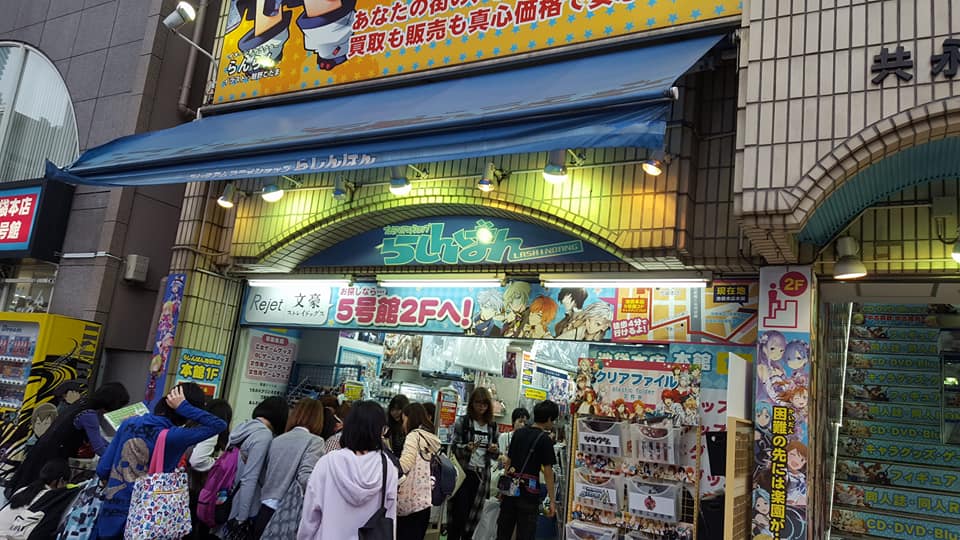
This book marks the very last of the pile of random things I picked up at the Animate Yuribu last November. I had no idea what this series was about, so it was a pleasure to find that it was both educational and entertaining. Having finished that pile, I’m very ready for a visit back to see what other delights those shelves hold, probably-a-vampire Yuri notwithstanding. 

For those of you interested in insect and their potential in a Yuri story should definitely take a look at this so-far single volume with it’s special-insert manga card.

Ratings:

Art – 8 Good, if a tad service-y
Story – 6 Slice of life with insects
Characters – 7 Pretty likable
Service – Amegappa Shoujogun the artist, likes drawing naked women, especially Mai
Yuri – 2 It’s not much but it is there.

Overall – 7

I was glad that my last book of the November crop was unique and not a vampire story. ^_^


Supporting Your Comics Ecosystem in 2018

April 1st, 2018

Three years ago, I wrote up a little treatise on the importance of financial (as well as emotional) engagement in our comics and manga ecosystem in Supporting Your Comics Ecosystem in 2015. And I’ve been thinking a lot recently about how things have, not so much changed, but we are able to see the situation with more nuance. So today, I wanted revisit this topic (although I am also behind on reviews and have some other writing to share with you, as well….!) because we’re at an extraordinary point in the evolution of comics – a term I will use here to include manga, doujinshi, webcomics, zines and mini-comics for the purposes of saving a few key strokes. If you haven’t read the original essay, go do that first. I’ll assume that you have, and then move forward.

The Macro-Level

In 2015, I focused on the importance on purchasing comics through legitimate licensed dealers with the understanding that our money supports the companies and that they are in turn supposed to support their employees and the industry. It is a reality that we live with that this is only partially true now. Yes, while supporting the companies does provide jobs to people at all levels, from the artists through to the kid shelving the books, it is also true that many of these jobs are not paid living wages nor do they have reasonable working conditions. Nonetheless, I still believe that purchases made on what I am now calling a macro-level of consumption does put some money back into the larger economy through wages, and taxes for all levels of employment, even though we must know also recognize that corporations are not paying their fair share.

That said, this macro-level, which we can also look at as the more traditional model, also includes small businesses like local comics shops (LCS) and online retailers. When you think about how many layers your dollars get sliced into, it can be very hard to believe that not paying for a comic will affect anyone negatively, but the drain from the ecosystem can be death to smaller pieces of that larger system. We’ve seen how the erosion has affected LCSs, for instance.  There’s a certain amount of inevitability in this erosion. When a store opens up near you that has everything you might want, the one store that only carries some of what you want will suffer. The LCSs I see surviving have taken one of two tacks – they’ve evolved to be community centers for the comics audience, running gaming nights and events, opening shelf space up to a more diverse audience or they’ve hunkered down, watching a shrinking audience stick to formats and characters with whom they are comfortable.

In the meantime, large retailers have seen sales go up and down in waves, but when we look at the larger ecosystem of comics, and include graphic novels outside the traditional LCS market we can see that it is young and diversifying.

I  buy a lot of my comics through major retailers. I buy Sweet Blue Flowers from Viz on Amazon, and pick up my Comic Yuri Hime by Ichijinsha at Kinokuniya (and while I am there, maybe I buy Slumbering Beauty by Seven Seas  or Nakayoshi from Kodansha as well.) Of these, only Viz and Seven Seas are “small” companies and they legitimately have larger companies invested in them. These purchases are the lifeblood of the traditional comics ecosystem.


Comics in the Middle

By 2015, we saw the creative success of a meso-level of consumption. When we pay money to projects on crowdfunding platforms we are injecting much-needed funds into what might otherwise be a closed system.

What do I mean by a “closed system”? When I was younger, I would attend events like pagan festivals and various “culture” festivals. At all these events, you could see the same vendors and performers on a circuit. And, at all these events, someone might have a personal life change- a marriage, a baby, etc. The vendors and performers who all knew each other, would often chip in to pay for expenses or buy gifts. This is where the system was closed – people might give this person a gift or money, and then next time a gift or that money was returned for something else. That same amount would cycle through the community. I’d buy a necklace from someone that bought a piece of art my wife was selling. We both “made” money, but nothing was gained or lost. Outsiders and spectators were the lifeblood of these events.  They brought in new money to the community. If I bought a piece of jewelry and was not there to accept something back because I was not part of the community, then that money remains with the community. This does not really apply to vendors at anime cons, except, maybe among the smaller sellers and artists, because vendors are not making or consuming their or other people’s goods. A dealer buys 200 DVDs to sell, they sells them, but doesn’t take that money to the artist’s alley or buy a figurine from someone else. They then pocket that money. It may go to con expenses, but doesn’t get recycled back into the community by purchase of good or services from the community.  

Crowdfunding has changed the way we perceive this meso-level comics market. Smaller publishing companies have a chance to put out nicher material – material that may well be appealing to a diverse audience, but will not or cannot be published by larger corporate publishing companies who rely on traditional models of printing, logistics, wholesale and retail. These meso-level publishers often have condensed staffing with only a few people for multiple tasks, and they often prioritize creator’s income over their own. They use social media and crowdfunding to recruit talent, staff, buyers and utilize customized distribution models that the macro-level publishers do not need. Again, some of this money goes to outside expenses, but a large portion of it gets recycled into the community directly in the form of paying artists and staff because that is what encourages backers to commit. Few backers are enthused by the idea of giving more money to support company costs, and in one notable case, the direct request for corporate expenses to be covered by backers tanked an already tenuous campaign.

I put my money behind crowdfunded publications as often as I can.  Right now I’m hoping that Lemonade Summer, a kid-friendly LGBTQ novel makes its goal! I’m much more likely to back original, niche work than I am reboots or remasterings of old work. Backing new work not only brings new money into circulation, it brings new artists in from outside, as well. I don’t have anything against anime auters of the 1990s getting HD reboots, but it doesn’t encourage creativity from them, or give jobs to folks breaking into the business. 


One to One, Person to Person

Now, in 2018, we are watching the success of payment processes that allow readers, consumers and fans to fund the work directly. These micro-level publishers are the creators themselves, for whom that income is, well, income, and is used however it is needed or wanted. Patronage is a a pretty old concept, but we have a pretty new technology for it. We can individually fund multiple creators through smaller payments or back a few or one creator with larger payments. This is revolutionary, because we can regularly inject the cash needed to fund people to have the lives they need to have in order to be able to create the work we want to see. 

(There are, of course, many external influences to the ecosystem, as well. The ACA was a massively positive change that allowed USA-based creators to have the kind of healthcare that other industrialized countries take for granted and freed people up to just create for a living…and the ongoing sabotage of that has had a detrimental affect to creative industries in the country.)

We are also now in a place where we can directly see the influence of our dollars in a way that we could not have, even a decade ago. Amazon proves for us that sales of a story about a lesbian manga artist with depression can sell well.  We can see directly that a small comic company can raise the kind of money that most comic companies would die for and that we are not alone in demanding more diverse and more representative comics for everyone.

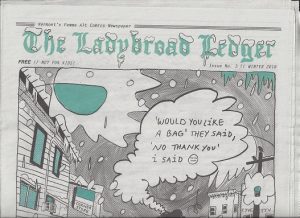
As I stated this week, I’ve launched new microgoals for Okazu. For every $50 more we make at this point on Patreon, I will be supporting another creator. I’ll specifically be supporting micro-level efforts like individuals, small collaborations like Okazu (which at this point is 94% me, and 6% other folks creating content, and all me doing the editing, promotion and the like. ) To begin with I’m supporting a talented artist, Nakawē Writer Mari and writer and a feminist collaborative newspaper the Ladybroad Ledger.

What does all mean for us? It means that we can be less naive about how our money is used. Yen Press might seem like a massive company with corporate backing, but it’s still a pretty small company with only a few employees. Sure, you might not want a huge book chain to make more profits off of you, but your money does impact Seven Seas or local comic shop…and the lack of it, even more so. Buy your books at the level of convenience and ethical responsibility that’s comfortable to you. But when you parse your purchases, remember you can directly affect the industry at macro-, meso- or micro-level as you choose, and at at each level, you’ll be helping to support a sustainable industry for the future.