Yuri Manga: Shoushin (傷心)

March 20th, 2015

ShoushinShoushin (傷心) by Yukimura is a Hirari Comics collection of stories that may well have flown under your radar, but were excellent examples of positive changes happening at Hirari, before it went out of business. (I’m not sure there’s a generalizable lesson these, so don’t project. ^_^)

The first story looks at two adult women,  friends with benefits, who realize that they’d kind of like their relationship to be more. The second story is an uncomfortable thing about a fox and the girl she becomes human for.

The third story follows a girl who is asked out by an admired sempai, only to find out that “out” means a mountain hike.  In a second outing they go shopping together.

“Armet” is a look at a woman and the female knight who protects and adores her. They live happily ever after. ^_^ I particularly enjoyed the art in this story.

Iriya and Hikaru are friends, planning for their school trip to Hawaii. Although Hikaru is on the swimteam, she doesn’t have a cute bathing suit. They try on a few suits and each realizes that they have a somewhat more physical interest in each other than they suspected. A sequel finds them in Hawaii together as they figure out this new relationship.

The next to last story is yet another friends become more tale and finally we turn back to the adult women of the first chapter, in the middle of – again – reworking the boundaries of this new relationship borne from the old.

So, there’s a distinct style here – two women already close become closer. And, in a sense, it’s not entirely different “Story A”, as the main drive is redefining boundaries, but I find it a more pleasant place to be. Less prurient, more sincere.

I also want to note the chapters that include a physically strong or athletic woman have exceedingly good art. Hikaru has the broad shoulders and developed back of a swimmer. She absolutely does look like a swimmer in a girl’s school uniform. Armet too, is drawn to look physically capable. She is tall and substantial. This was something I not only found appealing, but refreshing.

Ratings:

Art – 9
Characters – 8 Generally quite likable
Story – 8 I like this stylistic tic
Yuri – 10
Service – 5 A bit here and there

Overall – 9

Yukimura’s other work seems to be largely BL, but I really liked her Yuri debut, and hope to see more of her in the future.


Yuri Manga: Manpuku Yuri (満腹百合)

March 19th, 2015

ManfukuyuriLast year I read What Did You Eat Yesterday? by Yoshinaga Fumi. My chief complaint was that while the characters identified as gay, even discussing it with family members and friends, there was little affection between them shown. They were drawn in that “gay eunuch” style beloved by straight women’s media (like movies and Lifetime TV, not BL,) in which gay best friends don’t have messy affairs of their own. Volume 2 improved slightly when they actually touched one another. Gay couple and food = being out, but no kissing allowed.

In contrast there’s old school Yuri, which has physical affection between two women, but no one identifies as a lesbian. In Manpuku Yuri, by Miyabe Sachi, we cleave to the old school – the two women will sleep together and live together, but they aren’t gay. Lesbian couple and food = kissing, but no being out allowed.

Nonoka and Aya live together. Aya works at home, so she is usually in charge of meals. Nonoka works in an office, but when she is on her own or they have time to cook together, she lends a helping hand.

Unlike the complex foods of What Did You Eat Yesterday?, the meals in Manpuku Yuri are simple, few requiring even an explanation, much less an actual recipe. Pages are given over, for instance, to Nonoka’s paroxysms of ecstasy over Aya’s various pancake toppings.

Nonoka and Aya’s life is a happy and simple one. They have separate rooms, but sleep together when it suits them. They do have a physical relationship, that is made plain.

When Nonoka agrees to go to a group date (for the seafood fondue), Aya begins to question whether she is truly happy. Aya’s worries are compounded when she sees Nonoka briefly interacting with a child at the park. She asks if Nononka wants a child and Nonoka, says, someday, probably. Now Aya is in full-blown panic.  When Nonoka comes home from a friend’s wedding, and it turns out she’s caught the bouquet, Aya does the most obvious thing you’d do when the person you live with and love seems to be in the mindset to think about marriage and family… she moves out of the apartment without a word, leaving Nonoka alone and confused and hurt.

I wanted to slap Aya so hard it hurt.

Nonoka who loved to eat, is barely touching food now, until she comes home and finds a hot meal and note from Aya in front of the door. Apparently, Aya heard that Nonoka wasn’t eating right and was sneaking food over to her. Not surprisingly Nonoka, uses the chance to find Aya and confront her. Aya says she wasn’t able to make Nonoka happy…Nonoka is completely confused by this as she was perfectly happy and any problem was all in Aya’s head.

They reunite with a kiss and cute hearts all around them and Aya suggesting they have some dessert together.

So, yes, it was “obvious” that they were together, and they were blissfully happy, except when Aya lost her mind, but would it kill us to get a single “I love you?”

I wanted to love this book. So very much I wanted that. My life is pretty much day after day of amazing meals and happy snuggling in our big pluffy bed; how wonderful this story might have been if it wasn’t ball and chained into an old-fashioned construct of a lesbian relationship and heteronormative expectations. Ah well.

Ratings:

Art – 7 Cute rather than good
Characters – 7 Aya was the better of the two until she loses her mind. Then Nonoka seemed perfectly lovely.
Story – 5 It might well have been better if there wasn’t one.
Yuri- 10 /Lesbian – 0
Service – 2 maybe if you squint. There’s implications of sex

Overall – 6

It wasn’t terrible, but I wanted it to be amazing. I blame the editor who didn’t say, “Really? That whole misunderstanding thing is so overplayed. Let’s not go there.”


Flower Tales (花物語) Manga Guest Review by Michelle W.

March 18th, 2015

HanamonomanImagine me flailing wildly in excitement! Today we have two amazing things all at once. First of all, a Guest Review by long-time Okazu reader and commenter and all-around nice gal, Michelle W.! (yaaay!)  AND, the review is of the manga edition of Yoshiya Nobuko’s classic Hana Monogatari. (Of which Yellow Rose has been recently translated by Dr. Sarah Frederick and is absolutely terrific.)

So, two of my favorite things – Guest Review Wednesday and Yoshiya Nobuko all at once. Take it away, Michelle, before I cause a scene and swoon… ^_^

If you’re knowledgeable about the history of the Yuri genre, you’ve probably heard of Yoshiya Nobuko’s Taisho-era (1912-1926) work, Hana Monogatari (Flower Tales). The original Flower Tales is a collection of fifty-two short stories involving relationships between high school girls, and is largely considered the birth of the Class S genre. In 2014, almost 100 years later, Ozawa Mari turned fourteen of these stories into a manga by the same name.

Right away it’s obvious that this manga has a strong connection to the aesthetics of the past. Instead of relocating the story to current times, or leaving it floating in a non-specific time, Ozawa has put a lot of effort into reproducing the feel of the Taisho-era. The artwork is reminiscent of the 70s manga style, which is modern, and yet dated enough to be well suited for the material. The design itself is meticulous in its attempt at reflecting the era, and everything from hair, clothing, architecture, and even the trains are reproduced. If you enjoy the 1920s, this is a good manga to look into just for its visuals.

The stories are what you’d expect based on the original anthology. These are stories of two characters meeting, many only a few pages long each, with bittersweet endings. What’s striking is how many cliches are represented in these stories, however, when coupled with the art, you get the sense that this work created many of them. There are many classic topics, such as taking an entrance exam beside a cute girl, or a nurse falling for a patient.

Looking at Flower Tales in such a visual form, you can clearly see the impact Nobuko’s work had on Yuri (and homosexuality in Japan, for better or worse). The idea of fleeting, youthful romances being an ideal more than a reality is definitely present here, but unlike modern Yuri, this feels in context. You can see how impossible true homosexuality must have been in such a strict and orderly time period. It’s ultimately a testament to Nobuko’s passion that she herself was able to maintain a long-term homosexual relationship in this era.

It’s hard to give this story a rating, as it has such a specific appeal, even among fans of Yuri. In many ways, this feels less like a new work of fiction, and more like a loving retrospective of a classical work. For someone who wants to see Yuri’s tragic past come alive, this is for you. However, if you’re a fully modern or casual Yuri fan, who perhaps enjoys pretty artwork and fan pairings more, this is a tough sell. The art style is intentionally dated, and there’s very little, if any, Yuri content. Some of the kanji may also be a little bit difficult, as it relates to parts of 1920s culture that are no longer in common use. This is a world of flowers and subtext, a portrait of the past.

Ratings:

Art – 8
Story – 8
Characters – 6
Service – 0
LGBTQ – 5

Overall – 7

It’s hard to accurately rate something that is simultaneously so old and so modern, so maybe you should try it for yourself!

Squee! No, seriously, this manga sounds just fantastic. And thank you for the great review! I cannot *wait* to get this book. ^_^ I’m not sure I’d say Nobuko created “S”, but her work is definitely good examples of the genre. Her contribution to “girl’s literature” and therefore girl’s manga…and by extension, Yuri, is incontrovertible. ^_^


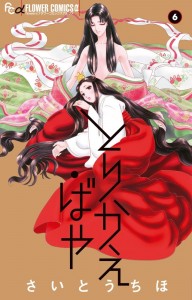
LGBTQ Manga: Torikaebaya (とりかえ・ばや ), Volume 6

March 17th, 2015

Torikaebaya6When we last left Chiho Saito-sensei’s beautiful and tragic retelling of the Heian classic tale, Torikaebaya (とりかえ・ばや ), I was having a crisis. It’s so damn beautiful, I want to keep reading, but it’s so damn heart-wrenching, it’s hard to keep reading.

Volume 5 ended with Sarasojuu running from the capital, pregnant with Tsuwabuki’s child, devastated that she can no longer live her chosen life. Suiren, overcome by love for Toguu-sama, gives in to desire and kisses her.

As Volume 6 opens, I keep wondering if there are any more boots to drop…and, of course, there are.

Suiren has been called up to the Emperor’s residence to be one of his women. This precipitates a decision that Suiren can never go back and change. Refusing the Emperor’s call, Suiren confesses that he is a man to Toguu-sama. He leaves her service, and returns home, to become the man his sister was. Passing is merely a matter of not interacting because, although Suiren and Sarasojuu are identical in looks, Suiren has none of Sarasojuu’s skills at horseback riding or other pursuits.

Suiren, disguised as Sarasojuu, overhears a rumor of Tsuwabuki’s second woman being pregnant, guesses what has happened and heads off to find Sarasojuu.

Sarasojuu, having been taken in by Tsuwabuki, is now called Sara-hime, and is pining away, as the baby’s birth grows near. Conversely, Tsuwabuki is beside himself with joy, having both the women he loves and their children in his home. Sara is not on board with this, and poor, poor Shi-no-hime, who had no idea who this other woman was, until her son calls Sara “father”. Shi-no-hime, who has been unconscious for much of the volume swoons once again. Of everyone, I feel the most pity for her, a woman drawn into someone else’s story with no good way out.

Sara’s baby is stillborn and, naturally, she blames herself.

Suiren finds Sara, at last, as she is just about to drown herself. Suiren tries to convince Sara to return to the capital and resume their lives as before, even though he himself is not sure he can ever return to the life he’s left.

I am less distraught this volume, as I carefully fed myself a few pages at a time, knowing that this story was going to offer no respite. Parsing out mere pages of exquisitely gorgeous, emotionally agonizing story, meant that I was able to get through it without trouble. I’m desperately flailing in mind, as I read every fresh hell, to come up with ideas for a non-horrible ending. So far I am failing. And the one ending I foresee that will give the characters the happy end they deserve will have to be a very annoying tengu ex machina. ^_^;

Ratings:

Art – 9
Story – 8
Characters – 9
Service – 1
LGBTQ – 6

Overall – 9

Saito-sensei’s art has always been exquisite and here, she reaches her pinnacle. It’s so perfect a tale for her style.


Yuricon Essays and Store Update!

March 16th, 2015

ILYicon

Today we announce the first translation from the Eureka “Current State of Yuri Culture” issue! Check out Yuri: A Genre Without Borders along with all the great Yuri Essays available to you for research.

More essays will be going up in days to come. For early access to translations from Eureka, become an Okazu Patron.

AND, work on the Yuricon Store is booking along. ^_^ We’re already the most comprehensive all-Yuri-in-one-place on the Internet and items are being added daily.

I recommend starting in the Digital Manga page with Yuri on Kindle, ebooks, and even Comixology! 

The English Manga page and English Anime pages are up to date and even have pre-orders listed.

And with the help of a few folks, we’ve got an amazing listing of great Yuri Literature for both scholarly and entertainment purposes. 

The Japanese Manga page has more than 200 items. No more wading through Amaon JP to find what you want. You can search the Store in English or Japanese, to find your favorite author or series.

Thanks again for all your support and here’s to a great 2015 for Yuri fans!