Lesbian Comic: Blue is the Warmest Color (English)

October 9th, 2013

BlueIsTheWarmestColorIf you pay attention to lesbian-themed media, you already know that the winner of the 2013 Palme d’Or at the Cannes Film Festival was Blue Is The Warmest Color, based on a French bande dessinée Le Bleu est une couleur chaude by Julie Maroh. Arsenal Pulp Press has put out an English translation, which is the subject of today’s review. The movie has been the object of much talk and considerable controversy – the actresses have stated that they hated doing it and the director has said it should never be released. Most damning, Maroh has repudiated the movie, claiming it was no more than porn. 

Blue Is The Warmest Color is not an easy book, no matter how you view it.

It begins with a setup similar to June Kim’s 12 Days. Clem has passed away and her lover Emma seeks some solace, perhaps closure. Emma visits Clementine’s family to read a diary that was left for her. The diary begins at the beginning of the story with Clementine, 15, as she starts to navigate the thorny path of human sexuality, love and friendship and, as she sees, meets and falls for Emma.

Right from the beginning, theirs is not a good relationship. Emma has a girlfriend, Clem is hiding her relationship from most of her friends. And when they finally seem to put it all together – we skip more than a decade into the future. Emma is distant, Clem is abusing alcohol and drugs and their relationship is a dead and rotting thing. Clem’s illness and death brings the two of them together in a way that her life never had.

Maroh’s art is very good, very moody. Flashback scenes are done in kind of sepia wash, which I appreciated as a nice cinematic touch. Emma’s blue eyes and hair stand out as a stark, vibrant spot of bright color in an otherwise dull world. The glimpses of Parisian student life struck me as very La Bohème or, perhaps, Rent. ^_^

The translation is good in the way that I define good – everything is perfectly understandable, but the rhythms of the words are just ever-so-slightly not American English enough to make me hear accents. Like watching a foreign movie with subtitles. Speaking of subtitles, I absolutely hated the fonts chosen for the English edition. They were both wholly appropriate, but hella hard for me to read – too thin for my taste.

Watching Clem handle her situation and her life so badly, I was reminded very forcefully of my first years with  my wife. It could have gone more like this; either one of our families could have made it impossible for us. I am once again mindful of the blessings which we have been given in our years together.

Ratings:

Art – 8
Story – A hard 8
Characters – I found both Clem and Emma hard to like, but they were both real – 8
Lesbian – 10
Service – Tough to score. There is sex, but it’s not mean to be – or be read as – titillating, which is why Maroh hated the movie, which had long, lingering sex scenes for the sake of sex scenes. Let’s say – 5

Overall – 8

Don’t expect a delightful tale of coming out, or emotional redemption – this is an excellently well-crafted, well-executed story of a reality in which there is no happily, much less an ever after.


Event: Manga Lecture in Yokohama

October 7th, 2013

Tomorrow you can find me at Kanagawa University, talking about LGBTQ audience and comics and manga.

The program is open to the public. The lecture will be in English.

Weaving Our Stories Through Manga and Comics: LGBTQ audiences and Re-telling Stories
October 8, 4:20PM – 5:50PM
Building 20, Room 109
Sponsor: James Welker, Department of Cross-Cultural Studies
Kanagawa University

マンガとコミックを通して私たちの物語を織る
10月8日、 16:20 to 17:50
ビル20、 109室
スポンサー: ジェームズ・ウェルカー、学部国際文化交流学科
神奈川大学


Paying My Respects to Yoshiya Nobuko

October 5th, 2013

There will be no Yuri Network News today. Instead I want to tell you about my day. Because today I was able to make a pilgrimage to the Yoshiya Nobuko Memorial Museum.

220px-Yoshiya_NobukoYoshiya Nobuko is the creator of Yaneura no Nishojo, Hana Monogatari (after which we named our Yuri Monogatari) and Wasurenagusa.

I have long considered her a grandmother of Yuri and an honored ancestor of a sort for myself. I was very excited to be able to make this trip.

Accompanied by my wife, Bruce, and Prof. James Welker of Kanagawa University, and his husband Jotaro, we made the trek down to Kamakura and from there, the Enoden to Yuigahama, a small station in a quiet residential area. A few minutes walk brought us to her home. 

ynmm1

Set back from the road by a gate and walk up along the garden, the house was surrounded by well-tended, just slightly wild trees, lawn and tons of greenery.

ynmm4

With the screens open, it was very easy to imagine the two of them sitting there, enjoying the breeze flowing through the house.

ynmm5

There was a small display of her books and original furnishings in her study.

ynmm2


It was a lovely place, despite the lack of personal memorabilia. It doesn’t matter that we didn’t, as James joked, see her pluffy bed each with a picture of the other on her nightstand, but I still felt it was possible to imagine them smiling at each other and saying “You know what? This is our house!” as my wife are still wont to do. ^_^

I’m so glad I was able to make this visit. I owe a lot to Yoshiya-sensei, I appreciate the chance to thank her personally. ^_^ And thanks to James and Jotaro for a really wonderful afternoon!


Yuri Manga: Tsuki to Doro (月と泥)

October 4th, 2013

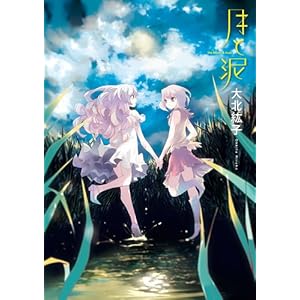
When I reviewed Ohkita Hiroko’s Hadashi no Chimera, I was distressed at the overall damage, both physical and emotional, inflicted upon the characters. It comes as no surprise, therefore, that I was ambivalent about picking up her next book,  Tsuki to Doro (月と泥). While I would hardly consider this book perfect, it is much less bad in that regard.

Unfortunately – or perhaps fortunately – the title story follows the pattern of the previous book, with a wounded girl, and unlikely relationship and a murder. After that story, the tone shifts. Yes, there’s still a lot of physical and emotional damage, but more of the characters take control of their lives on their own and for their own reasons – reasons which may or may not become clear during the stories.

I enjoyed this book much more than the previous one, but I think Ohkita could do even better. A little more storytelling and a little less torture would go a long way.

Ratings:

Art – 6
Story – Variable, from 4-6
Characters – 6
Yuri – 6
Service – 4

Overall – 6


Princess Knight Anime, Part 1 – Disk 2 (English)

October 3rd, 2013

After a rather stressful Disk 1, Disk 2 of Princess Knight settles down. Starting with the final episodes of the first disk,  Sapphire – referred to in the dub as “Prince Knight,” or “Knight” for short – sets off on more adventures.  Of course Duralamin and Nylon still slaver over her uncomfortably and their continuing obsession about her sex is always squicky. Knight’s energy is mostly spent protecting her kingdom from being invaded by shark necromancers and fighting wars on behalf of flower kingdoms. Knight even gets a moment to shine as she goes on an epic quest to save her mother from a poisoned flower.

It is during this last adventure where Knight meets the dashing young Prince Frank (Franz of the manga.) Prince Frank thinks young Knight is funny, always trying to outdo him. Something inside of Prince Frank is clearly resonating to Knight – when he gives the younger Prince a flower, Knight says she doesn’t like flowers, but Frank assures him that he will, someday.

Because we know the two of them are destined to be together, it seems to me that the vibe begins right away. While Knight seeks to establish equal status with Frank, Frank sees him as “cute.” Is the storyline not-so-subtlely reinforcing Knight’s femininity (and therefore her inferiority) even as she herself maintains that they are  equals, or am I working *way* too hard as I watch this out of the corner of my eye while I work? ^_^

Without a doubt, I far prefer the adventure stories to the obsessive creeping of Duralamin and Nylon. They are portrayed as so unambiguously mystery play-style evil they might as well have names like Duke DoNoGood and Sir Henchman. It leaves no room at all for the kind of masterful storytelling one associates with Tezuka. We get a glimpse of this when Knight is fighting off an evil plot to start a war and destroy the Prince of Roses, when she rejects Duralamin’s blustery, dangerous patriotism. (Gee, who does this remind me of….oh, wait, every politician ever, right.) Give me a good old fashioned shark invasion any day.

Ratings:

Art – 4
Characters – 7
Story – 7

Overall – 7