I’m out having some fun without you, so no Yuri Network News this week. I hope you’re out having fun without me. ^_^
Revolutionary Girl Utena Anime, Volume 3, Disk 2 (English)
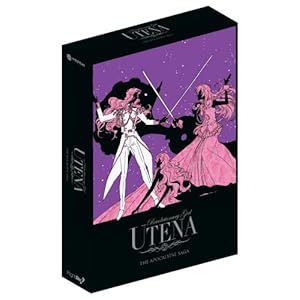 This is where the “Apocalypse Arc” of Revolutionary Girl Utena starts to get rough.
First, we have to watch Juri being run roughshod over; offered every single possible outcome except the two in which she can be happy.
Then there’s Akio’s seduction of Utena which, no matter how you slice it, is repulsive.
And last, while there had been a distinct hint of incest about Akio and Anthy since the beginning of this arc, in this disk it is made plain, not so much to shock us (speaking for myself, there is little else Akio can do to make himself more repulsive than he already is) but to shock Nanami. Which leads us to one of the most amazing things in the entirety of this series…when Nanami calls Utena dense.
Think about it.
Nanami has been presented to us, from the very beginning, as naive, selfish and quite dense. For her to stare at Utena in disbelief and scream “Are you dense?” is a pretty amazing moment. In three words, Nanami says, “I’m not perceptive and I just came to this place and I can see what is really going on , but you – you who have been here for a while – you’re blind and deaf and since even *I* can see what is going on you must be denser than a bag of doorknobs.”
I consider this to be one of the most profound moments in this arc.
Terrible things await, and we can feel it. Everything is contracting around Utena, like spiders just about to pull their silk tight. We can feel it, but we can’t predict it. When it comes, it’s going to hurt like no one’s business.
Ratings:
Art – 9
Story – 10
Character – 9
Yuri – 4
Service – 5
Overall – 10
I have two disks left to watch and I fear them. Only one thing drives me forward into the next disk…I’ll tell you what it is when I get there.
Quick reminder, the third Utena box set contest is still ongoing and will be until I make myself watch those last two disks. Send in your entry for a chance to win the third set plus smexy Duelist Ring!
Girls Jump Manga 2012 ( ガールズジャンプ)
 Back in 2011, I reviewed the first volume of Girls Jump magazine. I loved it instantly. It was full of talented female creators, drawing without any apparent limits on story or art.
I loved the variety, the sheer talent and the wtf-ness of so many of the stories. Now, over a year later, I’ve gotten my paws on the 2012 volume of Girls Jump ( ガールズジャンプ) and it’s just as wonderful.
The second story, “Hatsukoi Guardian” by Aiki Haruko, was perhaps the very best. It follows a female wrestler in high school as she deals with falling in love with an attractive male upperclassman in her school. She and her friend were both drawn as beefy, masculine looking girls – not as caricatures, just short-haired and strong, the way an actual wrestler should look. Although it did not have a happy ending, I loved it for the atypical female characters.
The short, tragic and battle-filled lives of bees are sung in the paean “Vespa” by Nakamura Ching. One bee, reaching out to save the other from drowning in a jar was absolutely epic. “short, but seems long time of their life” is a most fitting tagline.
Est Em has contributed a story about a shoe salesman, “IPPO.”
There was a unsubtle timeliness in “Damatte Sumi-chan” about a woman who incessantly Twitters. Maki Hirochi really nails the real-fake tone so many people adopt on the social platform. ^_^;
Hirao Auri gives us “Supernova” about a schoolgirl and the space girl she befriends…and their decision to face a future together, even as the planet faces destruction.
The magazine wraps up with old school, overdressed, vaguely European Vampires in “Darkness Blood” by Yukito. I have no idea what happened, I was too busy looking at the hot vampire woman in knee boots, velvet jacket and corset to read the story. ^_^
Ratings:
Overall – 8
As with the last volume, this brief overview does nothing to really explain the assortment and ability of the creators. Honestly, I really hope you’ll all get this annual volume and enjoy the hell out of it, as I have.
Novel: Kami no Moribito, Part 1 (神の守り人)
 It wasn’t easy, but I stepped up my reading to get this book done in record time, so I could tell you about it while I was still in a Balsa kind of mood. (The next one is several books down on the pile so don’t expect anything for a while.)
Kami no Moribito begins on a, dare I say it?, happy note. Balsa and Tanda, finding themselves with some mutual downtime, decide to go on a trip together. They have a destination in mind, but the real point of the trip is to revisit places they like with a close companion, and eat good food – you know, a vacation.
When they arrive in an inn that Tanda likes and knows the folks who run it, they are catapulted out of vacation into a very complex story. While they are there, Balsa sees a group of nomads manhandling two children and, being Balsa, ends up saving the kids. We learn that the children have had a very, very hard life, which culminated in the raiding party invading their home, killing their father and raping their mother. When their mother died, the two were kept as servants and were just, that very night, sold to slavers.
Having rescued them, Balsa has Tanda tend to their wounds and the fevers they get from them. The younger of the two, Asura, has some kind of vision, or connection, to her people’s god, and it’s not a terribly good thing, by everyone else’s standards. Tanda’s acquaintance and former military man, Sfaru, is convinced that the right thing to do would be to kill her right now.
Tanda tells Balsa not to get involved with the kids, but when he sees she can’t stop herself, warns her to get the hell out, asap. Balsa grabs the girl and takes off.
The next morning Sfaru sends his sons after her, and tells the boy, Chikisa, the story of who the god is, and why Asura is dangerous. Not surprisingly, Chikisa is not particularly thrilled to know that Sfaru is after his little sister, but he’s wounded and weak and a child, so he trusts Tanda and Balsa and waits. Balsa uses all her wits to evade Sfaru’s sons, and fights, and severly, but not fatally, wounds one when he gets too close.
She runs to a large-ish city, where she heads toward the house of someone who owes her. The old lady, Masa, isn’t thrilled to see her, but takes to Asura right away. When Balsa asks if Asura could see herself living there, for the first time in her life, Asura finds a sense of hope in her heart. Masa offers her and her brother a place to live if they should come back.
Tanda and Sfaru aren’t far behind, though. Although Tanda betrayed him, Sfaru knows that Tanda knows Balsa best and takes him and Chikisa to track down Balsa and Asura. They learn that Balsa has left the city.
Balsa gets an introduction to a guide – she has to nearly break his arm to convince him that she’s worth helping, but once she beats him into the ground, he comes around and promises to lead her and Asura where they are headed…back to New Yogo, by way of the far north.
The book ends there, with Balsa and Asura running for their lives, and Tanda and Chikisa following along with Sfaru.
Of all of the Moribito books, it was probably so far the weakest. There were long chunks of story-telling that weren’t terribly compelling, especially the history of the Taru and their eponymous founder Taru no Hamaya, and a long, excruciating sidebar about the Princes of Rota and the one that fell in love with the daughter of Taru no Tamashi. When I got to a chapter than was three pages of talking about sheep, the story simply ground to a halt.
Nonetheless, once the world building was over, the story – especially the chase between Sfaru and his sons (in which Sfaru, who is also a shaman as well as a fighter, puts his spirit into a hawk to hunt Balsa) and Balsa, who anticipates this, is excellent. Unexpectedly cute is Masa, who wins as the oldest tsundere character ever. ^_^
Also nice were the fight scenes, in which Balsa always wins, even wounded, and the magical moment when she practices spear form under the light of the full moon while the children watch.
Overall – 7
While not the most compelling story ever, I’m interested to see what happens, so definitely will be reading the second book once I get through the other 6 or so books on my pile. ^_^ Balsa’s just that cool.
Manga Artists Are Taking it to the Small Screen
Surely, you’ve noticed. Manga artists are no longer holed up in their apartments, appearing in public like groundhogs only for the occasional event. For one thing, events are becoming more and more common, so even the most reclusive manga artists are enjoying the company of their fellow artists and fans more than once or twice a year now. A mere 48 hours ago, thousands of fans and the artists they like were hobnobbing at Comitia 100. And Twitter has connected more of these artists together and more of the fans with those artists, than ever before. (Follow my Yuri Mangaka list on Twitter to see what your favorite artists are up to.)
But as small as the world is getting these days (and as glad as I am about it,) that’s not what we’re talking about today. We’re talking about the increasing role technology is playing in getting the artists, and their work, in front of fans in real time.
Last week, I took Yuricon into the live video age and a lot of manga artists are doing the same. Technology has reached the point where live video hangouts and streams not only make sense, but are accessible to nearly everyone, world-wide. Even at events, it makes sense for artists to show, rather than tell. At Comitia 100, creator of Dogs, Bullets and Carnage (a series I read regularly, but have not reviewed here,) Shiro Miwa, drew live and projected it on a large monitor for people to watch.
This is not a comprehensive list of live video sketching, but here are three mangaka of note that I know of who have been drawing live and doing tutorials, that you might want to check out:
Serial Experiments Lain, Haibane Renmei creator Yoshitoshi Abe has put some coloring demonstrations online for your viewing pleasure.
Iono-sama Fanatics, Ame-iro Kouchakan Kandan creator Fujieda Miyabi often sketches live on his Ustream site. If you have a Twitter account, you can sign in and chat with him.
Wedding Peach, Moon and Blood creator Yazawa Nao is doing a series of online demonstrations and Google Hangouts that you can join, for her Manga School Nakano. She’s got a Youtube channel with her videos, as well. (Yazawa-sensei has very good English, and is very friendly, so definitely drop her a message!)
These are only three of the many folks moving their work online. I think that the more we see how much work goes into even a single drawing, the less likely we, as fans halfway across the world, are to discount the amount of skill and effort that goes into a manga.
Technology has been kind of cruel to mangaka, so let’s support these technologies that give us access to them and to appreciate what goes into their work.