I am indeed back from The Netherlands and Yaoi and Yuri Con there, but have managed to rather severely injure my cornea in the process. There will be no new posts until I can see again. Please feel free to read old posts to console yourself while I am out of service. ^_^
Invisible Layers of Manga
I often refer to the fact that I very often mention “steps that were skipped” or “things readers don’t see” in reference to manga publishing. I’m asked about that quite often – what are those steps? What is it that readers don’t see?
I’ve been meaning to address some of this for ages and today seemed like a good chance to mention some, but probably not all, of the things that readers probably don’t know about (and frequently don’t care about.)
Let’s start with licensing. I imagine very few readers really have any grasp of what this entails, and to be honest there’s no one formula for licensing manga. Different companies have different requirements, some have agencies that represent them, some hire individuals, others have in-house groups that handle that. American manga companies may also hire an agent or representative, but they are more likely to do licensing in-house. In book publishing, this stage is handled by an “acquiring editor” who interfaces between legal and the author or agent. There are no acquiring editors in manga right now, because relationships are so often personal before they are professional and many of the Japanese companies, once they create a relationship, still prefer to go for exclusive agreements. That’s changing a bit. And some manga artists, especially independent ones, are starting to use an agent, but most still rely on their publisher to represent their interests.
Licensing involves more levels of negotiation than you can possibly imagine if you’ve never done it. This stage might takes months or years, while every single detail is hammered out – even down to the way the title looks, the way the credits are handled, distribution for first and successive printings, payment, milestones, formats the files will be sent in…Every. Single. Detail. Obviously, scanlation groups skip all this – they can hit the ‘net faster, because there’s no pesky lawyers, company wanting to know how the books will be distributed or how it will look, making sure that previous contracts are not infringed upon or creators wanting to be paid and make sure the spellings are the way they want them.
After the licensing is done, then the folks who are doing the localizing can get to it. The translator gets a script from what would, in the book publishing world be called a “managing editor.” Managing editors manage the project from this point on until it actually goes to the print. Ideally, these days the manuscript are the pages of the raw manga in digital form. This is where scanlators start the process, having skippped all the tediousness of licensing negotiation. Manga companies do not typically have a “managing editor” and the editor in chief of the company may act as project manager if it’s a really small company.
Translation is not a science. It’s an art. I’ll keep saying that until people get it. ^_^ There is no “right” way to translate, there are a number of ways to translate any given thing.
At this point, there’s a couple of ways a company can go. Some translators send the script as a text file to the adapter. Maybe that person has a bit of understanding of Japanese and has the manga to hand, so they can compare, but that’s pretty rare, honestly. Most companies now require translators to do their own adaptation. Some are better than others at it. Usually this takes some fluency as a writer in the language being translated to. That’s an entirely different thing than just speaking your own language fluidly. The most important thing removing the adapter does is 1) removes a fresh new pair of eyes looking over the script, and so losing an opportunity for some input on things like Voice. 2) It saves money and time, as well.
Some companies have an editor look over the script at this point. A few do, and you usually can tell, because those companies have unusually good translation. Copy editors do not just proofread. They are looking for consistent language use, widows and orphans in the text, grammatical and syntactical errors and other larger issues. Of course, they also find typos. Most manga companies have a translator and an “editor” who does the copy editing and project management. Because of this – and because the quality of editors are so variable, you sometimes get rougher “translation” to your language than you might like.
Then the script goes to lettering. Oh, but wait, there’s no way to letter a page with lettering already on it, so first the page is cleaned up and touched up in places and then it is lettered. Scanlation circles typically use a DPI of about 200 or 300 for their distribution. I can tell you from personal experience that that is absolutely nothing like cleaning up a page at 1200 dpi and retouching it, so that 1-pixel specks don’t show up as black dots in a print version.
Then lettering begins. Companies make hard choices about things like sound effects, which are so often drawn into the manga panels. Do they just translate them, or do they go to the considerable time and effort of replacing them? In almost all cases, I replace them at ALC, because it looks so much nicer. But it definitely takes way longer. And in a few cases, there’s just no way around it and a sound in English has to be set next to the art.
Here’s where it all gets very messy. In book publishing, the managing editor then gets a “galley” copy – a rough copy of the printed volume. This is sent back out to the editor and more importantly, another missing layer here – a proofreader. Some manga companies send lettered manuscripts to the copy editor at this point. It’s a little harder to make changes, but it’s pretty key because…
Okay, so when I reviewed JManga.com this week, I told you that there are almost always errors in manga. Well here’s why….because there are no galleys. Manga publishers do not get rough copies back. In offset printing the most expensive book is the first one and every time the plates are set, it costs. Even big manga publishers here in the US don’t have in-house printing and can’t afford this step. So there are no galleys to send back to the editors and proofreaders who can then spot the mistakes the letterer made. THIS is why one has to presume there are typos in every manga.
And, in some cases, where the letterer has already done their work, there still is only one layer of editing, so after the copy editor makes changes, *no one checks the finished manuscript.* This drives me absolutely crazy. Every manuscript needs more than one editor looking at it once.
True story – when we finished the very first Rica ‘tte Kanji!? volume, we had a total of 5 editors and proofreaders – and there were still two typos that escaped. You can never have too many eyes check a manuscript.
So, in book publishing, the galley goes back to the copy editor and then a proofreader…and then if the managing editor is not a moron, they take a look at it and THEN it goes to print.
In manga, the letterer gets a script that’s been edited once and no one checks the lettered manuscript for errors. Or, if the editor gets the manuscript after lettering, no one checks it a second time after those have been fixed. There can never be too many eyes. And manga companies almost always skimp on eyes.
So, why do they do that? Well, remember, manga companies have been constrained by comic book and bookstore distribution until recently. That means that they had to determine a release date way back at the beginning of the process. Readers expect the book to be ready by then, and are very demanding about things going as fast as possible, which means the company has to get that thing out the door to the printer asap to be ready. (Printers are never fast.) So they send books to print after one read rather than holding the thing up while they wait for a second round of reading/changes – and forget a third round. I have friends in book publishing who will be hired to copy edit/proofread books going to second and third printings and even with all those added layers, they still find errors.
About half the time when you see an editor-in-chief’s name on the book, they never actually edited it. Again, at ALC I always re-read a book after the editors have sent in their changes and then I hand it off to proofreaders to catch the things I still missed (and we still miss some. It’s just the way life is.)
True story – when I was a child I had a book I loved. (This was back in the day when publishing books was a respectable job.) At the very climax of the book there is a critical typo that changes the entire story. At 11 years old, I crossed out the wrong word and wrote in the right one. It just bothered me that much. ^_^
Then we head into issues of distribution and marketing which I have talked about previously, so I won’t belabor the points here. But they also take time, one of the many things fans are always so dissatisfied about.
I hope this gives you a little glimpse into some of the layers that readers never see – and hopefully explain to you why you see errors, and wonder why the company never caught it or what’s holding the book up or other questions and concerns readers have, but have no answers for.
Perhaps this new world of digital distribution will make it simpler for readers to catch an error and companies to fix it. Here’s hoping. ^_^
Yuri Manga: Kanojyo no Sekai (彼女の世界)

Well this book was kind of a surprise. You know how I’m always ragging on Hakamada Mera-sensei for writing the same old Story A and never really getting past that? Well, in Kanojyo no Sekai (彼女の世界) she does and, um, I kinda wish she hadn’t. (OMG, Erica, you are never satisfied!) ^_^;
Konno Natsuki has a run-in with Hikawa Hidari on the roof – that is, they actually collide with one another. They untangle notebooks and knees and return to their classroom, where Natsuki realizes she has one of Hidari’s notebooks. No big thing, really, except that the notebook contains an erotic novel. Natsuki can’t stop reading the novel so, when the teacher calls on her to stop reading and takes the notebook away, she’s worried that the teacher will read it…and Hidari is worried that Natsuki will throw her under the bus. Natsuki retrieves the notebook, never mentioning Hidari and waits on the roof to return it to the other girl. She won’t say anything, Natsuki promises, on the condition that Hidari continues to write the novel. And so they meet most days, up on the roof.
Hidari is not a well-liked girl. Her name is weird (who names their kid “Left”?) and she’s not personable or outgoing. Natsuki has friends, but she begins to blow them off to go to the roof and read Hidari’s work. She find the story stimulating, but also wants to know a bit more about the author. To make matters worse, Natsuki starts to have sexual fantasies about Hidari, but when she finally acts on one of them and kisses the other girl, she is rebuffed.
The novel changes, too. Now, not only is the protagonist thrown into a variety of sexual situations, a second character has appeared. Hidari confirms that it’s love between the two.
The class trip arrives, just in time to make things awkward for Natsuki and Hidari. Natsuki invites Hidari to join her group, but her friends nix the idea. Hidari goes off with another group and Natsuki can’t even manage to sit with the other girl for the trip. Natsuki sees Hidari from afar on the trip, having fun with her group, she’s overcome with jealousy and starts to cry. When she looks up to see Hidari sitting there, she confesses that she likes her. Hidari says nothing but, quite unusually, she smiles. That night, when all the other girls have gone to another room to have pillow fights and hang out, Hidari and Natsuki make love.
Although, Natsuki confides in us at the end, Hidari has never said she loves her back, she’s content to join the other girl in their world up on the roof.
It’s a strange, but not insane story, made uncomfortable only really by the fact that it’s set in high school and that it’s by Hakamada-sensei, whose art is not really well suited to more explicit scenes in my head. There’s nothing super explicit, and the characters are not drawn in a way that is inconsistent with her art or with their age or anything that might otherwise make one cringe. In every other way, it’s a pretty good doujinshi-like story.
Ratings:
Art – 6 on general appeal, but for Hakamada’s art 8
Story – 7
Characters – 7
Yuri – 10
Service – 7
Overall – 7
The heads aren’t even huge anymore. It’s just that…it’s Hakamada-sensei’s art and the idea of sex in her work seems so…odd. ^_^
Yuri Manga: Tsubomi, Volume 16 (つぼみ)
 Tsubomi, Volume 16 gets off to a strong start with the cover story “Aoi Honou,” about a girl that falls for another girl in school (what originality!) with ceramic making as the club prop, but ends some years in the future with a satisfying ending.
I’ve been on the fence with “Hoshikawa Ginza Yon-choume,” but now that they’ve moved into this loft, I’m find the story intolerably creepy.
On the other side of the fence is “Prism,” a series that I’m liking more and more with every chapter. *Now* we’re moving into after happily ever after.
And so it also is with “Candy” in which real life affects Kanan is a way she had never intended. Both this and “Prism” are the only two stories where the characters reactions read close to realistic. As a result, they are my favorite stories.
In “Hana to Hoshi” Hanaii learns about Hoshino’s past a bit and ends up in a ping-pong game for Hoshino’s affection.
There are so many other series, and most of them are fine to good, but these are the stories that stood out, good or bad in my opinion this volume. It’s a better read than it was a few years ago, that’s for sure.
Ratings:
Overall – 6
Yuri Network News – March 24, 2012
 Yuri Anime
Top news this week had to be the unexpected licensing announcement of Oniisama E / Dear Brother by streaming site Viki. Jasmine has written a very well-thought out short article on why Dear Brother is so important – and such a compelling watch for GeekGirl World.
Crunchyroll announced that it will be launching in Latin America with Spanish subtitles. This would be perfect if it were two separate news items – that they were launching in Latin America and offering Spanish subtitles for *anywhere.* Anime and manga companies really have issues with language =/ country.
The new Jormungand trailer looks…well…awesome. ^_^
And the second trailer for Saki: Achiga-hen, looks like….Saki.
Since Madoka Magica is on Crunchyroll and I’ve already written the series up at great length, I don’t really have more to say about it than I have already done. So…if you’d like to be the one to write up Madoka on CR, email me a three line proposal on what you have to say about the series and anilesbocon01 at hotmail dot com and you could be our next guest poster. )If you have never guested before, please also introduce yourself. Thanks.) Looks like we’ll get a Madoka movie this fall. I wish we wouldn’t. The series was wonderfully self-contained.
***
Yuri Manga
JManga is right in the middle of a special Yuri Manga promotion, until March 28. From their press release:
Subscribers who purchase any Yuri titles during the promotion will get 100 points back (up to 21% off) per volume! You must be a subscriber in order to purchase manga on JManga, but during this promotion Jmanga will be offering a special sign-up bonus of up to 4500 points!
For the purposes of this promotion the only “Yuri” titles are GIRLFRIENDS by Milk Morinaga, Poor Poor Lips by Hayako Goto, and Love My Life by Ebine Yamaji. And some regional limitations still exist. I have asked if JManga plans on making these all global soon, but have not yet heard back.
Amusingly, I clicked onto Okazu today and saw this in the advertising space below my post:
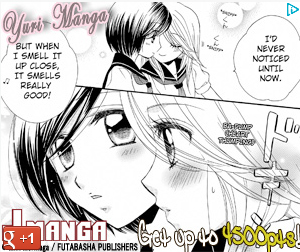
First time ever – a Yuri manga ad on Okazu. It gave me a bit of a thrill, I have to admit. ^_^
The first volume of Kimono Nadesico (きものなでしこ) from Comic Yuri Hime is forthcoming in April. As is Metesaratekya- (メッてされてキャッ) and Saitei Megami (最低女神),
***
Snatches of Yuri
Murasaki-iro no Chorea (紫色のクオリア) is a manga based on a light novel that has at least some Yuri, if not more.
I don’t think I’ve mentioned this manga here and shame on me, because now that GUNJO is over, it’s the only thing I’m reading in IKKI. Golondrina (ゴロンドリーナ) by Est Em is a really overwrought story about a young woman being trained to be a matador. There’s a previous affair with a woman, but that’s not really the point. The point is – woman in a “suit of lights.” Just sayin’. ^_^ Oh, and Est Em. Very cool.
***
Yuri Webcomics
On Twitter, YNN Correspondent Sparkle turned my attention to the already delightful story and art by Strangelykatie of Princess vs Princess.
And Kris Dresen has been drawing coffee-flavored flirtation over on Outlines Press. You can catch the first 10 pages of Closing Time and I hope it makes you smile as it did me.
***
Other News
YNN Correspondent Katherine H. points us towards Passionate Friendships: The Aesthetics of Girls in Japan, which covers shoujo romance in literature and manga, among other things. And it happens to use as its cover art a picture I adore and once wrote a story around. ^_^
And she forwarded this – something she learned about from Erin S. – and I wanted to tell all of you. Ohime-sama Youchien to Hakuba no Oujisama is a book about a class for Princesses, and one Princess who just doesn’t fit the mold. A great synopsis and discussion can be found on the Minesweeper Addict Tumblr.
***
That wraps it up for this week.
Become a Yuri Network Correspondent by sending me any Yuri-related news you find. Emails go to anilesbocon01 at hotmail dot com. Not to the comments here, please, or they might be forgotten or missed. There’s a reason for this madness. This way I know you are a real human, not Anonymous (which I do not encourage – stand by your words with your name!) and I can send you a YNN correspondent’s badge.