Yuri Manga: Seasons (シーズンズ)

February 12th, 2012

At the end of last year, I voted a trio of Takemiya Jin-sensei’s works in as the #1 manga of the year. Of those three, Seasons (シーソンズ) is quite possibly my favorite.

Like so many of my favorite manga artists, Takemiya-sensei started her career as a doujinshi artist. There are several ways in which a doujinshi artist can transition into a professional career, but the one that seems to be the most effective is this – draw original work. Manga publishers are less likely to want to publish look-alikes than, say, US book publishers, who so often are running after the latest trend, rather than creating the next one. Artists I first encountered as doujinshi artists include Hayashiya Shizuru, Morishima Akiko, Morinaga Milk, Nanzaki Iku, Nishi UKO, Mitou Kana and Kitao Taiki and many, many others. There’s only one, in fact that I haven’t seen make the transition to pro that I expected to, and weirdly, he’s gone the other way, from really well-conceived derivative serials to kind of crappy porn. Oh well.

So when I saw Takemiya Jin, who I have been following for years as Junk Lab, take the leap into the pro world, I was thrilled. For her – and for us, the readers. She’s got great short-story ability, honed by years of standalone doujinshi and can carry off a series with some chops.

Seasons is a collection of several doujinshi…a few of which I have. It gives the collection a feeling of meeting old friends and making new ones in one book. ^_^

The first few chapters follow Shirai-san and Kurozawa-san as they do the usual fall in love, be incoherent about it, not get together and get together in the end. Nothing ground-breaking here. What I found especially good about this series is Shirai-san’s friend, Asaki, who (maybe) inadvertently causes a massive crisis between the two main players. Asaki, it turns out, has a female lover and a whole life that Shirai-san is unaware of. And, Asaki is clearly part of the lesbian culture in Japan, as she and her lover both use slang in their conversations. Asaki gave it away to us, the readers, when she tells Shirai-san that Kurozawa-san is “nonke” (i.e., straight.) At that point, my slangdar pinged. Straight people do not refer to each other as “nonke.”

Let’s back up for a sec. I believe I’ve referred to this before, but here’s the deal about “nonke.” When a person is part of a culture in Japan, they are referred to as being whatever”ke” or “ka”, for instance a person who does Judo is a “Judoka.” You may remember we discussed the implication of “Kocchi no ke” in relationship to “Honey Mustard,” Morishima Akiko-sensei’s story for Yuri Hime that was collected into Ruri-iro Yume. “Kocchi no ke” is pretty much analogous to an American gay person saying “that person is ‘family.'” (The “ke” kanji is similar, where “ke” or “ka” 家 – as in mangaka 漫画家- means “house” as in the “House of Windsor.”)

So, “nonke” (ノンケ) is non-“ke,” i.e., “not one of us.” It’s use always implies that the user is, by default, “one of us.” So, when Asaki calls Kurozawa “nonke,” it’s pretty much saying that she is ke.

Asaki and her lover also use reba, neko and tachi, all slang words. For definitions, feel free to check out my Okazu Glossary of Terms. (I just added “nonke” there, as well.)

Following this story are a number of shorts, one- and two-shots that deal with a variety of “Story A” scenarios, and a few stories of couples dealing with a crisis in their relationship. A multi-part story about a girl falling in love with her class representative is a pile of well-used tropes (dress them up, then get jealous of them, the group date gone bad, misunderstood feelings, etc) that was nonetheless charming.

Almost the entire second half of the book is a look at a high school girl and a middle school girl who meet on the train (when a pervert starts to harass the younger girl) and their relationship over the next year. Unsurprisingly, the younger of the two is relatively immature, and causes no end of difficulties, but ultimately, there is a happy end that allows for the presumption of a happy future.

As I said in my write up of Takemiya-sensei’s work for the Top Ten list, the inclusion of gay slang in this book is one of the qualities that catapults her work to the top for me. Anyone can write a Yuri story, but it’s still pretty rare when we get a Yuri story with visible ties to Japanese lesbian community.

Ratings:

Art – I’ve always liked her art, so for me, 8, but your mileage may vary
Story – Variable, we’ll round it to 7
Characters – In most cases, I would invite them over for lunch – 8
Lesbian – 10
Service – 2, there’s some nudity and presumption of sex

Overall – More than the sum of its parts, Takemiya-sensei’s Seasons is a 9.

I’m so happy she’s gone pro. Here’s to more great work from her!


Yuri Network News – February 11, 2012

February 11th, 2012

Yuri Manga

YNN Correspondent Komatsu-san caught this: French Publisher Taifu Comics has licensed Morishima Akiko-sense’s Yuri Manga Hanjuku Joshi. More great news for French-reading Yuri fans!

JManga tells me that they are planning on launching Yamaji Ebine’s Love My Life manga next week. That’s absolutely stellar news for North American fans, and hopefully for English readers elsewhere, one day soon.

Forgot to tell you this, but YNN Correspondent Rachel wants you to know that Wandering Son was added to the American Library Association’s Rainbow List for 2012. The Rainbow List is a project that is run by a joint task force of the Social Responsibilities Round Table and the Gay, Lesbian, Transgender and Queer Round Table of the American Library Association. By the way, the ALA is and has been for *many* years, very LGBTQ-friendly, so don’t hesitate to ask your local library for LGBTQ books and let the ALA know if you get flack.

Sakamoto Ano’s Pie wo Agemasho, Anata ni Pie o ne (パイをあげましょ、あなたにパイをね) came out last month, and I forgot to tell you. Sorry.

There’s a manga with obvious Yuri called Sister Honey Biscuit, (シスターハニービスケット) that I will be avoiding like the plague. If you hate my taste, it looks like a good bet for you. ^_^

Morinaga Milk-sensei comments on her blog that the April issue of Comic High will include the final chapter of Kuchibiru Tameiki Sakurairo, and following that, she’ll be starting a new series. So I’m guessing that a continuation of that series is not likely.

Sabagebu, (さばげぶっ!) Volume 2 hit the shelves this month, in case you’re looking for some shoujo war games-style Yuri service. ^_^

***

Yuri Anime

From Soulassassinn457, we learn that Mahou Shoujo Madoka Magica tops Amazon Italy’s pre-order list. Italian fans can watch Madoka on RAI4 starting this weekend. “Also,” he continues, “it is said that Italian fans with a fistful more of Euros could get the full VIP treatment… er, an envy-inducing Limited Edition (includes specially-designed box, soundtrack CD, some special books, and even a Nendoroid).”

***

Other News

The happiest of all possible news, the March issue of Shueisha Cobalt has a supplementary Maria-sama ga Miteru story. Thank you gods. If I’m to believe Yuri Amagasa it’s called “Oppai Cake.” Indeed.

***

That wraps it up for this week.

Become a Yuri Network Correspondent by sending me any Yuri-related news you find. Emails go to anilesbocon01 at hotmail dot com. Not to the comments here, please, or they might be forgotten or missed. There’s a reason for this madness. This way I know you are a real human, not Anonymous (which I do not encourage – stand by your words with your name!) and I can send you a YNN correspondent’s badge.


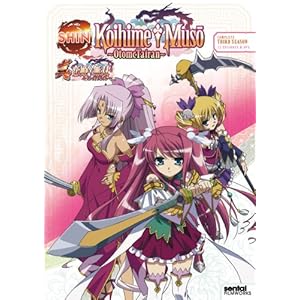
Koihime Musou ~ Otome Tairan Anime, Disk 2 (English)

February 11th, 2012

It’s always disconcerting when something like Koihime Musou actually stops staring at girls tits and tells some bits of the Romance of the Three Kingdoms in an almost sensible way.

It’s also kind of wasted, as no one is watching Koihime Musou ~ Otome Tairan for a retelling of the Romance anyway.

Luckily for Yuri fans, Volume 2 starts off with one of the least sucky episodes overall, in which Koukin and Sonsaku have a spat, and Kogai locks them in a warehouse to make up…and so they do, in time-honored fashion. This episode also contains the only genuinely amusing line of the series, in which Shuri mentions that she needs the Kotou pill (for an utterly idiotic subplot) and she knew it was a Son family treasure – to which the reply is something like, “Nah, it’s not a treasure, so we have no idea where it is. It’s in there somewhere.”

After a few more episodes related to cat ears and boobs, the story suddenly notices that it’s fairly deep in towards the end of the story and, so, with a few weird turns and about a million handwaves, the allianced generals defeat Ukitsu, who wasn’t really nearly that important in the original (except he may have haunted Sonken after his death, but that’s probably apocryphal.)

Anyway, Disk 2 is why I remembered this series sucking less than the rest of the series. I’m glad I didn’t entirely make that up in my head. Phew.

Ratings:

Art – Colorful
Story – Schizophrenic
Characters – Breasts DO NOT DO THAT
Yuri -There is some
Service – Infinity

Overall – Once I scour the cat ears and boob stuff from my brain, I will only remember that it was the least sucky Koihime Musou series. And I will be happy with that.


Yuri Manga: Yurikan Miel (百合缶 Miel)

February 9th, 2012

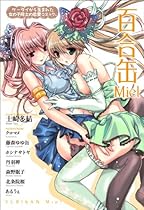
Yurikan Miel (百合缶 Miel) is the second in a trio of Yurikan ~something~ Yuri anthologies. The first was Yurikan Feuille,  with opening story by Morinaga Milk-sensei.  Yurikan Miel doesn’t bring that much star power to the floor, but it’s not entirely worthless, either.

The cover is pretty effective Erica-repellent. Two baby-faced female-shaped creatures with disproportionately sized breasts did not give me a good feeling about the contents. But the first story, “Rabu*Buri” was a silly and over-long single paragraph about a Princess in love with her female knight, which made me feel more kindly, until the totally un-sexy sex scene. So, now I was in a 50/50 mood.

A story or two passed without much notice, but…then!

We reach “Hyoko Zumai” and all was right with the world once again. This tells the story of a couple who have moved to the big city together; one a first-year college student and the other a newbie in a company office. The story shows how they grow from ugly ducklings into beautiful swans, and lo and behold! I loved this collection. This short was absolutely worth reading. The stress of their situations didn’t threaten their relationship, per se, but the lack of communication between them did.

This story was a lovely little break into realism from an anthology that otherwise pretty much stayed firmly mired in “I like her but she doesn’t like me the same way,” territory, with some really un-sexy sex scenes.

Ratings:

Everything variable, but overall, probably a 6.

“Hyoko Zumai” was worth the price of admission, though. I’m glad I read that story and will keep an eye out for others by Fujimori Yuyukan.


Mouretsu Space Pirates Anime (English)

February 9th, 2012

Mouretsu, in Japanese means violent or vengeful, so of course when it was being translated, the word “Bodacious” immediately comes to mind.

That was sarcasm. It’s a terrible choice for translation. Insulting, even. I know I’m not the only one who hates the translation, official or not.

Despite the egregious service of the title, Bodacious Space Pirates is a great story. As a combination moe bildungsroman and a classic space opera, it really works.

Marika, our protagonist is, for once, not an average girl by any means. Cheerful and competent, she has friends and a job and is instantly likable. We’re not too surprised when we learn that she’s the daughter of a famous pirate and a potential heir to her father’s captaincy.

When a Nadesico beauty with a dour personality transfers into her school, we know instantly that the two of them belong together. When Chiaki makes her big reveal in Episode 5, we get to add in “beloved rival” to the set-up for chemistry between them.

What really sold me on the series was the whole of Episode 5. High school girls in space may not sound like the most riveting story ever, but Mouretsu Space Pirates beats the hell out of Stratos 4, even without the lesbian space virus. The cast is likable, their jokes believable and there is relatively little service. The strategies and tactics employed by the crew of the Odette were clever, and quite sophisticated for an anime series.

There may not be wopping loads of Yuri, yet, or even at all, but if you like a series with a good set-up and some out-of-the-box thinking and a dollop of space adventure, give Bodacious Space Pirates a try – avaiable legally and for free on Crunchyroll, for those countries that are allowed access.

Ratings:

Art – 8 Very reminiscent of Mai Otome
Story – 9 So far…great
Characters – 8 They aren’t quite checklist-types, and a few are extraordinary, even in the first handful of episodes.
Yuri – 1 but only in our imaginations as of yet
Service – 4 because we can’t *possibly* have a series about girls without seeing them in the bath or in their underwear

Overall – 8

I’m hoping for a good story. But some rival/friend Yuri would be nice too. ^_^