I find myself in conversations about translation of anime and manga rather often. Fans who have ever read a scanlation and/or have taken a few years of Japanese in school seem to have very fixed opinions of the the meaning(s), transliterations and adaptations of the anime and manga they read.
Recently on Twitter, Kazami Akira-san, a Japanese commenter on the overseas anime and manga market, was asking how well done the translations we see in anime actually are. Because so many western anime streams and broadcasts are region-locked, Japanese enthusiasts and journalists are not able to see these translations for themselves. I volunteered to try to do this. I’ve got enough Japanese that I’m the jerk in the room saying, “That’s not what they said” when reading the subtitles and I’m a writer, so I can tell when the translation/adaptation are or are not written with a skilled level of understanding of narrative or voice.
But, I want to start off with a basic fact about translation:
There is no one right translation.
I know you think you know what “they really said,” but you (and I) don’t. We know what we think they really said, which is not the same thing at all. Just as art is in the eye of the beholder, language is in the ear of the listener. The more sophisticated a thinker you are, the more you know about the artistic, literary and cultural references, the more you have experience with language, the more you will get out of a sentence. Different audiences need different things out of a translation.
This same goes for professional translators. Some work hard to capture each nuance of the original work, others make ballpark decisions based on best guesses. Obviously, this kind of thing will affect the overall translation.
Translators rarely work in a vacuum, either. A translator, ideally, will be paired with a skilled adapter, who can write in their native language well, with an understanding of narrative, dialogue and voice. And, even more ideally, this will them get passed on to a skilled editor, who also knows the difference between a dialect and a spelling error. Unfortunately, this ideal situation is not always what happens. Sometimes translators really need a firm hand, but never get that good adaptation. Other times, the translator is awesome, but the adapter is not and ruins perfectly good language.
And no doubt it will come as no surprise that I have very strong views on being an editor. (^_^) Knowing how to speak English is not the same thing as knowing how to edit. Not only does an editor have to know how to fix mistakes, an editor has to know how to leave things alone. A good editor is truly a precious thing.
So, when it comes to anime and manga editing, anything that goes on between the translator, adapter (if there is one) and editor, can affect “the translation.” I know some cases where people were bitching about a thing, the translator had done it correctly and the adapter or editor re-wrote it and ruined it badly. It’s not the translator’s fault, although their name is on the translation, so they get the feedback.
As a translator, I still prefer to have an adapter, because I strive to get the best, richest, most sophisticated reading out of a line, so I may need an adapter to make it make sense in English. As an adapter, I smooth out pedantic, overly wordy or over-literal translations. As an a editor, I want the story to read as naturally as possible in English.
Then there is the issue with fan translation. Not every fan group has poor skills, not every group is good. Like everything else, there is a standard curve of deviation. There are a few groups that consistently produce error-filled, nearly incomprehensible scans or subs and some that produce professional quality work. The main body of groups is between these two extremes, providing varying degrees of good and bad, as their staff and inclination vary.
The problem with fan translations are not that they are “good” or “bad” but that they are often the first translation fans see. Otaku being what they are, the first is considered the benchmark and any changes after that are immediately perceived as negative. So, if a fan translation picks a name for a character – even if that name is not what the creator chose – that is the “right” name in fans’ minds. When a company “changes” that name to a creator-approved version, or a version that doesn’t violate western copyright, fans think it’s a bad translation. In this case perception is the problem, not the actual translation.
Okay, so that having been said, I’m going to do a short review of the top anime distribution companies in America. These reviews are filtered through my biases, not yours. They are, in fact, my opinion, based on my experience as translator, adapter and editor.
Viz Media – I watch very little Viz animation, so to prepare for this review, I watched some random episodes of a few series. In general, I feel that Viz anime is well-translated. As I am not familiar with the source material in most cases, it is easier for me to simply enjoy the anime and not focus on any changes being made. Their dubs are decent, their subtitles are not error-ridden and I find the stories to be easy to follow, so the narrative flow is preserved. Translations seem to fit the “voice” of the character well, which is really just the icing on the cake.
Overall – 9
Funimation – Funimation regularly makes choices in their translation that I would not personally choose, but I do not think that means they do “bad” translation. Overall, I think they capture narrative well. Subtitles are well-done technically. They do not always match the voice perfectly – I feel pretty strongly about honorifics in the subtitles matching what is actually being said – but again, that is a personal issue, not an issue with the translation itself. Dubs are excellent, except they still maul the pronunciation of names. I want to hold a workshop with all the western VAs to teach them how to pronounce Japanese names. It is that, more than anything that keeps me from watching dubs.
Overall – 8
Media Blasters – Media Blasters has some issues. The translations are good, but they rarely capture voice or narrative flow. Even punctuation in the titles is frequently limited to periods and question marks, which gives the dialogue a flat, monotonal feel. Their subtitles used to have many typographical errors, but that has improved significantly over the past few years. Their dubs, even the hentai…maybe especially the hentai…are pretty good, maybe better than most, because they don’t maul the names.
Overall – 6
AnimEigo – Their translations earned early respect from folks in the bygone days, so I’d put them among the top in translation. They get tone, voice, narrative. Idioms are hard and in general, AnimEigo picks pretty difficult series to translate, so I can’t really find fault with the way they handle it, even if I dislike the way their subtitles look. ^_^
Overall – 8
Bandai – Bandai translations are as good as the team working on that series. If the team is good, the translations are good. If the team is bad, the translation is bad. More than anything else, Bandai has a serious lack in the editorial process. Good translators need help and bad translators need to be rewritten…but that isn’t happening. Technically the subtitles haven’t been edited and are so full of syntactical and grammatical errors, it makes me cringe. Get an editor, guys. You’re killing me.
Overall – 4
Crunchyroll – The same, times two. There is just no consistency from episode to episode; names change, sentences read like they were written by 8th graders, there is no narrative flow, no understanding of voice and the only consistent thing about their subtitles is that they are consistently terrible. I weep when watching CR, because they take sublime stories and crap all over them with a complete lack of adaptation or editing.
Crunchyroll has the worst translations in the industry, without question.
Overall – 3
Section 23/Sentai Filmworks – Again, sometimes I don’t agree with the choices, but on the whole, very good translation. They are great on everyday language and fall down most obviously on more poetic passages. This shows a lack of someone on staff with skill at writing (and perhaps no one who reads.) The subtitles are good, error-free and timed well. I like, but do not love their translations.
Overall – 7
Nozomi/RightStuf – Just to prove that I’m more objective than you think…while I love TRSI for their exceedingly high-quality work on translations, I still don’t agree with all their choices. ^_^ Nonetheless, I think they are among the best in translation right now. Subtitles preserve honorifics, or manage to translate the honorifics with some sense and consistency, they “get” literary and artistic references and, in general, do a really excellent job of things.
Overall – 9
So, we begin and end with the best of translation today. If you know of any other companies and want to add your two cents, by all means!

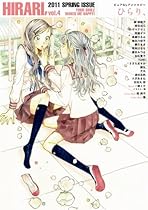 You know all the stuff I keep saying about Rakuen Le Paradis? That the stories are written for an adult audience who wants to be treated like adults, and it takes couples beyond happily ever after? Well…none of that applies to Pure Yuri Anthology, Hirari, Volume 4 (ピュア百合アンソロジー ひらり).