Alice on Deadlines Manga, Volume 1

January 30th, 2009

Can sexual harrassment ever really be “funny?” That is the question I asked myself as I picked up the first volume of Alice on Deadlines. As the pages piled mortification upon embarrassment, I began to suspect that, for me the answer would always be “no.” As with so many things though, as I thought about it, I came up with the somewhat different answer of “it depends.”

The manga itself is a pretty standard pervy-guy-perves-on-women-who-can’t-stop-him storyline, attached to the vaguely overused plot complication of a Shinigami sent to earth to complete some important task that must be done before he can move on/graduate/reincarnate/get off probation/something else.

Lapan is a slacker Shinigami who would prefer to spend his time reading porn than doing his job. His boss sends him to earth to accomplish a really important task to get back in his good graces. To punish Lapan for his slacker ways, he’s meant to be incarnated into a skeleton but…for reasons which we will call a ‘lame plot complication,’ he is instead incarnated into the body of a young girl, Alice, while she is displaced into the body of the skeleton.

Lapan immediately abuses Alice’s position as beloved idol of her all-girl school, sexually harrassing and molesting Alice’s fans, and Alice’s own body. As with Your and My Secret, Lapan is in no rush to switch back, so poor Alice is stuck in the role of skeleton-shaped boke, to a her own body-shaped tsukkomi, in a not terribly funny manzai routine. (For pretty funny manzai, I recommend watching Sean Gaffney and I nightly on IRC. We’ve got the routine down pretty well these days – I even slap him around a bit for effect. ^_^)

By about halfway through Alice, my progress through the story was positively glacial, because it just wasn’t making me a happy camper. And I began to think about the question that has come to me over and over as I read what passes for “comedy” in manga. Can sexual harrassment be funny? No, I said, and I meant it. (A small Lewis Carroll reference, in honor of his just-passed birthday.) But…why? Why can I read Ikkitousen or Ultra Sword and have absolutely *no* issue whatsoever with it, yet this kind of manga – which isn’t 1/1000th as offensive and violent as Ultra Sword – makes me want to stab something?

It came to me after a little thought – the issue is one of *power.* As anyone knows who has ever studied anything about sexual violence knows, the crime is not a crime of sex, but one of power. The criminal seeks to impress upon the victim that they are the one with the power and can therefore take away any and all power the victim might otherwise have.

Likewise, in manga where a character is endlessly sexually harrassing other characters, it becomes a fact that they hold the power in the relationship, since the harrassed character(s) *cannot* put a stop to it. (This is avoiding the issue of plot contrivances in which the harrassed character(s) *does* not want to put a stop to it. That’s a whole different rant.)

Put simply – the characters in Ikkitousen *do not care* that their clothes have just exploded off their bodies, or their underwear is exposed. They are annoyed, perhaps angry, and they go about showing their displeasure by establishing their complete dominance over the perpetrator. What they do, of course, is beat the bad guys flat. In Ultra Sword, the sexual molestation doesn’t stop the characters from beating the living daylights out of the bad guys. They are not disempowered by the actions of the molesters. In fact, they are *empowered* by the actions of the molesters, and subsequently adminster a violent – sometimes fatal – lesson in why hurting people is BAD.

But, in Alice physical, and in Mariaholic emotional, abuse actually robs the victim of something. They are disempowered, damaged, broken. Their pride, their world, their whole lives are taken away from them. That is true in real abuse, of course, and is very hard for me to tolerate as entertainment in any way. Especially not as “comedy.”

Which brings me back to this volume. Having learned this about myself, I turned back to the book, hoping to cope better with the contents.

The story took this opportunity to step off the path into a not hideously offensive side story about Lapan’s “date” with the beautiful guy Alice has admired for a long time. It wasn’t nearly as heinous as the previous chapters and the ending is sort of touching in a really bent way.

The second half of the book turns the tables completely on Lapan with the introduction of Ume, another Shinigami who lusts strongly after Lapan – even if he’s in Alice’s body. Ume engages in a little crossplay to join Lapan at school and pursues the entirely unwilling Lapan for the remainder of this volume. And because I now knew that it was an issue of power, I was completely fine with Ume making Lapan as miserable as he had made Alice. So there, nyeh. :p

Yuri in this volume is Alice’s body inhabited by Lapan sexually molesting Alice’s fans, and Ume crossdressing and molesting Alice’s body with Lapan inside. If a female-shaped being groping another female-shaped being’s breasts is good enough for you as Yuri, then this a Yuri manga. At least we are told plainly that in the world of the Shinigami, same-sex relationships are not taboo, which was completely unnecessary to the plot, but is the same level of relief as pulling a splinter out before it even hurts.

As a comedy, it wasn’t that funny. As a journey through bias into enlightement, it was about 5 minutes of good conversation. The *best* thing about the book is the title.

Ratings:

Art – 6
Story – 3
Characters – 4
Yuri – 5
Service – 7

Overall – 4

Today’s review was brought to you by Okazu Hero Martin S! Martin, please email me at anilesbocon01 at hotmail dot com and receive your Okazu hero badge and my sincere thanks. To become an Okazu Hero, simply sponsor a review and be a hero to all of us!


Yuri Anime Manga: Cream Lemon Escalation, Volume 2

January 29th, 2009

A few weeks ago, I regaled you with the tale of my visit to the Media Blasters store. While there, I was given this precious tome, the second volume of the anime manga of Cream Lemon Escalation (くりぃむレモン エスカレション).

This volume is quite literally stills from the third episode of Escalation, wherein our heroine Rie, having lost Naomi-oneesama to graduation, takes out her needs on new arrival Arisa. Rie’s roommate Mari chases Arisa out, only to declare her happiness at their friendship to Rie, followed by declarations of love, of desire and, after they make love, the fact that she’s leaving Japan in the morning.

Rie receives an invitation to Naomi’s mansion, where she has Arisa for appetizers and Naomi for the main course, after which Naomi declares she’ll be leaving Japan in the morning.

…

I never really noticed that before. Maybe it’s Rie’s love-making skills, driving women away in droves. lol

In any case, we see Rie graduate, leave Arisa her picture and driving off happily to be Naomi’s love slave. Presumably.

The book flips, and becomes the first Black Cat Mansion episode about a guy, some maids and a housefire.

This little treasure of a book is something that I’ll happily add to the collection here at Yuri Central. But I think that if I want to relive this forerunner of so much Catholic schoolgirl Yuri, I’ll stick with the novel, which was howlingly funny.

Ratings:

Art – 5
Story – 4
Characters – 6 Rie really grew on me, although I have no idea why.
Yuri – 9
Service – 9

Overall – 6

A brother-not-in-law saw it on the review pile and picked it up, blushed, then put it down. “Well…,” he said. “That’s pretty explicit.”


Yuri Manga: Magie Paire, Volume 4

January 28th, 2009

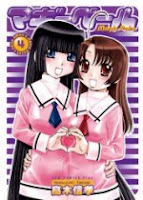
In Volume 1, Volume 2 and Volume 3 of Magie Paire (マギーペール,) we met mage-in-training Maria and her powerful and beautiful onee-sama Reina. We also learned that Maria, although from a family of powerful mages, cannot use her power unless she is touching magical jujubee Unyu. We then proceeded to ignore this mystery in favor of multiple scenes of dressing and undressing.

Now we arrive at Volume 4, the final volume of this series by Takagi Nobuyuki. It’s now or never, as graduation approaches and soon Maria will lose her beloved Reina-oneesama and, presumably, her chance to become a mage.

But first…some service! A cat-demon has escaped and whatever it inhabits immediately becomes a lustful creature intent on getting a little sugar from who or whatever it admires. When it jumps from the cat to Reina, it causes all sorts of cat-eared havoc, including a kiss between possessed Reina and a not unwilling Maria.

This is followed by a challenge by Nagi for Maria’s position as Reina’s Suite. They set out on a quest, the winner of which will retain or take the position. They end up having to work together and Maria keeps her place, but Nagi vows to keep trying.

There’s still one Magie without a Suite. He possesses the power of water. All the other Magies and their Suites are betting on who he choses. When he picks Maria’s friend Yunagi, everyone is pleased.

And, finally, Maria and Reina face down the problem they’ve had since the very beginning – Maria not being able to use her magic. They conjur a magic creature that almost immediately goes out of control. When Reina is put in a dangerous position, Maria finally hears the voice of her sword, Valentine. At last she is able to access her magic and take her position as the next Magie of Flame.

Graduation day arrives and Maria asks the question she’s had in her heart since the first day they met – why her? She was completely unable to use magic, so…why chose her as Suite? Reina replies that it was simple -she fell in love with Maria at first sight. Their attempts at a romantic kiss are foiled by first Unyu, then Nagi.

Later that day, Maria steps up as the next Magie of Flame and announces that she choses Nagi as her Suite. No one is surprised except Nagi.

And, at last, as they say goodbye, Mari and Reina *finally* get in their first genuine kiss.

Takagi’s stuff isn’t high art. It’s full of random dress-up and panty shots, bathing and Yuri. And it’s full cute pinked-cheeked characters, UST (Unresolved Sexual Tension) and usually something only slightly resembling a plot. Whether you’re reading Casseiopeia Dolce or Pure Marionation, his stories are all, roughly, the same. ^_^ The setting is different, but the general sense of dressing and undressing is consistent. It’s not brain killingly bad. It’s not genius. It’s what it is. ^_^

Ratings:

Art – 6
Story – 5
Characters – 6
Yuri – 6
Service – 7

Overall – 6

If you like your moe sweet and cute and slightly service-y without a nasty edge, Magie Paire will scratch that itch nicely.


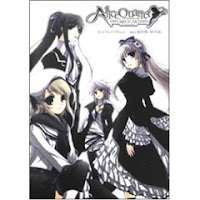
Alice Quartet Obbligato Manga

January 27th, 2009

If you have read Iono-sama Fanatics, or Kotonoha no Miko to Kotodama no Majyo to or Ame-iro Kouchakan Kandan you already know the ladies of Alice Quartet Obbligato.

Alice Quartet or AQ for short, is a fashion firm that includes the custom clothing lines of four designers. All four work only in black and white, but in no other way have anything in common.

Makino, known as Makinon, at 24 is the leader of the group and the designer of “Le Croix de Lune,” specializing in frilly, goth-loli-esque dresses.

Yuuki, still in high school, does the very butchy, yet somehow feminine “Aqua Drop” line.

Uber-cute Suika, known as Su-chan, designs cute activewear line “P’s.”

And last, Fumi, who you may remember from Iono-sama, receives her direction from Maria-sama for her “Saya” line which blends classic Japanese and Western concepts.

The AQ store is owned by Yukino, called Yukinon, a former classmate of Makino’s, a childhood friend and now business partner. If it was up to Yukino, it would be life partner as well, but Makino’s not biting. Her loss.

Aside from Yukino’s overt interest in Makino, Yuuki pulls in a few female admirers in her chapter as well. Understandably so, as her design for her outfit is darn sexy and not really androgynous at all, while being both kinda butchy and very feminine.

As an added bonus, in the last chapter in which the AQ designers decide to hold an event and invite all their customers, (which follows my Microniche Marketing principle of rewarding engagement, so I approve wholeheartedly!) if you look carefully at the invitees, you will see some characters who are instantly recognizable. ^_^

This is not a book one reads for plot. This volume collects a few short chapters about each designer and their mutual vision for AQ through the seasons. Nothing “happens,” but if you like Fujieda’s clothes – and I do, which seems as deeply weird to me as it might seem to you – this is a lovely little volume about clothing and the women who make them.

Ratings:

Art – 9
Story – 6
Characters – 7
Yuri – 4
Service – 2

Overall – 8

Fujieda Miyabi is probably the best costume designer in manga today. And, with the four designers that make up AQ, he can really stretch his skills. If you like clothes or stories about clothes or Fujieda’s art, with a little Yuri icing, this obscure little collection is a real treasure.


Yuri Anime: Magical Girl Lyrical Nanoha Season 1 Box Set (English)

January 25th, 2009

I’m just as likely to retcon my opinions as the next person. Only, I tend to go the opposite way from most. Instead of remembering the first thing as the best ever, never to be repeated or surpassed, I tend to like the newest and latest, and avoid going back to the orginal. When I first watched this series I was not impressed but, as the series went on, as the second and finally third season built up the characters and the situations, I began to like it more. By the time I finshed watching StrikerS, it was the greatest thing since sliced bread. So, it was with some trepidation that I stepped back more than four years to watch the Magical Girl Lyrical Nanoha season box set. Would I hate it? Like it? Well….

The story begins with typical 3rd-grader Takamachi Nanoha who finds herself embroiled in the typical magical girl setup of a magical creature who gives her both the power and imprimatur to collect a number of magical items. If left unchecked, these items will inhabit various organic beings and inorganic objects and cause havoc. Also quite typically, she is opposed in this task by an equally magical rival of the same age, in this case, the “girl with the gentle eyes,” Fate Testarossa.

Nanoha becomes more interested in hearing Fate’s story and trying to work with her than anything else – and Fate’s story, when we learn it, is orders of trauma above the typical magical girl series. Her mother, insane from the loss of a child, is driven by a hopeless obsession. Precia’s emotional and physical torture of Fate is extremely distressing, making us root for Nanoha to break through the wall that separates her and Fate just that much harder.

Of course, Nanoha does break through that wall, saving both the world as we know it, and Fate herself, by beating Fate down. Thus she sets up the precident of herself as the “White Devil,” and the also-typical “Dragonball Phenomenon” wherein all former enemies, once defeated, become allies. It’s all so comforting. ^_^ (This is a good point to note that the “White Devil”s particular form of “befriending” shows up right in the middle of the opening song, when the lyrics say something like “I will touch you with a love so soft,” as Nanoha is bring Raging Heart down on Fate’s head hard enough to crack her skull open. ^_^)

There are two things of note that set this series apart from the usual and typical. One is, of course, the intense interest Nanoha shows in Fate and the (obvious to Yuri fans) feelings Fate has for Nanoha. And I am still convinced that Suzuka and Arisa are also a couple, for no particular reason except that I’m a Yuri fan too. ^_^

The second is the sudden appearance of a completely different anime in the middle of the story. The Time Space Administration Bureau’s appearance and absorption of the story takes it to a completely different place and plot – and sets up the tale for the next two series. There is no doubt in my mind that Nanoha was originally conceived of as a seinen version of the popular mahou shoujo series Card Captor Sakura. The wife, who had never seen any of this series, walked in on an early episode and immediately commented on the similarities. Watching this series now, knowing what I know, I found this to be a welcome mid-stream change for the anime. I was actually *happy* when the staff of the Asura join the fight and shift the setting.

In a nutshell, because of my particular form of retconning, I enjoyed this series much more this time, than I did the first time around. ^_^ (If you read Okazu regularly, this won’t surprise you too much. I’ve done it before…I’m sure I’ll do it again.)

There were a number of technical problems, however. Some were clearly because Funimation rescued this title from the Geneon pit. Others were original. The art, for instance. The art was inconsistent and in many places, plain old *bad.* Bad enough that I had a hard time looking at the screen. There were about 5 different groups working on this series, with styles that were so different that they really clashed. The “carnival head” group got the uber-moe scenes. The group that put in too much detail and made everyone move so much that they all looked like they had Parkinson’s disease, got all the “unnecessary service” scenes. I was glad when we switched away from either of those two groups, back to the three or so groups that kept the animation to boring standards of “you audience – hey you out there – you do the work.” ^_^

The translation started off pretty consistent and, to my joy, used “Raging Heart” for Nanoha’s device. Midway it switches to “Raising Heart.” (The editing/adapting went out the door about a third of the way through the series, as well. That, I assume, was the Geneon/Funimation switchover.

And there were some technical issues with the subtitles, like lines through the words. And surprisingly, the timing was *bad*. I never notice that kind of thing, really. If I noticed it – it was really, really bad.

Extras can be counted on one finger – double-sided covers for the DVD cases. Credits and adverts just don’t count as “extras” to me.

The only other thing I had an issue with was that I am still not happy with the nudity. I never will be. If there was version of this anime the had none, I’d be that much more pleased with it. It’s just not needed and the people it serves are not me. Thankfully, by about halfway through the series, that too is cast off for the new, shiny, magical dimension kick-ass fighting story.

Despite the problems, I was really enjoyed rewatching this series. It made me want to watch A’s right away, which I did, and I’m about to start on a marathon of StrikerS today. Nanoha is a series that bears watching, sticking with and repeating. I’m not sure I could use this series to turn a non-fan into a fan, but if you already like magical girl stories, it’s probably a shoo-in for something you’ll grow to like.

Ratings:

Art – At best 6 at worst 3
Story – Starts at 5 and ends up at 8
Characters – 8
Yuri – 3
Sevice – 8

Overall – 7

Paeans of praise and thanks to the sponsor of today’s feast, newly awarded Okazu Superhero Brent A! Brent – email me to get your new badge – with thanks for all the support you’ve shown for Okazu over the years!