
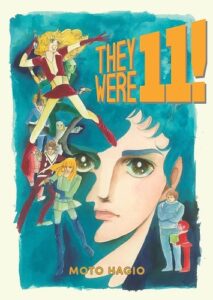
 Moto Hagio is, at this point in the understanding of manga history, understood to be an important driver of the development of manga as a medium. She is well-known for her role in the development of Shoujo and BL and is equally respected as a science-fiction author. Denpa Books’ edition of her science fiction classic They Were 11! is a fantastic example of the latter.
A group of young men from across the galaxy are brought together on a spaceship to conduct their final entrance exam to Cosmo Academy. The only rule – survive 53 days in space. Almost immediately, things begin to go wrong. And there are 11 people on the ship, not 10.
What a fantastic opener for a suspense story!
The 11 young men run into a series of setbacks, and more mysteries begin to form. One of the 11 seems to know too much about the ship, there is an outbreak of disease, and bombs are set around the ship! Will they make their 53 days? This story is followed by a sequel starring the main players of the crew, in a tale of political intrigue that will change the course of life on a number of planets.
Each of these tales is action-filled, full of twists and turns that make it almost impossible to guess what the outcome will be. This collection is beautifully put together by Denpa, with color pages, and solid translation by Ajani Oloye (who happens to have been the translator on several of the last few books I’ve read. His work is impeccable.) But the real reason I wanted to talk about this series, is the use of gender in the collection as a whole.
One of the characters, Frol, is small-framed, prone to emotional outbursts. Initially, some of the crew assume Frol is a girl, even though Frol insists that he is male. It is not until Knu identifies Frol as a species that is gender indeterminate, like their own, that we learn that Frol’s family wants him to become a woman, but he is determined to become a man. His choice is dependent upon whether he succeeds in passing this text.
As the story continues Tada, who seems to have a connection to the ship, and Frol go from being forced to work together to a team. Love appears to be on the horizon and, eventually, Frol states that, for Tada, he would become a woman.
That said, when we pick up in the sequel, Frol is 100% about performative masculinity. He talks about “getting” girlfriends and obsesses about his body and his strength. Tada and Frol continue to become more and more intimate. This time, Frol no longer speaks about becoming a woman, but still declares his affection for Tada, who returns the feeling, accepting Frol as he is.
There were some really interesting ideas in here, wrapped in an assumed heterosexuality for all the species. From my perspective of a half-century after these stories were published, that might seem disappointing, but for the time, this was surely revelatory. This series, which was published in Bessatsu Shoujo Comic, won a Shogakukan Manga Award in 1976, in a combined shounen and shoujo category.
Science fiction has always had a place in queer media, because of the unknowns of the future. Space is big enough to hold questions of gender and sexuality, and Moto Hagio was among those who understood that potential right along with James Tiptree Jr., Octavia Butler and Katherine V. Forrest.
Definitely worth adding to your or your local library’s classic manga collection!
Ratings
Art – 8
Story – 9
Characters – 8
Gender and Sexuality – Gender more than sexuality, let’s say a 4
Overall – 8




I didn’t realize it was a manga first! I saw the movie a couple of decades ago and quite enjoyed it.
Thank you for this review!
There was an anime, as well. Thank you for reading!