 by Matt Marcus, Staff Writer
Over a year after the end of the serialization of How Do We Relationship in Japan, I happened to stumble across a tweet for a casting call for a live action drama with a very familiar premise. A Girls Love story adapted from a popular manga series, set in a college, including members of a light music club. It was a no-brainer to me what series it was.
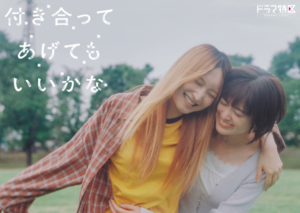
The Tsukiatte Agetemo ii Kana drama was announced in July, with J-Pop idol Riho Sayashi (originally a member of Morning Musume, more recently a solo artist) playing Saeko Sowatori and Sakurako Konishi (best known for her role in the crime thriller First Love) as Miwa Inazuki. I was equal parts delighted and trepidatious. How much of the story could they cover in one season? Would they be able to capture the essence of the characters? How would they depict The Content?
If you are unfamiliar with the story, the opening episode is a fairly accurate adaptation of the first three chapters of the manga. Miwa and Saeko, both first year college students, meet and join the light music club together. After a night out with their new club mates, Saeko admits to Miwa her interest in women and Miwa responds in kind. Saeko says they should take advantage of this rare opportunity of two lesbians organically finding each other and proposes that they date. Miwa reluctantly agrees, and the two awkwardly spend time together until they are caught kissing in the club room by their bandmate, Mikkun, and have to decide how to navigate being out (at least within the band).
I’ll admit that I have not watched too many live-action adaptations of manga or J-dramas in general, but the handful I’ve seen ranged from passably entertaining (the Death Note duology) to abysmally awkward (GAP the Series, sorry Frank). Sometimes the issue is that the source material reads very unnaturally when acted out with real people; often the issue is that the performances are rather middling. I find that in most cases these adaptations fail to match the impact of the source material, let alone elevate it.
I felt more optimistic when I read that the production was being handled by people who worked on Ayaka is in Love with Hiroko!, as that was one of the better of these adaptations that I’ve seen. So far, there are awkward moments and stiff performances, but I felt that it was at least intended to be so. Saeko and Miwa do not gel, and the one thing I would strongly credit the first episode for is making that awkwardness extremely palpable.
That said, there are myriad concerns I have, the first and obvious one being the pacing. There are only 8 episodes of 23 minutes each. Of course episode 1 has a lot to establish, so there isn’t much you could reasonably cut, but knowing that the previews show scenes up through volume 6, there is a LOT of ground to cover. Tamifull-sensei mentioned on her Twitter that there are changes to the story, which leaves the door open for a very different (read: heavily truncated) path towards the ending.
The trimming down of the story has already become impactful in episode 3, which covers the summer club retreat arc. The arc is split between Saeko wrestling with jealousy and Miwa struggling to stand up for herself against pushy men who are either hitting on her or threatening to out her. The instigator of the latter scenario, Kan, has been completely cut, which robs Miwa of the opportunity to try, however feebly, to defend herself. This ends up doing a disservice to her, reducing her role in the arc as merely the object for Saeko’s jealousy. It’s focusing the story down to the most core part of the plot, which is understandable given the runtime, but I fear more key character development moments will be shaved down to focus narrowly on the will they/won’t they of the love story.
The other issue is that of, frankly, the sex. Sex and physical intimacy in general play major roles in plot, characterization, themes, you name it. I think if a lot of that content is cut or glossed over, it will rob the drama of one of the elements that made the manga so potent. At least as of this writing, the sex is…there, but it is just off screen. There have been a couple hints towards Saeko’s discomfort with being touched, but aside from that there has not been much “action” depicted, which unfortunately means one of the funniest page-turn surprises from volume 2 is completely absent. You know the one.
If you approach the drama with an open mind and try not to get hung up too much on adaptation changes (I’m trying, I swear), you will find that the show has done a solid job of bringing the manga to the small screen. And there are some fun production details, like how Miwa and Saeko’s guitars were the ones Tamifull bought as reference.
Having a pop idol as one of your lead actresses also has some benefits, like including live performances that feel actually performed live.
So, that leaves me with two questions: will the drama stay in tune, and will you tune in?
Overall – 7
The series is airing in Japan on several TV stations (MBS, TV Kanagawa, Chiba TV, TeleTama, Tochigi TV, Gunma Television) and online via TVer and FOD; it is also available overseas on GagaOoLaLa.
 Matt Marcus is a cohost of various projects on the Pitch Drop Podcast Network. You can find him mostly reskeeting Yuri posts and sports takes on Bluesky @hyperartmarcussan.bsky.social