Archive for the Artists Category


Yuri Manga: Fu~Fu (ふ~ふ), Volume 1

December 2nd, 2011

If Yuri Danshi was written to give Yuri Fanboys a taste of what it feels like to have one’s emotions parsed uncomfortably closely, then Minamoto Hisanari’s Fu~Fu (ふ~ふ) was clearly written to explain important things about lesbian relationships to those same Fanboys in the cutest possible manner.

We are introduced to Kinana and Sumi, who have just begun living together after having been a couple for some time. Now that they are living together, they talk about what to call each other, since “lover” no longer is enough. Kinana asks if she can be Sumi’s bride, but that doesn’t feel right either (although Sumi does use “hanayome” 花嫁 later in the chapter.) Eventually Kina suggests a homonym for the word fuufu, which represents husband and wife, 夫婦. Since they are both wives, they should be called fufu, 婦婦. (So, technically a neologism and not really a homonym, since fuu and fu aren’t pronounced the same, but I don’t suppose that anyone but me cares about that.)

The second chapter of this volume is by far and away my favorite. If you are a regular reader, you know how much I long to read stories that focus on domestic life of an established couple. And, perhaps,  you know about my fondness for my big pluffy bed. So to have a chapter in which Su-chan and Kina go out to buy a pluffy bed of their own makes me happy beyond words. The fact that it’s a brutally adorable chapter helps.

Sumi and Kina go on a honeymoon, we meet Kina’s big gay sister Kanana, and their equally gay neighbors Hayase and Komugi. Every chapter is filled to the brim with appallingly cute lesbians.Of course no one uses the “l” word, but Hayase and Komugi do state plainly that they are lovers. Close enough.

The final two chapters are stories that ran in ES-Eternal Sisters, Volume 1 and Volume 2, from back in 2004 and 2005.

What I said in my original comments on Fu~Fu stands – this manga is important. Using moe art and adorable characters, this series quietly, cutely teaches Yuri Danshi what a lesbian relationship looks like, what is important to us, what daily life is like.

My personal favorite scene is the beginning of chapter 3, when Sumi announces work is over, and Kina points out how patient she’s been. They both stare at each other and throw their arms up…and give each other a great big hug. I mean, really. How cute/real is that? That kind of thing totally happens in my house nearly every day. (No, that is not sarcasm. I mean it.)

So, if no one I know was pining for a glimpse into the inner life of a Yuri Fanboy, almost everyone I know has been waiting with anticipation for a series like this, in which a lesbian couple is portrayed with honesty, affection and healthy dollop of cute.

Ratings:

Art – 8
Story – 9
Character – 10
Lesbian – 10
Service – 5

Overall – 9

Fu~Fu  is *so* close to perfect, Minamoto-sensei deserves heaps of praise. I’d like more of this please!


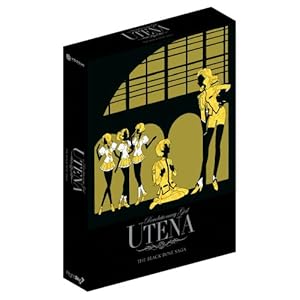
Revolutionary Girl Utena Anime Box Set – Volume 2, Disk 1 (English)

November 29th, 2011

The first episode of the first disk of Revolutionary Girl Utena, Volume 2, or what is commonly referred to as the Black Rose Arc, is that staple of long-running anime, the clip episode. Clip episodes became so common around the turn of the century, that in some infamous series, clip episodes were practically more common than actual story episodes.

In this case, the clip episode is welcome. Not only does it highlight each duel from the Student Council Arc, (which gives us a chance to relive the duels and their wonderful background music) but it provides an apparently objective perspective of each duel, allowing us to understand the motivation behind the duel, behind any discussion of the End of the World, a World Egg or Revolutionizing the World or other important-sounding nonsense.

The story of Nemuro Hall and the Mikage Seminar is set up, and we are quite suddenly dropped into a new, even more obscure arc than the last. Where the Student Council fights to possess Anthy, these new, derivative, duelists, seek to remove her completely from the game.

It’s not often I find myself incapable of half-watching an anime. Most of the time I watch something while simultaneously reading or writing. I wander off do a chore, come back and pick up the story wherever it’s taken me… it’s easy enough to do this if one doesn’t much care about the exposition. When Utena is on the screen, I do nothing else. There’s too much happening, too many symbols (both substantive and imaginary) and above all, there’s Anthy. This is the third or fourth I’ve watched this series and this time, I find myself watching Anthy intently. The joke is on me, because she rarely does anything. So every little nuance I perceive is me making it up in my head. ^_^

Of the many important things that happen on this disk, I consider most important the involvement of Kozue. It appears to us that her relationship with Miki and his with her are significantly dissimilar. Her Black Rose duel to me says that they are not, actually, that dissimilar at all. It’s simply that in those relationships, each holds a slightly different place in the other’s relatively similar world view. For Kozue, Miki holds the place of sibling, sempai and beloved, where for Miki, these are three separate positions. (I’ve always imagined that, post-series, it is Kozue who has the highest chance of becoming the next Rose Bride, despite it being a meaningless position by then.)

Also important is Nanami’s episode. These appear to always be the comedic relief episodes, but it’s important to remember that both Miki and Nanami are younger than Utena, and are working even harder to build a world that makes sense, with the fractured people around them. Miki appears to be the most innocent, but if we understand that innocence functions in part as a block to be carved, it’s instantly apparent that Nanami is the most innocent character in the series.

Two duels in to this arc and we still have no idea, really, what Mikage is after. However, if you’re adept at reading the signals here, you can see where at least two things are headed. Several key symbols have been introduced -the pointing fingers, the planetarium machine (which could spawn an essay all by itself) the pupa/moths (which return in the movie with a vengeance) and the elevators, both up and down, which Ikuhara uses again in Mawaru Penguindrum.

Two duels in and already the relationship between Utena and Anthy has radically altered. Anthy is something else to someone else and Utena begins to not note the obvious, in the most obvious manner. If Miki is clearly turning a blind eye to Kozue, how much more is Utena shuttering her eyes and ears?

The Black Rose Arc has always been my favorite. It is apparent to me that what Ikuhara does best is create tension. Scenes here are so fraught, so tightly wound, that we spend the episode watching wildly, waiting for the first blow. I described it recently as if, when we watch an Ikuhara production, we are standing in the middle of a ring of people with slingshots drawn, ready to shoot, not knowing where the first shot will come from, but knowing it will come. This tension makes us read into every comment, every scene, every background, whether there was something there to be read into or not. Every episode we’re standing on pins and needles, and Dios inhabiting Utena to win the duel fills us with the relief of predictability.

DVD extras are a pleasant addition for those who like production art, and the pamphlet this time is perhaps less distressing that the one that came with the first collection. Ikuhara’s episode commentary, and the discussion of the creation of Be-Papas and the anime and manga for Utena are equally full of pretension and insight. There is some discussion of the scene in which the sword is drawn from the Rose Bride’s chest and how the instructions were to make it look like a love scene, something that I think has stood the test of time. Of particular interest to me was the comment by one of the creators discussing the brief thought of redoing this anime, and realizing that it stood up so well and was so unique that there was no need. I agree completely. More than 10 years have passed since this series first aired and it still has the power to compel and enchant. Most series upon rewatching seem a little dated, maybe a little sentimental…not this one. I watch with the same creeping sense of…something… this time as I did the very first time. This series was one that I had on my personal top ten, but I presume, always, that nothing is as good as you remember it to be. This series is. Possibly even better.

Ratings:

Art – 9
Story – 10
Character – 9
Yuri – 3
Service – 3

Overall – 9

Stay tuned – we’re going to have a contest to win the second Box Set from Nozomi/RightStuf shortly! ^_^


Seven Seas announces a GIRL FRIENDS Omnibus

November 22nd, 2011

To continue the licensing frenzy of Morinaga Milk’s GIRL FRIENDS, Seven Seas has just announced that they will be releasing GIRL FRIENDS in Omnibus form.

The first volume is slated to ship in October 2012.


Yuri Manga: Himitsu no Recipe (ひみつのレシピ)

November 10th, 2011

Underclassman Wakatsuki is reasonably sure she’s gay, but not entirely, so she convinces her sempai, the president of the cooking club, to y’know, kiss her, just to see.

And so, Morinaga Milk’s Himitsu no Recipe, (ひみつのレシピ)begins with a very cheap, servicey opening, and then desperately tries to make a story out of it.

Now that she’s convinced she likes girls, Wakatsuki is also convinced that she likes Buchou. A lot. A lot a lot. And, um, she really wants Buchou to like her back. So Wakatsuki joins the Cooking Club and plots to be closer to the club president, who is almost completely oblivious of her not-all-that-mixed signals.

For her part, Buchou really wants the Cooking Club to be successful and she’s putting her heart and soul into recruitment and training, pretty oblivious of Wakatsuki’s ulterior motives.

Unfortunately for readers, the heart aching sincerity of GIRL FRIENDS is pretty much completely absent in this series. The first chapter very much reads like a one-shot. The overall feel was that the first chapter was a tryout to see if Morinaga-sensei and the Tsubomi editors got along and when they did, they just told her to continue with these two characters.

It’s hard to be sympathetic to Wakatsuki, who would be completely sympathetic if she had her crush, treasured it, fantasized about it, and told herself the whole story in her head, as we do with crushes. But it’s impossible to really like her the 5th or 6th time Buchou has pushed her off and said, “No.” Because sexual harassment isn’t funny or cute or, really, entertaining, no matter how moe the art is.

The big summer training camp is coming up and Wakatsuki has her battle underwear ready to go. I’m almost hoping that Buchou fends her off, gives her what for and throws her out of the club. From my perspective, Wakatasuki needs to be trained properly.

I’m sorry this manga isn’t better, but it had such a bare bones opening and really hasn’t developed any muscles since.

Ratings:

Art – 8
Story – 4
Characters – 5
Yuri – 6
Service – 6

Overall – 6

If you were a big fan of GIRL FRIENDS, I think you might be better off skipping this. If you just love Morinaga Milk’s work on principle, then definitely get it. It has her signature art style, but I know she can write better stories than this.

Sorry all the recent reviews have been grumpyish, but we’re getting down to the bottom of the pile of things I bought in September. And I’m saving the best for last. ^_^


Yuri Drama CD: GIRL FRIENDS (ドラマCD GIRL FRIENDS-ガールフレンズ)

September 29th, 2011

Because manga is primarily a visual media, I’m always fascinated by the transition of a manga story to Drama CD. Where something like Maria-sama ga Miteru is primarily communicated in words, a story like GIRL FRIENDS is first and foremost visual. And this manga, as good as it is, would  probably make a relatively dull anime, as most of the “action” exists only in interior monologue.

The GIRL FRIENDS Drama CD (ドラマCD GIRL FRIENDS-ガールフレンズ)does a decent job of balancing story framework and character development and, as a result, becomes something slightly different than the manga itself.

The manga starts off, (if you recall from my review of Volume 1,) as a catalog of fashionable girl interests. Hair, nails, clothes, etc., are the primary focus, and Mariko’s interest in Akiko grows from that. Because we’re listening to the conversations on the Drama CD, rather than watching the girls shop, the chapters feel very much like a tutorial. Bearing in mind that the manga ran in Comic High, which is generally targeted to men who want that glimpse behind the gauze curtain of “girls’ life,” this works amazingly well.

Let’s take a step back to the story itself to understand why. Mariko is a quiet, introverted girl. She is studious, has no real friends and generally lives a life of the mind. You know the type – reads during homeroom, lunch and any study periods. She is us. When Akiko breaks past her shell, Mariko finds herself dragged into a world she knows *nothing* about. This is a world in which girls talk about hair, clothes, fashion models, makeup colors and the like, endlessly and with actual interest. Mariko isn’t interested, per se, in the new fall colors for makeup, but her new friends’ interest interests her.

These sections of the Drama CD are the absolute best tutorial on what average girls like that I’ve ever heard. Because there are no visuals, and the spoken words have to provide the actions as well as the words, the dialogue very much sounds as if Mari is receiving training on “How to Be a Girl, 101.” Mariko even considers this, towards the end, as she’s rapidly slipping into “more than friend” feelings for Akiko. She recognizes that she never really had any girl friends before and never really had been socialized, so, she may be overreacting to just having a friend….

As in the anime, it’s the night of the group date that changes everything, irrevocably. After falling apart watching Akko with the guys, Mariko and Akko end up at Akiko’s place. After Akko drinks too much and falls asleep, Mari kisses her, then spends the rest of the week excoriating herself for it. Even after Akko laughs it off, Mari-chan realizes that her feelings aren’t just friendship.

The Drama CD comes to an end, as Mariko admits to herself that this is, quite probably, love. So, this CD covers chapters 1-10 of the manga.

There’s still a fair dollop of silly service in this story. Perhaps in some circles it is common for girls to kiss one another and feel each other up, but I can tell you that that never happened with any group of friends I had growing up. And we were on all sorts of sports teams, camp, school gym, which meant dressing and undressing in front of one another. No groping, peeking, breast size comparison….none of that ever went on anywhere I was. So, I’m still marking all that in the fanservice column as something things boys would like to think girls do.

The CD technicals were quite good. Everyone did a very decent job of voicing their characters. It was all very natural. I found Mari’s interior monologues (which were absolutely necessary to the story) a little cringe-making at times, but that was also necessary to the story. There is one short extra comic insert in the CD case, no cast talk track, though.

Noticably, this was a really long Drama CD. I had to drive quite a distance yesterday and listened to this CD for most of the trip there. Easily an hour, probably more. That was a pleasant surprise, as Drama CDs more commonly tend to be in the 30-45 minute range.

Ratings:

Overall – 8

I wasn’t sure how well this story would translate to Drama CD (I think some series are more suited than others, obviously) but overall found this to be a more than acceptable adaptation of what I considered to be a very good manga about first love.


